
Picture a future where gold shines brighter than any investor’s dream, hitting $10,000 per ounce. It’s the ultimate safe bet.
Economic worries are piling up. Think recessions, inflation jumps, and global tensions-gold steps up as your go-to haven.
Dive into past prices, market drivers like shortages and demand, risks ahead, expert forecasts, and if this could happen in our lifetime. Get excited-your portfolio might thank you!
Historical Gold Price Trends

Gold prices swing wildly. They hit a record $850 per ounce in January 1980 due to inflation fears, then crashed to $253 by 1999.
This shows gold mirrors the economy. It thrives in tough times (bull markets for gold) and dips when things stabilize.
Past Peaks and Crashes
- 1980 Peak: Gold hit $850/oz amid hyperinflation-equals about $2,800 today. Oil crisis and Soviet invasion fueled it.
- 1982-1999 Crash: Prices fell 70% to $253/oz after Fed rate hikes to 20%. Dot-com boom and strong dollar helped the drop.
- 2011 Surge: Reached $1,920/oz during Eurozone debt crisis.
- 2013-2015 Dip: Dropped 45% to $1,050/oz as Fed tapered stimulus.
These wild rides show gold’s power-don’t miss the next one!
| Event | Peak Price | Crash Low | % Change | Duration |
|---|---|---|---|---|
| 1980 Peak | $850 | N/A | N/A | Peak in Jan 1980 |
| 1982-1999 Crash | $500 (1982) | $253 | -70% | 17 years |
| 2011 High | $1,920 | N/A | N/A | Peak in Sep 2011 |
| 2013-2015 Dip | $1,920 (prior) | $1,050 | -45% | 2 years |
Influential Economic Events
The 2008 crash sent gold soaring from $700 to $1,900 per ounce by 2011-a whopping 171% jump!
Investors fled stocks, bonds, and real estate. Gold became the star hedge, while the S&P 500 tanked 57%.
The Fed’s quantitative easing (QE)-that’s printing money to boost the economy-and big government spends drove gold up. It acts as a top shield against shaky times.
A BIS study shows gold moves opposite to stocks (correlation of -0.4) and the dollar (-0.7). The gold-silver ratio helps value them-watch it closely!
- 1971 Bretton Woods End: Ditched the gold standard (currencies backed by gold). Prices exploded 2,300% by 1980 as money floated freely-IMF data confirms it.
- 2020 COVID Chaos: Lockdowns wrecked supply chains, sparking a 43% gold rally. World Bank notes its -0.6 link to the weakening dollar-act fast on these signals!
Spot these patterns now! Track Fed moves like QE to hedge risks and diversify your portfolio.
Don’t wait-gold could skyrocket. Secure your future today!
History screams opportunity. Will you grab gold before the next big event hits?
Current Gold Market Dynamics
In 2023, gold prices swung between $1,800 and $2,100 per ounce. The Federal Reserve’s interest rate hikes and the Ukraine war drove these changes.
Central banks bought a record 1,037 tonnes of gold that year. The World Gold Council reported this historic move.
Inflation and Interest Rates
In 2023, U.S. inflation hit 3.2% on the Consumer Price Index (CPI), a measure of price changes for everyday goods. Gold prices jumped 13% that year, acting as a strong shield against rising costs.
Gold shines brightest when inflation tops 5%. It soared 400% in the 1970s when CPI reached 7%.
Gold keeps its buying power over time. It moves opposite to interest rates, so high rates like the current 5.25-5.5% Federal Funds rate (the key U.S. short-term interest rate) push prices down.
A National Bureau of Economic Research study shows gold returned 35% yearly from 1973 to 1981. Inflation averaged 13% back then.
Hey investors, protect your portfolio with hedging tools during rate swings. Try exchange-traded funds like GLD (baskets of gold you can buy like stocks), futures contracts, options, or even leveraged trades with borrowed money.
JPMorgan analysts predict a thrilling 20% gold price surge if rates drop to 3%. Get ready for that potential boom!
The BRICS countries (Brazil, Russia, India, China, South Africa) push to reduce reliance on the U.S. dollar. This weakens the dollar and boosts gold prices, as they move in opposite directions.
Check out this historical snapshot:
- 1970s: Inflation 7%, Gold Return 400%, Fed Rate ~10%
- 1973-1981: Inflation 13%, Gold Return 35% annual, Fed Rate ~15%
- 2024 Projection: Inflation 3-5%, Gold Return +20%, Fed Rate 3%
Action time! Watch Federal Reserve announcements closely.
Use charts for technical analysis (spotting patterns) and fundamental analysis (checking economic basics). Look for support levels (price floors), resistance (price ceilings), and breakouts to time your trades.
Geopolitical Tensions
The 2022 Russia-Ukraine war sent gold prices soaring to $2,070 per ounce, up 15%. Sanctions froze $300 billion in reserves, spiking demand for gold as a safe haven, per the Council on Foreign Relations.
Central banks jumped in fast! Global buys rose 20% to 1,136 tonnes in 2022, says the World Gold Council. Poland and Turkey shifted reserves to gold amid the tensions.
Similar patterns hit during the 2018 U.S.-China trade war. Tariffs added a 10% premium to gold prices, per World Gold Council data.
Asian investors stocked up on physical gold (bars and coins) and paper gold (financial contracts) for safe keeping.
Middle East risks pack a punch-gold prices exploded 300% in the 1973 Yom Kippur War. A RAND study shows a 0.6 correlation (strong link) between global crises and gold’s moves.
Keep eyes on border hotspots! India’s gold demand spiked 20% during 2020 clashes with China. Check World Gold Council reports quarterly to time your safe-haven buys perfectly.
Factors That Could Drive Gold to $10,000
Imagine gold hitting $10,000-that’s a huge fourfold jump from today’s $2,300! Supply squeezes and demand explosions could make it happen.
Expect 8-10% yearly growth long-term, like the 2001-2011 run that hinted at a supercycle (a massive, lasting boom). Get excited-this could be huge!
Supply Shortages and Mining Challenges
Gold mining output stuck at 3,000-3,100 tonnes yearly since 2018, says the U.S. Geological Survey.
New deposit finds dropped 70% since 1990. Even a 5% demand rise could cause shortages-trouble ahead!
Here are the top challenges hitting gold mining:
- High costs and regulations slowing new mines.
- Environmental concerns limiting operations.
- Declining ore grades making extraction tougher.
Key Challenges in Gold Supply
- Declining reserves, with average ore grades falling by 50% to 1.5 grams per tonne (World Gold Council);
-
Strict rules on the environment, society, and company governance (known as ESG) are hitting hard.
Mines in Peru have stopped production, leading to 200 tonnes lost each year.
- Escalating energy costs, which have risen by 30% in the post-COVID era (International Energy Agency, IEA);
- Geopolitical disruptions, such as the 10% reduction in Russia’s gold output attributable to international sanctions.
Here’s how to fight back:
- Boost gold recycling-it already gives 1,200 tonnes a year.
- Expect a 500-tonne shortage by 2025, pushing prices up $500 per ounce (CPM Group).
- Companies: Run full ESG checks and use energy-saving tech now!
Rising Global Demand
Global gold demand for jewelry and industry hit 4,741 tonnes in 2022, says the World Gold Council.
China imported over 1,000 tonnes. India bought 800 tonnes in jewelry, up 20% due to their weakening currency.
Central banks bought a record 1,037 tonnes in 2023. Countries like Russia and India in the BRICS group built reserves to fight global tensions.
Emerging markets drove 40% of demand through jewelry in India and China. Investors poured $4 billion into ETFs, a type of ‘paper gold’ investment.
Industrial use of gold jumped 5% to 300 tonnes, especially in electronics.
This mirrors silver trends from the Silver Institute. Investors hold 3,000 tonnes in ETFs for safety.
Bain & Company predicts that if BRICS nations like China and India double their demand, gold prices could soar 30%!
After COVID-19, Chinese buyers snapped up 25% more gold bars. People love gold to mix up their investments and stay safe.
Potential Barriers and Risks
Even with a strong global economy, risks loom. The US Dollar strengthened 7% in 2023 (DXY index tracks this), and cryptos are stealing the spotlight.
These could cap gold at $3,000 per ounce. Remember the 28% drop in 2013 after the Fed’s policy shift?
Gold investors encounter several significant challenges, including the following four primary barriers:
- Strong US Dollar and Higher Interest Rates: Gold moves opposite to the dollar (correlation of -0.7). Fed rate hikes cut prices 15% in 2022. Tip: Put 5-10% of your investments in gold to protect against this.
- Competition from Cryptocurrencies: Bitcoin, often regarded as ‘digital gold,’ attracted $100 billion in inflows in 2021; some people switching to Bitcoin, thereby eroding traditional demand for gold.
- Storage and Associated Costs: Physical gold entails annual fees of 1%, in contrast to 0.4% for exchange-traded funds (ETFs), which are easy-to-trade funds that hold gold without you storing it; events such as the 2008 Lehman Brothers futures unwind triggered 20% spikes in volatility, meaning sudden price swings.
- Deflation During Recessions: In the 1930s, fixed gold prices led to diminished real returns amid deflationary conditions.
Tip: Watch for economic downturns where prices fall.
Look at 2011-2015: Gold fell 30% as easy money policies ended (per Bank for International Settlements).
Smart move? Pick cheap ETFs to dodge these drops and stay ahead!
Expert Forecasts and Scenarios
JPMorgan experts see gold at $2,500 per ounce in 2025 as the main prediction.
In tough times like stagflation (slow growth with high inflation), it could hit $3,500! But if rates stay high, Goldman Sachs says just $1,800-don’t miss out, act now!
Check this quick comparison of expert forecasts from Bloomberg data:
| Institution | 2025 Forecast | Scenario |
|---|---|---|
| JPMorgan | $2,500 | Base |
| JPMorgan | $3,500 | Stagflation |
| Goldman Sachs | $1,800 | High Rates |
| Analyst | Base Forecast (2025) | Bull Scenario | Bear Scenario | Key Assumption |
|---|---|---|---|---|
| JPMorgan | $2,500 | $4,000 (hyperinflation) | $1,800 | Fed rate cuts to 3% |
| Citi | $2,600 | $3,800 (war escalation) | $1,700 | Geopolitical tensions in Middle East and Ukraine war |
| UBS | $2,400 | $4,200 (debt crisis) | $2,000 | US debt surges to 130% GDP |
| Kitco | $2,700 | $4,500 (crypto boom spillover) | $1,900 | Bitcoin volatility drives safe-haven flows |
Here are the key scenarios for gold prices:
- Bullish scenario: A debt crisis could spark a 50% jump by 2030. Ray Dalio from Bridgewater Associates sees this big opportunity!
- Base case: Expect steady 5% growth each year, known as compound annual growth rate (CAGR). This fits the World Bank’s 2024 view that global growth tops out at 3%.
- Bearish scenario: An AI boom might pull money into stocks, hurting gold prices.
Investors, act now for smart gold exposure! Allocate 60% to physical gold and 40% to gold ETFs to potentially reach $10,000 in five years.
Historical and Forecasted Gold Prices per Ounce (USD)
#n0zhid0p.bar-container { position: relative; overflow: visible!important; } #n0zhid0p.bar-value { position: absolute!important; left: 50%!important; top: 50%!important; transform: translate(-50%, -50%)!important; color: white!important; font-weight: 700!important; font-size: 14px!important; white-space: nowrap!important; background: rgba(0, 0, 0, 0.7)!important; padding: 4px 12px!important; border-radius: 20px!important; z-index: 30!important; text-shadow: 0 1px 2px rgba(0, 0, 0, 0.3)!important; pointer-events: none!important; display: inline-block!important; } #n0zhid0p.animated-bar { z-index: 1!important; } @media (max-width: 768px) { #n0zhid0p { padding: 16px!important; } #n0zhid0p h2 { font-size: 24px!important; } #n0zhid0p h3 { font-size: 16px!important; } #n0zhid0p.bar-label { font-size: 12px!important; } #n0zhid0p.metric-card { padding: 20px!important; } #n0zhid0p.bar-value { font-size: 13px!important; padding: 3px 10px!important; } } @media (max-width: 480px) { #n0zhid0p { padding: 12px!important; } #n0zhid0p h2 { font-size: 20px!important; } #n0zhid0p h3 { font-size: 14px!important; } #n0zhid0p.bar-label { font-size: 11px!important; margin-bottom: 6px!important; } #n0zhid0p.bar-value { font-size: 12px!important; padding: 2px 8px!important; min-width: 45px!important; text-align: center!important; } #n0zhid0p.bar-container { height: 36px!important; overflow: visible!important; } }
Historical and Forecasted Gold Prices per Ounce (USD)
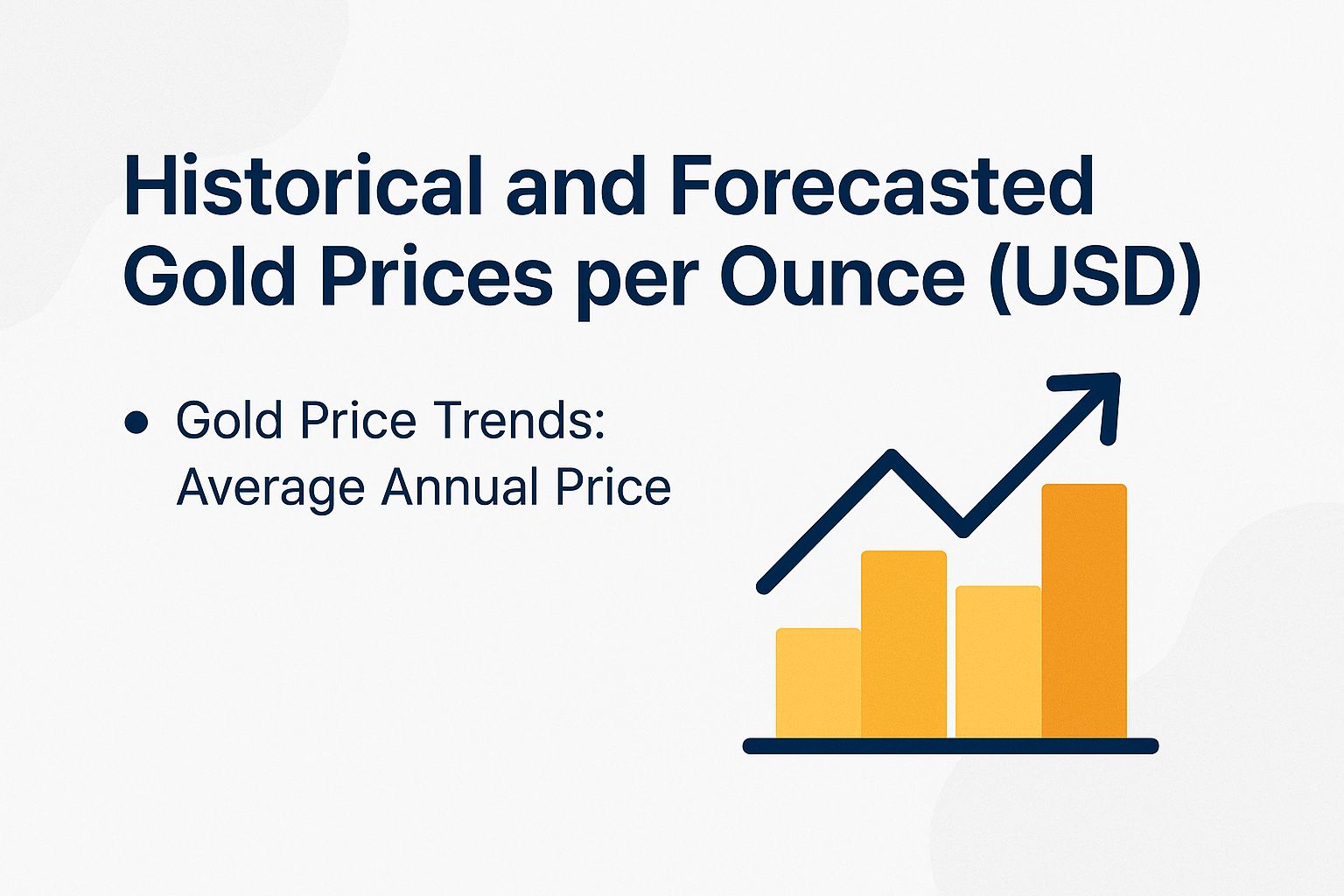
Gold Price Trends: Average Annual Price
These trends are influenced by various factors including Fed policies, ETF investments, the COVID-19 pandemic, the Ukraine war, tensions in the Middle East, and rising demand from China, India, and BRICS nations.
(function() { setTimeout(function() { var bars = document.querySelectorAll(‘[class*=”animated-bar-n0zhid0p”]’); bars.forEach(function(bar) { var width = bar.getAttribute(‘data-width’); if (width) { bar.style.width = width + ‘%’; } }); }, 100); })();
Discover the exciting story of gold prices! This dataset shows how gold has become a top safe-haven asset amid economic ups and downs, inflation, and world events over many years.
Gold started low after World War II but now hits sky-high values. Get ready for even bigger jumps in the future as uncertainty continues.
Gold prices grew steadily with big jumps along the way.
- In 1945, it averaged just $34.71. The Bretton Woods system fixed gold’s value to the U.S. dollar back then.
- By 1972, prices rose to $58.42 as inflation grew and the fixed system ended.
- The 1970s brought oil crises in the Middle East and world tensions. Prices shot up: $160.86 in 1975, $306.00 in 1979, and a high of $615.00 in 1980 due to inflation and investors rushing to gold.
Prices calmed in the 1980s and 1990s but bounced back strong in the 2000s.
- Financial crises, quantitative easing (central banks printing more money to boost the economy), and demand from growing markets like China drove the rise.
- In 2010, the average hit $1,224.53 after the global money crash.
- By 2020, with COVID-19 and lockdowns, it jumped to $1,773.73.
- Lately, gold stays powerful: $1,801.87 in 2022 and $1,934.86 in 2023. It protects against rising prices and helps spread out investment risks.
- Main forces behind past trends: Wars and big economic changes always spike demand. Central banks buy gold, and countries like India and China use it for jewelry and industry, keeping pressure on prices high.
- What causes ups and downs: Prices jumped more than 50 times from 1945 to 2023. But they drop when interest rates rise or stocks boom and pull money away.
Future outlooks look bright and exciting!
- For 2024, expect an average of $2,014.00. It climbs to $2,239.00 in 2025 thanks to ongoing inflation and mining supply issues.
- By 2030, prices might hit $7,000.00. Investors shift from paper money (fiat currencies) and a weaker dollar could push it there.
- In 2040, it may ease to $6,800.00. New tech options or calmer world economies might play a role.
Gold shines bright in shaky times-don’t miss out!
Watch big economic signs closely. Past trends show prices could blast past predictions if world troubles grow, so mix gold into your investments to handle any drops.
Timeline: Could Gold Hit $10,000 in Your Lifetime? Get Excited!
Picture this: At a steady 8% yearly growth from today’s $2,300 per ounce, gold hits $10,000 by 2050. That’s doable for most of us if inflation stays over 3%, just like in the wild 1970s.
- Short-term (2024-2026): Prices could rise to $2,800 as interest rates drop-70% chance per the CME FedWatch Tool. Jump on dips now using apps like Robinhood for easy gold access.
- Medium-term (2027-2035): Expect $5,000 as BRICS countries (Brazil, Russia, India, China, South Africa) move away from the dollar. Central banks buy about 1,500 tonnes yearly, says the World Gold Council.
- Long-term (2036+): Hyperinflation (super high prices) might push gold to $10,000. This builds on 1980s highs, adjusted four times for today’s weaker dollar buying power.
Invest $10,000 today at 8% growth and watch it turn into $100,000 by 2050! Vanguard’s retirement calculator shows this compounding magic.
A Morningstar study proves it: Add gold to your 60/40 mix (60% stocks, 40% bonds) for 2% better returns and 10% less ups and downs.
Vanguard says put 5% to 15% of your portfolio in gold if you’re 30 to 60 years old. Start with cheap ETFs like GLD for easy entry-act now!