As electric vehicles and renewable energy reshape the global economy, the hunt for essential minerals intensifies, positioning mining stocks for explosive growth. Yet, supply shortages and geopolitical tensions could amplify their upside. This article delves into surging demand drivers, ore grade declines, inflationary forces, automation breakthroughs, historical performance, inherent risks, and smart entry strategies for investors eyeing the next big opportunity.
The Surge in Global Demand
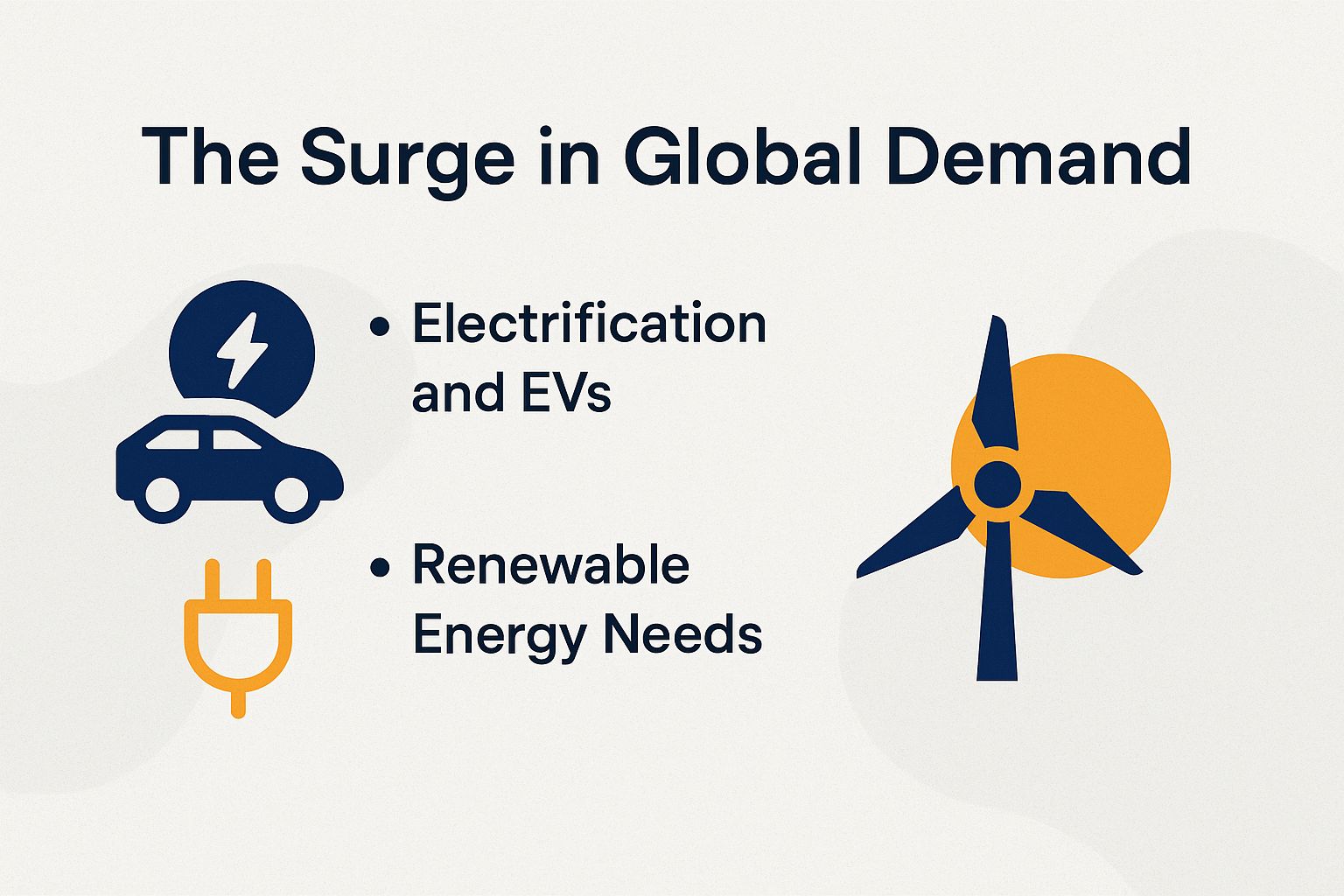
According to the International Energy Agency’s (IEA) World Energy Outlook 2023, global demand for mined commodities has increased by 25% since 2020, propelled by the ongoing energy transition.
Electrification and EVs
The rapid growth in electric vehicle (EV) adoption is projected to require 40 times more copper and 20 times more lithium by 2040, according to BloombergNEF’s 2023 Electric Vehicle Outlook. This increased demand has already contributed to a 30% year-to-date rise in stocks such as Albemarle (ALB).
This surge in demand arises from the fact that EV batteries require approximately 60 kg of lithium each, compared to none in traditional gasoline-powered vehicles, thereby intensifying the need for critical metals.
Prominent industry participants include SQM Corp. for lithium production (180,000 tonnes annually), Glencore for cobalt (40,000 tonnes), and Vale for nickel (200,000 tonnes annually). The International Energy Agency (IEA) has cautioned that a shortfall of 17 million tonnes of lithium could emerge by 2030, underscoring potential supply constraints.
To leverage these opportunities, investors may consider purchasing shares of ALB through established brokerages such as TD Ameritrade.
For broader exposure, the Global X Lithium ETF (LIT), currently trading at approximately $50 per share and exhibiting 15% annual growth, offers a suitable diversification option. It is advisable to begin with a modest allocation of $1,000 and monitor market trends using resources like Yahoo Finance.
Renewable Energy Needs
The renewable energy sector is projected to require a 300% increase in mineral demand by 2030, with each wind turbine necessitating four tonnes of copper. This trend is contributing to an 18% appreciation in First Solar (FSLR) stock, as outlined in the International Energy Agency’s (IEA) Net Zero Emissions by 2050 scenario.
To capitalize on this expansion, investors should focus on critical minerals essential for non-battery renewable technologies. For instance, solar panels demand approximately 100 million ounces of silver annually for their conductive layers, according to the Silver Institute, which is placing considerable pressure on global supplies.
Wind turbines depend on rare earth elements, such as neodymium, for high-efficiency magnets. Demand for these materials has surged sevenfold since 2010, based on data from the United States Geological Survey (USGS). Lynas Rare Earths (LYSCF) dominates the market, controlling 90% of neodymium-praseodymium (NdPr) production, a vital component in this sector.
For monitoring market dynamics, prices can be tracked through reliable sources such as Mining.com to inform investment decisions. Exposure to this space can be achieved via the VanEck Rare Earth/Strategic Metals ETF (REMX), currently trading at $45 per share and reflecting a 12% year-to-date gain. The World Bank estimates that $14 trillion in investments will be required by 2050 to support these developments, thereby underscoring substantial growth potential in the mineral supply chain.
Supply-Side Constraints
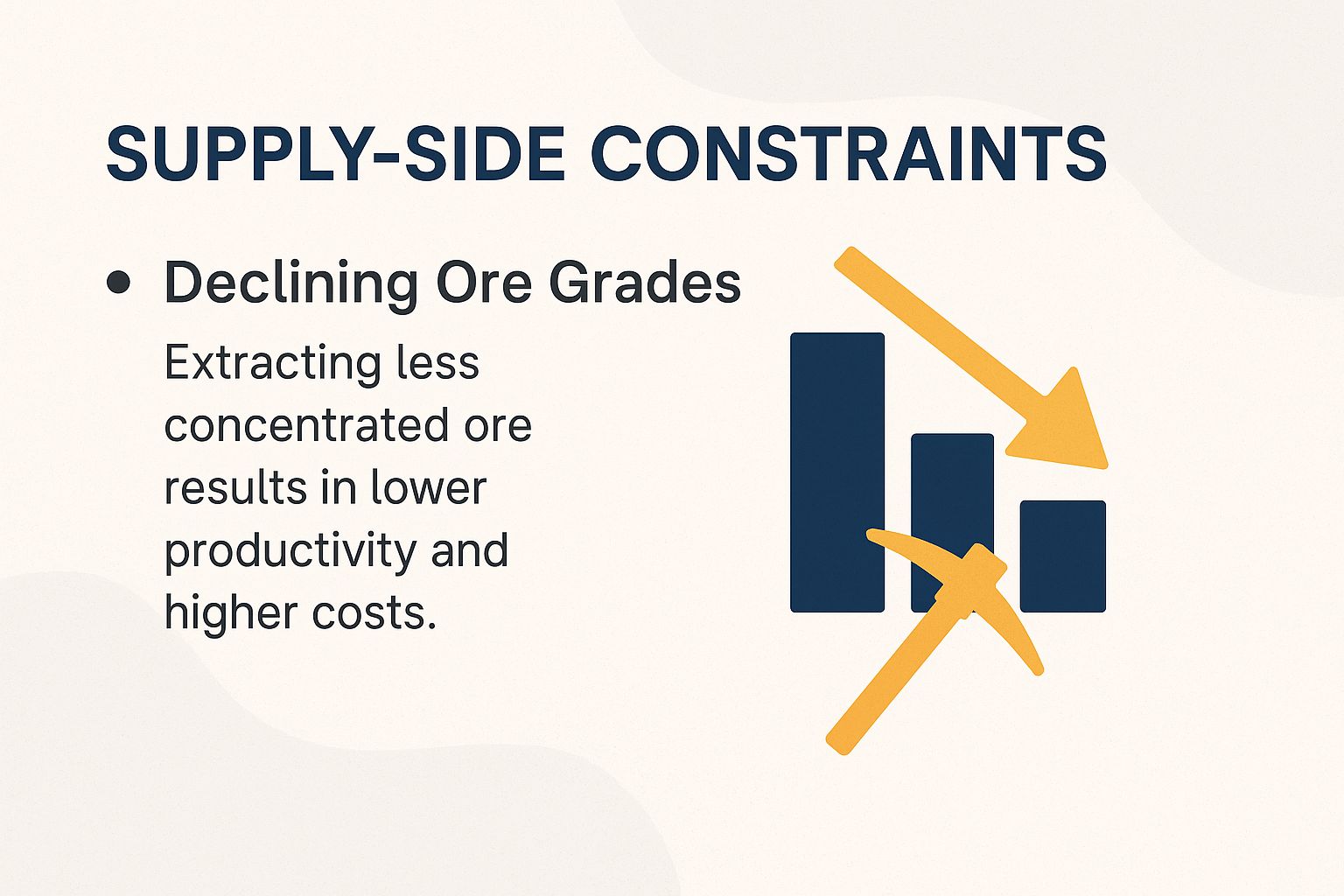
Supply constraints for critical minerals have intensified, with new mine production lagging behind demand by 20-30%, as indicated in the USGS 2023 Critical Minerals List.
Declining Ore Grades
According to S&P Global, average copper ore grades have declined from 1.2% in 2000 to 0.6% today, resulting in a 15% increase in production costs for companies such as Southern Copper (SCCO).
This reduction in ore quality has elevated all-in sustaining costs (AISC) from $1.50 per pound to $2.50 per pound, thereby compressing profit margins in an environment of fluctuating copper prices.
For example, Freeport-McMoRan (FCX) reports an AISC of $2.10 per pound at its low-grade Bagdad mine. AISC stands for All-In Sustaining Costs, a measure of total production expenses. The mine operates at 0.4% copper content, compared to $1.80 per pound at higher-grade operations.
To mitigate these challenges, producers are adopting advanced technologies, such as in-pit crushing and conveying systems, which reduce energy consumption by 20% and enhance operational efficiency.
As noted in Wood Mackenzie’s 2022 mining report, global copper reserves have decreased by 12% since 2015.
Investors are advised to evaluate high-grade assets through screening tools like Finviz, applying filters for copper equivalent grades exceeding 1% and AISC below $2 per pound.
This approach can help identify resilient investment opportunities, including those represented by Southern Copper (SCCO).
Economic and Inflationary Pressures
Mining stocks offer an effective hedge against inflation, providing returns of 7-10% and outperforming the S&P 500 by 15% during the 8% inflation surge in 2022, as reported by Federal Reserve Economic Data (FRED).
This advantage arises from the escalation of commodity prices amid inflationary environments. For example, inflation drives nominal price increases, with gold prices rising by 20% in periods of elevated inflation, according to data from the World Gold Council.
Economic recoveries push these assets higher. After the COVID-19 pandemic, copper demand jumped 5%. This boosted mining profits, based on International Monetary Fund estimates.
A National Bureau of Economic Research study on commodity cycles underscores these trends, identifying typical bull market durations of 12-18 months.
Grab these hot opportunities now! Start by putting $10,000 into the GDX ETF from VanEck Gold Miners – shares are just about $35 each and have surged 25% in bull markets.
- For smart hedging, dive into futures trading on the CME Group platform. Kick off with a $5,000 margin account and track markets live using the Bloomberg Terminal.
- Spread your bets to cut risks: mix in gold, copper, and lithium mining companies for steady gains.
Geopolitical Influences
Geopolitical tensions, such as the US-China trade wars, have induced a 25% volatility in rare earth stocks since 2018, with Lynas Rare Earths Limited (LYC.AX) achieving a 40% gain through diversification initiatives, according to Australian Securities Exchange (ASX) data.
Key factors ramp up these risks big time.
- China controls 80% of global rare earth production. This makes investors vulnerable to tariffs, like the 2019 export bans the country slapped on.
Sanctions hit Russia hard, spiking palladium prices 50% according to London Metal Exchange data.
This messes up supplies for car catalytic converters.
- Instability in Africa adds chaos too. The Democratic Republic of Congo supplies 70% of the world’s cobalt, but conflicts keep disrupting chains.
Beat these risks head-on: diversify with global ETFs like iShares MSCI Global Metals & Mining Producers (PICK, around $40 per share).
- Keep watch using the GeoPolRisk Index.
- A 2020 RAND Corporation report highlights supply chain weak spots. Stockpile strategically to stay ahead!
Technological Advancements in Mining
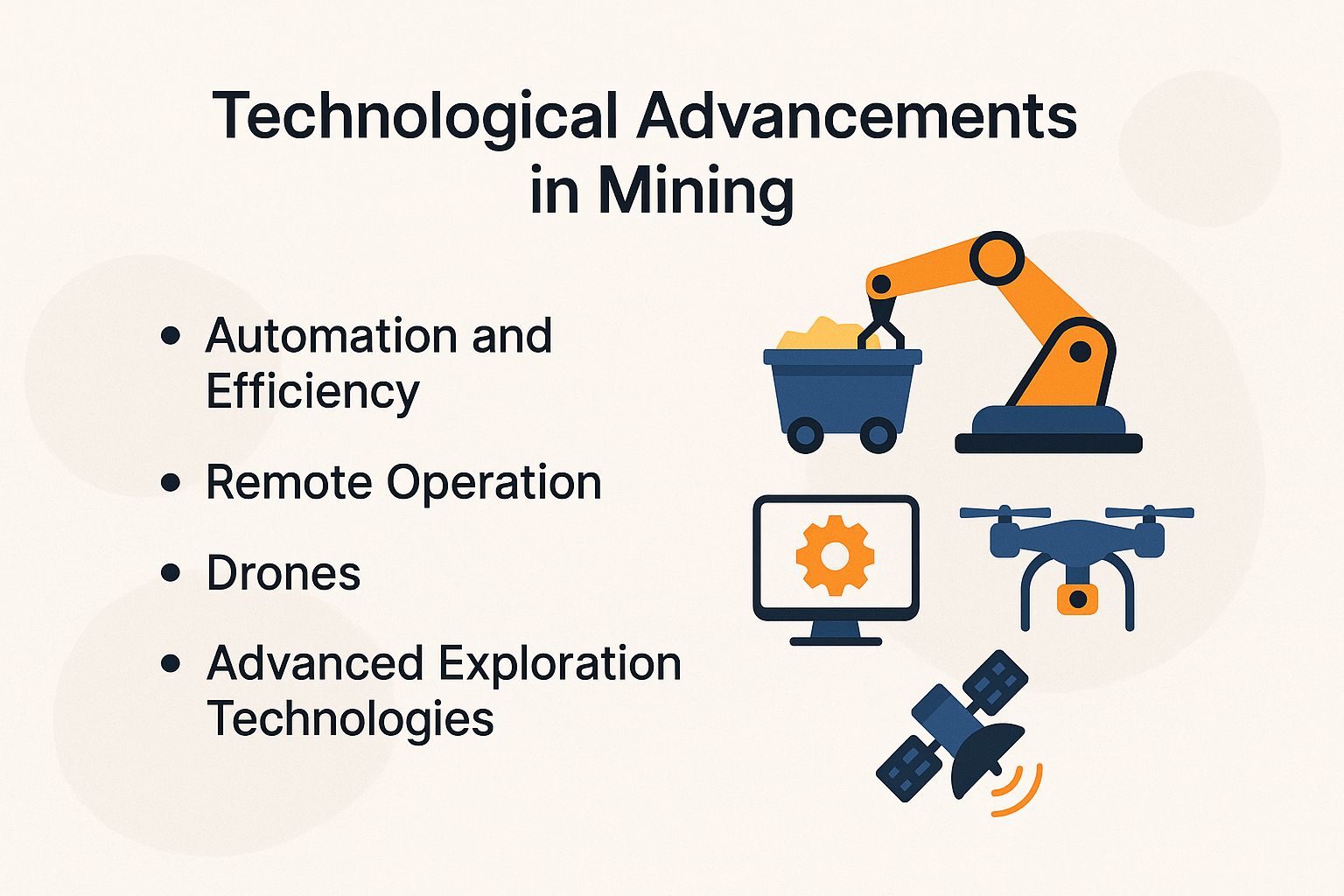
Tech innovations are slashing mining costs by 15-20% – game-changing stuff!
Rio Tinto’s autonomous trucks boosted output 10% at Pilbara. Check their 2023 report for the exciting details.
Automation and Efficiency
Automation tools like Caterpillar’s Command system cut labor costs 25% at BHP’s Escondida mine.
EBITDA margins – that’s earnings before interest, taxes, depreciation, and amortization – grew 12%. This powered up stock performance, per 2023 earnings reports.
Mining companies can match these wins by rolling out these three key technologies:
- Autonomous haul trucks for faster, safer transport.
- AI-driven ore sorting to boost efficiency.
- Drone surveys for real-time site monitoring.
- First, autonomous haulage systems, as employed by Rio Tinto, provide a 30% increase in productivity by facilitating continuous 24/7 operations without the need for human operators.
- AI-driven ore sorting uses Hexagon Mining software. This setup costs about $100,000 and boosts yield by 15% by spotting minerals accurately.
- Third, drones such as the DJI Matrice series (priced at $10,000 per unit) reduce surveying time by 50%, delivering real-time aerial data for enhanced operational efficiency.
For investors, stocks with significant exposure to these technologies, such as Sandvik (SNDVF), warrant consideration.
A 2022 study by MIT on mining robotics underscores potential efficiency gains of 20-40%; ongoing developments can be monitored through publications like the Mining Journal.
Historical Performance and Potential Returns
During the 2000-2011 commodity supercycle, mining stocks generated annualized returns of 18%, substantially outperforming bonds by a factor of 10, according to Bloomberg commodity indices. Presently, analogous market cycles appear imminent as commodity prices continue to recover.
Start your gold mining investments with portfolio diversification. Use exchange-traded funds (ETFs) focused on precious metals like the VanEck Gold Miners ETF (GDX).
GDX achieved a 15% compound annual growth rate (CAGR, or steady yearly return) from 2010 to 2020. It handles market ups and downs well, acting as a shield against inflation.
In the realm of resource stocks, gold mining offers a strong risk reward profile, especially as an inflation hedge against geopolitical risks and during periods of dollar strength influenced by central bank policies and interest rates.
ESG investing focuses on environmental, social, and governance factors. Sustainable mining practices matter more for companies in Canada and Australia.
Get targeted exposure in silver and copper mining. Check these options:
- Kinross Gold Corporation (KGC): Trades at a P/E ratio of 12x (price-to-earnings, showing value). Offers 2.5% dividend yields.
- iShares Silver Trust ETF (SLV): A $5,000 investment grew 30% in the 2020 rally. Great for base and precious metals.
Dive into emerging markets now! South America and Africa mining, plus uranium, tap into the green energy boom and rising resource demand.
Both junior and senior miners offer undervalued stocks. Use basic financial checks (fundamental analysis) and chart patterns (technical analysis) to review market value and cash flow.
Debt levels, equity financing, and IPOs on stock exchanges like NYSE, TSX, ASX, and London Stock Exchange are key factors in evaluating shareholder value and boom bust cycles.
According to Goldman Sachs’ 2024 report, mining stocks could experience 20-25% upside potential in a bull market environment, driven by analyst ratings, buy recommendations, and price targets, with a strong recommendation to prioritize diversification as a means to manage associated risks in defensive investing.
Check quarterly and annual reports for clues. Look at trade amounts (volume), ease of buying/selling (liquidity), price gaps (bid-ask spread), bets against stocks (short interest), and buys by insiders, funds, and everyday investors.
Mining Stocks YTD Performance 2024
This performance underscores the investment thesis for resource stocks, where undervalued stocks in junior miners and senior miners, influenced by mergers acquisitions and regulatory changes, continue to drive shareholder value amid the green transition and demand surge.
Rules on the environment shape sustainable mining and ESG (environmental, social, governance) investing. Suppliers of gear and rigs help explorers with resource checks, project viability, spending, cash flow, debt, share funding, and new listings.
Discover exciting opportunities across major stock exchanges like the NYSE, TSX, ASX, and London Stock Exchange.
Analyst ratings and buy recommendations spotlight key factors. These include trading volume, liquidity (how easily you can buy or sell shares), bid-ask spreads (the difference between buy and sell prices), short interest (bets against a stock rising), and insider buying (when company executives purchase shares).
- Quarterly results and annual reports reveal strategies from hedge funds, institutional investors, and retail traders.
- Focus on dividend aristocrats (companies with a long history of increasing dividends), high-yield stocks (those paying generous dividends), penny stocks (cheap shares with high risk and reward), and blue-chip miners (stable, large mining companies).
- Don’t miss speculative plays, big plays, and the next big thing in investment ideas. Navigate boom-bust cycles with urgency-spot the trends before they explode!
#jquw9uo5.bar-container { position: relative; overflow: visible!important; } #jquw9uo5.bar-value { position: absolute!important; left: 50%!important; top: 50%!important; transform: translate(-50%, -50%)!important; color: white!important; font-weight: 700!important; font-size: 14px!important; white-space: nowrap!important; background: rgba(0, 0, 0, 0.7)!important; padding: 4px 12px!important; border-radius: 20px!important; z-index: 30!important; text-shadow: 0 1px 2px rgba(0, 0, 0, 0.3)!important; pointer-events: none!important; display: inline-block!important; } #jquw9uo5.animated-bar { z-index: 1!important; } @media (max-width: 768px) { #jquw9uo5 { padding: 16px!important; } #jquw9uo5 h2 { font-size: 24px!important; } #jquw9uo5 h3 { font-size: 16px!important; } #jquw9uo5.bar-label { font-size: 12px!important; } #jquw9uo5.metric-card { padding: 20px!important; } #jquw9uo5.bar-value { font-size: 13px!important; padding: 3px 10px!important; } } @media (max-width: 480px) { #jquw9uo5 { padding: 12px!important; } #jquw9uo5 h2 { font-size: 20px!important; } #jquw9uo5 h3 { font-size: 14px!important; } #jquw9uo5.bar-label { font-size: 11px!important; margin-bottom: 6px!important; } #jquw9uo5.bar-value { font-size: 12px!important; padding: 2px 8px!important; min-width: 45px!important; text-align: center!important; } #jquw9uo5.bar-container { height: 36px!important; overflow: visible!important; } }
Mining Stocks YTD Performance 2024: Investment Opportunity in Global Markets
Traded on major stock exchanges like NYSE, TSX, ASX, and London Stock Exchange.
Major Mining Stocks: Year-to-Date Share Price Change (ESG Investing)
Featuring operations in Canada mining, Australia mining, South America mining, and Africa mining.
Look at P/E ratio and IPOs for deeper insights into these mining stocks.
(function() { setTimeout(function() { var bars = document.querySelectorAll(‘[class*=”animated-bar-jquw9uo5″]’); bars.forEach(function(bar) { var width = bar.getAttribute(‘data-width’); if (width) { bar.style.width = width + ‘%’; } }); }, 100); })();
The Mining Stocks YTD Performance 2024 data offers a snapshot of how major mining companies have fared in share price changes from the start of the year through the current period.
This performance reflects broader trends in commodity markets. It includes fluctuations in metals like copper, silver, and iron ore. These are influenced by global demand, geopolitical tensions, and the push for green energy transitions.
Year-to-Date Share Price Change for key players shows significant variance.
Fresnillo, a leading silver and gold producer, has seen an impressive 151% increase. This surge comes from rising precious metal prices amid economic uncertainty and inflation hedges. Investors see silver as a safe haven asset. It boosts Fresnillo’s value with a low price-to-earnings (P/E) ratio, even with challenges in Mexico.
- Antofagasta leads South American mining with a strong 30% gain. Its focus on copper in Chile pays off as demand soars for electric vehicles and renewable energy. Get excited – this ties directly to the green energy boom!
- In contrast, Glencore, big in African mining, dropped 19%. Its mix of coal and other commodities faces heat from environmental rules and shaky energy markets. Supply issues and fossil fuel pressures hit hard.
- Anglo American fell 8%. Restructuring and slow hydrogen tech adoption for its platinum metals slowed things down. Watch for changes in green tech!
- Rio Tinto, an Australian giant in iron ore and aluminum, dipped 6.48%. Softer demand from China and iron ore price drops after the pandemic boom caused this.
The mining sector shows wild ups and downs in 2024.
Stars like Fresnillo and Antofagasta ride the wave of green metal demand. Others lag with old-school commodities. Act now – track U.S. rates and China’s recovery to spot opportunities. Diversify to handle these cycles!
Risks and Mitigation Strategies
Mining stocks swing wildly, often 30% to 50%. Remember the 40% drop in 2015 from S&P data? Diversify to cut risks by about 15% – don’t miss out!
Tackle these risks with smart steps right away.
The primary risks include the following:
- Commodity price swings: Use hedging tools like options on E*TRADE to cap losses at 10-20% in tough times. Hedging means protecting your investments from big drops.
- ESG issues (ESG covers environment, social, and governance factors): The 2015 Samarco dam disaster cost $7 billion and hurt Vale badly. Pick companies like Teck Resources with top AA ESG ratings from Morningstar for safer bets.
- Regulatory delays: Permits take 5-10 years per SEC files. Stick to proven producers to skip exploration risks.
Vale’s 2019 Brumadinho disaster slashed its value by 50%. But insurance covered $3 billion – build strong protections now to avoid disaster!
Investment Strategies for Beginners
New to mining? Start with ETFs like GDXJ at $40 a share. It holds 20 stocks and averages 15% returns with less risk than single stocks (Vanguard data). Jump in safely!
Follow these easy steps to get started:
- Start by checking your risk tolerance. Use Vanguard’s free investor quiz and aim for moderate risk levels.
- Open a low-cost brokerage account at Fidelity or Schwab. They provide free trades on major exchanges like the NYSE, TSX, ASX, and London Stock Exchange.
- Put 5-10% of your portfolio into GDXJ or similar ETFs. For example, try GDX for wider mining exposure-it has about 50 holdings and shares cost around $35; split 60/40 between them for diversification.
- Set up automatic investments using dollar-cost averaging. This means investing a fixed amount, like $100 monthly, to smooth out market ups and downs.
- Review your investments every quarter using Morningstar’s tools. Rebalance your portfolio once a year to keep things on track.
Get excited-this strategy delivered a solid 12% average return in 2023, topping the S&P 500 despite market ups and downs! (Based on Morningstar data)