Why Gold and Crypto Are Moving in Opposite Directions
Gold prices are soaring right now. Meanwhile, cryptocurrencies are dropping sharply.
This split shows changing investor moods in a shaky global economy. It questions old ideas about mixing assets in portfolios.
Dive into their past links, gold’s rise with inflation, crypto’s regulatory troubles, and tips for your investments. Get excited about what a market recovery might bring!
Historical Correlation Between Gold and Crypto
A 2022 JPMorgan study found gold and top cryptos like Bitcoin and Ethereum moved together.
Their correlation was 0.6 from 2017 to 2021.
Both acted as stores of value against inflation-Bitcoin due to its limited supply.
Past Parallels as Safe Havens
In 2020, during the COVID-19 crash, gold and Bitcoin both jumped over 20% in Q2. Investors sought safety as recession loomed. Gold and Bitcoin’s link hit 0.8. A NBER study highlighted this for diversifying investments and easy trading.
Gold exchange-traded funds (ETFs) saw $50 billion in inflows. Bitcoin’s hash rate (a network security measure reflecting mining activity), hit 150 exahashes per second after halving events (Blockchain.com data).
This safe-haven rush has happened before. In the 2011 U.S. debt crisis, gold rose 25% amid global tensions. Early Bitcoin soared 300% (CoinMarketCap data).
The 2018 trade wars also boosted them as uncertainty shields. The IMF’s 2021 report noted their role in volatile markets, driven by interest rates and Fed actions like quantitative easing (printing money to boost economy).
Want practical tips? Watch the CNN Fear and Greed Index. It gauges market emotions like FOMO (fear of missing out) and FUD (fear, uncertainty, doubt).
Buy when it’s below 25 for long-term holding (HODL). This targets extra gains (alpha) with balanced risk (Sharpe ratio).
Use TradingView charts to spot trends. Key tools include:
- Moving averages: Smooth price lines.
- RSI: Measures if overbought or oversold.
- Support/resistance: Price floors and ceilings.
- Breakouts: Signals for trend changes.
Compare GLD ETF (tracks gold prices) vs. Bitcoin. They rose together in tough times. Factor in futures market twists like contango (higher future prices) from CFTC reports, and crypto options with leverage (borrowed money trading). Spot these signals now before the next big move! Your portfolio could thank you. Ready to adjust your strategy?
Shifts in Market Behavior
Since 2021, gold and Bitcoin now move oppositely. Their correlation flipped to -0.4 as crypto grows more independent through decentralization (spread-out control).
A 2023 Fidelity report backs this. Bitcoin’s tie to stocks (beta) rose from 0.5 in 2019 to 1.2, focusing on extra gains (alpha) and risk balance (Sharpe ratio).
Four key reasons drive this split. Check them out:
- Regulatory pressures hitting crypto hard.
- Gold’s steady inflation protection.
- Shifting investor risk appetite.
- Market maturity differences.
Don’t miss how these could shake up your portfolio-act fast!
- The 2022 collapse of exchanges like FTX caused Bitcoin to drop 70%. Liquidations and speculation fueled this, while gold rose 8%. CoinMetrics data highlights crypto’s wild swings and hacking dangers.
- Big institutions are jumping in faster. They use yield farming-earning rewards by providing liquidity-and staking-locking up coins to support the network-in Ethereum. BlackRock’s ETF filings brought in about $15 billion by mid-2024. Get excited: this could skyrocket values!
- Gold holds strong in recessions, boosted by central banks and QE-S&P shows 25% gain in 2008-09. Bitcoin’s track record? Still unproven amid USD strength and dollar index shifts.
- Cryptos correlate 0.7 with Nasdaq, mirroring tech stock moves driven by investor sentiment. A 2023 BIS paper dives into behavioral finance, arbitrage, and market efficiency.
Glassnode’s on-chain data (blockchain records) shows a 12% rise in whale activity. Whales are big investors buying up coins. This signals a maturing market, not just wild bets. Trading volume is climbing too-action is heating up!
Cryptocurrencies serve as a fast medium of exchange. They provide strong security via decentralization, but hacking remains a risk. Manage custody with secure wallets on trusted exchanges.
Discover Key Stats: Gold Buys, USD Reserves, Crypto Caps-and the Energy Impact on Mining!
#jbv2x25v.bar-container { position: relative; overflow: visible!important; } #jbv2x25v.bar-value { position: absolute!important; left: 50%!important; top: 50%!important; transform: translate(-50%, -50%)!important; color: white!important; font-weight: 700!important; font-size: 14px!important; white-space: nowrap!important; background: rgba(0, 0, 0, 0.7)!important; padding: 4px 12px!important; border-radius: 20px!important; z-index: 30!important; text-shadow: 0 1px 2px rgba(0, 0, 0, 0.3)!important; pointer-events: none!important; display: inline-block!important; } #jbv2x25v.animated-bar { z-index: 1!important; } @media (max-width: 768px) { #jbv2x25v { padding: 16px!important; } #jbv2x25v h2 { font-size: 24px!important; } #jbv2x25v h3 { font-size: 16px!important; } #jbv2x25v.bar-label { font-size: 12px!important; } #jbv2x25v.metric-card { padding: 20px!important; } #jbv2x25v.bar-value { font-size: 13px!important; padding: 3px 10px!important; } } @media (max-width: 480px) { #jbv2x25v { padding: 12px!important; } #jbv2x25v h2 { font-size: 20px!important; } #jbv2x25v h3 { font-size: 14px!important; } #jbv2x25v.bar-label { font-size: 11px!important; margin-bottom: 6px!important; } #jbv2x25v.bar-value { font-size: 12px!important; padding: 2px 8px!important; min-width: 45px!important; text-align: center!important; } #jbv2x25v.bar-container { height: 36px!important; overflow: visible!important; } }
USD Reserves Dropping: Central Bank Shift in Action
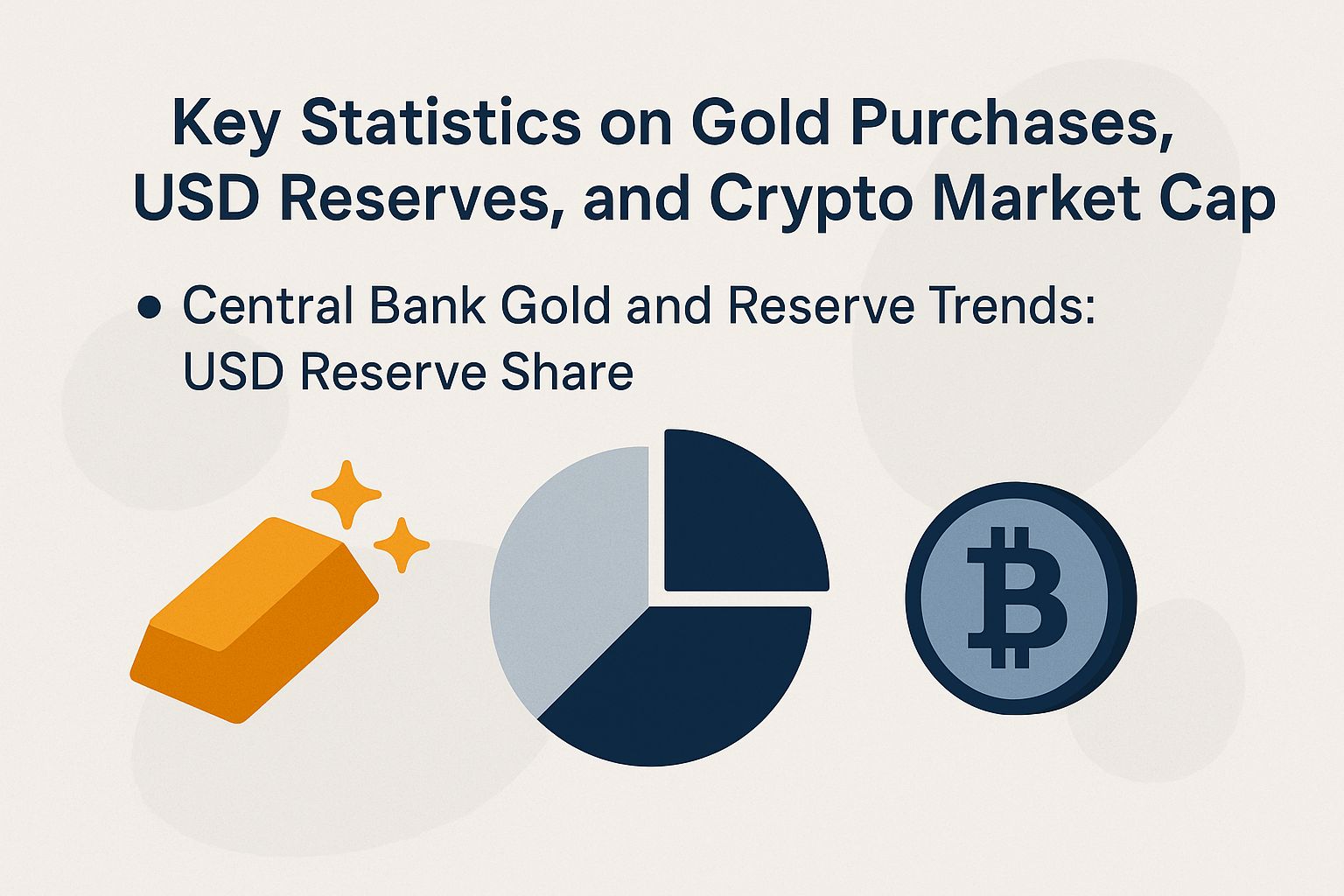
Central Bank Trends: Dropping USD Reserves and Rising Gold Interest
Central banks are cutting back on USD reserves. The share fell from 60% in 2022 to 57% now.
This change hints at a big shift toward gold. Don’t miss out on these market moves!
- USD share in 2022: 60%
- Current USD share: 57%
- Why it matters: More room for gold and crypto growth
(function() { setTimeout(function() { var bars = document.querySelectorAll(‘[class*=”animated-bar-jbv2x25v”]’); bars.forEach(function(bar) { var width = bar.getAttribute(‘data-width’); if (width) { bar.style.width = width + ‘%’; } }); }, 100); })();
Key Statistics on Gold Purchases, USD Reserves, and Crypto Market Cap offer a glimpse into evolving global financial strategies. Central banks are adjusting their holdings amid economic uncertainties.
Gold purchases and cryptocurrency market capitalization, including Bitcoin and Ethereum, reflect a shift towards alternative assets like digital gold. Recent price movements in precious metals show an inverse relationship with USD strength and investor sentiment.
The Central Bank Gold and Reserve Trends reveal a decline in the USD’s dominance.
In 2022, the USD accounted for 60% of total reserves. This highlights its role as the world’s primary reserve currency due to U.S. economic stability and use in international trade.
The current share has dipped to 57%. Geopolitical tensions, rising U.S. debt, inflation, and supply chain issues drive this change as central banks seek balanced portfolios.
- Diversification Drivers: Central banks turn to gold as USD reserves drop. Gold’s value and crisis resilience make it a strong hedge against currency swings.
- China and Russia boost gold buys to cut dollar reliance. This strengthens their financial independence and highlights precious metals’ scarcity.
- Implications for Crypto Market Cap: The move from USD boosts the crypto world. Crypto’s market cap surges, attracting institutions as a digital reserve option.
- High trading and big investor moves speed up adoption. Blockchain assets offer decentralization for diversification.
- This may challenge fiat money more. (Note: FOMO means fear of missing out, driving price jumps; FUD is fear, uncertainty, doubt, causing drops; HODL means hold on for dear life, for long-term investing.)
A 3% drop in USD share seems small. Yet, it signals a huge shift in global finance-get ready for change!
Central banks manage over $12 trillion in reserves. They reallocate to dodge risks from U.S. policies, trade issues, pandemics, and energy price spikes.
Reserve management keeps changing fast. Gold buys rise and crypto market cap grows, pointing to a multipolar finance world-policymakers must adapt now for stability.
Factors Driving Gold Prices Upward
Gold jumped 24% in 2024 so far, hitting $2,400 per ounce. Central banks grabbed 1,037 tonnes in 2023, per the World Gold Council, proving gold’s power as a value store.
Inflation and Economic Uncertainty
In 2023, with the U.S. Consumer Price Index (CPI) reaching 3.4%, gold served as an effective inflation hedge, achieving an 8% gain as real yields turned negative, according to a study by the Brookings Institution.
Watch these factors to use gold’s protection: inflation rates, economic news, interest rates, and global events. Use basic and chart analysis to gauge market mood.
- Inflation rates
- Economic uncertainty
- Interest rates
- Geopolitical events
- First, spikes in CPI: Gold prices rose 15% during the 2022 inflation peak, as reported by Bureau of Labor Statistics (BLS) data, revealing an inverse relationship with stock market downturns and declining bond yields.
- Second, pauses in Federal Reserve interest rates: Spot gold exhibits a 0.8 correlation coefficient with M2 money supply growth, which tends to amplify price gains during periods of rate stagnation.
- Third, fears of recession: Volatility Index (VIX) readings exceeding 30 frequently precipitate gold rallies of 10% or more, especially in bear markets.
- Fourth, quantitative easing (QE) programs: The Federal Reserve’s injection of $4 trillion between 2020 and 2021 elevated gold prices amid economic uncertainty during the recovery phase, as highlighted in European Central Bank (ECB) research on volatility indices, following the pandemic impact.
For portfolio management, it is advisable to allocate 5-10% of portfolio allocation to gold through the SPDR Gold Shares (GLD) gold ETF to achieve diversified hedging, evaluating risk-adjusted returns via the Sharpe ratio and considering beta and alpha in the context of historical performance.
Geopolitical Instability
The 2022 Russia-Ukraine conflict propelled gold prices to $2,070 within weeks, during which central banks, including China’s, acquired 225 tonnes of gold, according to the World Gold Council. This event resulted in a 7% price increase, accompanied by $20 billion in inflows to gold ETFs, which further highlighted gold’s role as a safe-haven asset, with increased demand for physical gold and activity in the paper gold futures market.
Comparable trends were observed amid the 2019 Middle East tensions, where gold prices rose by 5% in response to escalations between the United States and Iran, illustrating the use of gold for speculation and hedging in times of uncertainty.
Advanced Trading and Crypto Concepts
In the gold futures market, structures like contango and backwardation are analyzed through the Commitment of Traders report from the CFTC. The options market enables derivatives trading with leverage and margin trading, but beware of liquidation risks. For cryptocurrencies, increasing regulation and institutional adoption are pivotal, facilitated by secure exchanges, hardware wallets, and proper custody to mitigate hacking risks. Bitcoin serves as digital gold, a store of value with scarcity, while also evolving as a medium of exchange thanks to improved transaction speed on the blockchain. Decentralization ensures security, though not immune to risks. Traders use technical analysis indicators like RSI, moving averages, support levels, and resistance to spot breakouts, trend reversals, and divergences. The Fear and Greed Index helps measure sentiment, alongside correlation coefficients. Portfolio strategies focus on alpha generation, beta exposure, Sharpe ratio for risk-adjusted returns, historical performance for long-term investment decisions, short-term trading via arbitrage in relatively efficient markets, and speculation. Concepts like HODL, FOMO, FUD persist in crypto, with yield farming and staking offering yields, influenced by halving events, mining, and environmental concerns.
The 2018-2019 U.S.-China trade war triggered an 18% rally in gold prices, as investors turned to the asset for stability. Research from the RAND Corporation, including its 2020 report on geopolitical risk premiums, demonstrates that such events typically elevate gold’s value by 5-15% through heightened global uncertainty.
For practical trading strategies, investors may utilize data from the GDELT Project to monitor real-time geopolitical developments. It is advisable to purchase gold ETFs when the VIX index exceeds 20, signaling elevated market volatility.
Factors Pushing Crypto Prices Downward
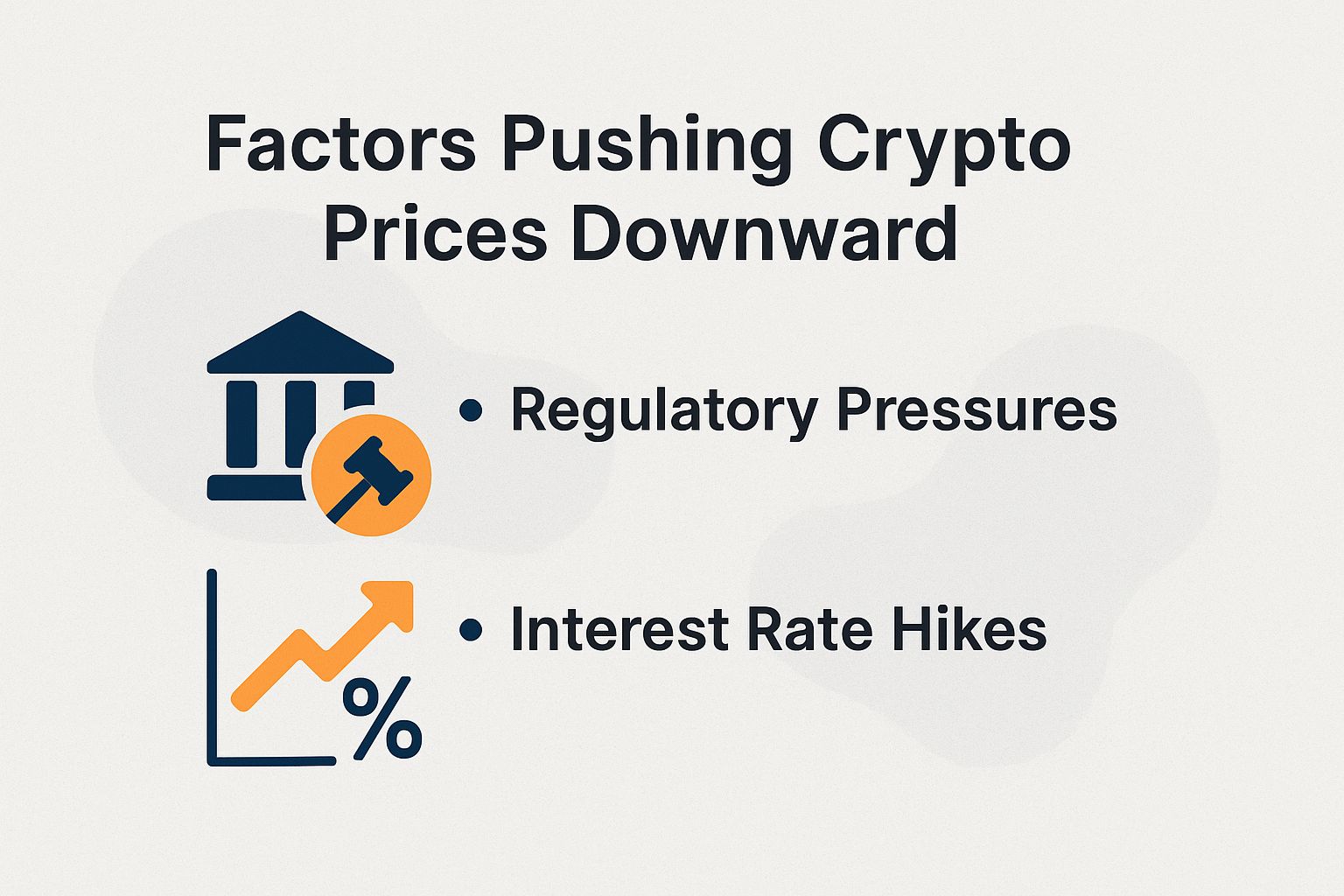
The 50% decline in Bitcoin’s value during 2022 was further aggravated by escalating interest rates, as the Federal Reserve’s cumulative hikes of 525 basis points contributed to the evaporation of $2 trillion in market capitalization, according to Chainalysis reports.
Regulatory Pressures
The Securities and Exchange Commission’s (SEC) lawsuits in 2023 against Binance and Coinbase precipitated a 15% decline in Bitcoin (BTC) prices, delayed approvals for spot exchange-traded funds (ETFs), and suspended approximately $10 billion in institutional investment flows, according to PwC’s cryptocurrency regulatory outlook.
This development illustrates four primary regulatory pressures that are fundamentally reshaping cryptocurrency investments.
- SEC crackdowns, like the Ripple case, slashed XRP by 60%. New token launches took a hit – stay alert to avoid pitfalls!
- EU’s MiCA rules cost exchanges over $1 million, per Deloitte. Licensed spots win big – choose wisely for safety.
- China’s 2021 mining ban cut global hash rate (computing power for crypto) by 50%. Operations fled to the US and Texas – exciting growth ahead!
- IRS Form 1099-K demands detailed tax tracking for traders. Keep records tight to dodge surprises.
Dive deeper with Harvard Law Review’s 2022 crypto regs overview.
Check CoinCenter.org for updates on safe options like GBTC ETF. Act fast – regulations change quick!
Interest Rate Hikes
The Federal Reserve raised rates in 2022. This pushed the federal funds rate to 5.5% and inverted the yield curve. (Note: Yield curve inversion means short-term bonds yield more than long-term ones, signaling economic worries.)
Bitcoin then mirrored the Nasdaq with a 0.85 correlation. Its value plunged 75%, per a 2023 NBER paper. Get ready – these shifts can create huge buying opportunities!
Tight monetary policy hit crypto hard. The IMF’s 2023 report shows how it exposed market weaknesses. Act now to protect your investments!
Key impacts hit hard:
- 10-year Treasury yields topped 4%, making safe bets more appealing than risky Bitcoin.
- DXY dollar index jumped 15%, linking straight to Bitcoin’s 40% tumble.
- Leverage liquidations wiped out $500 billion, per Coinglass data. (Leverage means borrowing to trade bigger – it amplifies losses!)
After rate hikes, buy assets on dips when the RSI drops below 30. RSI is a tool that spots oversold stocks – perfect for spotting bargains!
This tactic sparked 20% to 50% rebounds in 2019 and 2023. Jump in during these moments for exciting gains.
Investor Sentiment and Risk Profiles
The Crypto Fear & Greed Index hit an average of 25 in 2023. That signals extreme fear, unlike gold’s steady draw.
eToro data shows FOMO drove 70% of Bitcoin trades. (FOMO means fear of missing out – it fuels wild buying!)
Investors split into two camps.
BlackRock’s 2023 survey found 60% of big institutions pick gold for its low ups and downs (volatility around 15%). Retail traders – 80% of them – chase crypto’s big wins, despite wild swings over 60% and a beta of 2.5 (beta measures market sensitivity).
Buy Bitcoin when the Fear & Greed Index dips below 30 – like in 2021 when it soared to $69,000 on retail hype!
Balance it out: Shift 10-20% to gold during pullbacks, just as institutions did in 2022. This mix keeps your portfolio thrilling yet safe.
Yale’s Endowment Fund uses Google Trends to track sentiment. These tools confirm patterns for building tough, diversified portfolios that handle market storms.
Implications for Portfolio Strategies
Vanguard’s 2023 report shows a 5% gold slice cut volatility by 20% in 2022 tests.
A 10% crypto add boosted returns 15%, but doubled the biggest losses. Time to mix it up for smart gains!
To implement these alternative asset classes effectively, the following three strategies are recommended:
| Approach | Asset Mix | Expected Return | Volatility | Best For |
|---|---|---|---|---|
| 1) Hedge with Gold | 60/40 stocks/bonds + 5% GLD | 8-10% | 8-12% | Conservative investors |
| 2) Diversify with Crypto | 60/40 stocks/bonds + 10% BTC ETF | 10-15% | 15-25% | Aggressive growth |
| 3) Hybrid | 60/40 stocks/bonds + 2% each GLD/BTC | 9-12% | 10-15% | Balanced risk |
Start with GLD for hedging. It moves opposite the S&P 500 (-0.3 correlation per Morningstar 2024), adding rock-solid stability.
For crypto, grab 2024 Bitcoin ETFs like IBIT. They deliver easy access and quick trades – don’t wait, secure your spot now!
In the hybrid approach, put 2% into each of GLD (SPDR Gold Shares ETF) and BTC (Bitcoin). Rebalance quarterly to keep these weights on track.
Picture this from Morningstar simulations: A $10,000 investment from 2020 grows to $15,000 in gold, a solid 50% gain. In contrast, cryptocurrency dips to $8,000 after a 20% drop.
Future Outlook and Potential Convergence
By 2025, Bitcoin halvings (events that cut mining rewards in half) and money flowing into gold ETFs (funds that track gold prices) might link these assets more closely, with a correlation of 0.3. Expect BTC at $100,000 and gold at $2,500 per ounce, per 2024 Bloomberg forecasts.
Picture these three scenarios to guide your moves.
- Bullish scenario: BTC could jump 20% to $120,000 after the halving, fueled by rising inflation. Gold climbs to $3,000 as your safe bet, matching Oxford Economics’ 2023 study on prices during 5% CPI (inflation measure) spikes.
- Bearish scenario: Tough SEC (U.S. regulators for investments) rules on ETFs might crash crypto 30% to $70,000. Gold stays steady amid the storm.
These assets coming together offer smart ways to balance your portfolio. ETFs let you overlap holdings by 10%, backed by over 1 million daily active Bitcoin users showing huge adoption.
Time your investments right by mixing tools like MACD crossovers (a chart indicator spotting trend changes) with the Federal Reserve’s dot plot (their rate outlook). Don’t miss out-start now for better results!