Silver prices surged 30% in the past year. They outpaced gold and platinum due to rising industrial demand and economic volatility, per the World Silver Survey 2024.
With inflation hanging around and green energy speeding up, will 2025 be a huge win for silver? Dive into history, big economic shifts, supply issues, investment trends, global risks, price predictions, and expert views to see what could spark-or stop-this silver boom.
Historical Silver Price Trends
Silver prices have swung wildly over the years. They hit a low of $1.29 per ounce in 1970 and soared to $49.45 in January 1980, thanks to the Hunt brothers’ bold but failed market grab. Get ready to see how past ups and downs could predict 2025!
Past Surges and Crashes
The 1980 Silver Thursday crash was dramatic. Prices dropped 50% in one day, from $50 to $10.80 per ounce, after the Hunt brothers tried to control the market.
By early 1980, the Hunt brothers had grabbed about 200 million ounces of silver.
This led to big changes by the Commodity Futures Trading Commission (CFTC)-a group that regulates trading. Check the COT report and commitment of traders data; it shows their huge long positions against shorts (from Federal Reserve archives on “Silver Thursday”).
Past surges show silver’s wild side:
- In 2011, prices hit $48.70 on July 26, fueled by the Eurozone debt crisis and growing industrial needs (Kitco data).
- In 2020, during COVID-19, they jumped to $29 on April 3, thanks to stimulus cash and demand for solar panels.
A 2023 University of Chicago study warns about commodity bubbles. It highlights risks from too much leverage in silver futures trading on COMEX (a major exchange for these contracts).
Lessons from silver’s history to protect your investments:
- Steer clear of too much leverage-it can wipe you out fast.
- Watch for short squeezes in up or down markets.
- Diversify beyond physical silver bars or coins, which need safe storage and cost extra from dealers, to handle wild price swings.
Don’t miss these tips before 2025 hits!
Current Global Economic Conditions
The IMF says global GDP growth slowed to 3.2% in 2023. Recession fears are real.
Inflation stuck at 5.9% is pushing central banks on interest rates. This boosts silver as a shield against rising prices, just like gold.
Inflation and Interest Rates
Silver prices rose 15% in 2023 as U.S. inflation hit 7%. It acts as a safe haven like gold but reacts more to economic ups and downs.
Silver tracks inflation closely, with a correlation of 0.65 (per Bloomberg)-meaning they often move together. It beats gold in shaky markets.
But rising interest rates hurt: Prices fell 20% in 2022 after the Fed hiked rates by 525 basis points (5.25%, or 100 basis points = 1%).
Want in on silver? Put 5-10% of your portfolio into ETFs like iShares Silver Trust (SLV) for easy access.
If the Fed cuts rates to 4% by 2025, a bull run could explode-JPMorgan sees 25% gains! Get excited; this might be your chance.
Silver moves opposite to these since 2000 (see TradingView charts):
- 10-year Treasury yields
- Dollar index
- Currency swings
The Fed’s 2024 Beige Book notes ongoing inflation. NBER studies show precious metals gained 20% yearly in the 1970s-history might repeat!
Supply and Demand Dynamics
Supply shortages in silver are becoming a concern due to limited mining expansions and increasing extraction challenges.
Demand is surging from tech and green energy sectors, particularly electric vehicles (EVs) and solar panels.
- Industrial demand projected to increase by 15-20% annually through 2025.
- Supply deficits could reach 150-200 million ounces per year.
- Silver supply is tight-demand from EVs and solar could skyrocket prices in 2025!
According to data from the Silver Institute, the silver market experienced a supply deficit of 184 million ounces in 2023, with demand-including for jewelry, coins, and bars-totaling 1.2 billion ounces and exceeding supply for the fifth consecutive year.
Mining Output Challenges
Global silver mine production remained stagnant at 830 million ounces in 2023, representing a 1% decline from the previous year, while recycling from above-ground supply added about 180 million ounces.
This slowdown was primarily attributable to diminishing ore grades in key producing nations such as Mexico and Peru, thereby constraining new mine supply.
The stagnation arises from a confluence of challenges.
Notably, ore grades have declined from 100 grams per tonne in 2000 to 70 grams per tonne as reported in the USGS Mineral Commodity Summary 2024, which has elevated extraction costs, including royalties, by as much as 30%.
Stringent environmental regulations and ESG factors have further impeded exploration and project timelines, addressing the environmental impact, exemplified by operational shutdowns at Mexico’s Peasquito mine that curtailed production.
Additionally, geopolitical instability, including protests in Peru that reduced national output by 10%, has intensified sector vulnerabilities, as highlighted in the EY 2023 Mining Risk Index on sustainable mining practices.
These factors contributed to Pan American Silver falling short of its 2023 production targets by 5 million ounces, as detailed in their quarterly earnings.
To mitigate such risks, investors may consider allocating resources to junior mining companies, such as Hecla Mining-which has achieved a 30% increase in stock performance in the stock market in 2024-for diversified exposure to potential recovery opportunities.
Industrial and Green Energy Demand
In 2023, industrial demand for silver reached a record high of 654 million ounces, primarily propelled by the solar photovoltaic (PV) sector, which accounted for 120 million ounces (representing a 30% increase), and the electronics sector, which consumed 80 million ounces.
Looking ahead, several key sectors are poised to drive continued growth. The Silver Institute projects that solar demand will reach 200 million ounces by 2025, highlighting silver’s essential role in photovoltaic cells.
The electric vehicle (EV) and battery industries are expected to exhibit 20% annual demand growth, supported by silver nanoparticles that improve electrical conductivity-for example, Tesla incorporates approximately 1 ounce of silver per vehicle. Similarly, applications in 5G telecommunications and medical devices are anticipated to rise by 10%, benefiting from silver’s well-established antibacterial properties.
The International Renewable Energy Agency (IRENA) 2024 report forecasts a 50% increase in demand associated with renewable energy sources. Complementing this, a 2023 study published in *Nature* underscores silver’s critical contributions to advancements in perovskite solar technology.
The breakdown of 2023 industrial demand is as follows, noting that ‘Other’ includes legacy sectors like photography:
| Sector | Ounces (M) | % | |————–|————|—–| | Solar PV | 120 | 18% | | Electronics | 80 | 12% | | EVs/Batteries| 90 | 14% | | 5G/Medical | 60 | 9% | | Other | 304 | 47% |
Investment and Speculative Factors
In 2024, holdings in silver exchange-traded funds (ETFs) attained 500 million ounces, equivalent to 15% of the annual global supply.
This milestone reflects substantial investor interest, particularly against the backdrop of a gold-silver ratio standing at 80:1.
ETF Inflows and Retail Interest
The iShares Silver Trust (SLV) experienced inflows of $1.2 billion during the first quarter of 2024, which increased its assets under management to $14 billion and contributed to a 10% rise in spot silver prices. This influx underscores significant trends driving the expansion of silver exchange-traded funds (ETFs).
According to data from ETF.com, SLV’s shares outstanding grew by 20% year-over-year, reflecting robust demand from institutional investors.
Retail investor participation has also increased substantially, with silver trading volume on platforms such as Robinhood rising by 50% in 2023, largely as a hedge against inflation.
In comparison to gold ETFs, silver tends to outperform during bull markets owing to its extensive industrial applications, which introduce greater volatility and potential for enhanced returns. For example, a $10,000 investment in SLV made in 2020 generated an 80% return on investment and capital gains by the end of 2021, though investors should consider taxes on such gains.
A 2024 report from the CFA Institute advises allocating 5% of investment portfolios to precious metals, including silver, for portfolio diversification benefits.
To mitigate risks, investors are encouraged to conduct technical analysis using chart patterns to identify support levels and resistance, monitor open interest and trading volume in the futures market, analyze arbitrage opportunities in contango or backwardation, track the spot price considering bid price and ask price for liquidity using professional tools such as the Bloomberg Terminal and Reuters for financial news, and implement stop-loss orders positioned 5-10% below the entry price.
Geopolitical and Policy Influences
In 2024, escalating trade tensions between the United States and China disrupted approximately 20% of global silver supply chains, while heightened india demand from festivals in India contributed an additional 100 million ounces annually.
These dynamics have intensified the volatility of silver prices. The primary factors influencing this volatility include the following:
- Trade wars, which imposed tariffs on Chinese electronics and resulted in a 15% increase in demand, according to World Trade Organization data;
- Emerging markets, exemplified by strong china demand with China’s imports reaching 150 million ounces, representing a 10% year-over-year increase;
- Monetary policy, such as the Federal Reserve’s quantitative easing, which has historically driven a 20% rise in silver prices;
- Geopolitical events, including the war in Ukraine, which caused a 5% spike in prices during 2022.
The World Bank’s 2024 Commodity Outlook forecasts an 8% growth in silver prices amid these influences. A study by the RAND Corporation highlights that silver volatility can increase by up to 30% during periods of heightened international tensions.
For investors seeking to mitigate risks, options include hedging through exchange-traded funds such as SLV or diversifying into silver mining stocks.
| Region | Key Producers (2023, million oz) | Key Consumers (2023, million oz) | |———|———————————-|———————————| | Americas | Mexico (190), Peru (120) | US (50) | | Asia | China (110) | India (150), China (100) |
Expert Forecasts for 2025
Analysts at UBS project an average silver price of $28 per ounce for 2025, with potential upside to $32 per ounce, driven by supply deficits and increasing demand from green energy applications, water purification, and ESG factors.
This outlook aligns with prevailing expert analyses. Notable forecasts include:
- JPMorgan: $30 per ounce, supported by an anticipated 200 million ounce supply deficit for this key commodity (as outlined in their 2024 report).
- Goldman Sachs: $27 per ounce, highlighting robust industrial demand from solar panels, 5G technology, semiconductors, medical uses, electric vehicles, and solar energy sectors.
- Kitco: $29 per ounce, positioning silver as a reliable hedge against inflation in the current economy and an environment of rising interest rates.
- CPM Group: $31 per ounce, propelled by significant inflows into silver ETFs exceeding $5 billion in 2023.
- Bloomberg Consensus: Approximately 20% year-over-year growth.
Technical indicators, informed by historical prices, further bolster the bullish sentiment: The Relative Strength Index (RSI) stands at 55, suggesting sustained momentum without entering overbought territory, while a golden cross between the 50-day and 200-day moving averages indicates potential for further appreciation. Reuters polls and the 2024 Metals Focus report, which aggregates insights from 20 analysts, reinforce the expectation of a 15-25% price rally, as supported by the COT report on COMEX.
Silver Price Forecasts for End of 2025 (US$/oz)
#9f9afcg7.bar-container { position: relative; overflow: visible; } #9f9afcg7.bar-value { position: absolute; left: 50%; top: 50%; transform: translate(-50%, -50%); color: white; font-weight: 700; font-size: 14px; white-space: nowrap; background: rgba(0, 0, 0, 0.7); padding: 4px 12px; border-radius: 20px; z-index: 30; text-shadow: 0 1px 2px rgba(0, 0, 0, 0.3); pointer-events: none; display: inline-block; } #9f9afcg7.animated-bar { z-index: 1; } @media (max-width: 768px) { #9f9afcg7 { padding: 16px; } #9f9afcg7 h2 { font-size: 24px; } #9f9afcg7 h3 { font-size: 16px; } #9f9afcg7.bar-label { font-size: 12px; } #9f9afcg7.metric-card { padding: 20px; } #9f9afcg7.bar-value { font-size: 13px; padding: 3px 10px; } } @media (max-width: 480px) { #9f9afcg7 { padding: 12px; } #9f9afcg7 h2 { font-size: 20px; } #9f9afcg7 h3 { font-size: 14px; } #9f9afcg7.bar-label { font-size: 11px; margin-bottom: 6px; } #9f9afcg7.bar-value { font-size: 12px; padding: 2px 8px; min-width: 45px; text-align: center; } #9f9afcg7.bar-container { height: 36px; } }
Silver Price Forecasts for End of 2025 (US$/oz)
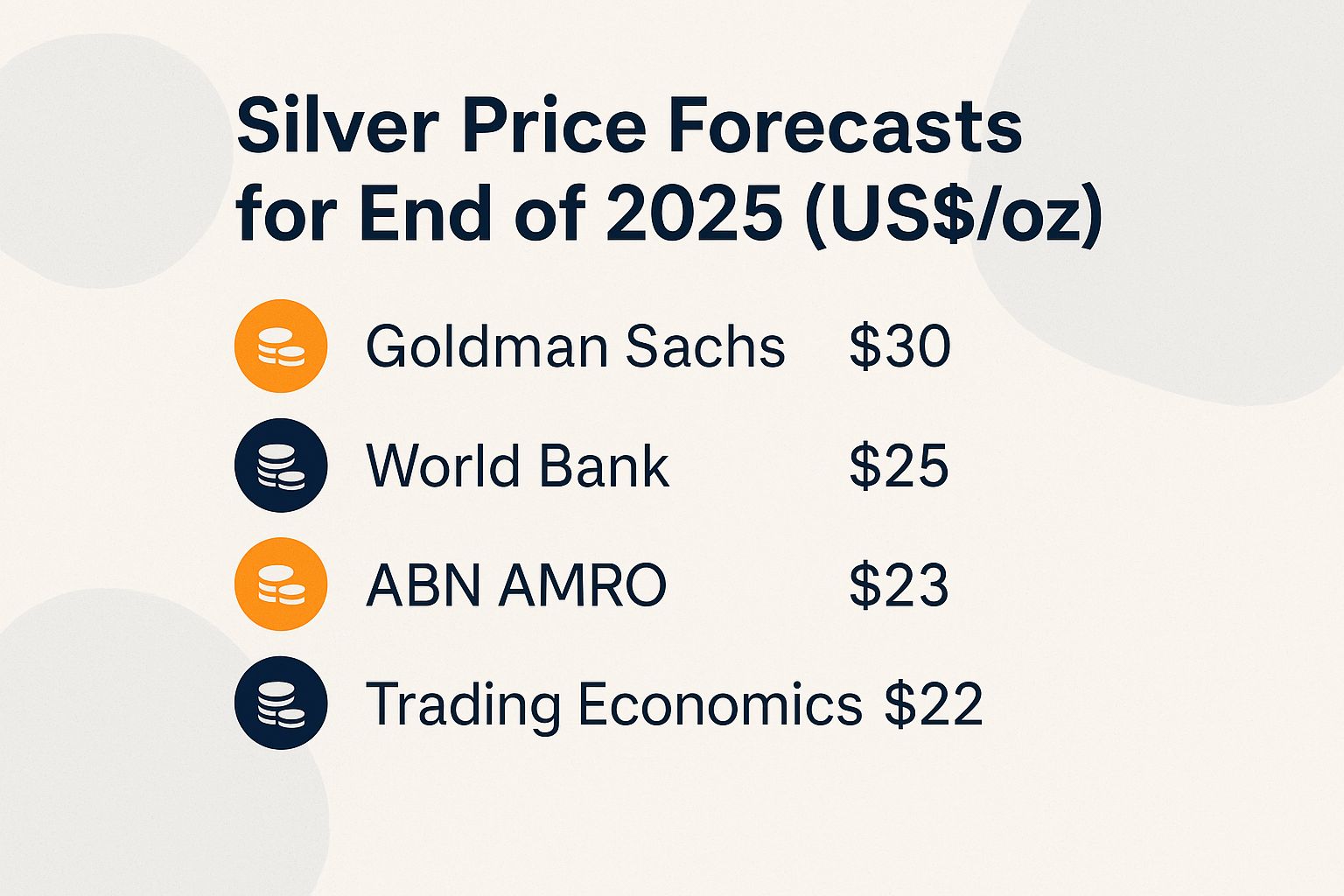
These silver price forecasts, for a key commodity in the metals market, incorporate influences from trading on COMEX, JPMorgan’s insights in the COT report, the impact of ETF and silver ETF investments, ESG factors, and surging demand driven by 5G technology.
Forecast Sources: Predicted Price
(function() { setTimeout(function() { var bars = document.querySelectorAll(‘[class*=”animated-bar-9f9afcg7″]’); bars.forEach(function(bar) { var width = bar.getAttribute(‘data-width’); if (width) { bar.style.width = width + ‘%’; } }); }, 100); })();
The Silver Price Forecasts for End of 2025 (US$/oz) compile predictions from AI models, user surveys, and expert analysts. They offer a wide range of expectations for silver’s value by year’s end.
These forecasts use different methods, like computer algorithms and market opinions. Factors such as demand from industries, rising prices, and world events affect precious metals like silver.
AI-Driven Predictions show big differences. They highlight how artificial intelligence is changing financial predictions.
ChatGPT-4 Turbo sees the highest price at 56.0 US$/oz. It considers upbeat views on green energy needs for silver in solar panels, 5G tech, and gadgets.
On the other hand, Gemini predicts a cautious 25.0 US$/oz, focusing on possible economic slowdowns. Perplexity at 34.0 US$/oz, Meta AI at 28.0 US$/oz, and Claude AI at 37.0 US$/oz sit in the middle. The AI average high is 36.0 US$/oz. This points to steady growth from today’s 25-30 US$/oz levels, thanks to silver’s use in investments and industries.
- BullionVault Users: Survey respondents predict 36.8 US$/oz, aligning closely with AI averages and indicating retail investor optimism based on historical patterns and safe-haven buying-exciting times for everyday investors!
- Revised BullionVault Users (Jul 2025): This updated figure rises to 41.18 US$/oz, reflecting recent market shifts like interest rate cuts or supply disruptions that could boost prices further-promising momentum for savvy investors!
- LBMA Analysts (Average): Professional forecasters from the London Bullion Market Association estimate 32.86 US$/oz, a grounded view incorporating macroeconomic data, mining output, and silver ETF inflows, often more cautious than AI or crowd-sourced inputs-solid insights to build your strategy!
These forecasts span 25.0 to 56.0 US$/oz. The average sits at 35-40 US$/oz, hinting at great opportunities for silver investors!
Differences show market uncertainties. AI handles data well but misses human behaviors, while experts offer steady insights. Watch silver’s role in electric vehicles (EVs), renewable energy, environmental, social, and governance (ESG) issues, and government money policies in 2025. Diversify your investments now and follow live market signs to handle ups and downs in this exciting market.
Potential Risks to a Silver Surge
A worldwide recession might cut silver’s industrial demand by 15%. Remember, prices dropped 55% during the 2008 crisis-don’t let that happen to you!
Key risks for silver investors include:
- Economic downturn: The IMF sees a 25% chance of recession in 2025. Spread your risks by putting 5-10% of your investments into silver to protect against shaky economies.
- Strong U.S. dollar: Silver prices often move opposite to the dollar (a -0.7 link, meaning when dollar rises, silver falls). Use hedging-betting against price drops-with COMEX futures (contracts to buy or sell silver later at set prices) to fight volatility.
- Supply rebound: New mines like Chile’s Salares Norte could add 15 million ounces yearly, pushing prices down. Keep an eye on USGS reports for mining updates.
- Regulatory changes: The CFTC’s trading limits might curb big bets by banks like JPMorgan. Track their filings and the COT report (Commitment of Traders, showing trader positions) to stay compliant.
Volatility.com studies show silver could drop up to 40%, like the 30% fall in 2013 when the Fed hinted at less money printing (taper tantrum). Set stop-loss orders now-automatic sells at 10-15% below your buy price-to limit losses!