In an era of economic turbulence, gold has surged over 50% in value since 2019. World Gold Council data shows it as the decade’s top safe-haven asset.
Gold’s rise comes from its long history. The Gold Standard’s end boosted it amid inflation fears, low interest rates, trade wars, and the COVID-19 crisis.
Want to know how gold beat stocks and bonds? Dive into the future trends and predictions that could make you act now!
Historical Foundations of Gold as an Asset
Gold’s story starts in ancient Egypt and Mesopotamia. It served as money and a value keeper for over 5,000 years.
The Gold Standard Era
The gold standard started in the 1800s. It peaked with the 1944 Bretton Woods Agreement, tying money to gold at $35 per ounce until 1971, which kept world trade steady.
From 1870 to 1914, Britain’s pound relied on 29 million ounces of gold. Bank records show this kept inflation under 1% yearly and fueled worldwide trade growth.
In 1944, 44 countries joined Bretton Woods. It set fixed rates to the U.S. dollar, backed by gold.
The U.S. owned 20,000 tons of gold then-70% of global reserves. This setup drove post-WWII growth at 4.8% yearly, per IMF data.
Economist Barry Eichengreen explains in his 1992 book *Golden Fetters* why it failed. The system’s stiffness limited crisis fixes, leading to its 1971 end due to U.S. debt and inflation.
Abandonment and Modern Shifts
In 1971, President Nixon ended dollar-to-gold swaps-the Nixon Shock. This killed Bretton Woods and shot gold prices from $35 to $850 by 1980, as inflation hit 13% yearly.
After 1971, gold broke free from paper money. It jumped 2,300% in the 1970s due to oil crises and wild inflation, like Argentina’s 5,000% in 1989.
By 2023, U.S. gold reserves dropped to 8,133 tons. Federal Reserve studies confirm this shift.
Today, gold protects against ups and downs-a hedge means it balances risks. In 2008’s crash, it moved opposite stocks (correlation -0.1), per World Gold Council, for better stability. China bought 2,200 tons since 2009 to mix up its holdings.
James Rickards’ 2014 book *The Death of Money* highlights gold’s key role in shaky global money systems. Don’t miss its ongoing power!
Economic Factors Fueling Demand
Global inflation over 3% in 2023 boosted gold demand. Central banks grabbed a record 1,037 tons, per World Gold Council. Key drivers include:
- Jewelry in India and China.
- Electronics and tech industries.
Get ready to see why gold is hotter than ever!
Inflation and Currency Devaluation
In the 1970s stagflation-high inflation plus slow growth-gold returned 35% yearly. The dollar lost half its buying power, proving gold’s power as an inflation shield over 100+ years of proof.
Gold’s capacity for value preservation is attributable to its inherently limited supply, constrained by mining, with only 210,000 tons having been mined throughout history, according to data from the U.S. Geological Survey. Modern mining practices are increasingly focused on sustainability, environmental protection, and ethical sourcing, including fairtrade gold, to mitigate mining impact. In 2022, as U.S. inflation reached 9.1 percent, gold exchange-traded funds (ETFs) such as GLD recorded inflows of $10 billion, reflecting investor demand for a reliable safe haven.
A 2021 study by the Federal Reserve Bank of St. Louis demonstrated that gold delivered a real return of 4.4 percent from 1971 to 2020, surpassing the 0.7 percent real return of bonds over the same period. For practical portfolio protection and wealth preservation, it is advisable to allocate 5 to 10 percent of assets to physical gold bullion-such as American Eagle coins-taking into account storage and security-or to ETFs within IRA and retirement accounts, considering regulations, taxes, and capital gains, for inheritance and legacy planning when the Consumer Price Index (CPI) exceeds 3 percent.
The hyperinflation crisis in Venezuela in 2018, which saw inflation rates soar to 1.7 million percent, provides a stark illustration: citizens resorted to smuggling gold to safeguard their wealth amid the complete devaluation of the national currency.
Low Interest Rates and QE Policies
The Federal Reserve’s zero-interest-rate policy, implemented from 2008 to 2015 and accompanied by $4.5 trillion in quantitative easing (QE), resulted in real yields declining to negative 2 percent. This environment propelled gold prices upward by 150 percent during that period.
This development underscores gold’s attractiveness in periods of low yields, where the opportunity costs associated with non-yielding assets become more favorable. When real yields fall below 1 percent, gold emerges as a compelling alternative to bonds, particularly as QE-induced liquidity distorts financial markets in ways that extend beyond mere inflation pressures.
For example, the European Central Bank’s EUR2.6 trillion QE program, conducted from 2015 to 2018, coincided with a 20 percent increase in gold demand within the eurozone. According to the Bank for International Settlements’ 2023 report, central banks increased their gold purchases by 108 percent in the aftermath of QE eras.
Investors are advised to closely monitor the Federal funds rate and consider acquiring gold during price dips when rates drop below 2 percent. This strategy is supported by Japan’s experience, where 30 years of persistently low interest rates led to imports of 500 tons of gold in 2022 alone.
For a more comprehensive analysis, including charts and expert opinions, refer to the International Monetary Fund’s Working Paper (2020) on the effects of QE on asset prices.
Geopolitical Influences
Developments in geopolitics, including the 2022 conflict between Russia and Ukraine, precipitated a 10% surge in gold prices. This escalation was fueled by Russia’s repatriation of 2,300 tons of its reserves and the intensified de-dollarization initiatives pursued by BRICS nations.
Trade Wars and Sanctions
The 2018 U.S.-China trade war resulted in the imposition of $550 billion in tariffs, which triggered a 25% rally in gold prices. This development was driven by China’s decision to increase its annual gold imports by 300 tons as a means of diversifying away from U.S. dollar-denominated assets.
In a parallel development, U.S. sanctions imposed on Russia following 2022 prompted the export and sale of 211 tons of gold to finance military efforts, according to data from Swiss Customs. This action contributed to a 10% increase in global gold prices.
A 2023 study by the Carnegie Endowment for International Peace further revealed that such sanctions led to a 15% rise in gold reserves among affected nations, as they sought to mitigate risks associated with potential asset freezes.
For investors, it is advisable to monitor the U.S. Treasury’s Office of Foreign Assets Control (OFAC) list for indications of escalating geopolitical tensions and to buy, sell, or hold gold accordingly.
During periods of heightened risk, allocating 5-10% of a portfolio to gold exchange-traded funds (ETFs), such as GLD, is recommended.
This strategy is supported by evidence from a Council on Foreign Relations report on the commodity impacts of trade wars, which documented a 50% surge in Iran’s gold demand since the 2018 sanctions.
The COVID-19 Catalyst
The COVID-19 pandemic sparked a huge rise in gold prices. They jumped 40% from $1,500 to $2,070 per ounce in 2020.
Global lockdowns led to $19 trillion in stimulus. Stock markets crashed hard as a result.
The S&P 500 dropped 34% in March 2020. This sent $200 billion into gold ETFs-funds that track gold prices-per ETFGI data.
Central banks and big funds bought 273 tons of gold amid the uncertainty. Demand for gold soared.
Get this: The World Gold Council’s Q2 2020 report shows gold demand jumped 37%! It’s exciting proof of gold’s pull in tough times.
Investors love gold as a safe spot in recessions. Its 15% volatility beats cash’s zero returns.
Platforms like eToro saw gold trades triple-up 300%-from everyday and big investors.
Post-pandemic, gold stays strong above $1,800 per ounce into 2023. It shines as a top shield against market ups and downs-don’t miss out!
Gold’s Investment Performance
Over 10 years, gold returned 60% total. It barely moves with stocks-correlation just 0.2.
This makes gold key for mixing up your investments. Think of the 2022 S&P 500 drop of 20%-gold helped balance it.
Comparisons to Stocks and Bonds
Gold beats many alternatives in crises. Here’s how it stacks up:
- Vs. Real Estate: More liquid and less hassle.
- Vs. Bitcoin: Gold won big in 2020 crash-steadier than crypto’s wild swings.
- Digital Gold: Blockchain versions make it modern and easy to own.
Check these returns from 2013-2023:
- Gold: 5.2% yearly, 12% volatility.
- S&P 500: 12.5% yearly, but 15% volatility.
- 10-Year Treasuries: 1.8% yearly, 4% volatility.
Gold offers a smart middle ground!
Gold boosts portfolio mix since 1971’s Nixon shock ended fixed currencies.
It hedges crises like 2008 and COVID, with -0.1 link to stocks.
Easy to trade via ETFs like SPDR Gold Shares (0.4% fee).
Stocks grow 10% on average but swing wild in recessions (beta 1.0). Bonds give steady 3-5% but fell 13% in 2022 as rates rose-gold avoids that drama!
| Asset | Key Attributes | Use Case |
|---|---|---|
| Gold | 5-6% return; low/negative stock correlation | Hedge in tough times |
| Stocks | High growth; recession volatility | Long-term growth |
| Bonds | Low risk; rate-sensitive | Steady income |
Vanguard’s 2023 study: Add 5% gold to cut volatility by 10%!
Try 60% stocks, 30% bonds, 10% gold-backed by 2021 research.
Future Outlook for Gold
JPMorgan says gold hits $2,500/oz by 2025! Central banks buy 700 tons yearly, and India grabbed 800 tons in 2023-demand is exploding.
Goldman Sachs 2024 report agrees: 8% yearly growth (CAGR) to 2030 from ditching the dollar. BRICS countries upped gold reserves 20% since 2020-big shift!
Key boosters:
- Fed rates drop to 3% by 2025-could spark 15% gold surge.
- India and China demand 1,200 tons yearly.
Get in now!
Watch out: A strong dollar could cap gold at $2,200/oz. Still, upside looks huge!
Grab shares in the GLD ETF or physical gold coins for your IRA now. Prices below $2,200 offer a great entry point.
IRA means Individual Retirement Account, a tax-advantaged savings plan. This beats volatile picks like Bitcoin.
Recession coming? Gold prices could jump 30% based on past events.
Oxford Economics’ 2023 report details this boost in commodities during policy shifts. Act fast to protect your investments!
Top Gold Reserves by Country 2024
#dr3gh8gq.bar-container { position: relative; overflow: visible!important; } #dr3gh8gq.bar-value { position: absolute!important; left: 50%!important; top: 50%!important; transform: translate(-50%, -50%)!important; color: white!important; font-weight: 700!important; font-size: 14px!important; white-space: nowrap!important; background: rgba(0, 0, 0, 0.7)!important; padding: 4px 12px!important; border-radius: 20px!important; z-index: 30!important; text-shadow: 0 1px 2px rgba(0, 0, 0, 0.3)!important; pointer-events: none!important; display: inline-block!important; } #dr3gh8gq.animated-bar { z-index: 1!important; } @media (max-width: 768px) { #dr3gh8gq { padding: 16px!important; } #dr3gh8gq h2 { font-size: 24px!important; } #dr3gh8gq h3 { font-size: 16px!important; } #dr3gh8gq.bar-label { font-size: 12px!important; } #dr3gh8gq.metric-card { padding: 20px!important; } #dr3gh8gq.bar-value { font-size: 13px!important; padding: 3px 10px!important; } } @media (max-width: 480px) { #dr3gh8gq { padding: 12px!important; } #dr3gh8gq h2 { font-size: 20px!important; } #dr3gh8gq h3 { font-size: 14px!important; } #dr3gh8gq.bar-label { font-size: 11px!important; margin-bottom: 6px!important; } #dr3gh8gq.bar-value { font-size: 12px!important; padding: 2px 8px!important; min-width: 45px!important; text-align: center!important; } #dr3gh8gq.bar-container { height: 36px!important; overflow: visible!important; } }
Top Gold Reserves by Country 2024
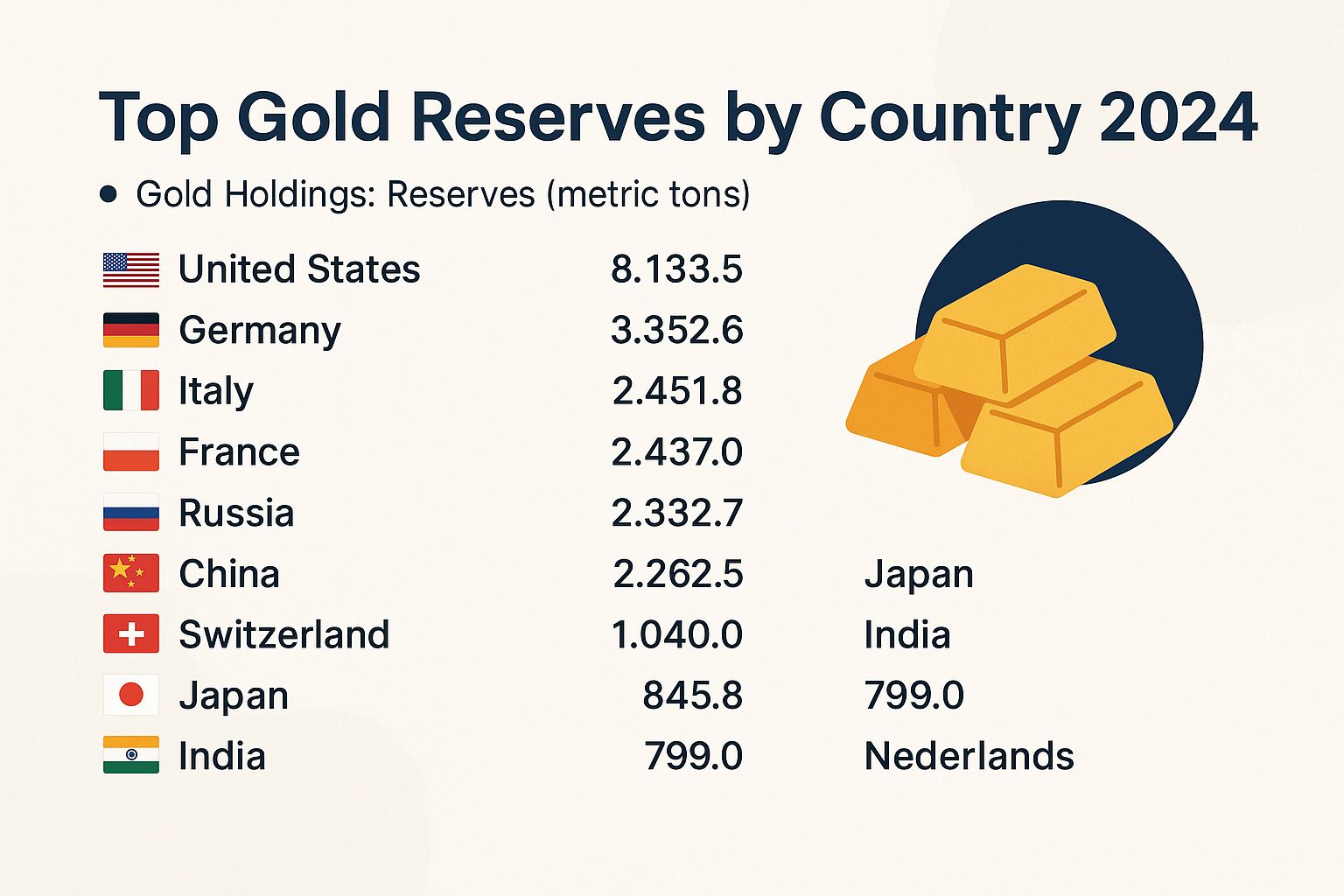
Gold reserves back up a country’s money system. Check out the top holders in 2024 – their massive stashes could shake up global finance!
Gold Reserves in Metric Tons (Explained: A Metric Ton is 1,000 Kilograms of Pure Gold)
Quick Summary of Top Reserves
- United States: 8,133 metric tons – the undisputed leader!
- Germany: 3,352 metric tons – Europe’s gold powerhouse.
- Italy: 2,452 metric tons – holding strong in the rankings.
Don’t miss out – gold trends are heating up fast!
(function() { setTimeout(function() { var bars = document.querySelectorAll(‘[class*=”animated-bar-dr3gh8gq”]’); bars.forEach(function(bar) { var width = bar.getAttribute(‘data-width’); if (width) { bar.style.width = width + ‘%’; } }); }, 100); })();
Top Gold Reserves by Country 2024
This data shows the leading nations in gold holdings. It highlights a key sign of economic stability and financial independence.
Gold acts as a shield against rising prices, changing currencies, and global risks. Central banks use it to back their money and keep investors trusting.
We focus on the top three countries here. Their huge stockpiles in metric tons show years of building and smart money plans.
United States leads with a stunning 8,133 metric tons of gold. It’s mostly kept at Fort Knox and the Federal Reserve Bank of New York.
This huge stash equals about 25% of global official gold. It highlights America’s lead in world finance since the Bretton Woods pact (a key post-World War II deal).
The U.S. keeps these amounts steady. They see gold as a base to support the dollar’s role as the main world currency, even after Nixon’s 1971 move ended gold-for-dollar swaps.
During tough times like the 2008 crash, COVID-19, or high inflation now, this gold acts as a safety net. It lets the Federal Reserve guide markets without using up other funds.
- Germany sits second with 3,355 metric tons. It’s Europe’s biggest gold owner.
- Germany brought much of this gold back home lately. This boosts security and openness.
- Exports and smart spending built these reserves, which steady the eurozone, fight debt crisis risks, and make up 70% of Germany’s total reserves.
- Italy comes third with 2,452 metric tons. This helps its bank amid high debt troubles.
- Italy gathered this gold in its post-war growth spurt. It guards against money instability.
- Some talk of selling to cut debt. But leaders keep it to strengthen the euro and draw investors.
These three nations hold over one-third of the world’s official gold. Big economies clearly value precious metals in their plans.
2024 data shows a move to mix up holdings. Countries avoid leaning too much on paper money like the dollar or euro.
- Places like China, India, and Russia buy more gold fast.
- This trend excites investors eyeing gold ETFs. Or even Bitcoin as another option.
Gold stays a top safe spot. It affects bond rates and commodity costs.
Grasp these reserves to see global power shifts. They highlight changes in how nations handle money stores.
Gold matters big time in today’s money world. The U.S., Germany, and Italy lead with smart, huge reserves.
These inspire ways to add gold to retirement accounts like IRAs. Act now to protect your future!
Charts show the gaps clearly. They spark talks on enough reserves and gold’s future role.