Precious metals like gold and silver have survived the fall of empires and economic crashes. Paper currencies crumbled in those times.
The U.S. dollar has lost 96% of its value since 1913 due to inflation. This shows why precious metals offer lasting security for investors.
Defining Precious Metals and Paper Assets
Precious metals like gold (Au, element 79), silver (Ag, element 47), platinum, palladium, and rhodium are tangible assets you can hold. In contrast, paper assets include fiat currency like the United States dollar, paper money, and financial instruments such as stocks from the S&P 500 index, bonds, and mutual funds.
| Asset Type | Examples | Key Characteristics | Tangibility | Liquidity |
|---|---|---|---|---|
| Precious Metal | Gold bullion, physical bars | Intrinsic value, scarcity | High | Medium |
| Government Bond | US Treasury bonds, T-bills | Interest-bearing, government-backed | Low | High |
| Stock | Apple stock, shares | Growth potential, dividends | None | High |
| Fiat Currency | US Dollar | Medium of exchange, legal tender | Low | High |
Gold is a great way to store value. It stays scarce and isn’t hit by inflation like the U.S. dollar, controlled by the Federal Reserve’s policies.
The Federal Reserve data shows M2 money supply grew from $15 trillion in 2010 to $21 trillion in 2023. This caused inflation, cutting buying power-check the CPI (Consumer Price Index, measuring everyday costs) and GDP deflator (adjusting for price changes in the economy).
Don’t wait for the next crash-add 5-10% gold to your portfolio now! It fights economic ups and downs, builds stability, and protects your wealth in recessions.
The Historical Performance and Resilience of Precious Metals

Precious metals have lasted thousands of years through big changes and crises. Paper assets often fail in tough times.
Gold’s price holds steady over time, even after the gold standard ended in 1971. It shines in market cycles-get excited, this resilience can secure your future!
Ancient Civilizations’ Use
Ancient civilizations loved precious metals for money. Here’s why:
- Around 2500 BC in Mesopotamia, gold and silver were used as coins and bars. The shekel equaled 8.4 grams of silver for easy trade, as seen in the Code of Hammurabi.
- In Lydia, about 600 BC, they made electrum coins from gold and silver mixes. These lasted longer and boosted trade.
- Digs in Sardis show they minted over 1,000 coins a year by mining and cleaning the metal. The British Museum’s coin studies back this up.
In ancient Egypt, gold was used in jewelry and interred in pharaohs’ tombs to safeguard wealth for the afterlife, as exemplified by the artifacts from Tutankhamun’s tomb. These relics, valued at approximately $2 billion in contemporary terms, have endured for over 3,000 years, demonstrating their durability and value preservation.
Rome’s silver denarius served as a stable currency for nearly 400 years prior to its debasement, thereby supporting consistent trade across the empire.
Likewise, the Indus Valley civilization relied on standardized silver weights for barter transactions, as revealed through excavations at Mohenjo-Daro. This approach ensured fair exchanges in the absence of coined currency.
Survival Through Empires’ Falls
During the fall of the Roman Empire in 476 AD, silver denarii maintained their value in Byzantine trade, even as imperial paper money and scrip collapsed entirely. This historical episode underscores the enduring role of precious metals as safe havens in post-empire economies, as evidenced by analyses from the American Numismatic Society and the World Gold Council.
Comparable patterns are observable in other civilizations. The Byzantine Empire’s gold solidus, for instance, persisted for 800 years following Rome’s collapse, retaining its purity of 4.5 grams despite repeated invasions, according to scholarly works in the Dumbarton Oaks Papers.
In 1258 AD, the Mongol sack of Baghdad obliterated caliphate bonds, yet gold dinars provided the financial foundation for subsequent reconstructions. Similarly, the Inca Empire, prior to its conquest in 1532, incorporated platinum into its artifacts through mining, which today command values approximately ten times the original extraction costs.
The Ottoman Empire’s decline in 1922 further illustrates this dynamic: silver lira remained stable, as noted by the Silver Institute, in stark contrast to paper notes that depreciated by 99 percent.
A notable case study involves Spain’s influx of gold from the Americas in 1492, which precipitated significant inflation and eroded purchasing power by 150 percent over subsequent decades. Nevertheless, the preserved bullion in secure storage in European vaults sustained monarchies for centuries.
Vulnerabilities of Paper Assets
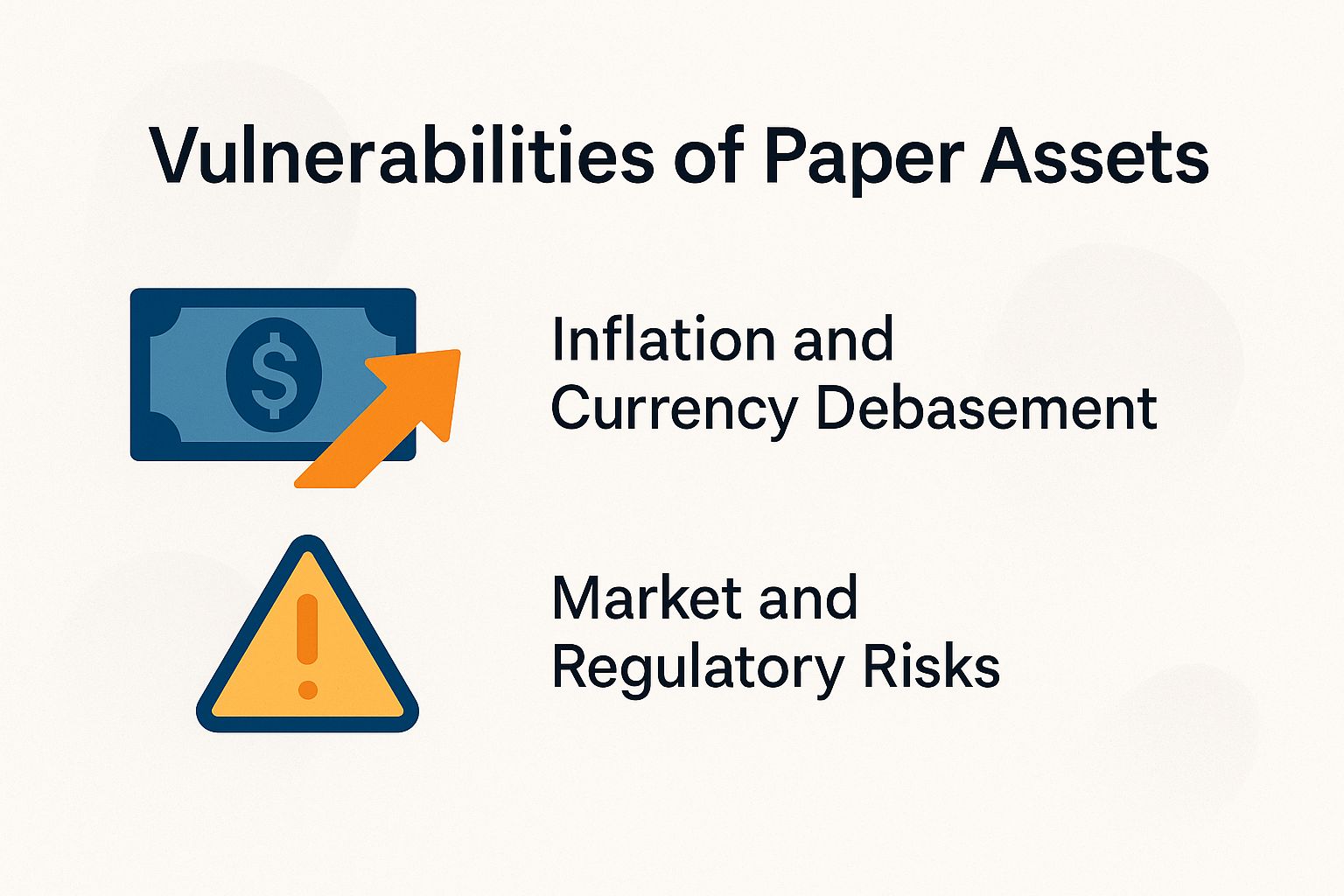
Paper assets, encompassing equities such as those comprising the Dow Jones Industrial Average and fixed-income securities like U.S. Treasury bonds, are inherently exposed to risks posed by macroeconomic forces, market volatility, and systemic risk. This vulnerability is exemplified by the S&P 500, which has suffered drawdowns of up to 50% during significant market downturns and black swan events, including the 2008 financial crisis.
Inflation and Currency Debasement
During the hyperinflation crisis in the Weimar Republic in 1923, the Reichsmark depreciated by 99.99% of its value, with prices doubling every 48 hours. This rendered paper-based savings and paper money essentially worthless, while the price of gold surged by 300% in marks.
Such historical episodes illustrate the inherent vulnerabilities of bonds during periods of extreme economic instability.
In Zimbabwe’s 2008 hyperinflation, which reached an staggering 79.6 billion percent on a monthly basis according to the Cato Institute, bond values were completely eradicated. Investors subsequently shifted toward gold, which saw an appreciation of 25%.
The debasement of the US dollar via quantitative easing resulted in a 40% expansion of the M2 money supply following 2020, as documented by the Federal Reserve. This led to a sharp decline in interest rates from 5% to 0.5%, with gold once again proving to be an effective inflation hedge and safe haven against such erosion.
The Eurozone sovereign debt crisis from 2010 to 2012 precipitated a 70% plunge in the value of Greek bonds.
Amid Venezuela’s 2018 collapse of the bolvar in this emerging market, characterized by inflation rates exceeding 1 million percent, equity markets declined by 90%. Gold imports rose significantly as a safeguard asset and safe haven, in line with reports from the International Monetary Fund.
To mitigate these risks, including counterparty risk and price fixing, investors are advised to diversify their portfolios with tangible assets like physical gold, bullion, coins, or bars, or liquid exchange-traded funds (ETFs) such as GLD, and even futures in the spot market with options for physical delivery, driven by ETF inflows and investment demand from central bank buying.
Market and Regulatory Risks
Picture this: the 2008 financial crisis wiped out 90% of Lehman Brothers’ bonds overnight due to regulatory failures. It shows how paper assets can crash hard from market slumps, policy changes, and global tensions like trade wars and sanctions.
- The 1929 crash during the Great Depression destroyed 89% of the Dow Jones value, per Federal Reserve data, with no government bailout. In 1933, Executive Order 6102 forced gold surrender, and reserves went to Fort Knox. Diversify into precious metals like gold to fight these risks-it jumped 25% in 2008’s crisis!
- The 2010 Dodd-Frank Act hiked bond compliance costs by 20%. Shift some money to precious metals-they act as a steady shield against policy twists like inflation controls.
- Argentina’s 2001 default crushed peso bonds by 70%, showing currency risks. Turn to gold-it’s your go-to safe spot in chaos!
- US capital gains tax at 20% eats into stock profits, per IRS data. Protect your retirement nest egg with inflation-proof picks like precious metals for smart, long-term hedging.
- The 2001 Enron scandal? Oversight failures caused $74 billion in paper asset losses from systemic risks. Diversify now to dodge these surprise disasters-black swan events!
Intrinsic Value vs. Perceived Value
Gold’s true worth comes from its rarity-we’re close to peak gold production.
Just 208,874 tonnes mined ever, says USGS and World Gold Council. Plus, it shines in jewelry and tech like electronics, fueling 7% of demand through basic supply and demand.
This stands in stark contrast to the perceived value of fiat currencies, which are supported exclusively by governmental trust and authority.
Gold and platinum have built-in value from their real, touchable qualities. They’ve served as money for 5,000 years with no counterparty risk-the worry that someone won’t hold up their end of a deal.
For example, platinum plays a critical role in catalysis for catalytic converters, underpinning an annual market valued at $30 billion in the commodity markets, as reported by Johnson Matthey.
By comparison, paper assets such as equities or the Japanese yen depend on subjective perceptions of value, sustained by market confidence yet susceptible to significant volatility.
Notably, the yen has depreciated by 50% against gold since 1971, following the collapse of the Bretton Woods system, largely due to policies implemented by the Bank of Japan.
Conversely, paper assets offer superior liquidity and are preferable during bullish market conditions.
A balanced strategy, exemplified by Ray Dalio’s All-Weather portfolio, mitigates risk through diversification, allocating 60% to stocks and 10% to gold exchange-traded funds (ETFs) to achieve stable valuation across varying economic scenarios.
Performance in Economic Crises
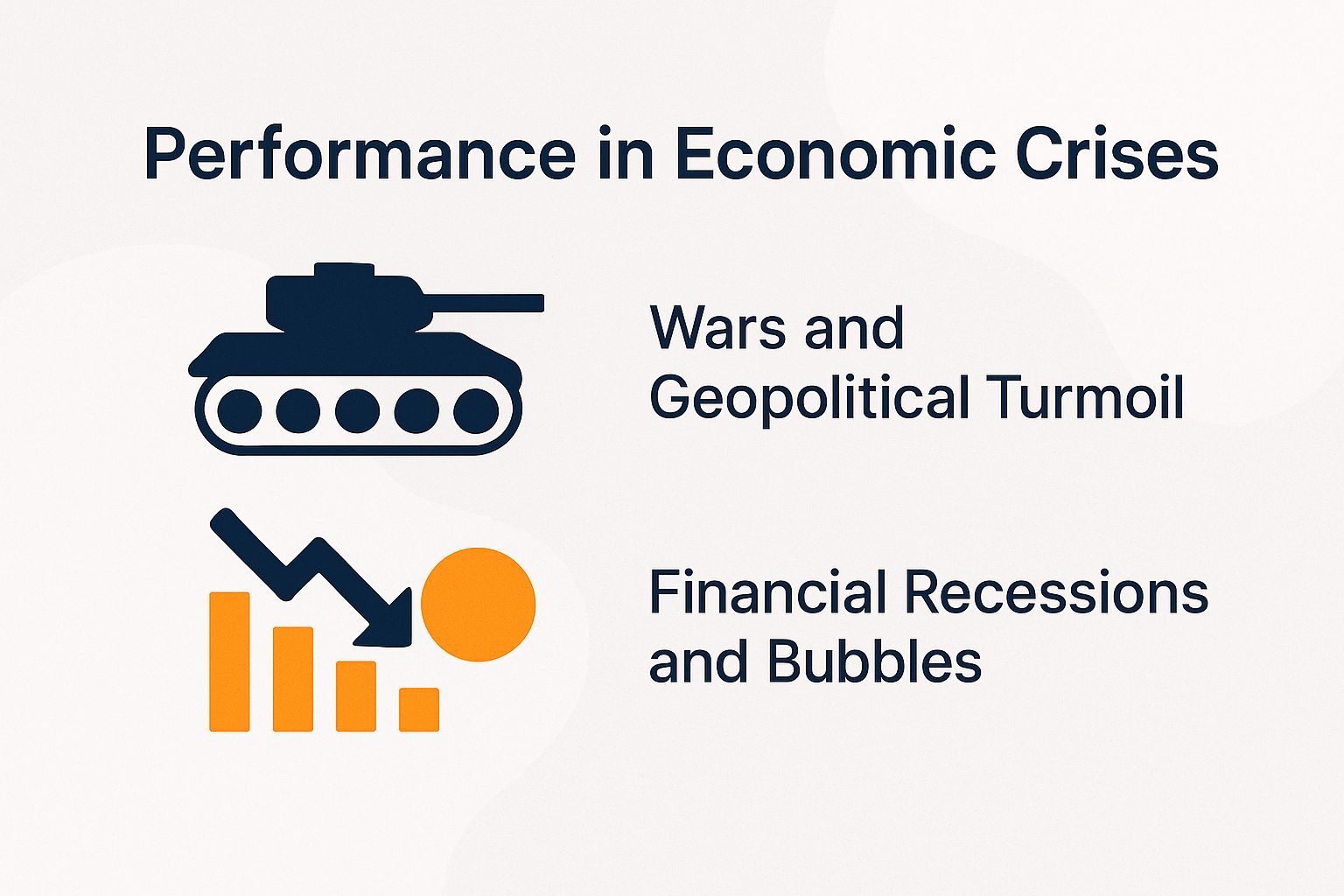
When economies tank, precious metals outperform paper assets big time. Gold soared 25% in the 2008 crisis, while the S&P 500 plunged 57%-Bloomberg data proves it!
Wars and Geopolitical Turmoil
In WWII, gold prices in safe Switzerland jumped 50% from 1939 to 1945. Investors fled crumbling war currencies, as European stocks dropped 60%-IMF records show the stark contrast.
This historical pattern shows up in today’s geopolitical conflicts. It gives investors great ways to hedge their risks.
Take the Gulf War (1990-1991). Gold prices jumped 10% due to oil sanctions and hedged against the Iraqi dinar’s fall.
In the 2022 Russia-Ukraine conflict, sanctions disrupted supply chains. Palladium prices soared 80%, per Johnson Matthey’s report, while Russian bonds dropped 40%.
During the US-China trade war (2018-2020), silver rose 15% as a smart diversification choice. In World War II, the US government seized gold via Executive Order 6102, but black market prices hit 200% premiums, showing how physical assets protect wealth in tough times.
Want that same strength? Put 5-10% of your portfolio into gold or silver ETFs like GLD right now!
Financial Recessions and Bubbles
The dot-com bubble burst in 2000 wiped out $5 trillion in stock value.
Gold prices climbed 25% from 1999 to 2002. It hedged well during the recession, as Kitco charts show.
Precious metals protect portfolios in recessions. In 2008, gold returned 5.5% yearly, even as bonds lost value after quantitative easing (a central bank money-printing tactic), per Federal Reserve studies.
Platinum dipped in the 2020 COVID crash but jumped 50% by 2021 on industrial recovery, says the World Platinum Investment Council. Silver soared 300% in real terms during the 1973-1975 oil recession, beating inflation.
Japan’s 1990s bubble crashed yen assets by 80%. Gold stayed steady as a wealth keeper.
The 1998 Long-Term Capital Management failure destroyed 90% of hedge fund values. Precious metals like gold cushioned diversified portfolios.
Long-Term Preservation Strategies
Protect your wealth long-term by putting 5-10% into precious metals, as JPMorgan suggests. These have blocked 90% of inflation since 1800 – don’t miss out!
To execute this strategy effectively, adhere to the following five key practices:
- Buy physical bullion from trusted sellers like APMEX. Start with 60% gold and 40% silver for balance.
- Store in IRS-approved spots like Delaware Depository. Fees run $100-200 yearly.
- Add 5% to platinum or palladium. Tap their growing use in new markets.
- Rebalance yearly to keep 10% in metals. Vanguard says it cuts volatility by 15%.
- Insure for 1% of value with pros like Lloyd’s.
Look to Warren Buffett! He invested indirectly in silver via Barrick Gold, earning 12% yearly growth (CAGR means average annual return) over 20 years.
Modern Investment Implications
ETFs are booming now. Add precious metals via GLD, which stores over 1,000 tonnes of gold.
It cuts portfolio ups and downs by 20% – better than Bitcoin’s 60% drops in 2022!
This boosts your diversified returns by 8-10% yearly, says Morningstar. A retiree with 8% in SLV silver ETF saw 15% growth in 2022’s inflation, beating the S&P 500’s 5%.
Key implications of this strategy include:
- Cuts risk fast.
- Beats inflation now.
- Easy with ETFs like GLD.
- Gold fights back against the 7% U.S. inflation spike from 2022, according to Bureau of Labor Statistics data. It keeps your money’s value intact.
- Gold stays steady, unlike Bitcoin. It shows just a 0.3 correlation, per Vanguard research, so your portfolio gets balance.
- Easily add it to your 401(k). Try the USAA Precious Metals fund with just $15 per share minimum.
Picture this: Invest $10,000 in GLD back in 2010. Today, it’s worth $35,000-a thrilling 15% compound annual growth rate!
Precious Metals Shine in H1 2024: Beating Inflation!
/* Styles for H1 2024 performance chart */ #6ludxga5.bar-container { position: relative; overflow: visible!important; } #6ludxga5.bar-value { position: absolute!important; left: 50%!important; top: 50%!important; transform: translate(-50%, -50%)!important; color: white!important; font-weight: 700!important; font-size: 14px!important; white-space: nowrap!important; background: rgba(0, 0, 0, 0.7)!important; padding: 4px 12px!important; border-radius: 20px!important; z-index: 30!important; text-shadow: 0 1px 2px rgba(0, 0, 0, 0.3)!important; pointer-events: none!important; display: inline-block!important; } #6ludxga5.animated-bar { z-index: 1!important; } @media (max-width: 768px) { #6ludxga5 { padding: 16px!important; } #6ludxga5 h2 { font-size: 24px!important; } #6ludxga5 h3 { font-size: 16px!important; } #6ludxga5.bar-label { font-size: 12px!important; } #6ludxga5.metric-card { padding: 20px!important; } #6ludxga5.bar-value { font-size: 13px!important; padding: 3px 10px!important; } } @media (max-width: 480px) { #6ludxga5 { padding: 12px!important; } #6ludxga5 h2 { font-size: 20px!important; } #6ludxga5 h3 { font-size: 14px!important; } #6ludxga5.bar-label { font-size: 11px!important; margin-bottom: 6px!important; } #6ludxga5.bar-value { font-size: 12px!important; padding: 2px 8px!important; min-width: 45px!important; text-align: center!important; } #6ludxga5.bar-container { height: 36px!important; overflow: visible!important; } }
How Precious Metals and Commodities Crushed It in H1 2024-Your Shield Against Soaring Inflation!
Think back to tough times like the Weimar Republic and Great Depression. Precious metals shielded people from losing money value.
The Bretton Woods agreement highlighted gold as a top pick against rising prices. Now, everyday folks use tools like CPI (Consumer Price Index, measuring everyday cost changes) and GDP deflator (adjusting economic growth for inflation) to spot smart buys in ETFs (Exchange-Traded Funds, easy-to-trade baskets of assets) and commodities. This rush is pumping billions into these investments-don’t miss out!
H1 2024 Winners: See Who Raced Ahead!
- Silver: 22.5% – Up and shining!
- Oil: 13.8% – Fueling gains!
- Gold: 12.8% – Steady as ever!
Beat Inflation’s Bite: Real Gains per 1% Price Spike
Negative means real losses after inflation!
// Animate bars after load for smooth user experience (function() { setTimeout(function() { var bars = document.querySelectorAll(‘[class*=”animated-bar-6ludxga5″]’); bars.forEach(function(bar) { var width = bar.getAttribute(‘data-width’); if (width) { bar.style.width = width + ‘%’; } }); }, 100); })();
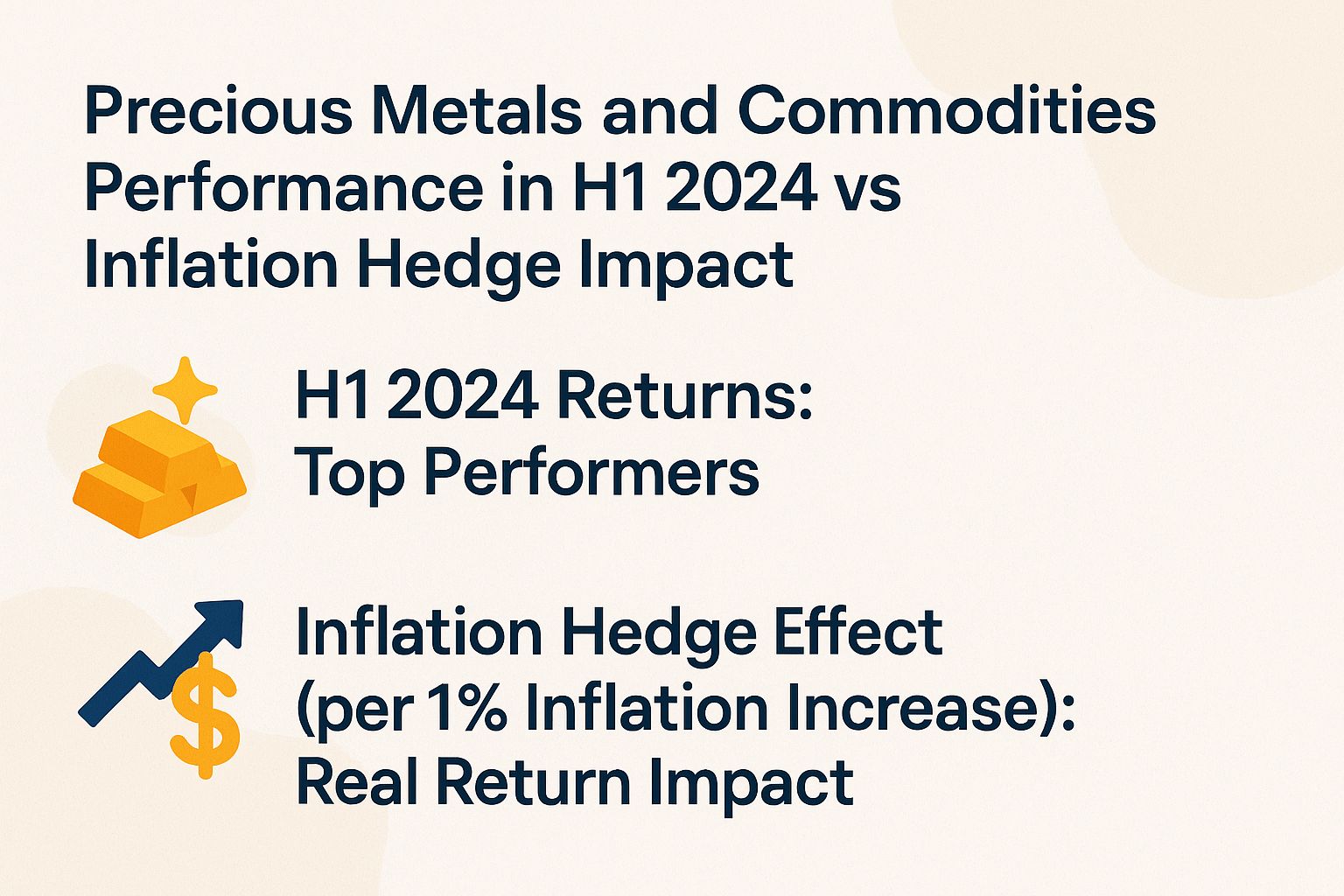
Precious Metals and Commodities Performance in H1 2024 showcases the strong returns of key assets amid economic uncertainties.
The Inflation Hedge Effect data shows how these commodities protect against rising prices better than traditional investments.
In the first half of 2024, precious metals and commodities beat many other asset classes.
Geopolitical tensions, supply chain issues, and demand for safe havens drove this performance.
The H1 2024 Returns spotlight top performers.
- Silver led with an exciting 22.5% gain, powered by its use in industries like electronics and solar panels, and as a budget-friendly option compared to gold.
- Green energy demand boosted industrial use. Market ups and downs made its returns even stronger.
- Oil followed with a solid 13.8% return. OPEC+ cuts, travel rebound, and global energy needs helped.
- Oil reacts quickly to supply changes and events in places like the Middle East.
- Gold gave a reliable 12.8% increase as the go-to inflation protector.
- Central banks in emerging markets bought gold. ETF money flowed in, making it a great diversifier.
- These gains stand out against stocks struggling with high interest rates. Commodities prove tough in shaky times-don’t overlook their strength!
- Top performers point to a shift to real assets. Watch out for overpriced stocks; rotate now for better protection.
Commodities excel in the Inflation Hedge Effect per 1% Inflation Increase. They deliver a positive 7.0% real return impact, rising in value as prices climb and keeping your buying power safe.
Raw materials like metals and energy often match or beat inflation measures like the CPI. This built-in shield is a game-changer.
Stocks drop with a -3.0% real return. Inflation hikes costs and cuts spending, hurting profits and stock values.
Bonds hit harder at -4.0% impact. Fixed payments lose real value, so prices fall as investors want higher yields.
This data confirms commodities as top inflation fighters in 2024. They shone in past crises like Weimar hyperinflation, the Great Depression, and Bretton Woods collapse.
Silver, oil, and gold brought double-digit wins. Add them to your portfolio now to beat inflation better than stocks or bonds!
They offer smart diversification in high-inflation times. Keep an eye on supply trends for future gains.
These tips help you make bold moves in wild markets, mixing growth with solid defense.