In an era of volatile currencies and geopolitical risk, central banks hold trillions in reserves. Gold remains their unwavering anchor as a store of value. This trust comes from centuries of history, from the gold standard’s stability to adaptations in fiat systems. Gold hedges against inflation with its scarcity and durability. It offers diversification as a non-correlated asset-meaning it doesn’t move with stocks or bonds. Institutions like the IMF and Federal Reserve buy gold as a safe haven. Discover why it beats other assets in uncertain times!
Historical Role of Gold in Global Finance
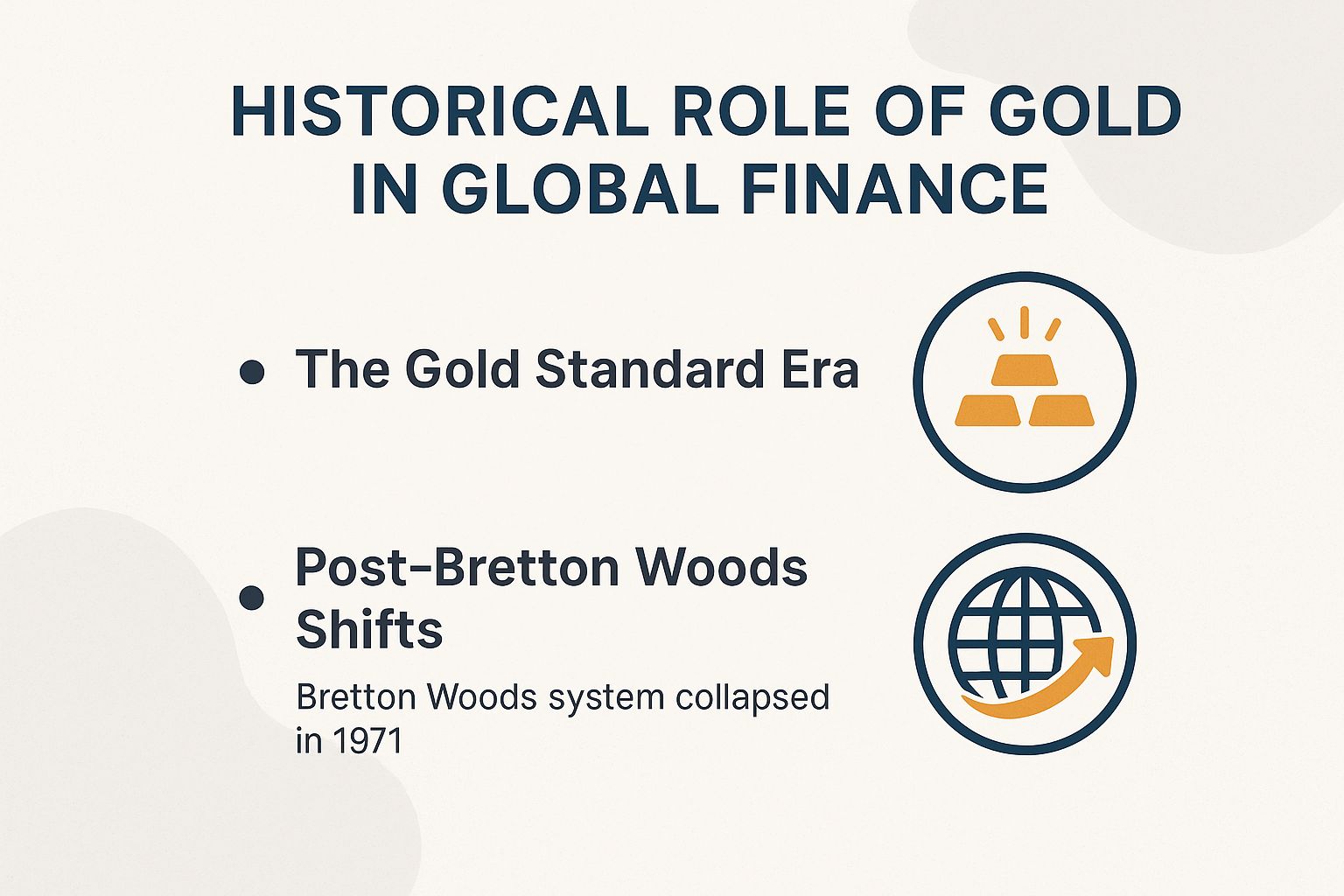
Gold has shaped global finance for over 5,000 years.
Ancient Egyptian pharaohs used it as currency. It stabilized international trade in the 19th century under the gold standard. Imagine the timeless appeal!
The Gold Standard Era
The classical gold standard ran from 1870 to 1914.
It fixed currencies to gold at $20.67 per ounce. This setup boosted trade in over 50 countries. Check out Barry Eichengreen’s *Golden Fetters* (1992) for a deep dive. This is why gold endures!
The gold standard evolved in four key phases.
- 1870s Origins: Nations like Germany and the US adopted gold after the Franco-Prussian War. This stabilized economies from bimetallism chaos-where both gold and silver were used. Imagine the stability!
- Pre-WWI Peak: UK’s reserves hit 1,000 tonnes in 1914. Inflation stayed low at 0.5%, fueling global trade.
- Interwar Collapse (1920s-1930s): War debts and speculation ended it. The UK ditched it in 1931 amid deflation, like the 1890s US price drop of 20%.
- WWII End: By 1944, it fully collapsed, leading to the Bretton Woods fiat system. This shift was monumental!
Post-Bretton Woods Shifts
The 1944 Bretton Woods Agreement tied currencies to the US dollar.
The dollar was fixed at $35 per ounce of gold. In 1971, President Nixon ended dollar-to-gold swaps. This shift to pure fiat money sent gold prices soaring from $35 to $850 by 1980. What a dramatic rise!
Bretton Woods unfolded in critical phases that changed everything.
- 1940s-1960s Setup: Fixed exchange rates under the IMF stabilized post-WWII trade. But US deficits from the Vietnam War eroded trust in the dollar-fast.
- 1971 Nixon Shock: Nixon’s TV announcement closed the gold window ‘temporarily.’ It killed Bretton Woods overnight. The tension was electric!
- 1970s Volatility: Oil shocks and inflation exploded. Gold prices jumped 2,300%, per World Gold Council data-don’t miss this lesson!
- Friedman’s Warning: In *Capitalism and Freedom* (1962), he warned fiat money could lead to endless money printing and chaos. This foresight is gold!
Gold as an Inflation Hedge
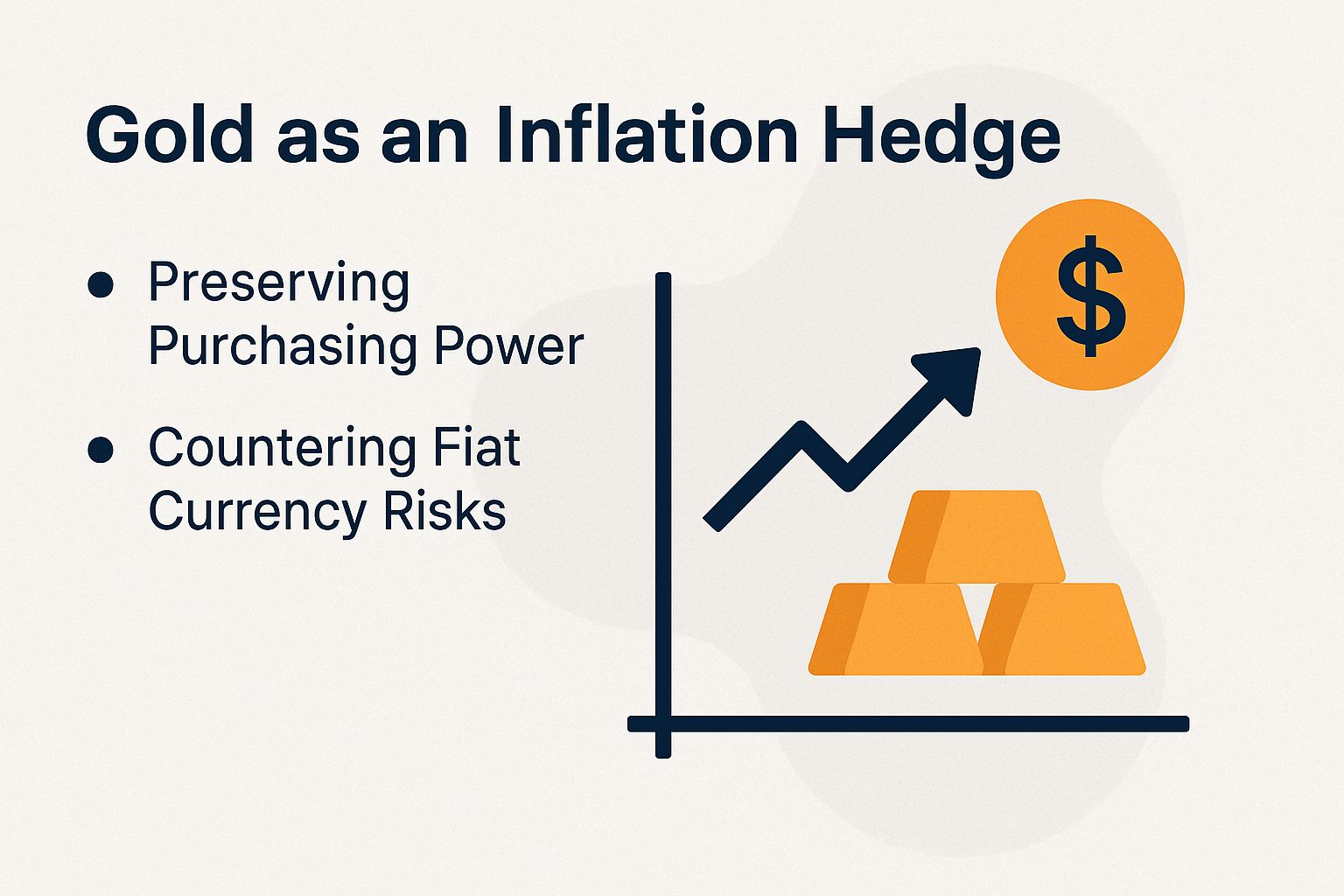
A 2022 JPMorgan study shows gold beat inflation by 4.5% each year over 50 years. It acts as a shield for your wealth in tough times like recessions.
Take the 1970s U.S. stagflation-prices jumped 13.5% yearly with wild swings. Gold proved its worth as portfolio insurance.
Preserving Purchasing Power
From 1979 to 1980, inflation soared. Gold skyrocketed 400%, while the CPI-a measure of price changes-hit 14.6%. Gold turned heads with that massive gain!
This kept gold’s buying power strong. Today, one ounce buys about 1.5 barrels of oil, up from 0.8 in 1980, per U.S. Bureau of Labor Statistics data.
This shows gold’s power as an inflation hedge. Between 1971 and 2023, it delivered 7% yearly real returns, edging out stocks’ 6%, according to Vanguard.
Want to check gold’s real value over time? Use this simple formula: Adjusted Price = Nominal Price x (Current CPI / Base Year CPI). Grab CPI data from the Bureau of Labor Statistics site for spot-on results-it’s easy and free!
In 1923, Germany’s Weimar Republic faced hyperinflation as the mark crashed. Gold held its true value, per a 2013 Bank for International Settlements paper. It stays steady, free from fiat money’s pitfalls like endless printing.
Protect your portfolio by putting 5-10% into physical gold or ETFs like GLD. This fits modern strategies, balancing risks with gold’s low correlation to other assets-think Sharpe ratio for returns vs. risk, and its steady beta.
Countering Fiat Currency Risks
Zimbabwe’s 2008 hyperinflation hit a mind-blowing 89.7 sextillion percent! Gold holders kept their wealth safe as the dollar vanished, says the Cato Institute.
These fiat risks still lurk today. In Venezuela’s 2018 meltdown, inflation exploded to 1,000,000%-gold climbed 25% as the bolivar tanked!
Too much money printing hurts currencies. After COVID, U.S. M2 money supply-which tracks broad money like cash and savings-jumped 40%, sending gold prices up 50% from 2020 to 2022.
Debt defaults shake faith in money. Argentina’s 2001 crisis slashed 75% of debts and crashed the peso-gold would have been your savior!
Act now-follow Ray Dalio’s All Weather strategy by adding 5-10% gold via GLD ETFs or bullion to fight these risks.
The IMF’s 2023 report warns of growing dangers: huge debts, loose fiscal policies, money printing (quantitative easing), rising bond yields, and worldwide chaos.
Gold shines here as a diversifier, real asset, and wealth preserver. It cuts systemic risks and banking moral hazards-like ‘too big to fail’ bailouts.
Intrinsic Properties Making Gold Unique

Gold’s atomic number 79 and Au symbol give it standout traits. It’s chemically inert, so it doesn’t rust or react easily.
One ounce lasts forever thanks to top malleability, conductivity, and corrosion resistance-unlike fleeting assets.
- Malleability: Shapes easily without breaking.
- Conductivity: Carries electricity and heat superbly.
- Corrosion resistance: Stays shiny forever.
Smithsonian studies of 1500s Inca gold artifacts prove it. This timeless quality boosts its true value for trading or holding.
Scarcity and Finite Supply
Gold is rare and won’t run out like printed money. Only about 200,000 tons exist above ground. New mining adds just 1-2% yearly-act fast before prices surge!
- Total gold ever mined: ~200,000 tons.
- Annual supply growth: Mere 1-2%.
- Why it matters: Keeps value high amid demand.
Miners have extracted just 212,582 tonnes of gold worldwide. Annual production averages 3,000 tonnes, or about 1% of total above-ground stocks, per World Gold Council data (2023).
This low output highlights gold’s true scarcity. Unlike fiat money, which governments can print endlessly, gold faces supply chain disruptions and shocks, much like silver and platinum.
Demand makes gold even scarcer. About 70% goes to jewelry and industry, while 30% fuels investments like ETFs (funds traded on stock exchanges) and physical bars.
Above-ground gold stocks total about 210,000 tonnes. This dwarfs yearly mining of 2,500 to 3,500 tonnes, per USGS (2022), limiting quick supply increases when demand spikes.
Peak gold theory suggests mining will hit its max by mid-century. Easier reserves are running out, which could spark serious shortages, based on the 2004 update to Limits to Growth by Meadows et al. This theory warns that as high-quality deposits deplete, production peaks, leading to tighter supplies and higher prices in the future.
Central banks bought a net 1,136 tonnes of gold in 2022, the most since 1967, according to the World Gold Council.
They use gold to diversify holdings and protect against fiat money losing value. This shows strong trust in gold’s power to hold value over time.
Durability and Portability
Gold doesn’t corrode, so 90% of all mined gold is still around. This keeps it highly liquid.
A 1-kilogram bar, worth $65,000 in 2023, fits easily for travel. People smuggled gold across borders during World War II to save assets in crises.
Gold resists oxidation, unlike silver that tarnishes over time. That’s why gold holds its value for centuries.
Gold divides easily. You can use tiny milligrams in electronics or ship tonnes to banks, giving investors tons of options.
Gold is super portable-a briefcase holds $1 million in bars. But $1 million in $100 bills means 10,000 bulky notes!
Banks love gold too. Under Basel III rules (international banking standards), it’s a top liquid asset that boosts portfolio stability.
Roman aurei coins lasted over 500 years in use. This proves gold’s qualities go way beyond just being rare-it’s built to last!
Gold’s Role in Portfolio Diversification
Adding 5-10% gold to portfolios cut volatility by 15% in the 2008 crisis. It boosted the Sharpe ratio (a measure of risk-adjusted returns) to 0.8, versus 0.4 for stocks alone, per a 2021 CFA Institute study.
Use Modern Portfolio Theory (Markowitz, 1952-a way to mix assets for best returns) to see gold’s benefits.
Over 20 years, gold correlates just 0.2 with the S&P 500, versus 0.6 for bonds, per Morningstar. This low link makes gold a great hedge.
- Gold: Correlation 0.2, Reduces volatility 15% in 2008
- Stocks: Correlation 1.0, Minimal reduction
- Bonds: Correlation 0.6, 10% reduction
In a classic 60% stocks/40% bonds mix, 5% gold has boosted returns by 2%, says Bridgewater Associates. Don’t miss this edge!
Picture a $100,000 portfolio with 5% in gold ($5,000). It shields against 20% drops, saving $20,000 more than all-stocks in crashes-check with tools like Vanguard’s analyzer.
Geopolitical Stability and Safe-Haven Status
Gold shines as a safe haven during geopolitical crises and economic turmoil, drawing investors seeking stability when other assets falter.
- In wars like World War II and the recent Russia-Ukraine conflict, gold’s portability allowed quick asset protection amid invasions and sanctions.
- During inflation spikes, such as the 1970s oil crisis, gold prices skyrocketed over 2,000% as currencies lost value, proving its hedge power.
- Even in modern tensions, like U.S.-China trade wars, gold rallies, urging investors to allocate now before the next shock hits.
This track record builds urgency: in an unpredictable world, gold’s safe-haven status is more vital than ever for wealth preservation.
During the 2022 Russia-Ukraine conflict, gold prices rose by 15% as investors turned to it as a safe-haven asset, while equities declined by 10%. This trend closely resembled the 25% surge in gold prices during the 2008 Global Financial Crisis, as evidenced by Bloomberg data on correlations during crises.
This safe-haven behavior is a consistent pattern observed across major geopolitical shocks. For example, gold prices increased by 25% during the 2003 Iraq War, by 24% amid the 2020 COVID-19 pandemic, and by 10% in response to the 2019 sanctions on Iran.
The World Bank’s Geopolitical Risk Index illustrates how such events-unlike those driven solely by inflationary pressures-often trigger swift capital flight toward gold, according to its 2023 analysis.
To implement effective portfolio protection, investors should consider allocating 2-5% of their assets to physical gold bars or coins, acquired through established dealers such as JM Bullion, to maintain liquidity for efficient sales. Russia’s reserves of 2,300 tonnes, as reported by the Central Bank, served as a stabilizing force for the ruble during the 2022 sanctions, mitigating economic volatility by 15% against fluctuations in foreign exchange markets.
Modern Trends in Central Bank Gold Holdings
In 2022, central banks recorded an unprecedented purchase of 1,082 tonnes of gold, primarily driven by emerging markets such as Turkey, which acquired 315 tonnes, and China, with an estimated addition exceeding 200 tonnes. This marked a significant reversal from the selling trends observed throughout the 2010s, as documented in surveys by the World Gold Council.
Emerging markets accounted for 80% of these acquisitions, surpassing the contributions from developed economies, according to data from the International Monetary Fund’s Currency Composition of Official Foreign Exchange Reserves (COFER). Notable examples include Poland, which added 130 tonnes to its reserves-resulting in a 20% increase-and India, which incorporated 50 tonnes for portfolio diversification purposes, as reported by the Reserve Bank of India.
This upsurge in demand can be attributed in part to the implementation of Basel III regulations, which classify gold with a 0% risk weight to bolster capital stability. The World Gold Council’s 2023 report forecasts sustained annual demand ranging from 500 to 700 tonnes and recommends that investors closely monitor geopolitical tensions and fluctuations in the U.S. dollar to inform effective hedging strategies.
Central banks may emulate this approach by allocating 5% to 10% of their reserves to gold, thereby enhancing resilience against inflationary pressures.
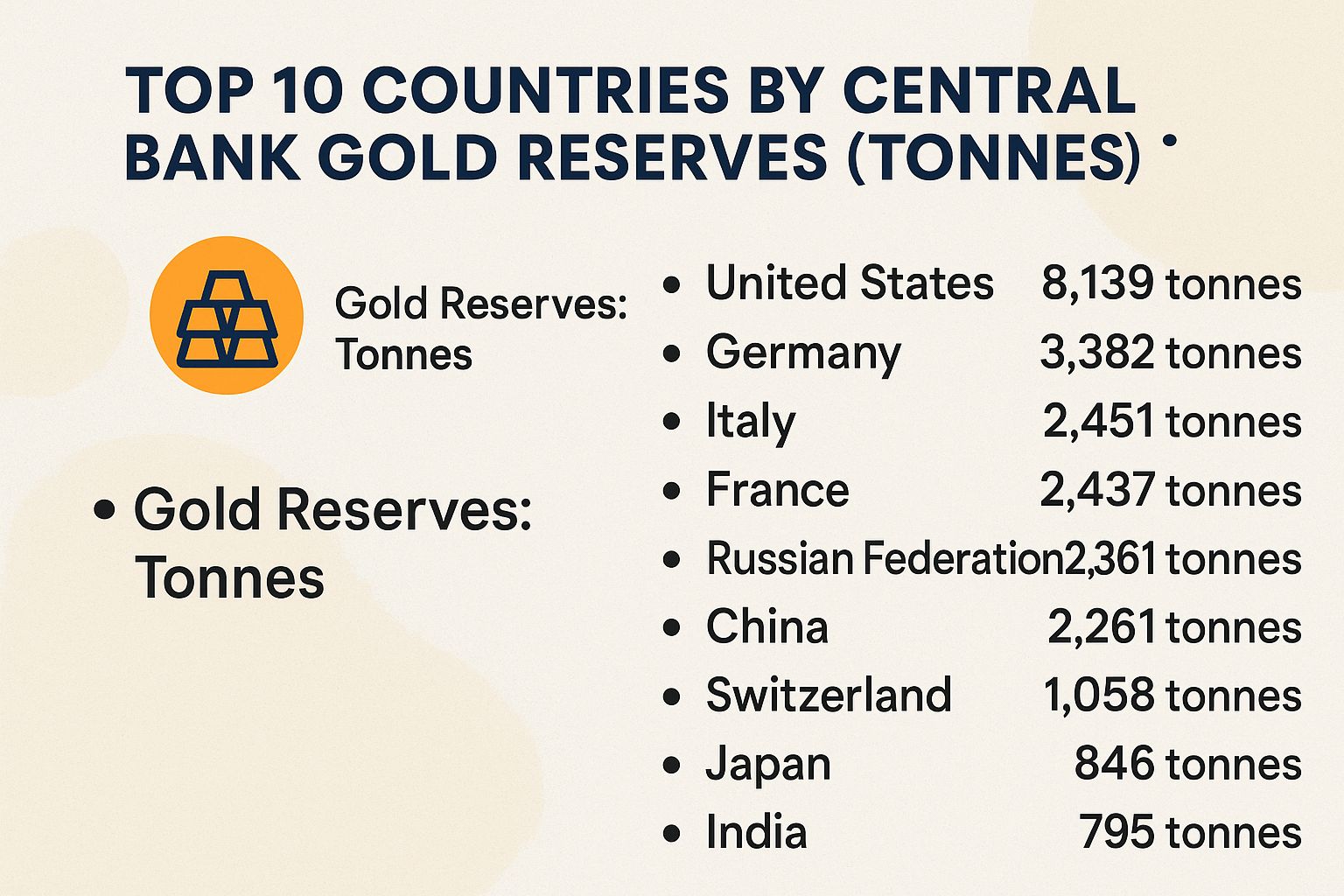
Top 10 Countries by Central Bank Gold Reserves (Tonnes) 2025
/* Main styles */ #dnr0g5az.bar-container { position: relative; overflow: visible!important; } #dnr0g5az.bar-value { position: absolute!important; left: 50%!important; top: 50%!important; transform: translate(-50%, -50%)!important; color: white; font-weight: 700; font-size: 14px; white-space: nowrap!important; background: rgba(0, 0, 0, 0.7)!important; padding: 4px 12px!important; border-radius: 20px!important; z-index: 30!important; text-shadow: 0 1px 2px rgba(0, 0, 0, 0.3)!important; pointer-events: none!important; display: inline-block!important; } #dnr0g5az.animated-bar { z-index: 1!important; } /* Tablet media query */ @media (max-width: 768px) { #dnr0g5az { padding: 16px!important; } #dnr0g5az h2 { font-size: 24px!important; } #dnr0g5az h3 { font-size: 16px!important; } #dnr0g5az.bar-label { font-size: 12px!important; } #dnr0g5az.metric-card { padding: 20px!important; } #dnr0g5az.bar-value { font-size: 13px!important; padding: 3px 10px!important; } } /* Mobile media query */ @media (max-width: 480px) { #dnr0g5az { padding: 12px!important; } #dnr0g5az h2 { font-size: 20px!important; } #dnr0g5az h3 { font-size: 14px!important; } #dnr0g5az.bar-label { font-size: 11px!important; margin-bottom: 6px!important; } #dnr0g5az.bar-value { font-size: 12px!important; padding: 2px 8px!important; min-width: 45px!important; text-align: center!important; } #dnr0g5az.bar-container { height: 36px!important; overflow: visible!important; } }
Top 10 Countries by Central Bank Gold Reserves (Tonnes) 2025
Gold Reserves: Tonnes
(function() { setTimeout(function() { var bars = document.querySelectorAll(‘[class*=”animated-bar-dnr0g5az”]’); bars.forEach(function(bar) { var width = bar.getAttribute(‘data-width’); if (width) { bar.style.width = width + ‘%’; } }); }, 100); })();
Top 10 Countries by Central Bank Gold Reserves (Tonnes) 2025
Discover the leading nations with massive gold stockpiles. They use gold to stay stable during tough times like wars or shaky money values.
Gold acts as a safe backup for countries. It helps fight rising prices and spreads risk away from paper money.
These gold piles, weighed in tonnes, boost a nation’s money strength and global sway.
Check out the USA leading with a whopping 8133.5 tonnes of gold. Most of it sits secure at Fort Knox, showing off America’s money muscle and why the dollar rules the world.
Germany comes right behind with 3351.6 tonnes. They built this up after World War II, sticking to safe, real-value gold over risky bets.
- Italy sits third at 2451.9 tonnes. This gold strengthens the euro area even during money troubles, acting as a shield against big debts.
- France holds 2437.0 tonnes. Leaders like de Gaulle piled it up to keep France independent and strong.
- Russia jumped to 2333.1 tonnes since 2014. They’re grabbing gold fast to fight sanctions and ditch the dollar-de-dollarization means cutting ties to U.S. money for more freedom.
- China has 2279.6 tonnes and keeps buying more. This pushes the yuan (their currency) onto the world stage, but real numbers might be higher since they don’t share everything.
- Switzerland owns 1039.9 tonnes. As a neutral banking hotspot, they love gold for keeping wealth safe over time.
- India boasts 876.2 tonnes. Their culture treasures gold, and it helps back the rupee during growth and import needs.
- Japan keeps 846.0 tonnes. It’s not huge for their big economy, but gold adds variety beyond just the yen.
- The Netherlands finishes strong with 612.5 tonnes. This backs the euro and shows smart money habits in their trade-heavy world.
These top 10 countries control over 70% of global official gold reserves, highlighting concentration among Western powerhouses and rising Eastern nations. Trends indicate Russia and China accelerating purchases while the U.S. and Germany maintain steady holdings, with 2025 projections suggesting shifts from surging demand amid inflation fears and mining constraints. These reserves buffer crises, impacting interest rates, currency values, and international trade, as investors monitor them for insights into financial system confidence and market volatility. Gold’s enduring role in modern economics bridges traditional wealth preservation with contemporary geopolitical strategies, continuing to shape worldwide monetary policies as reserves evolve.