
In uncertain times, gold acts as a safe investment to protect against rising prices. It has been a reliable choice for years.
Do you want to hold real gold or invest in a gold ETF? Pick the right one to strengthen your investments. This guide covers the good and bad sides, ease of selling, fees, taxes, and more. We use tips from experts like the World Gold Council to help you decide.
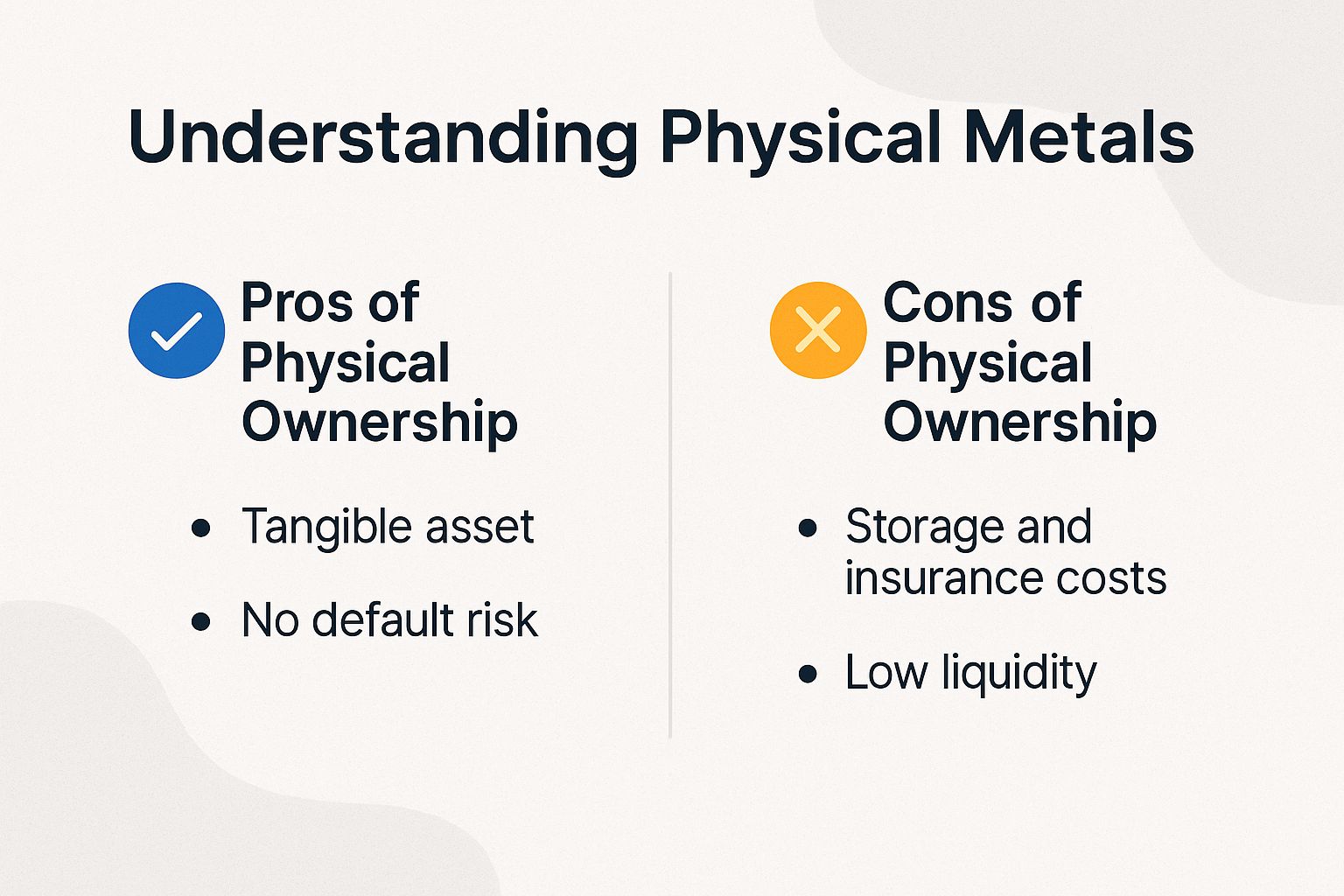
Understanding Physical Metals
Physical precious metals like gold bars and coins give you direct control over real assets.
Examples include the American Eagle or Canadian Maple Leaf coins.
You own them outright, no middlemen needed.
Pros of Physical Ownership
Owning physical gold bars or coins gives you real security you can touch. It cuts out risks from third parties dealing with your money. A 2022 Fidelity study shows 78% of owners felt safer when markets got shaky.
Gold’s price jumped 25% in 2020 during tough economic times, per Bloomberg. Picture this: A retiree put 10% into American Eagle coins in 2018 and saw 15% growth in five years-better than bonds!
Get ready to own gold that you can grab in a pinch! Key advantages of physical gold include:
- No risk from third parties: Assets can be stored in secure vaults, such as the Delaware Depository, for an annual fee of $150.
- Easy access in emergencies: Holdings can be liquidated promptly at the market price or current market price through reputable dealers like APMEX.
- Enhanced privacy: Purchases under $10,000 are not subject to IRS reporting requirements, although capital gains tax may apply on profits from sales.
- Collectible premium: Coins such as South African Krugerrands often command a 5% premium over the current market price.
New investors, think about mixing it up for the long haul. Start with 5% in physical gold and add ETFs for quick selling options (that’s liquidity).
Cons of Physical Ownership
Physical gold sounds great, but watch out for costs. Storage and insurance run 0.5% to 1% a year, per 2023 SmartAsset data.
These fees can eat into your gains, especially if you have less money to invest.
The principal challenges associated with physical gold ownership include the following:
- High storage costs: To mitigate costs, consider home safes priced under $500, such as models from SentrySafe, and secure insurance coverage through Lloyd’s for approximately $100 per year.
- Harder to sell quickly: The difference between buy and sell prices on coins can range from 2% to 5%; executing sales through platforms like APMEX enables efficient transactions with narrower spreads and dealer discounts.
- Theft vulnerabilities: The Federal Bureau of Investigation (FBI) reported a 15% increase in precious metal burglaries in 2022; Don’t let thieves steal your gold-use pro vaults now! utilizing professional vaults from providers such as Brinks ensures secure, insured storage.
- Transportation complexities: Take advantage of dealer delivery programs offered by entities like JM Bullion to eliminate associated shipping risks.
- Premiums on jewelry: Markups can exceed 50%; investors are advised to prioritize bullion bars for more cost-effective options.
Be careful and talk to a financial advisor. In 2022’s wild markets, one person lost 3% just to fees. Manage costs closely to avoid this!
Understanding Metal ETFs
Gold ETFs like SPDR Gold Shares (GLD) track gold prices via shares on stock exchanges.
You get the benefit from gold price changes (that’s exposure) without handling real metal or dealing with futures contracts (agreements to buy or sell at a future date). ETFs started in 2004 and make it simple.
Pros of ETF Investments
- Easy to buy and sell on stock apps.
- Low fees, around 0.4% yearly.
Gold ETFs offer easy trading all day long. The SPDR Gold Shares (GLD) sees about 10 million shares traded daily on the New York Stock Exchange.
You can quickly add gold to your portfolio. Best of all, you don’t need a lot of money to get started.
The iShares Gold Trust (IAU) keeps fees low at just 0.25%. This expense ratio helps you earn about 2% more each year than owning physical gold, according to Vanguard’s 2023 report.
Picture this: Put 5% of your retirement savings-like in an IRA or 401(k)-into GLD. In 2022, it delivered a thrilling 12% return, even with 8% inflation raging, per Morningstar data.
- Open a brokerage account with companies like Fidelity or Vanguard.
- Search for the gold ETF tickers, such as GLD or IAU.
- Buy shares with no commissions and start with just $100.
This includes investing in a Self-Directed IRA.
- Seamless accessibility through conventional brokerage platforms.
- Elimination of storage and insurance expenses, supported by professionally vaulted gold reserves.
- Enhanced tax efficiency when held within a self-directed IRA or Roth accounts.
- A 99% correlation to spot gold prices, as reported by Bloomberg data.
- Scalability suitable for diversified investment portfolios.
Gold ETF Inflows Q3 2025 by Region (US$ bn)
#akdufg6v.bar-container { position: relative; overflow: visible!important; } #akdufg6v.bar-value { position: absolute!important; left: 50%!important; top: 50%!important; transform: translate(-50%, -50%)!important; color: white!important; font-weight: 700!important; font-size: 14px!important; white-space: nowrap!important; background: rgba(0, 0, 0, 0.7)!important; padding: 4px 12px!important; border-radius: 20px!important; z-index: 30!important; text-shadow: 0 1px 2px rgba(0, 0, 0, 0.3)!important; pointer-events: none!important; display: inline-block!important; } #akdufg6v.animated-bar { z-index: 1!important; } @media (max-width: 768px) { #akdufg6v { padding: 16px!important; } #akdufg6v h2 { font-size: 24px!important; } #akdufg6v h3 { font-size: 16px!important; } #akdufg6v.bar-label { font-size: 12px!important; } #akdufg6v.metric-card { padding: 20px!important; } #akdufg6v.bar-value { font-size: 13px!important; padding: 3px 10px!important; } } @media (max-width: 480px) { #akdufg6v { padding: 12px!important; } #akdufg6v h2 { font-size: 20px!important; } #akdufg6v h3 { font-size: 14px!important; } #akdufg6v.bar-label { font-size: 11px!important; margin-bottom: 6px!important; } #akdufg6v.bar-value { font-size: 12px!important; padding: 2px 8px!important; min-width: 45px!important; text-align: center!important; } #akdufg6v.bar-container { height: 36px!important; overflow: visible!important; } }
Discover Surging Gold ETF Inflows in Q3 2025 by Region (US$ bn)
Q3 Net Inflows Breakdown by Region
Key Highlights:
- North America: Led the pack with a whopping $16 bn – investors can’t get enough!
- Europe: Close behind at $8 bn, showing strong interest.
- Asia: Gained $2 bn, with room to grow fast.
Gold ETFs track gold prices like stocks. Jump in now before prices soar!
(function() { setTimeout(function() { var bars = document.querySelectorAll(‘[class*=”animated-bar-akdufg6v”]’); bars.forEach(function(bar) { var width = bar.getAttribute(‘data-width’); if (width) { bar.style.width = width + ‘%’; } }); }, 100); })();
The Gold ETF Inflows Q3 2025 by Region (US$ bn) data illustrates the net investments into gold exchange-traded funds during the third quarter of 2025, highlighting regional variations in investor appetite for gold as a safe-haven asset amid global economic uncertainties. These inflows reflect broader trends in financial markets, where gold ETFs serve as accessible vehicles for investors seeking portfolio diversification, inflation hedges, and protection against geopolitical risks. Gold, as a key precious metal, offers an effective inflation hedge alongside other precious metals.
Regional Inflows show a stark disparity in investment activity across major regions. North America dominates with US$16.1 billion in net inflows, underscoring the region’s robust demand driven by institutional and retail investors responding to volatile stock markets and persistent inflation concerns. This figure suggests strong confidence in gold’s value preservation, particularly in the U.S., where monetary policy shifts and election-year dynamics may have bolstered ETF purchases. Investors often consider a hybrid approach, combining Gold ETFs with physical gold investments like gold coins.
- Europe recorded US$8.2 billion in inflows, a significant but secondary contribution, likely fueled by economic slowdown fears in the Eurozone and energy crisis aftershocks. European investors, facing regulatory changes and currency fluctuations, increasingly turn to gold for stability, with ETFs gaining popularity over physical holdings like gold bullion and gold jewelry due to ease of trading. Popular physical options include American Eagles and Canadian Maple Leafs.
- Asia trails with US$1.7 billion, indicating more cautious engagement despite the region’s historical affinity for gold, including gold coins such as South African Krugerrands and gold jewelry. Factors such as China’s property market woes, India’s festive season demand, and Japan’s yen depreciation may have tempered inflows, though rising middle-class wealth could signal future growth.
Overall, these inflows totaling US$26 billion across the regions point to a resurgence in gold’s appeal in 2025, potentially influenced by central bank buying and global trade tensions. North America’s lead highlights its influential role in setting ETF trends, while Europe’s solid performance reflects diversified risk management. Asia’s lower inflows, however, present opportunities for expansion as economic recoveries unfold. This data emphasizes gold ETFs’ growing role in modern portfolios, such as in a brokerage account or IRA, encouraging investors to monitor regional shifts for strategic allocation decisions in an unpredictable economic landscape. Consulting a financial advisor can help with IRS-compliant strategies like a Self-Directed IRA for precious metals.
Cons of ETF Investments
Gold coins like American Eagles, Canadian Maple Leafs, and South African Krugerrands represent alternatives to Gold ETFs, often held in a 401k or IRA for tax advantages, as noted by resources like SmartAsset.
Although gold exchange-traded funds (ETFs) offer significant convenience, they also present counterparty risk associated with custodians. In contrast, physical gold, including Gold Bullion, Gold Coins, and Gold Jewelry, avoids much of this but involves other considerations.
This risk was evident during the 2008 financial crisis, when ETF premiums deviated by up to 5% from spot prices, as documented in a JPMorgan study. Investors mitigating this may opt for a hybrid approach with physical gold stored in secure vaults.
To address this concern, investors should consider fully allocated ETFs, such as the Perth Mint Gold Token, which segregate physical gold holdings for each investor. For physical alternatives, options like gold coins come with insurance costs for storage and transport.
Additional challenges with gold ETFs include management fees that average 0.4% annually, which can erode investment returns over time. A self-directed IRA allows inclusion of physical gold, such as american eagles or canadian maple leafs, to diversify beyond ETFs.
To minimize this impact, it is advisable to select low-cost alternatives, such as the iShares Gold Trust (IAU), which charges just 0.25% per year. For those preferring physical assets, Gold Jewelry or Gold Bullion can be held directly, though consulting a financial advisor is recommended for IRS rules on precious metals in retirement accounts like a 401k.
Furthermore, the absence of physical possession limits the utility of these ETFs during periods of crisis; a prudent approach involves constructing a hybrid portfolio that allocates approximately 20% to physical gold bars sourced from reputable dealers like APMEX.
Gold ETF tracking errors can stray up to 1% from real gold. Use tools on ETF.com to watch performance closely-stay ahead!
Volatile markets swing premiums wildly. Hit high liquidity hours (9:30 AM-4:00 PM ET) for smooth trades.
For example, data from the CME Group indicates that an investor in a gold futures ETF experienced a 3% loss attributable to contango effects.
Key Comparison Factors
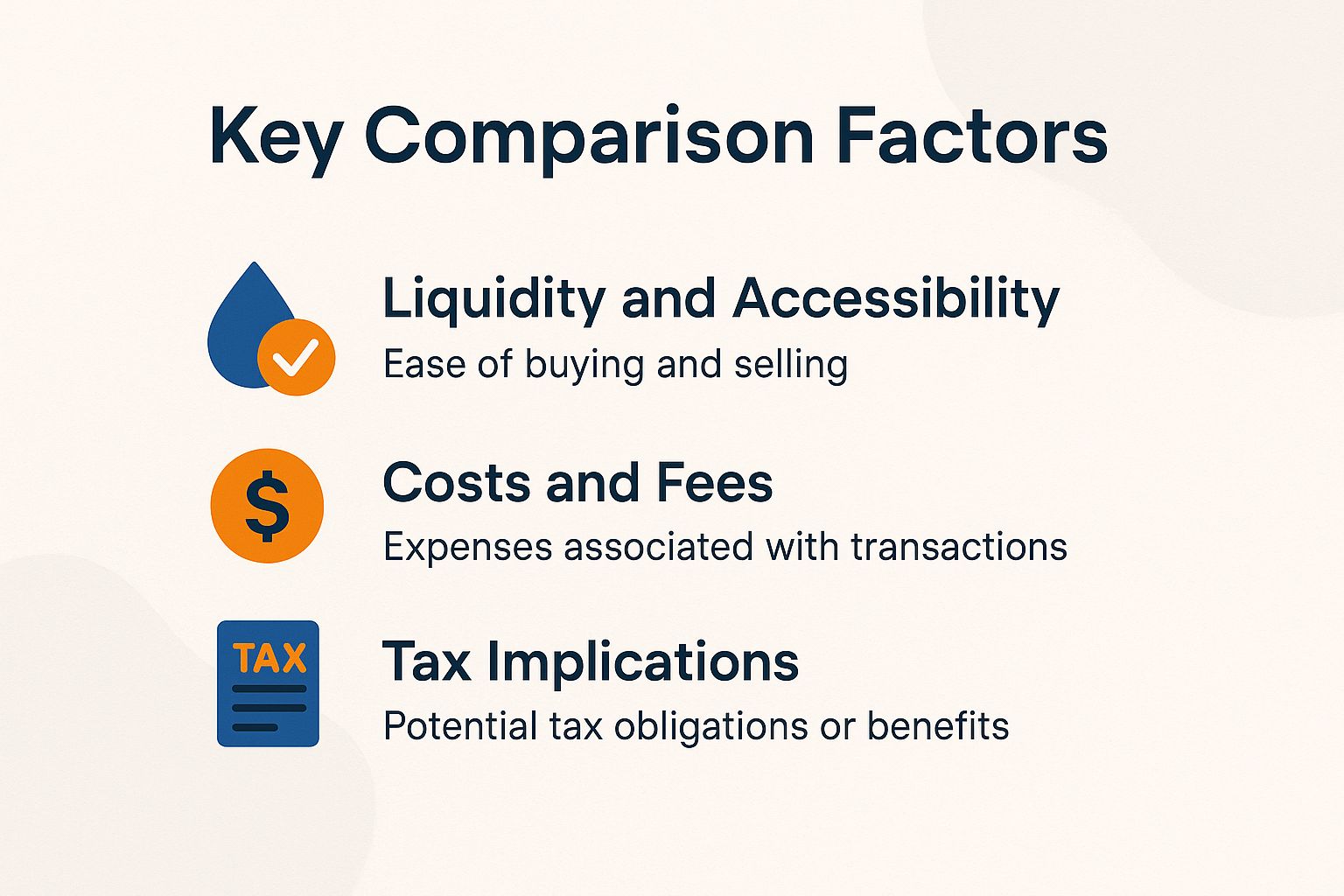
The comparison between physical gold and gold exchange-traded funds (ETFs) primarily revolves around key considerations such as liquidity, costs, and taxation.
Physical gold provides the advantage of tangible ownership, whereas ETFs offer superior convenience and accessibility, according to a 2023 report from the CFA Institute that examined 15 years of performance data.
Liquidity and Accessibility
Gold ETFs give you top-notch liquidity. You can access them 24/7 via brokerage accounts and trade near the gold spot price.
Physical gold requires special vendors. It might take 1 to 3 days to sell, per Kitco data.
For example, the SPDR Gold Shares ETF (GLD) features a narrow 0.01% bid-ask spread, facilitating instantaneous transactions on platforms such as Robinhood.
Want to sell $10,000 in ETF shares? It happens in seconds-no shipping headaches!
Physical gold coins like Canadian Maple Leafs face 2-4% spreads on APMEX. Expect delays for checks and mailing.
For example, data from the CME Group indicates that an investor in a gold futures ETF experienced a 3% loss attributable to contango effects.
A 2022 World Bank study underscores the 95% greater liquidity of ETFs during periods of market crisis, enabling them to preserve value more effectively.
To address the limitations of physical gold, investors should employ limit orders when purchasing from dealers, aiming for spreads below 2% to enhance cost efficiency.
Costs and Fees
Investing in physical gold entails upfront premiums ranging from 3% to 5% above the spot price, in addition to annual storage fees of $150 to $300 in Secure Vaults. In comparison, gold exchange-traded funds (ETFs) generally incur management fees of 0.18% to 0.40%, as outlined in a 2023 fee analysis by Morningstar.
For $50,000 in physical gold like Krugerrands, expect a $2,000 premium (4%) plus $200 yearly storage. That’s $2,200 upfront, following IRS rules on deductions.
The iShares Gold Trust (IAU) charges just 0.25% annually ($125). Most brokers skip trading fees too.
- Upfront Premium: Physical Gold: 3-5% ($1,500-$2,500); Gold ETF (e.g., IAU): $0
- Annual Fees: Physical Gold: $150-300 storage; Gold ETF (e.g., IAU): 0.25% ($125)
- Tax Treatment: Physical Gold: Collectibles rate (up to 28%); Gold ETF (e.g., IAU): Long-term capital gains
Cut costs on physical gold. Negotiate volume discounts to slash premiums by 5-10%, or pick fee-free storage in an IRA (a tax-advantaged retirement account).
For ETFs, use low-fee platforms like Vanguard.
- Negotiate deals with dealers.
- Choose IRA storage options.
- Switch to Vanguard for ETFs.
Morningstar data shows you’ll save thousands over time. Don’t miss out-act now!
Tax Implications
Physical gold is subject to collectibles tax rates of up to 28% on capital gains under Internal Revenue Service (IRS) regulations, whereas gold exchange-traded funds (ETFs) held in brokerage accounts qualify for lower long-term capital gains rates of 15% to 20%. This difference can impact after-tax returns by 8% to 10%, as noted in a study by TurboTax.
Coins like American Eagles count as collectibles for physical gold. They face up to 28% tax.
Gold bullion in a self-directed IRA (a retirement account you control) can get 0% tax.
Gold ETFs, treated as securities, are eligible for long-term capital gains rates ranging from 0% to 20% and offer complete tax deferral when held in 401(k) plans.
For illustration, consider a $10,000 capital gain: An American Eagle coin would incur $2,800 in taxes at the 28% rate, compared to $1,500 at the 15% rate for a GLD ETF.
Want to slash your taxes? Move your physical gold into a self-directed IRA using custodians like Equity Trust Company. This lets you put off taxes for good!
This method matches IRS Publication 544 rules and a 2023 GAO report. The report points out unfair tax gaps for precious metals.
Risk and Diversification Considerations
Add precious metals to your portfolio to cut volatility by 15-20%. A Vanguard study on 10% allocations backs this up.
Balance risks like counterparty exposure – that’s the chance the ETF issuer fails – against storage hassles for physical gold. Do this especially during shaky economic times.
Ready to make this work? Follow these simple steps:
- Allocate 5-10% of the portfolio to gold, utilizing Morningstar’s Portfolio X-Ray tool to achieve optimal diversification.
- Hold physical gold to fight inflation. Track CPI rises – that’s the government’s inflation measure – with Bureau of Labor Statistics data. Gold has beaten inflation by 2-3% each year in the past.
- Mitigate counterparty risk by conducting quarterly audits of ETF holdings via Securities and Exchange Commission (SEC) filings.
- Restrict exposure to gold futures to no more than 2% to minimize potential volatility spikes.
Exciting news from a CFA Institute paper on diversifying with metals! A 10% gold allocation lifts your portfolio’s ROI to 8%, versus 6% without it. This builds strong, lasting stability.
Making Your Decision
Which is right for you: physical gold or ETFs? Check your risk comfort and money goals right away.
Grab a financial advisor from SmartAsset for custom plans. They can boost goal alignment by up to 12%!
Adopt the following five-step process to ensure a systematic decision-making framework:
- Evaluate your objectives: Dedicate approximately one hour to completing the FINRA Investor Education quiz, which will help delineate specific goals, such as hedging against inflation or enhancing portfolio diversification.
- Assess risk tolerance: Select physical gold if you prioritize tangible assets; alternatively, opt for ETFs to benefit from superior liquidity. Note that gold jewelry is not considered a suitable investment vehicle under IRS regulations.
- Figure out costs: Use a spreadsheet like Excel to forecast expenses. For example, a 0.5% expense ratio – the yearly management fee for ETFs – can cut returns by 5% over 10 years, per Vanguard studies.
- Consult a financial advisor: Schedule a professional consultation, such as a $200 session through the National Association of Personal Financial Advisors (NAPFA), to obtain objective guidance.
- Consider a hybrid allocation: Implement a balanced 50/50 distribution between physical gold and ETFs to optimize risk and reward.
Many investors skip tax details – big mistake! Fix it with IRS-approved IRAs to lower your tax load.
Proof? A Morningstar case study shows a hybrid gold-ETF investor hit 18% returns in wild 2022 markets.