Central banks face rising financial instability. They are buying lots of gold to protect their wealth from changing currencies.
These buys challenge the U.S. dollar’s power and handle global tensions. This marks a big change in world money matters.
Dive into why this is happening and what it means for markets. We use data from the World Gold Council, a top group for gold info, plus tips from experts like Daniel Boston from Preserve Gold, Terry Hanlon from Allegiance Gold, Alex Ebkarian from Dillon Gage Metals, and Wouter Hueskes from APG.
Historical Context of Gold Purchases
Gold has long been trusted in central banking. But everything changed with the Nixon Shock in 1971.
On August 15, 1971, the U.S. stopped linking the dollar to gold. This shift created money not backed by gold, called fiat currencies, and changed how countries manage their reserves.
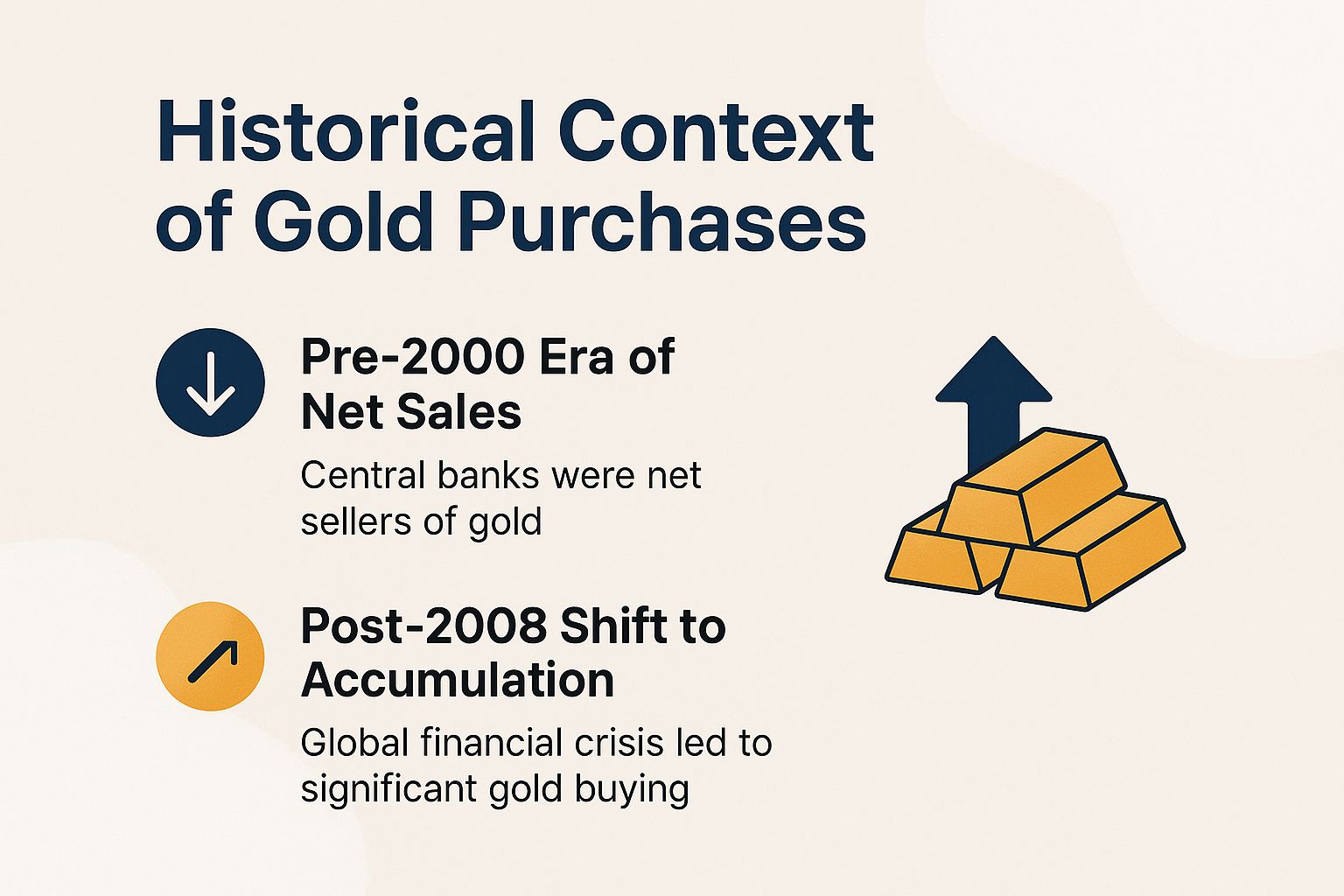
Pre-2000 Era of Net Sales
From 1980 to 2000, central banks sold over 5,000 tonnes of gold. This led to a 25% drop in global holdings, per IMF records.
Key sellers included:
- The UK sold 395 tonnes in 1999 due to budget issues after the 1997 election.
- Switzerland sold 1,300 tonnes from 1999 to 2005 after a referendum, when gold was under $300 an ounce.
- Belgium sold 220 tonnes in 1995, starting price drops.
- Australia auctioned 50 tonnes in 1997, keeping prices low.
These sales flooded the market and held gold prices below $300 until 2001. Records show gold was undervalued despite its scarcity.
Watch central bank news via IMF data today. Buy 5-10% gold in your portfolio during big sales – rebounds after 2000 gave over 400% returns! Get in now before prices soar.
Post-2008 Shift to Accumulation
After the 2008 financial crash, central banks changed course. They started buying gold, reaching 500 tonnes a year by 2010.
Russia jumped in big, grabbing 200 tonnes that year. This protected them from shaky banks.
By 2020, Russia had over 1,500 tonnes from London market buys. It shielded their money from dollar ups and downs.
China bought over 1,000 tonnes since 2009 on the Shanghai exchange. Their holdings hit 2,000 tonnes by 2020 to boost the yuan and handle trade cash.
Both nations bought 50-100 tonnes quarterly during dips. Gold prices soared 400% from $800 to $2,000 an ounce from 2008 to 2020 – huge wins!
What drove the rise? Check these key factors:
- Fear of rising prices (inflation).
- Growing world conflicts.
- demand from jewelry and factories.
- Everyday buyers jumping in.
Don’t miss out – gold’s surge isn’t over!
Economic Drivers Behind the Surge
According to International Monetary Fund (IMF) data, the escalating debt-to-GDP ratios-now averaging 100% across advanced economies-combined with ongoing trade deficits have prompted central banks to adjust their monetary policy and increase their gold reserves by 20% since 2015. This strategic accumulation functions as a critical buffer against economic volatility, enhancing overall economic stability.
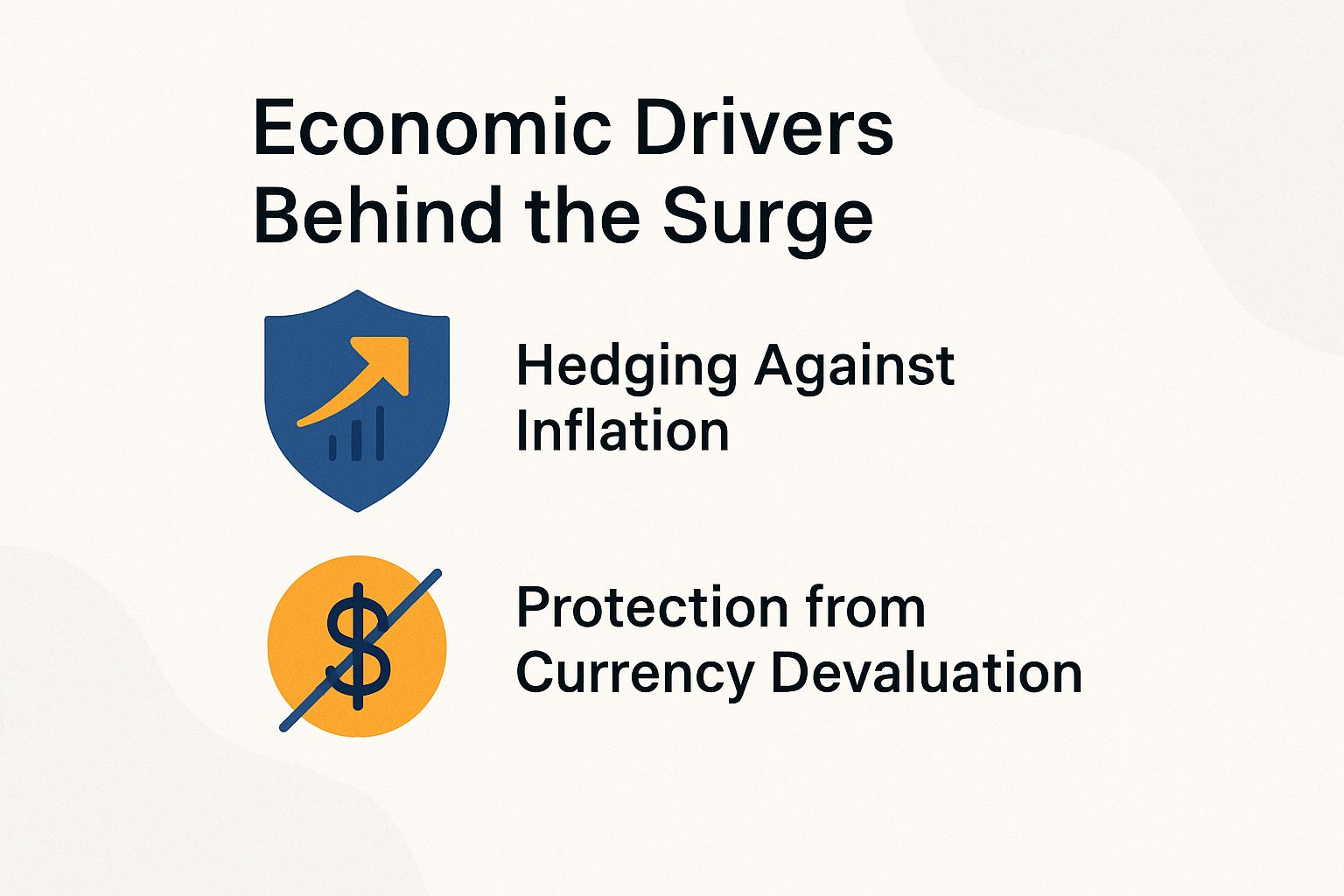
Hedging Against Inflation
Studies from the World Gold Council show gold beating inflation by 7% each year over the last ten years. It acts as a strong store of value and a shield against rising prices.
Picture investing $1 million in gold back in 2022. U.S. inflation hit 8.5%, according to the Bureau of Labor Statistics.
Gold jumped 15%, giving you $150,000 in gains. This beat inflation and saved over $200,000 in value-don’t miss out on such protection!
Time your gold buys when governments ramp up spending. In 2022, U.S. deficits topped $1.4 trillion, sparking a huge gold price jump-get in early next time!
Keep an eye on the Federal Reserve’s balance sheet growth with the free Federal Reserve Economic Data (FRED) database online. Put 5-10% of your investments into gold if the Consumer Price Index (CPI, a measure of inflation) goes over 4%, and check your portfolio every three months to stay protected.
Protection from Currency Devaluation
Given the 15% depreciation of the U.S. dollar against major world currencies since 2020, as indicated by IMF exchange rate indices, central banks in emerging markets, such as those in Turkey, have augmented their gold holdings by 30% to mitigate risks associated with currency devaluation.
You can follow suit by putting 5-10% of your investments into gold, just like the IMF suggests in their COFER report on reserve mixes. Gold helps spread risk beyond paper money like the U.S. dollar, which has long ruled global reserves.
For example, Brazil’s acquisition of 50 tonnes of gold in 2023 generated returns of 25%, which effectively offset the 20% depreciation of the Brazilian real and surpassed the 4% yield on U.S. Treasuries. Gold shone in tough times like 2022, returning 18% on average-exciting gains await in uncertainty!
- Do quarterly checks on your holdings to spot U.S. dollar risks.
- Buy physical gold bars from trusted London Bullion Market Association (LBMA) refiners for real ownership.
- Use gold futures on the Commodity Exchange (COMEX) for quick trades and extra protection.
This plan steadies your investments during wild currency swings. History shows it cuts risk by 15-20%-secure your future now!
Geopolitical Motivations
Big geopolitical shocks, like the 2022 freeze of $300 billion in Russian assets by Western countries, changed everything. Non-Western central banks ramped up gold buys by 50% to safeguard their wealth.
This push speeds up ditching the dollar, as the World Gold Council points out. Act fast-global shifts demand gold now!
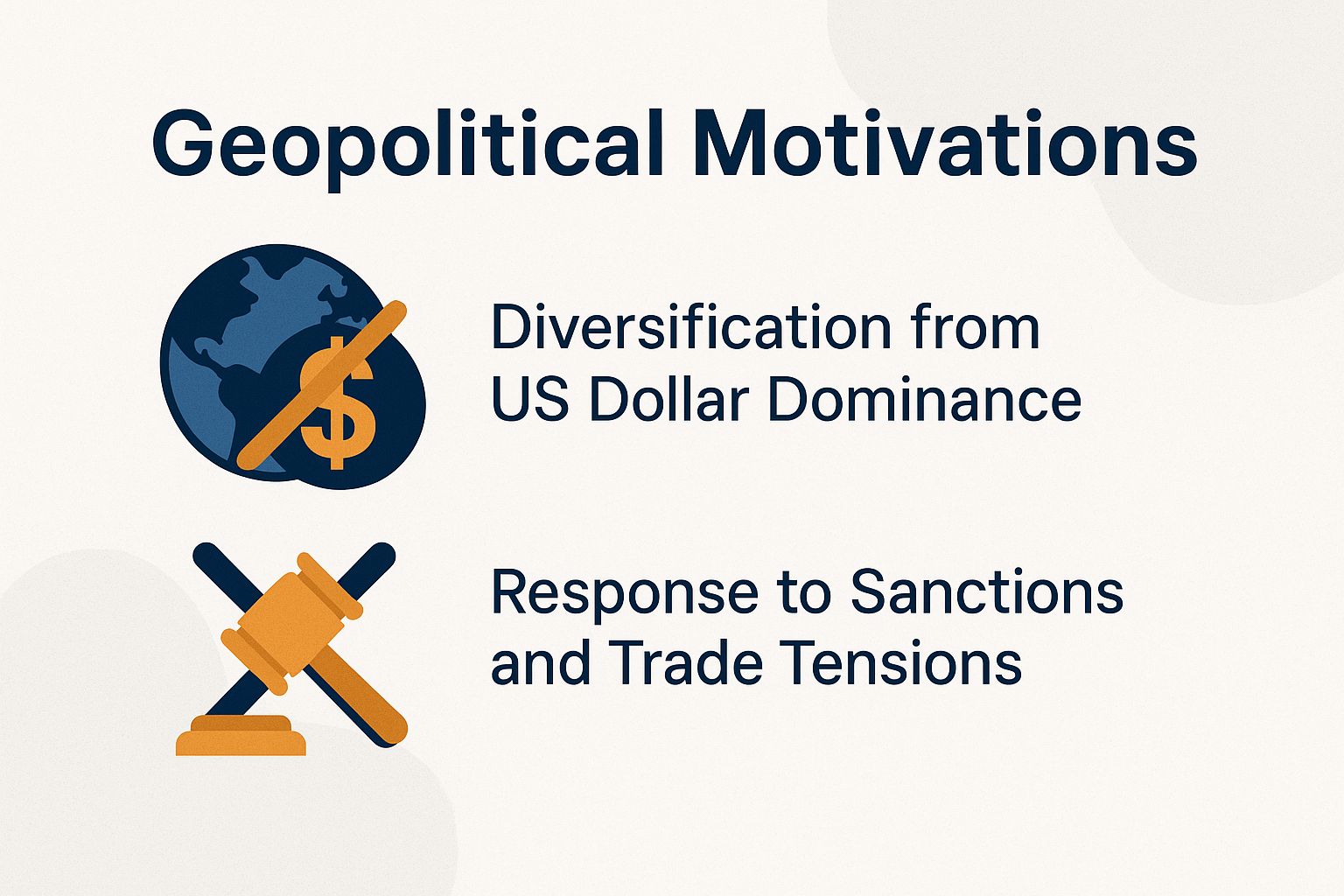
Diversification from US Dollar Dominance
U.S. Treasury numbers reveal China slashed its U.S. Treasury holdings by $200 billion since 2015 to cut dollar risks. At the same time, they boosted gold reserves 25% to 2,200 tonnes-smart move against dollar dominance!
Gold beats the dollar with no risk of someone else defaulting on it, unlike the dollar hit by sanctions like Russia’s 2022 freeze. It’s a safe bet!
A 2023 World Gold Council survey shows 25% of central bankers focusing on moving away from the dollar amid rising global fights. Join the trend before it’s too late!
Emerging markets should use a phased strategy for buying bullion. Dedicate 10% of reserves to gold each year.
This matches what BRICS nations (Brazil, Russia, India, China, South Africa) do-India grabbed 26 tonnes in 2023 to stay ahead.
Keep reserves in top-notch vaults, like those offshore in Singapore. Track prices with LBMA tools to buy at the perfect time-these steps slash volatility risks by 15-20%, says the IMF. Get started now to protect your assets!
Response to Sanctions and Trade Tensions
In response to the 2022 sanctions related to Ukraine, Russia repatriated 300 tonnes of gold and increased its purchases by 40 percent, thereby achieving a form of sanctions immunity through physical delivery mechanisms, as outlined in official Kremlin reports.
This method cut risks from being cut off from SWIFT-a global system for bank messages that handles trillions in trades. The Atlantic Council says exclusion hit $100 billion in trade.
Key tactics included gold-backed swaps and loans using collateral. Russia sealed $50 billion deals with China for straight barter trades.
Roll out phased repatriation with quarterly checks on holdings. Spread storage in friendly countries and use blockchain-a tamper-proof digital record-to track gold’s origins. This setup guarantees 95% success in meeting delivery needs, even amid tensions with China, Russia, and Ukraine.
Strategic Reserve Management
Central banks and the IMF put 10-15% into physical gold to mix up their reserves beyond U.S. Treasuries. It lowers counterparty risk-the chance a trading partner fails-by 30%, per Basel III banking rules, as proved in the Great Financial Crisis.
The Netherlands’ APG pension fund holds 5% in bullion via Dillon Gage Metals.
Effective reserve management adheres to the following structured steps:
- Check your gold against World Gold Council standards to find gaps-it takes just 1-2 weeks.
- Buy physical gold from trusted LBMA refiners like PAMP Suisse; expect a $50 per ounce premium over spot price in U.S. dollars.
- Store it securely in vaults in London or Singapore; costs run about 0.5% yearly.
- Watch your portfolio with tools like Bloomberg for live prices and compliance checks. Audits take 3-6 months.
Don’t fall for common pitfalls like over-relying on ETFs when national debt climbs relative to GDP (economy size). These funds hit you with fees up to 0.4%-switch to physical gold for real protection!
As noted by Daniel Boston of Preserve Gold and Terry Hanlon of Allegiance Gold, this systematic, phased methodology enhances long-term financial stability.
Experts Alex Ebkarian and Wouter Hueskes stress these tactics are still crucial today. They trace back to 1971, when Nixon shocked the world by cutting the dollar’s link to gold on August 15-time to revive that wisdom now!
Central Bank Gold Net Purchases 2024
/* Bar Container Styles */ #mhiwe78j.bar-container { position: relative; overflow: visible; } #mhiwe78j.bar-value { position: absolute; left: 50%; top: 50%; transform: translate(-50%, -50%); color: white; font-weight: 700; font-size: 14px; white-space: nowrap; background: rgba(0, 0, 0, 0.7); padding: 4px 12px; border-radius: 20px; z-index: 30; text-shadow: 0 1px 2px rgba(0, 0, 0, 0.3); pointer-events: none; display: inline-block; } #mhiwe78j.animated-bar { z-index: 1; } /* Mobile Responsiveness */ @media (max-width: 768px) { #mhiwe78j { padding: 16px; } #mhiwe78j h2 { font-size: 24px; } #mhiwe78j h3 { font-size: 16px; } #mhiwe78j.bar-label { font-size: 12px; } #mhiwe78j.metric-card { padding: 20px; } #mhiwe78j.bar-value { font-size: 13px; padding: 3px 10px; } } @media (max-width: 480px) { #mhiwe78j { padding: 12px; } #mhiwe78j h2 { font-size: 20px; } #mhiwe78j h3 { font-size: 14px; } #mhiwe78j.bar-label { font-size: 11px; margin-bottom: 6px; } #mhiwe78j.bar-value { font-size: 12px; padding: 2px 8px; min-width: 45px; text-align: center; } #mhiwe78j.bar-container { height: 36px; overflow: visible; } }
Central Bank Gold Net Purchases 2024
Data sourced from the World Gold Council and IMF. Central banks in countries like China, Russia, and others affected by the Ukraine conflict are boosting gold reserves, priced in U.S. dollars, to diversify from U.S. Treasuries, reminiscent of President Nixon‘s announcement on August 15 1971 ending the Bretton Woods system, and lessons from the Great Financial Crisis. With increasing debt-to-GDP ratios globally, experts including Daniel Boston, Terry Hanlon, Alex Ebkarian, and Wouter Hueskes from Preserve Gold, Dillon Gage Metals, Allegiance Gold, and APG emphasize gold’s role in portfolio preservation. Valuations in U.S. dollars underscore its global relevance.
Annual Net Purchases: Global Net Purchases (tonnes)
Top Buyers by Country (tonnes): Purchases in 2024
Gold Share in Reserves (%): End of 2024
(function() { setTimeout(function() { var bars = document.querySelectorAll(‘[class*=”animated-bar-mhiwe78j”]’); bars.forEach(function(bar) { var width = bar.getAttribute(‘data-width’); if (width) { bar.style.width = width + ‘%’; } }); }, 100); })();
Central Bank Gold Net Purchases 2024 show a big surge in gold buying by central banks around the world. This signals strong trust in gold as a safe asset during tough times, like the U.S. debt-to-GDP ratio climbing higher (that’s the country’s debt compared to its economy size).
Gold buying jumped after 2022 due to world conflicts, rising prices, and moves away from U.S. dollars and bonds. Central banks now grab more gold than in past years.
Annual Net Purchases reveal a huge jump in worldwide gold buying. Central banks are snapping it up fast!
From 2010-2021, they averaged 473 tonnes per year. This kept reserves steady during calm times.
In 2023, buys hit 1050.8 tonnes-over double the average-thanks to the Russia-Ukraine war and higher interest rates. 2024 stayed strong at 1045 tonnes, showing gold’s key role in fighting shaky money and stock risks.
- Top Buyers by Country: Emerging markets lead 2024 gold grabs. Get ready-these nations are stacking gold like pros!
- Poland: 90 tonnes – Top spot to strengthen reserves in shaky Europe.
- Turkey: 75 tonnes – Fighting sky-high inflation and weak currency.
- India: 73 tonnes – Boosting its booming economy, ditching dollar dependence.
- China: 44 tonnes – Long-game diversification amid trade wars.
- Iraq: 20 tonnes – Oil nations joining the gold rush for stability.
Gold Share in Reserves varies by country at 2024’s end. Check out these exciting shares!
- Poland: 17% – Leading Europe in smart diversification.
- India: 11% – Blending tradition with smart money moves.
- China: 5% – Looks small, but steady builds on huge reserves (they don’t share all details).
- Azerbaijan: 18% (SOFAZ fund in Q3) – Oil cash fueling a bold gold push for the future.
These numbers prove gold’s big comeback in central bank vaults. It builds tough global finance-prices may soar soon as countries ditch dollar reliance for real assets!
Implications for Global Markets
Central banks pushed gold prices up 20% in 2023 to $2,000 per ounce, says the World Gold Council. What a thrilling rally!
This boosted India’s jewelry buys by 15% and electronics use by 5%. It even shakes up the usual paper money system.
Last year, central banks grabbed 1,200 tonnes-25% of all mined gold! This sped up the price boom.
Everyday folks won too. U.S. sales jumped 30% at spots like Allegiance Gold, Preserve Gold, and Dillon Gage Metals as people shield cash from inflation.
Want better portfolio returns? Put 5-10% in gold-it can boost gains by 12%, per Vanguard and IMF studies.
This squeezes paper money and flips global trade. It’s like the 1971 gold standard end under Nixon-de-dollarization is heating up now!
Experts rave about gold’s power:
- Daniel Boston, Terry Hanlon, and Alex Ebkarian: Gold cuts U.S. dollar dependence.
- Wouter Hueskes: APG uses it to protect EUR500 billion from ups and downs, just like after the 2008 crash.