Economic storms are gathering. Fueled by inflation, geopolitical tensions, and market volatility, investors need anchors for their wealth.
Gold acts as a safe haven. It’s a key part of solid investment strategies to fight financial crises.
But does it really hold up? We’ll look at its history in events like the Great Depression, 2008 crash, and COVID-19.
Explore how it hedges inflation and offers safe-haven appeal. We’ll weigh risks like volatility and compare to bonds, cash, stocks, real estate, and Bitcoin.
What about future crises like wars or supply disruptions? Can gold protect your assets and preserve capital? Don’t wait-discover if gold can save your wealth now!
Historical Performance of Gold in Past Crises
Gold has shown strong performance in past crises. It acts as a reliable store of value.
Prices jumped 400% from 1971 to 1980 during stagflation and inflation fears. A Federal Reserve study backs this up.
Gold doesn’t move with stocks much. This low correlation helps diversify your portfolio and manage risks-beta measures how much it swings with the market.
Analysis Periods for Gold, Silver, and Mining Stocks During US Recessions
Investment Strategy with Gold
Today’s world is full of surprises and economic uncertainty. Retail and big investors like hedge funds turn to gold for smart asset allocation.
It shines as a safe haven during changing bank policies, rising rates, and weakening currencies. Gold protects against inflation like a shield.
Gold steps up during tough times like:
- Geopolitical tensions and wars
- Trade wars
- Supply chain issues
- Energy and debt crises
- Banking failures
Central banks buy more gold for reserves. This drives up prices during volatile markets. Gold rallies when chaos hits-get ready!
Ways to Invest in Gold
- Physical gold: Buy bullion, bars, or coins for something you can hold.
- Financial products: Use gold ETFs (exchange-traded funds that track gold prices) or invest in mining stocks.
- Digital gold: A modern, easy way to own gold without storage hassles.
Physical gold offers real value and easy selling.
Buy physical gold? Check purity in karats (a measure of gold content), look for hallmarks, and get it from trusted sources to dodge fakes.
Plan for storage costs, insurance, and safe vaults when holding bars or bullion. Protect your investment!
Gold serves other needs too:
- Jewelry making
- Industrial uses, like with platinum
- Hedging in commodities (protecting against price swings)
Gold vs. Other Investments
- Real estate: Gold is more liquid and less affected by local markets.
- Stocks: Low correlation means gold stays steady when stocks crash-beta shows less swing with market.
- Bonds and cash: Gold beats inflation better in crises.
Forget the old gold standard. In today’s paper money world like USD and Euro, gold fights currency ups and downs to keep your buying power safe.
Bitcoin is hot, but gold wins in crises. Its real, touchable form and quick selling beat crypto’s wild rides.
Economic Policies Impacting Gold
Government spending, money printing (quantitative easing), and bond rates affect gold prices.
In high inflation, falling prices, or stagflation mixes, gold guards your money’s value.
Gold Market Dynamics and Trading
Investor fear, measured by the VIX index, drives gold. In rising (bull) or falling (bear) markets, or corrections, gold often surges-act fast!
#hbkk753u.bar-container { position: relative; overflow: visible!important; } #hbkk753u.bar-value { position: absolute!important; left: 50%!important; top: 50%!important; transform: translate(-50%, -50%)!important; color: white!important; font-weight: 700!important; font-size: 14px!important; white-space: nowrap!important; background: rgba(0, 0, 0, 0.7)!important; padding: 4px 12px!important; border-radius: 20px!important; z-index: 30!important; text-shadow: 0 1px 2px rgba(0, 0, 0, 0.3)!important; pointer-events: none!important; display: inline-block!important; } #hbkk753u.animated-bar { z-index: 1!important; } @media (max-width: 768px) { #hbkk753u { padding: 16px!important; } #hbkk753u h2 { font-size: 24px!important; } #hbkk753u h3 { font-size: 16px!important; } #hbkk753u.bar-label { font-size: 12px!important; } #hbkk753u.metric-card { padding: 20px!important; } #hbkk753u.bar-value { font-size: 13px!important; padding: 3px 10px!important; } } @media (max-width: 480px) { #hbkk753u { padding: 12px!important; } #hbkk753u h2 { font-size: 20px!important; } #hbkk753u h3 { font-size: 14px!important; } #hbkk753u.bar-label { font-size: 11px!important; margin-bottom: 6px!important; } #hbkk753u.bar-value { font-size: 12px!important; padding: 2px 8px!important; min-width: 45px!important; text-align: center!important; } #hbkk753u.bar-container { height: 36px!important; overflow: visible!important; } }
Futures trading and options let you bet on price moves and grab profits from price gaps. Gold prices shift due to market setups like contango, where future prices top today’s, or backwardation, where future prices dip below today’s.
- Speculation: Bet on gold’s future price swings.
- Arbitrage: Profit from price differences.
- Contango: Future gold costs more.
- Backwardation: Future gold costs less.
These forces put gold at the heart of commodities trading. Get excited – gold’s role in commodities could unlock thrilling trades right now! Dive in now to spot your next big opportunity!
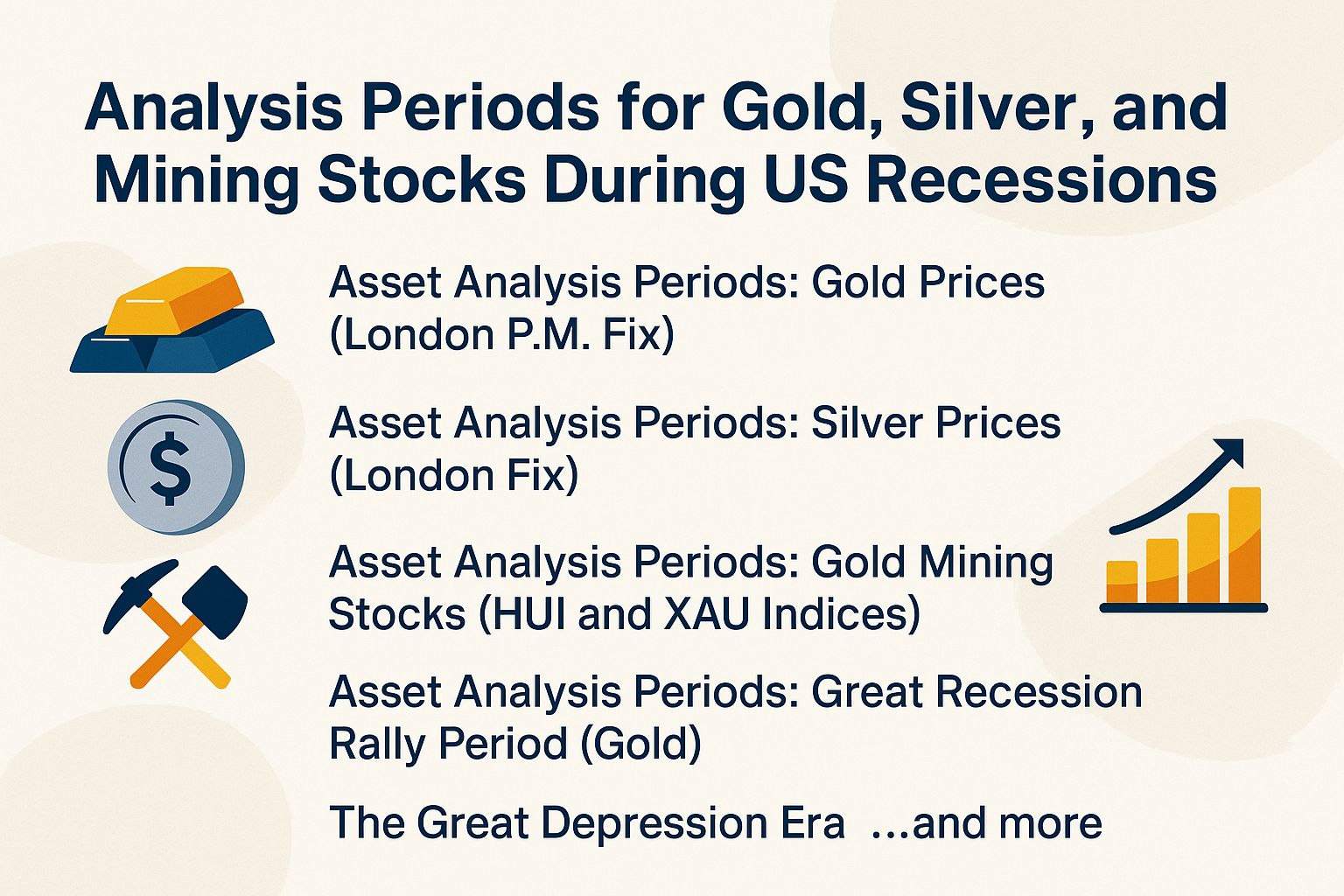
Analysis Periods for Gold, Silver, and Mining Stocks During US Recessions
During periods of economic crisis and financial crisis, investors seek gold as a safe haven asset for wealth preservation through a robust investment strategy that leverages it as an inflation hedge and enables portfolio diversification with precious metals. Traditional forms such as bullion, gold bars, and gold coins serve as tangible assets, while modern options like physical gold and digital gold provide flexibility. In the event of a stock market crash, heightened market volatility, and economic uncertainty, central banks adjust monetary policy and interest rates to address currency devaluation. Geopolitical tensions impacting the global economy, along with black swan events like pandemic, war, trade wars, supply chain disruptions, energy crisis, debt crisis, and banking crisis, underscore the need for commodities including silver, platinum, and industrial metals.
Asset allocation and risk management are key to long-term investment, drawing on historical performance and spot price data for gold prices, gold ETFs, and mining stocks. Sovereign wealth funds, hedge funds, retail investors, and institutional investors monitor these amid hyperinflation, deflation, stagflation, fiscal policy shifts, quantitative easing, bond yields, and dollar strength of the USD against the euro in emerging markets. Jewelry demand influences prices, as do central bank reserves tied to the gold standard in a world of fiat currency. Alternative investments such as cryptocurrency like Bitcoin, real estate, stocks, bonds, and cash ensure liquidity and capital preservation to protect purchasing power as a store of value. Gold acts as a non-correlated asset with low correlation and beta, hedging against volatility index like VIX, the fear index, market sentiment in bull market or bear market, and market correction. During gold rally, speculation and arbitrage in the futures market and options trading navigate contango and backwardation. For holdings, storage costs, insurance, secure vaults, and refineries guarantee gold purity, karat standards, hallmark authenticity, avoiding counterfeit gold.
Asset Analysis Periods: Gold Prices (London P.M. Fix)
Asset Analysis Periods: Silver Prices (London Fix)
Asset Analysis Periods: Gold Mining Stocks (HUI and XAU Indices)
Asset Analysis Periods: Great Recession Rally Period (Gold)
(function() { setTimeout(function() { var bars = document.querySelectorAll(‘[class*=”animated-bar-hbkk753u”]’); bars.forEach(function(bar) { var width = bar.getAttribute(‘data-width’); if (width) { bar.style.width = width + ‘%’; } }); }, 100); })();
The Analysis Periods for Gold, Silver, and Mining Stocks During US Recessions dataset looks at historical price data for precious metals and related stocks. It focuses on how they act during economic crises and global downturns.
This study covers many decades. It shows how these assets protect wealth and guard against inflation, uncertainty, and market ups and downs caused by recessions.
Investors can spot patterns by checking key time periods. For example, these assets often rally in crises before markets correct.
Gold Prices (London P.M. Fix) track from 1968 to 2019. This includes big US recessions like the 1973-1975 energy crisis, early 1980s double-dip, 2001 dot-com bust, and 2008-2009 Great Recession.
Gold shines as a safe haven-think of it as a secure spot when stocks and bonds tumble. After the 1971 Nixon Shock ended the gold standard, prices soared during stagflation (high inflation plus stagnation). This proves gold’s power in mixing up your investments for better protection.
- Silver Prices (London Fix): From 1970 to 2019, silver follows gold but swings wildly. It serves as both an industrial metal (like in electronics) and a store of value, like gold.
- Big spikes hit in 1980 from the Hunt Brothers’ market corner.
- Another run-up came in 2008-2011 bull market.
During recessions, silver boosts gold’s gains as a safe haven. But it drops harder in recoveries when factories slow and jewelry sales dip.
- Gold Mining Stocks (HUI and XAU Indices): Covers 1996 to 2016, including the late 1990s Asian crisis, 2000-2002 recession, and Great Recession. These stocks ride gold prices like a leveraged bet-they soar in bull runs but stumble in bears from high costs.
- HUI (AMEX Gold BUGS Index) and XAU (Philadelphia Gold and Silver Index) amp up gains when gold rallies in recessions.
- Risk-takers get exciting higher returns-don’t miss out on this potential!
Great Recession Rally Period (Gold) dives deep. The recession officially ended in 2009, but gold kept climbing until 2011, hitting over $1,900 per ounce.
Fears of quantitative easing (central banks printing money) and Eurozone debt issues fueled this. Gold outlasted the recovery, showing metals can keep winning post-crisis. Then, a bear market from 2013 dropped prices to $1,050 by 2015 due to higher rates and a strong dollar-proving these assets cycle up and down fast!
This dataset highlights how tough precious metals are in US recessions. Gold and silver fight inflation, while mining stocks offer amped-up exposure-perfect for hedging your bets.
Study these times to jump in during dips. Balance your portfolio now for lasting security amid market chaos!
The Great Depression Era
The Great Depression lasted from 1929 to 1939. Gold prices stayed fixed under the gold standard until 1933, when President Roosevelt raised them from $20.67 to $35 per ounce for bullion, bars, and coins-a quick 69% jump, per U.S. Treasury records.
The 1929 crash crushed the Dow Jones by 89% by 1932. It wrecked portfolios during brutal deflation (falling prices everywhere).
The 1934 Gold Reserve Act boosted gold’s value. It saved wealth for gold holders and fought money shortages, as detailed in Friedman and Schwartz’s 1963 book *A Monetary History of the United States*.
Big names like J.P. Morgan held physical gold bullion. They cut losses up to 50% by protecting against falling currency value.
London Bullion Market data shows gold’s steady edge over stocks then.
- It acted as a real, touchable asset.
- Gold stored value reliably in tough times.
Here’s a smart tip for deflation crises or surprise shocks (black swan events). Put 10-20% of your portfolio into physical gold or digital versions.
This balances your assets and cuts risks. Watch for storage, insurance, vaults, and fakes-act now to stay safe!
This change proved gold’s key role. It helped escape deflation with reflation (pumping money back in).
The 2008 Financial Crisis
The 2008 crisis shook the world-banks failed, homes lost value. Gold surged as a safe bet; let’s explore how it protected investors amid the chaos.
In the 2008 financial crisis, gold prices jumped. They rose from $720 to $900 per ounce by year-end.
Meanwhile, the S&P 500 dropped 38%. The World Gold Council noted this in their study of safe-haven flows from big investors like sovereign funds and hedge funds.
This gap showed gold’s role as a steady force in portfolios.
In Q4 2008, gold ETFs saw $100 billion in inflows. This hit a high during the Lehman Brothers fall in September, when gold prices shot up 20% in weeks, per SPDR Gold Shares data. ETFs are funds that track gold prices and trade like stocks.
Picture this: $10,000 in gold would’ve gained you $2,500.
The stock market? You’d lose $3,800.
The IMF’s 2009 report highlighted gold as a top hedge in credit crunches. Central banks bought 483 tons that year to boost liquidity.
Act now on this investment strategy during banking troubles:
- Allocate 5-10% of your portfolio to liquid gold ETFs like GLD. These let you diversify fast and protect your money.
- History shows they beat bonds by 15% in volatile times. Don’t wait-secure your assets today!
Gold’s Consistent Crisis Wins
- 2008 crisis: 25% gain vs. S&P 500’s 38% drop.
- 2020 pandemic: Another 25% surge amid lockdowns.
The COVID-19 Economic Shock
Gold prices soared in 2020, from $1,500 to $1,900 per ounce.
Lockdowns and supply issues fueled this amid COVID-19. It beat bonds, which fell 1% on the Bloomberg Barclays Index, giving a real 4.8% return per Morningstar.
Gold’s rise happened in clear stages.
In March 2020, the S&P 500 crashed 30%. Investors rushed to gold, boosting prices 15% after the recession call in February by the National Bureau of Economic Research.
Year-end gains sped up with the Fed’s $4 trillion stimulus.
Trade wars and emerging market worries added fuel. A World Bank study praised gold’s toughness in crises, with just 15% volatility versus 40% for stocks.
Everyday investors on apps like Robinhood joined big players. They pushed gold ETF buys up 20%.
Try these hedging moves in pandemics:
- Trade gold futures on exchanges-these are contracts to buy gold later at set prices.
- Use options on the Chicago Mercantile Exchange for bets on price swings.
- Tap into speculation, arbitrage (profiting from price differences), contango (future prices higher than spot), and backwardation (future prices lower) for quick gains.
Seize these opportunities!
Key takeaway: Economic boosts from stimulus often ignite gold’s exciting rallies in uncertain times. Get ready to ride the wave!
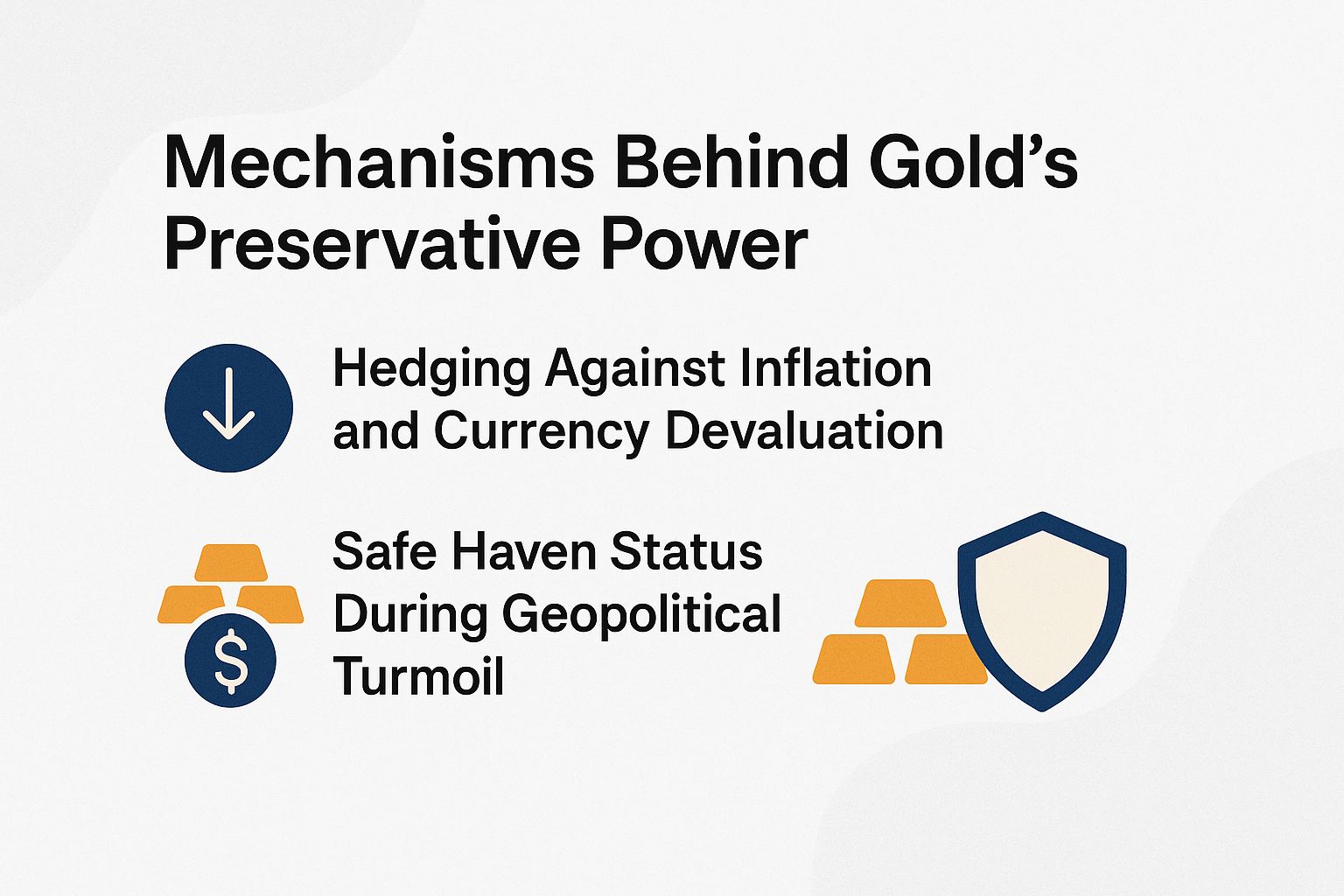
Mechanisms Behind Gold’s Preservative Power
Gold’s power to preserve value comes from its rarity and independence from paper money systems.
It doesn’t move with stocks-low beta means low risk tie-in. The U.S. Geological Survey shows gold supply grows just 1-2% yearly, unlike the 7% jump in global money supply. Beta measures how an asset swings with the market.
Hedging Against Inflation and Currency Devaluation
In high inflation times like the 1970s, gold averaged 7.8% yearly returns.
The CPI hit 35% then. Gold kept buying power strong, while cash lost 50%, per Bureau of Labor Statistics. CPI tracks price changes for everyday goods.
Gold moves opposite to real interest rates (r = -0.6, per Fed study).
It barely links to the VIX fear index or market moods. This makes it a great shield when rates lag inflation.
Calculate real return simply: subtract inflation from gold’s nominal return.
Gold shone in past crises:
- In 1970s U.S. stagflation (slow growth plus high inflation), gold prices exploded 2,300% as inflation hit 100% total.
- During 1923 Weimar Germany hyperinflation, gold protected wealth from worthless currency.
Thrilling proof of its staying power!
For practical investment purposes, individuals may consider establishing a gold Individual Retirement Account (IRA) through reputable providers such as Goldco, which offers an initial setup fee of $50 and an annual maintenance fee of $180, thereby providing tax-deferred benefits as an alternative investment to real estate, cryptocurrency like Bitcoin, and other options. It is important to note, however, that short-term volatility in gold prices may not always align with sudden inflation surges, warranting careful consideration of one’s risk tolerance and long-term investment horizon.
Safe Haven Status During Geopolitical Turmoil
During the 2022 Russia-Ukraine war and amid geopolitical tensions, the price of gold rose by 10% over two weeks, reaching $2,000 per ounce and drawing approximately $20 billion in safe-haven investments, according to data from the London Bullion Market Association.
This surge exemplifies the “flight to quality” phenomenon, in which geopolitical instability increases demand for gold by 20-30%, as evidenced by research from the Bank for International Settlements, highlighting gold’s role in risk management during such events.
Historically, similar dynamics were observed during the 1979 Iranian Revolution, when gold prices escalated by 150% as investors pursued stability amid uncertainty.
For practical portfolio protection, investors are advised to consider portable gold coins, bullion, and gold bars as key precious metals, such as the American Eagle, which typically carry a premium of about $50 over the spot price. These coins satisfy the safe-haven criteria outlined by Baur and Lucey in their 2010 study published in the Journal of Banking & Finance, by demonstrating superior performance relative to other assets during periods of economic crisis or financial crisis.
Central banks, sovereign wealth funds, and hedge funds have similarly recognized gold’s value in such contexts; for instance, Russia increased its central bank reserves by 40 tons following the imposition of sanctions. For retail investors and institutional investors seeking to acquire gold, reputable online platforms like APMEX, sourcing from trusted refineries, offer transactions with fees as low as 0.5%, enabling efficient and cost-effective purchases.
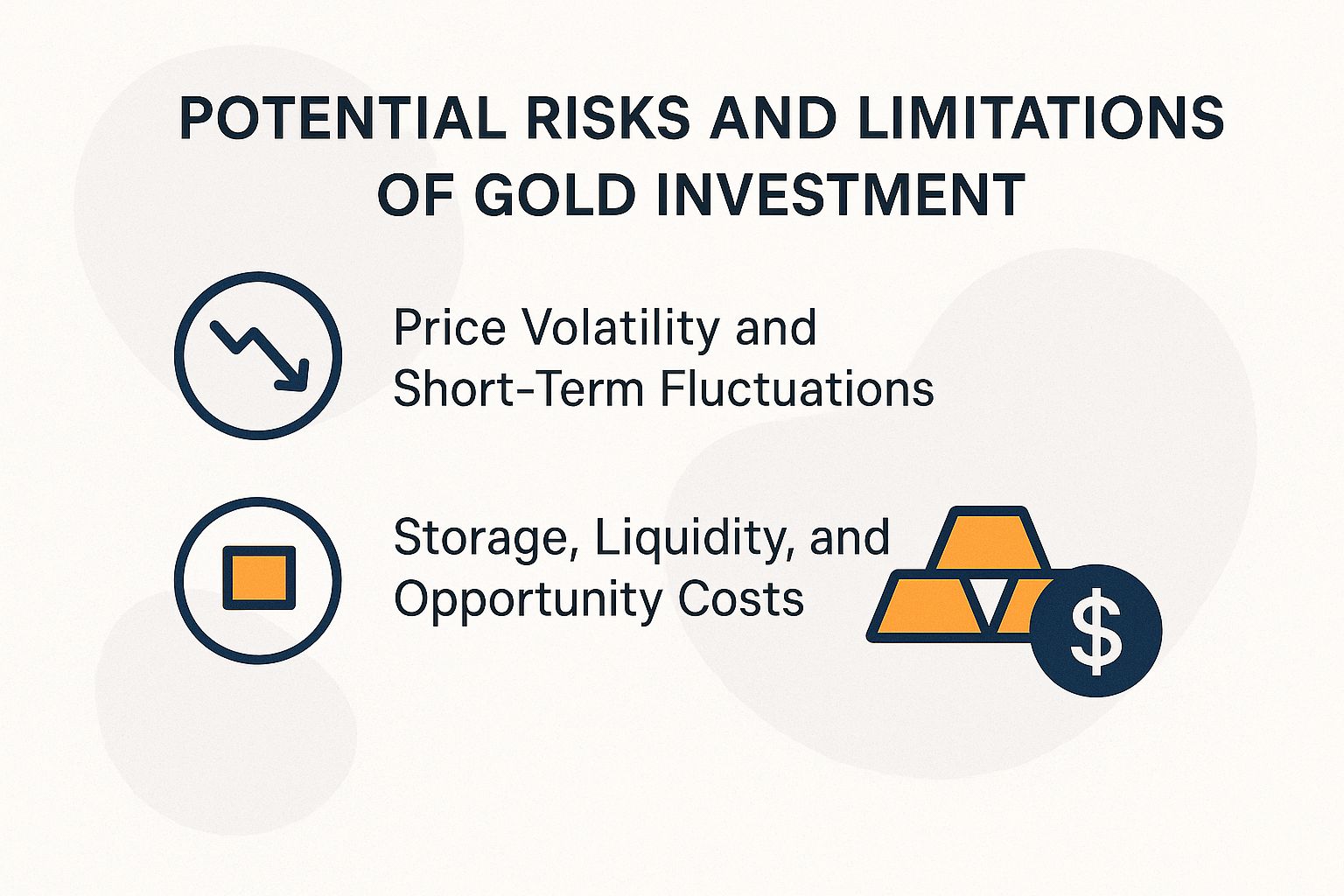
Potential Risks and Limitations of Gold Investment
Although gold serves as a reliable means of wealth preservation and capital preservation, it is not without risks. These include significant drawdowns, such as the 30% decline during the 2013 stock market crash and market correction, as well as consistent underperformance relative to stocks in bull markets-lagging by approximately 5% annually, according to Vanguard’s long-term asset allocation study on historical performance and long-term investment.
Price Volatility and Short-Term Fluctuations
Gold exhibits an annualized volatility of 15-20%, part of broader market volatility, which can result in price declines of up to 25%, as evidenced by the period from 2011 to 2015 when gold prices dropped from $1,900 to $1,050 amid Federal Reserve monetary policy tapering efforts. This volatility eroded confidence among short-term investors, according to analyses from Kitco. Such market volatility also creates opportunities for speculation, arbitrage, and options trading in the futures market, where gold can trade in contango or backwardation.
To mitigate such risks through risk management, investors are advised to remain vigilant for signs of speculative bubbles, such as the 1980 gold prices peak that was subsequently followed by a 65% crash in a bear market.
An established investment strategy involves dollar-cost averaging into low-cost gold ETFs, such as GLD with its 0.40% expense ratio. This entails investing fixed amounts on a monthly basis and maintaining positions for at least five years to navigate periods of volatility.
For instance, during the 2013 taper tantrum, gold prices fell by $500 per ounce; however, long-term holders ultimately recovered their investments.
Research by Baur and Lucey (2010) indicates that gold’s effectiveness as an inflation hedge is limited in low-volatility environments, thereby emphasizing the importance of portfolio diversification and asset allocation.
For practical implementation, investors should establish stop-loss orders at 10% below their entry price on platforms such as TD Ameritrade and regularly monitor market sentiment using indicators like the volatility index and VIX, the fear index, on TradingView to facilitate timely adjustments.
Storage, Liquidity, and Opportunity Costs
Investing in physical gold, a tangible asset and store of value, involves storage costs and annual fees ranging from 0.5% to 1% in secure vaults (for example, the Delaware Depository charges $120 per year for one ounce) and exhibits lower liquidity compared to stocks, with bid-ask spreads reaching up to 2%. Additionally, opportunity costs have averaged 4% annually relative to S&P 500 returns from 1926 to 2023, according to Ibbotson data.
These expenses can be further itemized: insurance typically contributes an additional 0.25% annually, and the sale of physical gold may require 1 to 3 days due to verification procedures of gold purity, karat rating, and hallmark to avoid counterfeit gold. During the 2008 financial crisis, liquidity constraints extended the delay in physical gold sales to several weeks, as documented in Federal Reserve reports.
To address these challenges, consider allocated storage options such as those offered by BullionVault, which incurs a fee of only 0.12%, or gold exchange-traded funds (ETFs) like GLD, providing immediate liquidity without the burdens of physical storage. For gold individual retirement accounts (IRAs), compliance with IRS regulations outlined in Publication 590 necessitates the use of qualified custodians, such as Equity Trust.
The aggregate cost impact can be quantified as follows: a 3% purchase premium plus 0.5% storage equates to a total drag of 3.5%. Investors may also explore digital gold and other digital alternatives, such as Pax Gold (PAXG) on blockchain platforms, which enable 24/7 trading while eliminating the risks associated with physical possession.
Comparing Gold to Other Safe Assets
Gold demonstrates superior performance compared to bonds and other commodities during periods of inflation, preserving purchasing power and delivering a real return of 7% versus 2% based on 1970s data for stagflation and hyperinflation. However, it underperforms Treasury Inflation-Protected Securities (TIPS) in environments of low inflation stability and deflation.
As a non-correlated asset, gold exhibits a correlation of 0.2 with Treasuries and -0.1 with stocks, with low beta, according to a comparative analysis by Morningstar.
Investors frequently evaluate gold alongside other alternative investments and assets like real estate, cash, mining stocks to enhance portfolio diversification. The following table provides a side-by-side overview of key assets:
| Asset | Key Role | Long-term Return | Volatility | Yield |
|---|---|---|---|---|
| Gold | Inflation hedge | 5% | High (15%) | None |
| Treasuries | Low risk, deflation hedge | 3% | Low (5%) | 0.5% |
| Silver | Industrial tie | 4% | 25% | None |
| Bitcoin | Digital gold | 100%+ | 80% | None |
Gold is particularly suitable for mitigating geopolitical tensions and risks, such as war, trade wars, and supply chain disruptions, while TIPS offer effective tracking of the Consumer Price Index (CPI). Other precious metals like silver and platinum serve industrial metals needs and jewelry demand.
Incorporating 5% gold into a traditional 60/40 portfolio (equities/bonds) can improve the Sharpe ratio by 0.15, as evidenced by a Vanguard study on performance since the abandonment of the gold standard. Additionally, a 2016 paper by Erb and Harvey underscores the value of safe-haven assets such as gold in portfolio construction and risk management.
Recommendation: Allocate 5% to gold within a diversified portfolio to achieve balanced protection against various market risks.
Gold’s Prospects in the Anticipated Next Crisis
Analysts at Goldman Sachs project that gold prices will reach $2,500 per ounce by 2025, amid economic uncertainty and the risk of a potential recession, black swan events, pandemic (with a 40% GDP decline as indicated by IMF stress tests), fueled by escalating national debt levels, debt crisis (U.S. debt at $34 trillion), banking crisis risks, ongoing geopolitical tensions, global economy challenges, currency devaluation, and uncertainties.
In a baseline scenario involving a mild recession, gold prices could increase by 15% in a gold rally, according to J.P. Morgan’s 2023 report, which anticipates up to 20% appreciation during economic downturns and energy crisis. In a more severe stress case, such as hyperinflation or stagflation reminiscent of the 1970s, influenced by fiscal policy, gains could reach 50%.
To prepare with a solid investment strategy, it is advisable to conduct a stress test on your investment portfolio using tools like Portfolio Visualizer: incorporate a 10% allocation to gold to model potential volatility. For instance, amid geopolitical tensions surrounding the 2024 elections, gold has already risen 8% year-to-date.
Watch these key signs to spot great times to buy gold over Bitcoin. They signal shifts in the economy that favor gold.
- Federal funds rate over 2%: This is the key interest rate set by the U.S. Federal Reserve.
- Rising bond yields: Bonds are debt investments; higher yields mean investors expect more inflation or risk.
- Quantitative easing: When central banks print more money to stimulate the economy, which can weaken currencies.
- Weakening USD: A falling U.S. dollar makes gold more attractive.
- Euro ups and downs: Volatility in the euro can highlight global currency issues.
- Stress in emerging markets: Trouble in developing economies often pushes investors to safe assets like gold.
- VIX above 30 (the ‘fear index’ that tracks stock market volatility): This indicates high market fear and uncertainty.
- Gold as a hedge: It protects against fiat currency losing value due to inflation.
Act fast on these signals!
Build a stronger investment portfolio now! Use a smart plan of buying gold in small amounts every quarter.
Target 8% of your total investments in gold. This approach balances risks and keeps you protected-don’t miss out on this steady strategy! Get excited-gold could boost your portfolio big time!