
Inflation quietly eats away at your money’s value. It rose 3.2% last year, according to the U.S. Bureau of Labor Statistics.
Protect your wealth with smart choices like silver. This metal fights rising prices thanks to its use in industry and limited supply. Get ready to learn how inflation works, why silver stands strong, and how to mix it into your investments to beat tough times!
The Basics of Inflation

The Consumer Price Index (CPI), a tool that tracks average price changes for everyday items, shows U.S. inflation averaged 3.2% a year since 1913, per the Bureau of Labor Statistics. Over time, this shrinks what your money can buy.
Defining Inflation
Inflation means prices for goods and services keep going up over time.
We measure it with the Consumer Price Index (CPI), a number showing average price changes. It started at 100 in 1982-1984 and hit 307.3 by July 2023, says the Bureau of Labor Statistics.
Calculate the inflation rate like this: (Current CPI minus Previous CPI, divided by Previous CPI) times 100.
In 2022, it hit a high of 9.1% in the U.S. This came from too much spending after the pandemic and supply chain messes, per the Federal Reserve.
- Demand-pull inflation: Happens when people want more stuff than can be made, like during the 1970s oil crises.
- Cost-push inflation: Comes from higher costs to make things, such as bigger wages or pricier raw materials.
Check how inflation hits your wallet with the BLS Inflation Calculator.
It shows $100 from 2000 buys like $178 today. Wild cases like Zimbabwe’s 89.7 sextillion percent in 2008 warn us-printing too much money can destroy economies, says the IMF.
Causes and Effects on Wealth
Inflation starts from several key triggers.
- Too much money printed: U.S. M2 money supply jumped 40% from 2020-2021, per Federal Reserve, weakening the dollar.
- Central bank moves like quantitative easing: Fed added $4 trillion to its books from 2008-2014.
- Government spending: The 2021 $1.9 trillion stimulus boosted debt and prices.
- Supply shocks: 1973 oil embargo pushed inflation to 12%.
- Wage-price spiral: Higher pay leads to higher prices, creating a loop.
Watch your wealth shrink! At 3.5% inflation yearly, a $1 million portfolio buys half as much after 20 years.
Inflation hits low-income families hardest, says the IMF’s 2023 report. It costs them two to three times more for basics like food and rent.
Track inflation with the free FRED database from the Federal Reserve. Use it to tweak your plan-save more or buy assets that fight inflation!
Silver as an Inflation Hedge
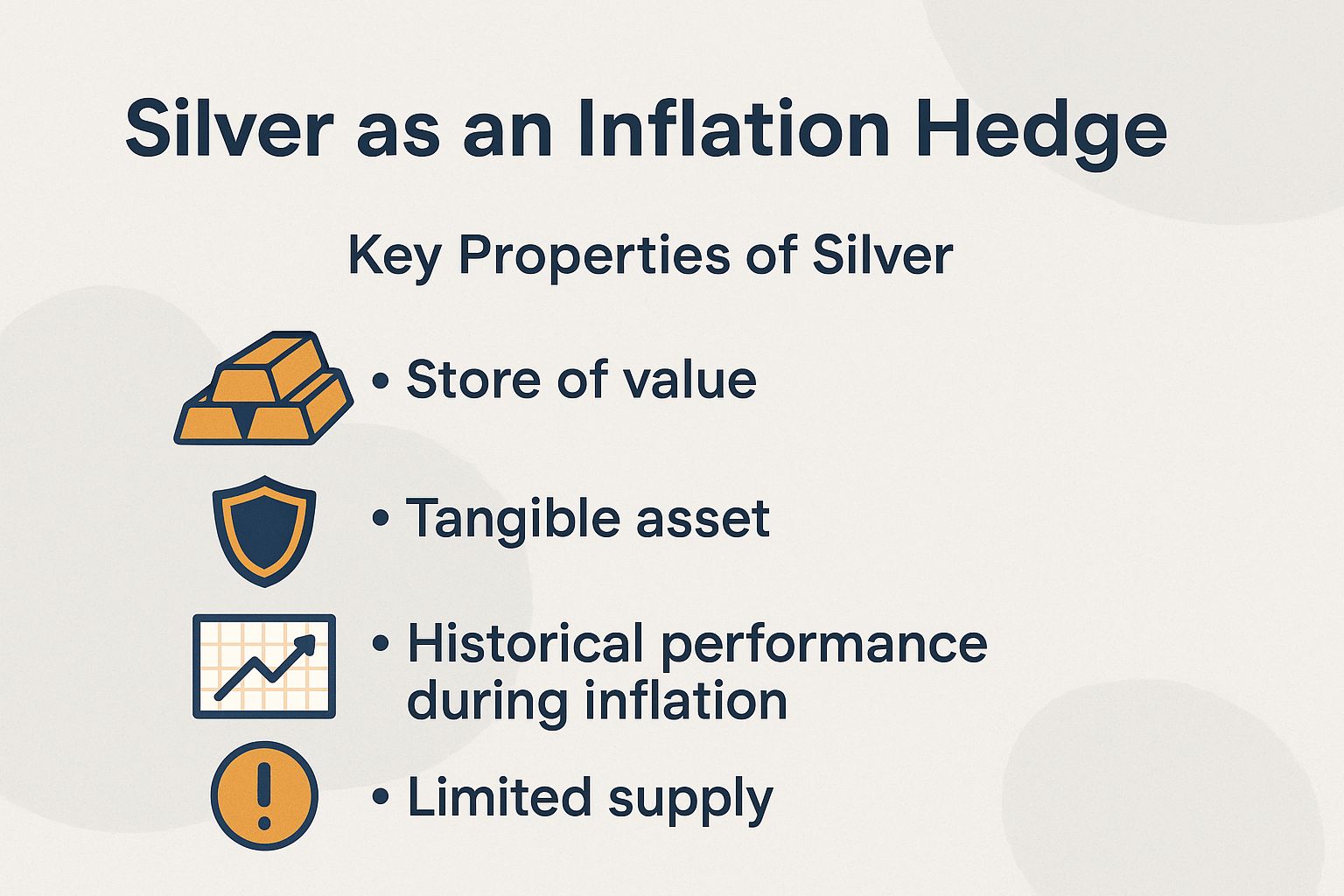
Silver shines as your shield against inflation. Let’s dive in and see how it can supercharge your portfolio!
Silver has long been a trusted store of value. It acts as a safe haven during inflation.
From 1971 to 2020, it beat fiat currencies and other commodities by 7.5% each year, adjusted for inflation. The World Silver Survey provides the data.
Key Properties of Silver
Silver stands out as an investment and industrial metal. It has top-notch electrical and thermal conductivity.
Among metals, it offers the best density, malleability (ability to be shaped without breaking), and antimicrobial qualities. You can buy it as 99.9% pure bullion.
This makes silver perfect for both investing and industry use. In 2022, global demand hit 1.2 billion ounces, per the Silver Institute. Demand is booming!
Investors particularly appreciate silver for five distinctive attributes:
- Scarcity: Above-ground stocks are estimated at approximately 3 billion ounces, based on data from the United States Geological Survey (USGS).
- Tangibility: It is standardized in troy ounces, exemplified by the 1-ounce American Silver Eagle coin, which achieves 99.9% purity.
- Liquidity: Silver is actively traded on the COMEX exchange, with spot prices averaging around $25 per ounce in 2023.
- Industrial Utility: This accounts for about 50% of demand, primarily from applications in solar panels and electronics.
- Aesthetic Value: It drives approximately 25% of usage in jewelry and related sectors.
Silver is more volatile than gold or platinum. Its beta of 1.5 (a measure of market risk, compared to gold’s 1.0) shows bigger price swings, seen in the silver-to-gold ratio.
Yet, it offers higher returns in inflation times. The CPM Group’s 2023 survey confirms this exciting potential.
- Physical silver: Bullion, coins like Silver Eagles or Maple Leafs, junk silver, or 90% coins for collectors (numismatics means coin collecting).
- Paper silver: ETFs, futures, or options trading.
- Mining stocks: Great for quick trades.
These options make entry easy. Watch for storage fees, liquidity, fakes, verification, and trusted dealers to stay safe. Jump in now before prices rise!
Historical Performance of Silver
From 1915 to 2023, silver delivered 4.8% real annual returns. It beat inflation measures like the CPI (a gauge of rising prices) by 2.3% on average, per Kitco data.
Silver’s toughness shines through history. Ancient civilizations valued it highly.
Silver shaped history from ancient times to the Spanish dollar era. The Comstock Lode rush and silver standard era highlight its power – imagine the excitement of those discoveries!
Key Historical Wins
- 1970s Stagflation (stuck high inflation and slow growth): With CPI at 13%, silver soared 1,200% from $1.50 to $50/oz. Adjusted for 7% inflation, that’s about 35% annual gains (Macrotrends.net data) – what a ride!
- 2008 Crisis: Silver jumped 444% from $9 to $49/oz in two years. After 3% inflation, real return hit 160%.
- Post-2020: It rose 50% to $30/oz during 7% inflation. Adjusted, that’s 40% over three years – silver’s comeback power!
Don’t miss the next surge!
The LBMA study shows silver beat bonds by 150% in high-inflation decades. Its low link to stocks and bonds adds diversification.
Use it to hedge against inflation risks. Add 5-10% to your portfolio via ETFs like SLV – easy and exciting!
Current Market Dynamics
In 2023, silver’s spot price averaged $23.50/oz. A 184 million ounce supply deficit drove it up (Silver Institute).
Industrial demand hit 654 million ounces, up 10% from last year. Act fast – shortages could push prices higher!
This gap highlights ongoing mining hurdles. Production can’t keep up with demand – a golden opportunity for investors!
In 2022, global mining produced 830 million ounces of silver.
Recycling added 180 million more ounces, according to the 2023 Mineral Commodity Summaries from the USGS (United States Geological Survey).
Industrial uses drove half the demand, especially in solar panels and electronics.
Investments took 30%, and jewelry 20%.
Today’s mining must tackle environmental effects.
Choose sustainable sources to protect our planet-it’s urgent!
The market flipped from a 2020 surplus of over 100 million ounces to a 2023 deficit.
U.S.-China trade tensions boosted tech demand by 5-7%.
Watch silver prices live on sites like Kitco or TradingView.
Spot great buys when prices dip-don’t miss out!
Silver Price Performance and Demand Growth 2024
Boost your wealth protection in shaky times.
Add silver to your mix of stocks, real estate, crypto, collectibles, and bonds.
Try these smart strategies for long-term investing and retirement:
- Dollar cost averaging: Buy fixed amounts regularly to smooth out costs.
- Buy low, sell high: Grab deals and cash in on rises.
- Time the market wisely: Watch trends to boost gains.
Handle risks like volatility and taxes along the way.
Talk to a financial advisor for your setup.
They’ll guide on minimum investments, holding times, and rebalancing.
Build an emergency fund and diversify-silver excels in recessions, inflation spikes, or money printing (like quantitative easing, where central banks print more money) when real value matters most!
/* Economic indicators dashboard styles incorporating CPI, fiat currency, bars, silver ETFs, monetary policy, Federal Reserve, Spanish dollar, Comstock Lode */ #rh5z5y4l.bar-container { position: relative; overflow: visible!important; } #rh5z5y4l.bar-value { position: absolute!important; left: 50%!important; top: 50%!important; transform: translate(-50%, -50%)!important; color: white!important; font-weight: 700!important; font-size: 14px!important; white-space: nowrap!important; background: rgba(0, 0, 0, 0.7)!important; padding: 4px 12px!important; border-radius: 20px!important; z-index: 30!important; text-shadow: 0 1px 2px rgba(0, 0, 0, 0.3)!important; pointer-events: none!important; display: inline-block!important; } #rh5z5y4l.animated-bar { z-index: 1!important; } @media (max-width: 768px) { #rh5z5y4l { padding: 16px!important; } #rh5z5y4l h2 { font-size: 24px!important; } #rh5z5y4l h3 { font-size: 16px!important; } #rh5z5y4l.bar-label { font-size: 12px!important; } #rh5z5y4l.metric-card { padding: 20px!important; } #rh5z5y4l.bar-value { font-size: 13px!important; padding: 3px 10px!important; } } @media (max-width: 480px) { #rh5z5y4l { padding: 12px!important; } #rh5z5y4l h2 { font-size: 20px!important; } #rh5z5y4l h3 { font-size: 14px!important; } #rh5z5y4l.bar-label { font-size: 11px!important; margin-bottom: 6px!important; } #rh5z5y4l.bar-value { font-size: 12px!important; padding: 2px 8px!important; min-width: 45px!important; text-align: center!important; } #rh5z5y4l.bar-container { height: 36px!important; overflow: visible!important; } }
Silver Price Performance and Demand Growth 2024 Amid Fiat Currency Concerns and CPI Pressures

Price Changes: Annual Price Gain (%) Influenced by Federal Reserve’s Monetary Policy
Demand Metrics: Solar Demand Share (%)
Demand Metrics: Solar Industry Growth (%)
Supply and Ratio: Gold-Silver Ratio, Physical Bars, and Silver ETFs
(function() { setTimeout(function() { var bars = document.querySelectorAll(‘[class*=”animated-bar-rh5z5y4l”]’); bars.forEach(function(bar) { var width = bar.getAttribute(‘data-width’); if (width) { bar.style.width = width + ‘%’; } }); }, 100); })();
The Silver Price Performance and Demand Growth 2024 data underscores silver’s robust market dynamics, driven by industrial demand and investment appeal amid economic uncertainties. This overview examines price fluctuations, escalating solar sector needs, and the evolving gold-silver ratio, highlighting silver’s potential as a strategic asset.
In Price Changes, silver has shown impressive gains, with a 21.46% annual increase over the 12 months to December 2024, reflecting steady appreciation. From January to October 2024, silver surged by 28.0%, outpacing many commodities despite volatility in global markets. Comparatively, gold achieved a remarkable 70.0% gain in the same period, signaling broader precious metals strength amid inflation concerns and geopolitical tensions. These trends suggest silver’s dual role as an industrial metal and safe-haven investment, benefiting from supply constraints and rising demand.
Demand Metrics reveal silver’s pivotal role in renewables, particularly solar energy. The current solar demand share stands at 16% of total silver consumption, a significant rise from just 6% in 2015, as photovoltaic panels increasingly incorporate silver for conductivity. The solar industry’s explosive growth further bolsters this: 76% expansion in 2023 was fueled by policy incentives and technological advancements, with a 34% forecast for 2024 indicating sustained momentum. Annualized growth since 2015 at 27% emphasizes silver’s essential position in the green energy transition, where efficiency demands more silver per panel.
- Silver’s industrial applications extend beyond solar to electronics and EVs, amplifying overall demand pressure.
- This growth trajectory could tighten supply, supporting higher prices long-term.
The Supply and Ratio metrics highlight market imbalances. The gold-silver ratio, currently at 85 in 2024, exceeds the historical average of 70 since the 1980s, evolving from bimetallic standards based on the Spanish dollar, meaning it takes more ounces of silver to buy one ounce of gold. This elevated ratio indicates silver’s relative undervaluation, often signaling bullish potential for silver as ratios normalize during economic recoveries.
Overall, the Silver Price Performance and Demand Growth 2024 paints an optimistic picture, with price gains and solar-driven demand positioning silver for continued strength. Investors and industries alike should monitor these factors for opportunities in sustainable technologies and portfolio diversification.
Calculating Your Silver Needs

To mitigate the anticipated 3-5% annual inflation rate, it is advisable to allocate 5-10% of one’s investment portfolio to silver. For a portfolio valued at $100,000, this corresponds to 100-500 ounces, in accordance with modern portfolio theory as outlined in Vanguard studies.
Assessing Inflation Rates
Utilize the Bureau of Labor Statistics (BLS) Consumer Price Index (CPI) calculator to evaluate inflation’s impact: An annual inflation rate of 4% over 10 years diminishes the purchasing power of $10,000 to approximately $6,755, underscoring the importance of implementing hedges such as silver investments.
To implement an effective hedging strategy, adhere to the following structured approach:
- Access the CPI Inflation Calculator on BLS.gov; input the base amount ($10,000), starting year (e.g., 2023), and ending year (2033), applying a 4% inflation rate to verify the extent of purchasing power erosion.
- Conduct thorough research on silver investments: Monitor spot prices through Kitco.com (currently approximately $25 per ounce); acquire physical bars or coins from reputable dealers such as APMEX, allocating 5-10% of your portfolio in accordance with Vanguard’s recommended guidelines.
- Diversify holdings by investing in Treasury Inflation-Protected Securities (TIPS) via TreasuryDirect.gov, which provide real yields exceeding 1% based on Federal Reserve data from 2023.
- Perform annual monitoring aligned with the Federal Reserve’s long-term inflation projection of 2.5%; utilize portfolio management tools such as Personal Capital to track erosion. A common oversight is excessive reliance on silver without adequate diversification-maintain a balanced allocation across asset classes. (92 words)
Portfolio Allocation Formulas
Use this simple formula to figure out your silver allocation: Silver Allocation = (Portfolio Value x Hedge Percentage) / Current Spot Price. For instance, a 5% hedge on a $500,000 portfolio at $25 per ounce means you need 1,000 ounces.
To implement this strategy, adhere to the steps outlined below for effective hedging.
- First, pick your hedge percentage. Aim for 5-10% to fight inflation, like the 7.5% in Ray Dalio’s All-Weather Portfolio for commodities including silver.
- Grab the current spot price – that’s the market price right now – from trusted spots like Kitco.com or Bloomberg.
- Next, calculate your allocation in Excel or similar tools. Use this formula: =(portfolio_value * 0.05) / spot_price.
- For the example, buy via ETFs like iShares Silver Trust (SLV) to skip storage hassles. That 1,000 ounces costs about $25,000 at $25 per ounce – easy and cost-free!
- Rebalance the portfolio annually employing tools such as Portfolio Visualizer to preserve the target allocation.
Check out Morningstar’s 2022 study – it’s full of promise!
A 10% allocation to precious metals boosts annual returns by 1.2%. It also cuts volatility by 20% compared to an all-stock portfolio.
Factors Influencing Silver Prices
Silver prices are significantly influenced by interest rates, where a 1% increase by the Federal Reserve typically results in a 10-15% decline in prices due to the opportunity cost of holding non-yielding assets. This dynamic was evident in 2022, when silver prices fell by 25% amid interest rates reaching 5.5%.
Along with interest rates, six primary factors contribute to the dynamics of silver pricing:
- Macroeconomic trends: The U.S. Dollar Index rose by 10% in 2022, which correlated with a 15% decline in silver prices (according to CME Group data).
- Supply and demand imbalances: A deficit of 184 million ounces in 2023 contributed to a 5% increase in prices.
- Industrial demand: The growing adoption of electric vehicle batteries is projected to increase demand by 20% by 2030 (BloombergNEF estimates).
- Investment flows: Inflows of $2 billion into the SLV ETF during the first quarter of 2023 helped bolster price gains.
- Geopolitical events: The Russia-Ukraine conflict led to a 20% spike in silver prices in 2022.
- Mining costs: Modern all-in sustaining costs reached $12 per ounce (World Gold Council data), contrasting with the prolific silver output from the historic Comstock Lode in the 19th century.
Silver prices climb with extra demand and drop when the U.S. dollar strengthens, says CME Group.
Risks and Mitigation Strategies
Silver investments can swing wildly, with 30% annual volatility – twice that of stocks.
But diversification works wonders! It slashed losses by 40% in the 2008 crisis, per JPMorgan’s study.
Key challenges associated with silver investments include the following:
- Price Volatility: Silver experienced a 40% decline in 2020, which substantially eroded prior gains. This risk can be managed through the implementation of stop-loss orders on reputable platforms such as TD Ameritrade.
- Storage and Security Concerns: Storing silver at home introduces a premium risk of 5-10% due to potential theft. Investors are advised to utilize allocated storage facilities, such as those provided by Brinks, at an annual cost of $0.50 per ounce.
- Liquidity During Market Downturns: Over-the-counter (OTC) markets may become illiquid during periods of economic stress. To address this, investors should consider exchange-traded funds (ETFs) like the iShares Silver Trust (SLV), which boasts $15 billion in assets under management and facilitates rapid transactions.
- Opportunity Cost: In bullish market conditions, silver has underperformed the S&P 500 by approximately 5%. To minimize this, exposure to silver should be limited to no more than 5% of the overall portfolio.
The 2011 silver crash hit hard – prices plunged 50%, crushing over-leveraged traders.
Stay smart with dollar-cost averaging to cut losses. It matches SEC tips for handling commodities.