Silver has long played second fiddle to gold among precious metals. Now, it’s on the edge of a huge boom driven by demand in the commodities market.
Industries worldwide are speeding up electrification and green energy efforts. Silver’s top-notch conductivity and ability to kill bacteria are sparking massive demand, which could cause prices to skyrocket like the 1980 Hunt brothers’ squeeze.
This article explores silver’s key roles in electronics, solar panels, 5G tech, electric cars, and medical devices.
It looks at mining supply issues and shortages. You’ll also see historical price jumps and forecasts for investment chances as shortages grow.
Current Industrial Applications of Silver
Silver conducts electricity and heat better than most metals. This makes it essential in modern industries, where it met 54% of demand in 2022-the Silver Institute’s World Silver Survey calls it the biggest chunk of global use that year.
Electronics and Semiconductors
- Silver paste powers 90% of solar cells and semiconductors-85 million ounces used in 2022 (Silver Institute).
- In RFID tags, silver ink boosts signal range by 50% over copper.
- Smartphone touchscreens use silver nanowires to cut resistance by 70% for faster response (2023 IEEE study).
- Silver alloys replace gold in semiconductors, saving 20% on costs.
- Each iPhone 14 has 0.034 grams of silver-1.3 million ounces for 100 million units.
Keep an eye on supply chains using tools like Bloomberg Terminal. Watch for price changes and economic shifts to spot trends.
Photovoltaics and Solar Energy
Solar panels gobbled up a record 140 million ounces of silver in 2022-21% of all industrial use. Installations jumped 24% that year (IRENA 2023).
Silver creates conductive grids in solar cells, capturing electrons at 99% efficiency. A 400W panel needs just 0.1 grams of silver paste.
- New silver mixes boosted cell efficiency from 22% to 24% (NREL 2023), using less material for more power.
- A 1MW solar farm requires 250 kg of silver and pays back in 8-10 years at $0.30 per watt.
- Recycle up to 90% through programs like PV Cycle to fight shortages and boost sustainability.
Silver Supply and Mining Challenges
Rising demand is hitting silver mining hard. Production is dropping in key areas, draining reserves fast.
We need more exploration and new mines to fix shortages. Sustainable practices are key with tougher eco-rules.
The market has an ongoing deficit. There’s little extra stock to meet booming needs-act now before prices surge!
Emerging Technologies Fueling Demand
These techs could double demand-don’t miss out!
- 5G networks need silver for high-speed connections.
- Electric vehicles use silver in batteries for better range.
- Medical devices rely on silver’s antibacterial power.
Exciting news from the CPM Group’s Silver Yearbook 2023! Emerging tech sectors like AI could add 100 million ounces to annual silver demand by 2030.
This surge speeds up market growth past old uses like photography and jewelry.
Silver Demand Breakdown 2024
- Industrial: 50% (electronics, solar).
- Jewelry/Silverware: 20%.
- Investment: 25%.
- Other: 5% (photography declining).
Silver in Diverse Applications
Silver goes beyond basics with its antibacterial powers. These make it key for medical devices, water purification, and catalysts.
- In green energy, silver boosts EV batteries.
- It powers wind systems and hydrogen fuel cells.
- Silver powers mirrors, glass coatings, brazing, and solder. It also stars in silver powder and nanoparticles via nanotechnology.
Investment and Market Dynamics
Silver acts as a strong shield against inflation in precious metals. Invest through physical bullion, ETFs (funds that track silver prices like stocks), or the futures market.
Analysts see a huge bull market coming, with prices ready to explode! Supply shortages and rising industrial demand drive this thrill.
Economic factors like inflation, falling currencies, and global tensions spark speculation and wild price swings.
- Central banks’ moves affect the US, Europe, emerging markets, and China’s booming demand.
Analysis and Trading Strategies
Make smart choices using fundamental analysis. Pair it with technical tools for better insights.
- Study charts and the silver-to-gold ratio.
- Watch support and resistance levels.
Track linked assets too.
- Precious metals: gold, platinum, palladium.
- Industrial ones: copper, aluminum.
Market Participants
Hedge funds, big institutions, and everyday investors jump into the futures market. They use options, leverage (borrowed power to amp trades), and margin while watching volume and open interest.
Stay safe with smart risk management and spread-out portfolios. This helps ride bull markets, survive bears, handle corrections, join rallies, and spot breakouts.
#abe4g78o.bar-container { position: relative; overflow: visible!important; } #abe4g78o.bar-value { position: absolute!important; left: 50%!important; top: 50%!important; transform: translate(-50%, -50%)!important; color: white!important; font-weight: 700!important; font-size: 14px!important; white-space: nowrap!important; background: rgba(0, 0, 0, 0.7)!important; padding: 4px 12px!important; border-radius: 20px!important; z-index: 30!important; text-shadow: 0 1px 2px rgba(0, 0, 0, 0.3)!important; pointer-events: none!important; display: inline-block!important; } #abe4g78o.animated-bar { z-index: 1!important; } @media (max-width: 768px) { #abe4g78o { padding: 16px!important; } #abe4g78o h2 { font-size: 24px!important; } #abe4g78o h3 { font-size: 16px!important; } #abe4g78o.bar-label { font-size: 12px!important; } #abe4g78o.metric-card { padding: 20px!important; } #abe4g78o.bar-value { font-size: 13px!important; padding: 3px 10px!important; } } @media (max-width: 480px) { #abe4g78o { padding: 12px!important; } #abe4g78o h2 { font-size: 20px!important; } #abe4g78o h3 { font-size: 14px!important; } #abe4g78o.bar-label { font-size: 11px!important; margin-bottom: 6px!important; } #abe4g78o.bar-value { font-size: 12px!important; padding: 2px 8px!important; min-width: 45px!important; text-align: center!important; } #abe4g78o.bar-container { height: 36px!important; overflow: visible!important; } }
Silver Demand Breakdown 2024
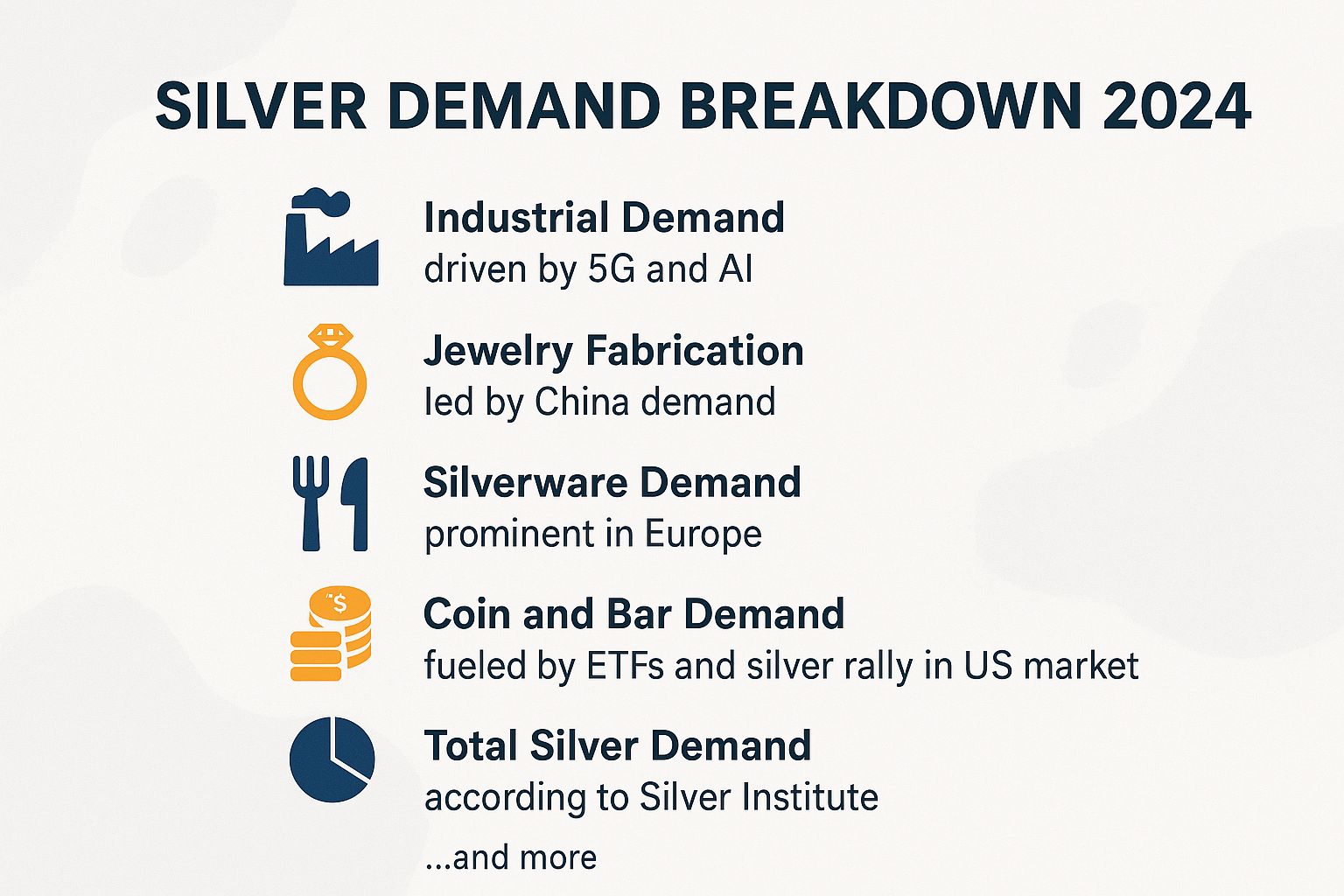
Demand Categories: Industrial Demand (driven by 5G and AI)
Demand Categories: Jewelry Fabrication (led by China demand)
Demand Categories: Silverware Demand (prominent in Europe)
Demand Categories: Coin and Bar Demand (fueled by ETFs and silver rally in the US market)
Demand Categories: Total Silver Demand (according to Silver Institute)
(function() { setTimeout(function() { var bars = document.querySelectorAll(‘[class*=”animated-bar-abe4g78o”]’); bars.forEach(function(bar) { var width = bar.getAttribute(‘data-width’); if (width) { bar.style.width = width + ‘%’; } }); }, 100); })();
The Silver Demand Breakdown 2024 offers a comprehensive view of how silver is utilized across various sectors, measured in million ounces (Moz) except for the total in billion ounces (Boz). This data reveals a mixed picture of growth and contraction.
Total demand reached 1.16 Boz, marking a -3.0% year-over-year decline. Despite the overall dip, industrial applications show resilience, highlighting silver’s critical role in technology and manufacturing amid economic uncertainties.
Industrial Demand, the largest segment at 680.5 Moz, experienced a modest 4.0% growth. This surge is driven by silver’s essential properties as a conductor in electronics including AI hardware, solar panels, and automotive components.
The photovoltaic (solar power) industry boosted demand as renewable energy adoption accelerates in Europe and globally. Sectors like medical devices and batteries for electric vehicles further contribute, underscoring silver’s critical status in green technologies and innovation-driven markets.
- Jewelry Fabrication: At 208.7 Moz with 3.0% growth, this category reflects steady consumer interest in silver as an affordable luxury. Emerging markets in Asia, especially India and China, drive, fuel this demand through cultural traditions and rising disposable incomes. Artisanal and sustainable jewelry trends also play a role, encouraging ethical sourcing.
- Silverware Demand: This smaller segment totals 54.2 Moz but saw a -2.0% decline. Shifting preferences toward modern tableware and less formal dining post-pandemic caused the drop, though premium silverware for gifting holds steady.
- Coin and Bar Demand: This volatile area hit 190.9 Moz with a sharp -22.0% drop. High interest rates and stock fluctuations hurt investment, but silver’s safe-haven status could spark a thrilling rebound amid economic chaos-don’t miss it!
Industrial growth offsets investment losses, signaling caution for miners and suppliers. Silver acts as both an industrial powerhouse and speculative asset-watch geopolitical shifts and tech breakthroughs closely for exciting rebounds. Diversify into booming renewables now to thrive in this dynamic market!
5G Infrastructure and EVs
Each 5G base station needs up to 1 kg of silver for antennas and switches. Electric vehicles (EVs) use 25-50 g in batteries and wiring.
This ramp-up drove a 15% surge in silver demand in 2023, per the International Energy Agency-get ready for more!
Silver’s top conductivity powers 5G radio frequency (RF) filters, cutting signal loss by up to 40%, says Ericsson’s 2023 whitepaper. This boost enables blazing-fast data speeds in busy cities-imagine the possibilities!
In the context of electric vehicles, the Tesla Model 3 incorporates approximately 35 g of silver in its power electronics to facilitate efficient energy transfer, as outlined in the Silver Institute’s 2022 report.
This combined demand from 5G and EVs is projected to necessitate 50 million ounces of silver globally by 2025 for the 5G rollout alone, per GSMA Intelligence.
Stay ahead by checking Reuters commodity feeds for live supply updates. Focus on mining from top spots like Mexico and Peru to spot price swings early-act fast!
Antimicrobial Uses in Healthcare
Silver kills 99.9% of bacteria like E. coli in just six hours, per EPA studies. This power drives its use in 20% of wound dressings and catheters, with the market growing 8% yearly through 2028, according to Grand View Research.
Colloidal silver shines in wound care products like Acticoat dressings. These use 0.1% silver nanoparticles to release ions that bust bacterial cell walls and stop infections cold.
A 2022 NIH study showed silver dressings cut hospital infections by 50% in burn patients-way better than old gauze! This breakthrough highlights silver’s lifesaving edge in healthcare.
The demand for silver-infused personal protective equipment (PPE) increased by 30% during the COVID-19 pandemic, according to data from the Silver Institute, underscoring silver’s critical role in infection prevention and control.
For future innovations, integrating silver-impregnated bandages with Internet of Things (IoT) sensors could enable real-time monitoring of wound pH and moisture levels. This approach would facilitate proactive adjustments to patient care, emphasizing medical efficacy in contrast to applications in water purification.
Water Purification Innovations
Silver nanoparticles incorporated into ceramic filters effectively eliminate 99.99% of pathogens, as confirmed by World Health Organization guidelines. This technology is projected to drive a global market valued at $2.5 billion by 2027, with applications in approximately 500 million household units worldwide (Market Research Future).
To make these filters last longer, makers use a process called electrochemical deposition to add 10-50 parts per million (ppm) of silver nanoparticles into the ceramic material. This stops bacteria from growing back and keeps silver from seeping into the clean water.
A 2023 U.S. Environmental Protection Agency study shows silver-enhanced reverse osmosis systems cut costs by 15% compared to standard methods. Reverse osmosis uses pressure to filter out impurities, making this tech perfect for scaling up in rural spots.
Take LifeStraw’s silver filters-they clean up to 4,000 liters each and stop around 10,000 waterborne illnesses yearly in needy areas. Game-changer for clean water access!
Investors may monitor advancements in this field through the United States Patent and Trademark Office databases, which recorded over 1,200 patents related to silver filtration in 2022. These filings emphasize eco-friendly scalability rather than medical applications.
Supply Constraints and Shortages
The Silver Institute reports a huge 215 million ounce shortfall in 2023-the fifth year running! Demand exploded to 1.2 billion ounces while mine output stayed flat, creating real urgency for suppliers.
Mining Production Limits
Silver mining output dropped 1% in 2022 to 830 million ounces. Lower ore grades of 80 grams per ton and rising costs of $12 per ounce caused this, per the World Silver Survey 2023.
- Diminishing reserves hit hard, with Peru and Mexico supplying 40% of global output. Drone surveys help find new sites, like Franco-Nevada’s $100 million push.
- Regulatory hurdles from ESG and NI 43-101 standards raise costs 20%. Streamlined tools counter this.
- Labor issues, such as KGHM’s 2022 Poland strike, cost 5 million ounces. Union talks prevent repeats.
- The 2020 Peasquito shutdown in Mexico spiked prices 10%.
Recycling efforts provide a counterbalance, with annual recovery reaching 185 million ounces-a 5% increase-facilitated by improved processing of electronic waste.
Historical Price Surges from Demand
- In 1980, prices jumped from $6 to $50 per ounce-a whopping 733% surge-as the Hunt Brothers tried to control the market amid inflation. Check out the dramatic ‘Silver Thursday’ story!
- Fast-forward to 2011: Prices soared 150% to $49.80 on booming industrial needs, like 15% more solar panels, plus investors grabbing safe assets (Kitco data).
Following 2020, amid the global pandemic, advancements in green technologies, including electric vehicle batteries, contributed to a 140% price escalation from their lows to $29.50. A particularly noteworthy episode occurred in 2021, when the r/WallStreetBets Reddit community’s silver squeeze effort led to a temporary 20% price increase, attracting significant retail investor participation in the US market.
For traders, watch the Relative Strength Index (RSI), a tool that measures the speed and change of price movements. Readings above 70 show overbought conditions, so stay cautious to cut losses in this volatile market.
Investment Opportunities and Risks
Investment Options
- Buy shares in the SLV ETF, which holds 450 million ounces of silver and manages $25 billion in assets.
- Trade futures on the COMEX exchange for direct exposure.
- Opt for physical bars from dealers like JM Bullion at a $1-2 premium over spot price.
- Store physical silver in Brinks vaults for $0.50 per ounce yearly.
- Choose SLV for easy trading, no storage hassle, a 0.50% fee, and a solid 4-star Morningstar rating.
Pros and Cons
- Physical Bullion:
- Pros: Tangible ownership you can hold.
- Cons: 5-10% premium and storage costs.
- ETFs (SLV):
- Pros: High liquidity and no storage needed.
- Cons: Counterparty risk from the fund manager.
Add 5% to 10% silver to your portfolio. This follows smart strategies from investor Ray Dalio.
Geopolitical events can shake prices. The 2022 Ukraine conflict caused a 15% jump. Protect yourself with hedging tools like call options at a $20 strike price.
Imagine investing $10,000 in SLV back in 2020. By 2023, it would have grown to $14,700 – that’s real potential!
Future Outlook for Silver Prices
JPMorgan analysts predict silver at $26 per ounce in 2024, rising to $30 by 2025. Expect 12% demand growth from electric vehicles, solar power, 5G, and AI in the US and Europe – the future looks bright!
China’s demand adds fuel. Imports jumped 20% in 2023, per official data.
Bullish vs. Bearish Scenarios
- Bullish: Prices could hit $35 per ounce by 2030, with demand over 1.5 billion ounces yearly (Silver Institute).
- Bearish: A strong US dollar might cap prices at $20 per ounce (UBS analysis).
Silver holds support at $21, its 200-day moving average. The RSI at 55 shows neutral momentum right now.
Try a hybrid approach. Target a gold-silver ratio of 60:1 for better protection against ups and downs.
Silver plays a huge role in green tech shifts. The World Bank’s 2023 Critical Minerals Outlook stresses this key point.