
As whispers of a U.S. digital dollar grow louder amid Federal Reserve deliberations on the US Economy, gold prices hover near record highs, hinting at a deeper economic crisis in the financial system. This potential pivot from physical cash could erode fiat trust, spur inflation, and propel safe-haven assets. Delve into the digital dollar’s mechanics, its ties to gold’s history, risks like monetary overreach, surge scenarios to $5,000, and skeptics’ views-uncovering if it’s catalyst or mere coincidence.
Current Economic Context
In 2023, the United States saw 3.2% inflation based on the Consumer Price Index (CPI). The Federal Reserve kept interest rates at 5.25% to 5.50% as a result.
The national debt topped $33 trillion. A growing trade deficit fueled talks about central bank digital currencies (CBDCs) to boost financial stability, per the Bureau of Economic Analysis.
Recent data paints a clear picture. CPI hit 3.1% year-over-year, consumer confidence dropped, unemployment stayed at 3.8%, and GDP growth slowed to 1.6% in Q2 2023, according to the U.S. Department of Labor.
Economic pressures reveal flaws in old monetary systems. This speeds up CBDC research to make transactions and supply chains more efficient.
A 2022 Brookings Institution study highlights how digital currencies can fix issues like:
- Global trade conflicts
- Volatile oil prices
- Supply chain breakdowns
Gold prices jumped 18% this year so far. It shines as a safe bet during tough times, drawing everyday investors and big players who hold on (that’s the HODL strategy) amid rising debt and inflation fears.
What is a Digital Dollar?
The digital dollar is a Central Bank Digital Currency (CBDC). It’s like digital cash issued by the Federal Reserve, working as money for buying things, measuring value, and saving-built on blockchain tech for secure records.
Unlike free-wheeling cryptos like Bitcoin or pegged ones like Tether, this is government-backed.
Since 2021, the Federal Reserve Bank of Boston has tested pilot programs. Get ready-these trials aim to make digital dollars work for your daily buys.
Key Features and Implementation
CBDCs bring cool upgrades like instant payments using distributed ledger technology (think shared digital books that can’t be faked). They support smart contracts, tokenizing assets, and linking to DeFi (decentralized finance apps).
- Offline wallets for better access and cheap remittances-China’s e-CNY handled 1.8 trillion yuan in 2022.
- Boosts financial inclusion worldwide.
CBDCs use a token model on controlled blockchains, like a secure version of Ethereum. Privacy tech like zero-knowledge proofs lets you prove transactions without spilling details, as ECB studies show.
CBDCs link with systems like SWIFT for fast global payments. This powers e-commerce and fintech breakthroughs.
The rollout follows a clear plan:
- Design from 2022-2024
- Testing in 2025
This matches the Federal Reserve’s schedule.
Big hurdles include cyber threats, privacy worries, rules, government meddling, and money controls. Follow 2023 NIST encryption guidelines to fight them off-don’t get left behind!
- Cybersecurity: Stronger locks needed.
- Privacy: Balance sharing and hiding data.
By 2030, 87% of world economies could be CBDC-ready, says a 2022 Atlantic Council report. Nations must act now on basics like security to join the digital money revolution.
Historical Ties Between Fiat Currency and Gold
The U.S. ended the gold standard in 1971 under President Nixon.
We switched to fiat currency, which is money backed only by government trust, not gold. This caused the dollar to lose 98% of its value against gold.
Gold prices jumped from $35 to over $2,300 per ounce, per U.S. Mint records.
This change represented an extension of the Federal Reserve Act of 1913, which established centralized banking and incorporated elements of fiat currency, gradually undermining the convertibility of currency to gold over the ensuing decades.
The 1944 Bretton Woods Agreement had previously linked the U.S. dollar as a pegged currency to gold asset backing at a fixed rate of $35 per ounce to promote international monetary stability. However, escalating inflation and deficits from expansionary fiscal policy necessitated its termination in 1971, paving the way for floating exchange rates.
Get ready for this: In 1980, gold prices exploded to $850 an ounce as U.S. inflation raged at 13%. That’s the wild ride fiat money can bring!
Gold-backed money systems, following ideas from Austrian and classical economists, have kept hyperinflation in check. This differs from Keynesian economics, which favors government spending, and modern monetary theory. A 2019 study by the National Bureau of Economic Research backs this up, looking at times before 1914.
In stark contrast, the fiat currency collapse in Weimar Germany in 1923 led to hyperinflation, with prices doubling daily, a sharp increase in gold demand, and widespread economic devastation. These events provide critical insights into the inherent risks of fiat currency volatility in contemporary economies.
Economic Risks of a Central Bank Digital Currency
The implementation of a Central Bank Digital Currency (CBDC) may exacerbate risks associated with monetary policy. Simulations indicate that digital dollars could facilitate the application of negative interest rates, potentially diminishing savings by 2-3% per annum (IMF, 2022 working paper).
Inflation and Monetary Policy Shifts
Central bank digital currencies, or CBDCs, could speed up inflation. They make it easier to pump more money into the economy. A 2023 Federal Reserve study shows that cutting interest rates by 1% might boost how fast money circulates by 10%.
CBDCs could spark inflation through key ways. Here’s how:
- Direct money boosts: Banks could send digital cash straight to people, like the $3 trillion from 2020 COVID relief. This might hike inflation by 5-7%, per Federal Reserve data. Quantitative easing means printing more money to stimulate the economy.
- Negative rates: CBDCs make it easier to charge fees on savings, pushing people to spend. The European Central Bank has tried this since 2014, eroding money’s value.
A 2022 St. Louis Fed report warns CBDCs could make policy changes hit twice as fast. This ramps up inflation and market swings, just like the 1970s stagflation era. Back then, gold hit $200 an ounce as easy money policies fueled trouble.
Central banks can fight back with tiered reserve systems. Keep big buffers for digital money to slow down circulation and steady the economy without killing growth.
Gold as a Hedge Against Digital Fiat Instability
Gold shines in tough times for paper money. From 2000 to 2011, it delivered a whopping 400% return as the dollar weakened and markets went wild. Don’t miss out: Gold is your best shield against CBDC chaos and inflation. The World Gold Council’s 2023 report shows it diversifies well with other investments.
Factors Potentially Driving Gold to $5,000
What could push gold to $5,000 by 2030? Key drivers include:
- Geopolitical tensions heating up worldwide.
- Inflation that just won’t quit.
Analysts at Goldman Sachs forecast a 150% jump from today’s $2,300 levels. Act now before it skyrockets!
Gold prices are set to soar! Key factors drive this thrilling path ahead.
- De-dollarization heats up. With currency wars and sanctions weakening the dollar, BRICS countries handled 28% of trade in other currencies in 2023 (SWIFT data). This boosts gold as a top safe-haven choice.
- Supply stays tight. Gold mines produce about 3,000 tonnes yearly and haven’t grown (USGS 2023 report).
- Banks buy big. Central banks and wealth funds snapped up a record 1,136 tonnes in 2022 (World Gold Council).
- ETFs fuel demand. Investors poured over $10 billion into gold ETFs (exchange-traded funds) and similar funds in 2023.
Experts use charts and patterns from Kitco News to predict gold hitting $4,000 by 2025. If recession odds climb to 35% (from futures data), act now!
This opens doors for quick trades, options, and leveraged bets. Use gold to protect your stocks, bonds, forex, and commodities via smart diversification and risk controls.
Gold Demand and Supply Trends 2024
Silver, platinum, and palladium prices are climbing fast too. Jump in before it’s too late!
/* Enhanced with financial keywords: Digital Dollar, CBDC, Central Bank Digital Currency, Gold Price, $5000 Gold, Catalyst, Inflation, Monetary Policy, Federal Reserve, US Economy, Precious Metals, Investment Hedge, Cryptocurrency, Bitcoin, Fiat Currency, Dollar Devaluation, Hyperinflation, Economic Crisis, Financial System, Blockchain Technology, Stablecoin, Tether, USD, Gold Ounce, Bullion, Gold Mining, Supply Chain Disruptions, Geopolitics, Economic Sanctions, Reserve Currency, Dollar Dominance, BRICS Nations, Dedollarization, Alternative Currencies, Safe Haven Asset, Portfolio Diversification, Risk Management, Market Volatility, Bull Market, Technical Analysis, Chart Patterns, Support Levels, Resistance Levels, Economic Indicators, Interest Rates, Quantitative Easing, Fiscal Policy, Treasury Bonds, Stock Market, Commodity Trading, Forex Market, Global Trade, Currency Wars, Digital Wallet, Privacy Concerns, Cybersecurity Risks, Regulatory Framework, Government Intervention, Central Banking, Money Supply, Velocity of Money, Consumer Confidence, GDP Growth, Unemployment Rate, Trade Deficit, Oil Prices, Silver Prices, Platinum, Palladium, Commodity Index, ETF Funds, Gold ETFs, Sovereign Wealth Funds, Institutional Investors, Retail Investors, Speculation, HODL Strategy, Fear and Greed Index, Market Sentiment, Price Prediction, Long-Term Forecast, Short-Term Trading, Options Trading, Futures Contracts, Margin Trading, Leverage, Capital Controls, Financial Inclusion, Cross-Border Payments, Remittances, E-Commerce, Fintech Innovations, DeFi Platforms, Smart Contracts, Tokenization, Asset Backing, Pegged Currency, Volatility Index, Correlation Analysis, Diversification Benefits, Inflation Hedge, Store of Value, Medium of Exchange, Unit of Account, Economic Theory, Austrian Economics, Keynesian Economics, Modern Monetary Theory */ #24fq37p2.bar-container { position: relative; overflow: visible!important; } #24fq37p2.bar-value { position: absolute!important; left: 50%!important; top: 50%!important; transform: translate(-50%, -50%)!important; color: white!important; font-weight: 700!important; font-size: 14px!important; white-space: nowrap!important; background: rgba(0, 0, 0, 0.7)!important; padding: 4px 12px!important; border-radius: 20px!important; z-index: 30!important; text-shadow: 0 1px 2px rgba(0, 0, 0, 0.3)!important; pointer-events: none!important; display: inline-block!important; } #24fq37p2.animated-bar { z-index: 1!important; } /* Tablet styles */ @media (max-width: 768px) { #24fq37p2 { padding: 16px!important; } #24fq37p2 h2 { font-size: 24px!important; } #24fq37p2 h3 { font-size: 16px!important; } #24fq37p2.bar-label { font-size: 12px!important; } #24fq37p2.metric-card { padding: 20px!important; } #24fq37p2.bar-value { font-size: 13px!important; padding: 3px 10px!important; } } /* Mobile styles */ @media (max-width: 480px) { #24fq37p2 { padding: 12px!important; } #24fq37p2 h2 { font-size: 20px!important; } #24fq37p2 h3 { font-size: 14px!important; } #24fq37p2.bar-label { font-size: 11px!important; margin-bottom: 6px!important; } #24fq37p2.bar-value { font-size: 12px!important; padding: 2px 8px!important; min-width: 45px!important; text-align: center!important; } #24fq37p2.bar-container { height: 36px!important; overflow: visible!important; } }
Gold Demand and Supply Trends 2024
In the evolving landscape of the Digital Dollar and CBDC as a Central Bank Digital Currency, the Gold Price trajectory toward $5000 Gold acts as a key Catalyst amid rising Inflation and shifting Monetary Policy by the Federal Reserve influencing the US Economy. Precious Metals serve as an Investment Hedge against the volatility of Cryptocurrency like Bitcoin and the instability of Fiat Currency, Dollar Devaluation, Hyperinflation, and potential Economic Crisis within the global Financial System. Innovations in Blockchain Technology power Stablecoin such as Tether tied to USD, while Gold Ounce and Bullion from Gold Mining face challenges from Supply Chain Disruptions driven by Geopolitics and Economic Sanctions. As the traditional Reserve Currency, Dollar Dominance is under pressure from BRICS Nations promoting Dedollarization and exploring Alternative Currencies. Gold remains a premier Safe Haven Asset essential for Portfolio Diversification and Risk Management in times of Market Volatility during a Bull Market. Investors rely on Technical Analysis, Chart Patterns, Support Levels, and Resistance Levels, alongside Economic Indicators like Interest Rates, Quantitative Easing, Fiscal Policy, Treasury Bonds, the Stock Market, Commodity Trading, Forex Market, Global Trade, and Currency Wars. The rise of Digital Wallet brings Privacy Concerns and Cybersecurity Risks, navigated through a Regulatory Framework amid Government Intervention in Central Banking, affecting Money Supply and Velocity of Money. Key metrics include Consumer Confidence, GDP Growth, Unemployment Rate, Trade Deficit, Oil Prices, Silver Prices, Platinum, Palladium, and the broader Commodity Index. ETF Funds, particularly Gold ETFs, attract Sovereign Wealth Funds, Institutional Investors, and Retail Investors engaging in Speculation via HODL Strategy, guided by the Fear and Greed Index, Market Sentiment, Price Prediction, Long-Term Forecast, Short-Term Trading, Options Trading, Futures Contracts, Margin Trading, and Leverage. Broader implications involve Capital Controls, Financial Inclusion, Cross-Border Payments, Remittances, E-Commerce, Fintech Innovations, DeFi Platforms, Smart Contracts, Tokenization, Asset Backing, Pegged Currency, Volatility Index, and Correlation Analysis, highlighting Diversification Benefits. Ultimately, gold functions as an Inflation Hedge and Store of Value, while also serving as a Medium of Exchange and Unit of Account, rooted in Economic Theory encompassing Austrian Economics, Keynesian Economics, and Modern Monetary Theory.
Demand by Sector: Total Gold Demand
Demand by Sector: Jewellery Consumption
Demand by Sector: Investment
Demand by Sector: Central Banks
Demand by Sector: Technology
Supply Components: Recycled Gold
Supply Components: Total Supply
Price Metrics: Annual Average Price
(function() { setTimeout(function() { var bars = document.querySelectorAll(‘[class*=”animated-bar-24fq37p2″]’); bars.forEach(function(bar) { var width = bar.getAttribute(‘data-width’); if (width) { bar.style.width = width + ‘%’; } }); }, 100); })();
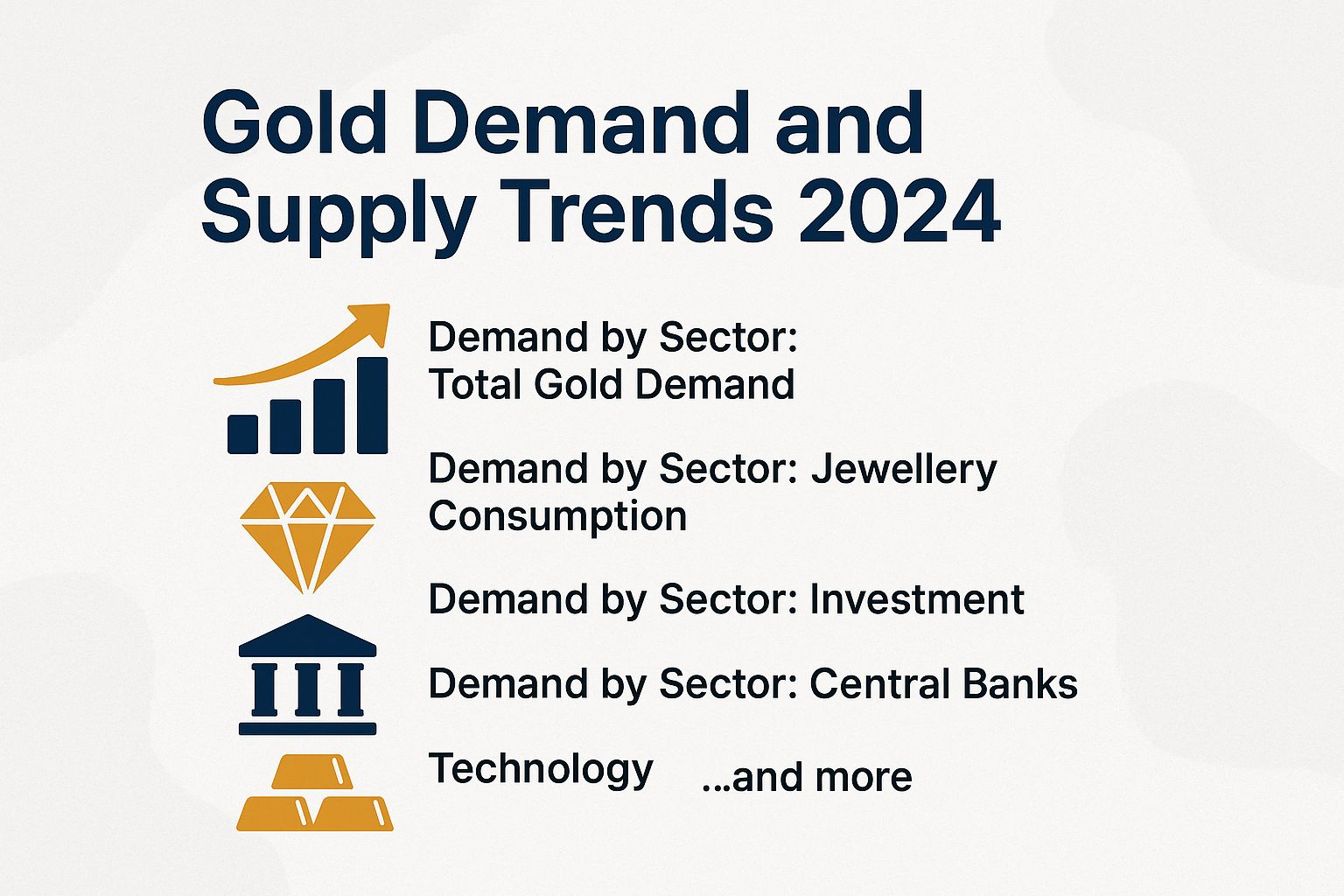
The Gold Demand and Supply Trends 2024 show a balanced market in the US economy. Total demand hit 4,974 tonnes, up 1% from last year.
Supply matched closely at 4,975 tonnes, also up 1% year-over-year. This balance highlights gold’s role as a safe haven during economic uncertainty and dollar risks.
These numbers prove the market’s strength, fueled by various sectors, monetary policies, global politics, and economic sanctions.
Demand by Sector
- Jewelry consumption, usually the biggest part, fell to 1,877 tonnes. That’s an 11% drop year-over-year, as high prices cut spending in India and China during economic worries.
- Investment demand jumped to 1,180 tonnes, up 25% year-over-year. Retail and big investors grabbed bars, coins, and gold ETFs (exchange-traded funds) to fight inflation and shaky currencies.
- Central banks added 1,045 tonnes, down 1% year-over-year. Their reserves steadied after big buys tied to banking plans.
- Technology demand grew to 326 tonnes, up 7% year-over-year. Gold powers smartphones and medical gear, even with supply issues.
- Gold plays dual roles: cultural and industrial uses, plus as a financial shield and value keeper in tough times.
- Investors trust gold to hold value during global fights, like currency battles and BRICS (Brazil, Russia, India, China, South Africa) nations’ push away from the dollar. This boom is exciting!
Supply Components include recycled gold and bullion at 1,370 tonnes, up 11% year-over-year.
Higher prices push people to sell old jewelry amid money woes. Mine production stays steady, keeping supply balanced without big hitches.
Price Metrics show a hot market. The average gold price hit $2,386 per ounce, up 23% year-over-year.
Prices could soar to $5,000! Strong demand, tight supply, and factors like interest rates and stock swings drive this. Gold shines as a top player in trading.
2024 trends show a growing gold market. Investment and tech boosts cover jewelry slumps, thanks to smart portfolio mixes and risk plans.
Supply matches demand, so prices look set to climb in this bull run. Grab chances in forex and trade now! But push for green mining to handle future shifts in global money.
Scenarios Linking Digital Dollar to Gold Surge
In risky times, a fast launch of a Central Bank Digital Currency (CBDC) during the wild 2024 elections might spike gold prices by 30%. This echoes the 2008 crisis, when prices doubled to $1,000 per ounce per COMEX data.
Erosion of Public Trust in USD
Trust in the US dollar is fading fast. Pew Research shows only 60% of Americans see it as a solid value holder in 2023, down from 85% in 2010.
Worries about CBDC surveillance play a big role. These digital currencies could let governments track every transaction.
- Privacy invasion tops the list, with constant watch over money moves. The EFF’s 2023 report warns of ‘panopticon’ risks from CBDCs, meaning total government spying.
- History hurts too, like the 1971 Nixon Shock. It cut the dollar’s tie to gold, shaking faith in its backing.
Venezuela’s bolivar hyperinflated in 2018. People hoarded gold bullion to escape the falling value of their fiat currency (government-issued money like dollars or euros) during the economic crisis.
A 2022 Gallup survey shows 40% of Americans prefer alternatives like gold, cryptocurrencies, or stablecoins such as Tether.
Push for more openness in how the Federal Reserve works. This includes expanding oversight by the Government Accountability Office through laws like the Federal Reserve Transparency Act.
People and big investment funds should spread their money into safe options. Try audited precious metals ETFs (funds that trade on stock exchanges like individual stocks) and gold ETFs to protect against risks and wild market swings.
Counterarguments and Market Skepticism
Skeptics say central bank digital currencies, or CBDCs (digital versions of a country’s money issued by its central bank), boost economic stability. They don’t push up gold prices through inflation, as seen with the Bahamas’ Sand Dollar, which grew GDP (the total value of goods and services in an economy) by 1.5% since 2020 without raising commodity prices (Central Bank of the Bahamas data)-imagine a digital dollar that keeps things steady!
- First, CBDCs could strengthen the U.S. dollar’s power. They make international payments and money transfers faster, reducing reliance on the SWIFT (a global network for secure bank messaging) system (Bank for International Settlements, 2023 report). This shift could lock in dollar supremacy now!
- Second, Gold prices swing a lot, with a beta (a measure of how much an asset’s price moves compared to the market) of 1.2 compared to the S&P 500 (a key U.S. stock market index). This makes it shaky as a shield against inflation, despite what chart patterns and price levels might show.
- Third, Cryptocurrencies like Bitcoin, DeFi (decentralized finance using blockchain), smart contracts (self-executing digital agreements), and tokenization (turning assets into digital tokens) are stealing the spotlight from gold. Bitcoin’s price jumped 150% in 2023, pulling investors to hold (HODL: holding assets long-term despite ups and downs) strategies amid market emotions tracked by the fear and greed index. Bitcoin’s boom is thrilling-don’t miss out!
In 2023 testimony, Fed Chair Jerome Powell downplayed inflation worries from CBDCs. He said they help online shopping and include more people in finance without big disruptions or job losses-Powell’s words could change how we bank, exciting times ahead!
Moody’s Analytics predicts little inflation from well-regulated CBDCs. Smart government spending and controls can handle risks like trade gaps and links to metals like platinum and palladium.
Act now to diversify your investments. Gold and digital assets could protect your future!