Retirees face a stark reality in tough economic times. Inflation eats away at fixed incomes, and stock market drops can wipe out savings.
Gold has a 5,000-year history as a safe haven, including its role in the gold standard. It stands out as a key investment to protect your wealth.
This piece dives into gold’s track record during inflation spikes and market crashes, backed by Federal Reserve data. We’ll cover its perks for hedging, diversification, risks, and choices like physical gold (bullion, bars, or coins measured in troy ounces with specific karat purity), ETFs, or a Gold IRA for retirement. Don’t wait-is gold essential for your secure retirement?
Why Retirees Seek Stable Assets
U.S. retirees handle pensions, 401(k)s, Roth IRAs, and traditional IRAs. They watch savings shrink with 3-5% yearly inflation and a weakening dollar, per Bureau of Labor Statistics reports.
That’s why stable assets like gold matter. This tangible store of value protects buying power and boosts retirement security.
Challenges of Fixed-Income Reliance
Fixed-income options like Treasury bonds yield just 2-4% a year, based on 2023 U.S. Treasury data. They often lag behind inflation, cutting retirees’ buying power by 20-30% over ten years.
This challenge is exacerbated by four primary factors:
- Low yields fall behind the 3.5% CPI inflation rate (Federal Reserve data). TIPS, or Treasury Inflation-Protected Securities, help shield against rising prices and falling currency value.
- Interest rate changes caused 10-15% bond losses in 2022. Gold hedges against this market ups and downs.
- Portfolios for 20+ year retirements face duration mismatches, per Morningstar. This raises depletion risks-ladder TIPS maturities to fight it, based on your age and risk level.
- Taxes eat up to 37% of interest. Switch to municipal bonds for tax savings.
A Kiplinger report shared a retiree’s story: they lost 15% in real bond value during 2022’s rate hikes. Act now-rebalance your portfolio with 20% in growth assets like stocks, real estate, or even crypto to build resilience.
Historical Performance of Gold
World Gold Council data shows gold grew at 4.8% yearly from 1971 to 2023. It beat inflation in 70% of years through price rises, not dividends.
Gold During Inflationary Periods
Gold shines during high inflation. Its price correlates 0.8 with the CPI, per IMF studies.
- In the 1970s stagflation, gold jumped 2,300% from $35 to $850 per ounce (U.S. Mint), outpacing 7-13% inflation.
- During 2008-2011 crisis, it rose 150% with 3-5% inflation (Bloomberg).
- In 2022, gold gained 8% against 8% peak CPI (Federal Reserve).
Fidelity advisors suggest 5-10% portfolio allocation to gold when inflation tops 3%. Get excited-protect your nest egg today!
The World Gold Council’s 2023 report shows gold delivered positive real returns in 95% of 20-year periods. It’s an impressive track record!
This proves gold’s strength for diversifying portfolios using ETFs like GLD. Get ready to safeguard your investments.
Gold in Market Crashes
In the 2008 financial crisis, gold prices jumped 25% while the S&P 500 dropped 37% (Yahoo Finance data). This highlights gold as a safe-haven asset.
The same happened in the 1987 Black Monday crash. Gold rose 15% as stock indices fell 20% (historical records).
Gold surged 24% in 2020’s COVID-19 crash. Meanwhile, the S&P 500 plunged 34% (CFA Institute data). Don’t miss this protective power!
Gold has a negative beta. This means it often moves opposite to stocks, as shown in the CFA Institute‘s 2008 crisis analysis.
A Federal Reserve study backs this up. It shows gold boosts diversification during tough economic times.
History shows gold gains about 20% in the year after big market crashes (Baur and Lucey, 2010, Finance Research Letters). Protect your investments now!
Allocate 5-10% of your portfolio to gold for protection against volatility.
Choose ETFs like GLD or IAU for easy trading and low costs. Avoid physical gold hassles like storage and fakes.
- ETFs (GLD, IAU)
- Mining stocks
- Gold futures
Gold futures based on spot prices work too.
Key Benefits for Retirees
Vanguard research shows gold correlates little with stocks (0.1 to 0.2 in bull and bear markets). This fits modern portfolio theory for balanced investing.
For retirees, add 5% gold to cut portfolio risk by 10-15%. It boosts the Sharpe ratio, which measures return per risk unit, for better management.
Gold Demand Changes: 2024 vs 2023
- Mining production shifts
- Jewelry demand
- Industrial uses
- Central bank gold reserve buys
- Speculation from geopolitical risks and economic uncertainty
#7xr7a1r9.bar-container { position: relative; overflow: visible; height: 40px; } #7xr7a1r9 { padding: 20px; } #7xr7a1r9.metric-card { padding: 20px; } #7xr7a1r9.bar-value { position: absolute; left: 50%; top: 50%; transform: translate(-50%, -50%); z-index: 30; pointer-events: none; } #7xr7a1r9.bar-value { color: white; font-weight: 700; font-size: 14px; white-space: nowrap; text-shadow: 0 1px 2px rgba(0, 0, 0, 0.3); } #7xr7a1r9.bar-value { background: rgba(0, 0, 0, 0.7); padding: 4px 12px; border-radius: 20px; display: inline-block; } #7xr7a1r9.animated-bar { z-index: 1; } @media (max-width: 768px) { #7xr7a1r9 { padding: 16px; } #7xr7a1r9 h2 { font-size: 24px; } #7xr7a1r9 h3 { font-size: 16px; } #7xr7a1r9.bar-label { font-size: 12px; } #7xr7a1r9.bar-value { font-size: 13px; padding: 3px 10px; } } @media (max-width: 480px) { #7xr7a1r9 { padding: 12px; } #7xr7a1r9 h2 { font-size: 20px; } #7xr7a1r9 h3 { font-size: 14px; } #7xr7a1r9.bar-label { font-size: 11px; margin-bottom: 6px; } #7xr7a1r9.bar-value { font-size: 12px; padding: 2px 8px; min-width: 45px; text-align: center; } #7xr7a1r9.bar-container { height: 36px; overflow: visible; } }
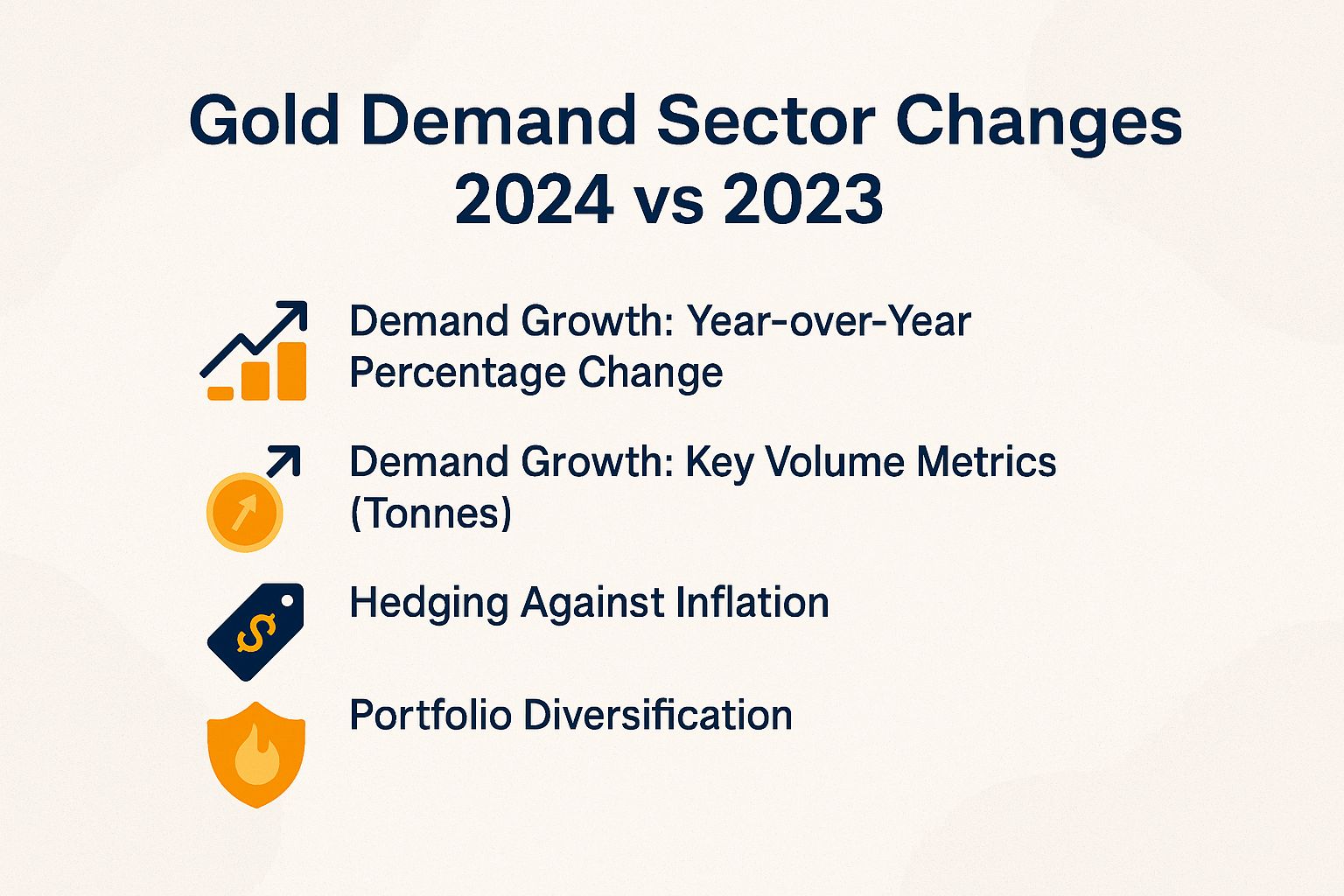
Gold Demand Sector Changes 2024 vs 2023
In the face of economic uncertainty and market volatility, gold remains a must-own asset for retirees and senior citizens planning for retirement. As a tangible asset and store of value, it offers financial security through diversification, serving as a safe haven and inflation hedge. Investors can choose physical gold such as bullion, gold bars, gold coins, or opt for ETFs, Gold ETFs, mining stocks, or even cryptocurrency alternatives, but gold’s stability as a hedge against recession, bear market, interest rates, currency devaluation, and geopolitical risks is unmatched. Central banks are increasing gold reserves through central bank buying, contributing to price appreciation. For portfolio management, consider asset allocation, rebalancing, risk tolerance, age-based investing, retirement age, fixed income, growth assets, defensive assets, modern portfolio theory. Gold in IRA, Gold IRA, Roth IRA, alongside stock market, bonds, real estate, alternative investments, helps with wealth preservation and risk management. Despite storage costs and opportunity cost, liquidity is high, with no yield or dividends but capital gains and potential tax implications for long-term investment vs short-term trading. Historically, from the gold standard to history of gold, it protects purchasing power against inflation rate, CPI, dollar weakening. Supply and demand is driven by mining production, jewelry demand, industrial use, speculation, gold futures, spot price per ounce or troy ounce. Ensure purity, karat, avoid counterfeit with authentication from dealers, consider buyback, premiums, spreads. In volatile times, volatility index, correlation, beta, Sharpe ratio show gold’s historical performance in backtesting. Expert opinions in financial news recommend it for pension planning with a financial advisor during bull market or recession.
Demand Growth: Year-over-Year Percentage Change
Demand Growth: Key Volume Metrics (Tonnes)
Demand Growth: Gold Price Change
(function() { setTimeout(function() { var bars = document.querySelectorAll(‘[class*=”animated-bar-7xr7a1r9″]’); bars.forEach(function(bar) { var width = bar.getAttribute(‘data-width’); if (width) { bar.style.width = width + ‘%’; } }); }, 100); })();
The Gold Demand Sector Changes 2024 vs 2023 data shows a subtle change in global gold use. Total demand grew modestly by 1.0% year-over-year to 4,974.5 tonnes. This small rise hides different results across sectors, driven by economic worries, protection against rising prices (a strategy to keep money’s value during inflation), and tech advances. It highlights gold’s lasting role as a safe-haven asset.
Year-over-Year Percentage Changes show big differences across sectors.
- Jewellery consumption fell 11.0% to 1,877.1 tonnes in 2024. Higher gold prices cut non-essential buying in places like India and China. High costs made fancy pieces too pricey, so people chose lighter items or other materials.
- The technology sector jumped 7.0%. Demand grew for gold in gadgets like smartphones and AI devices, thanks to its great conductivity (ability to carry electricity) and dependability.
- Investment demand soared 25.0% to 1,179.5 tonnes. Global conflicts and bank policies drove this, as people spread investments to escape unstable stocks.
- Central bank purchases dropped 1.0% to 1,044.6 tonnes. Still strong, Asian emerging economies built reserves to fight currency swings.
- These changes show gold’s exciting double role: a fancy treat that dips with prices, but a tough powerhouse in tough times.
- Grab the investment surge now-it mirrors global worries! Tech’s rise points to hot new demands from innovation.
Gold Price Changes explain these trends better. The annual average price rose 23.0% to $2,386.2 per ounce, hitting a record $2,790 per ounce.
Supply shortages and investors betting big caused this jump. It hurt jewellery sales but boosted appeal for investors.
Higher prices squeezed demand in budget-conscious areas. Yet, they strengthened gold as a shield against rising prices.
The 2024 data shows a tough gold market handling big economic stresses.
Jewellery’s drop warns of short-term hurdles. But investment and tech gains promise long-term steadiness-exciting times ahead!
Everyone involved, from miners to leaders, should watch these trends closely. Act now to handle coming ups and downs, as gold blends old traditions with new uses.
Hedging Against Inflation
Gold has demonstrated a robust capacity to preserve value against inflation, achieving an average annual real return of 4.2% from 1971 to 2023, according to data from the Council on Foreign Relations. This performance starkly contrasts with cash holdings, which yielded a negative real return of -1.5% over the same period.
Adding 5-10% gold to your retirement savings protects against the expected 2-3% yearly loss in Social Security benefits. The Social Security Administration backs this up.
Picture a retiree with $500,000 who puts 10% into gold via ETFs like GLD-funds you trade like stocks. It’s a smart, easy move!
In 2022, when inflation hit a scary 9.1%, this gold strategy kept the real value safe. It dodged about $45,000 in losses-don’t miss out on this protection!
Gold offers key perks. Check them out:
- It beats other options in high-inflation times, like the huge 1,200% jump in the 1980s.
- Super easy to sell quickly for cash when you need it.
- No risk from the other party failing, unlike regular bonds.
Think about this: $10,000 in gold from 2000 grew to $45,000 by 2023, after inflation. That’s gold’s powerhouse long-term value-jump in today!
For practical implementation, investors may opt for physical gold bars or diversified funds sourced from established dealers such as APMEX. This approach is supported by International Monetary Fund research, including the 2020 study “Commodity Prices and Inflation,” which affirms the role of commodities as reliable inflation hedges.
Portfolio Diversification
Incorporating 5-10% gold into a traditional stock-bond portfolio can reduce volatility by 12% without compromising returns, according to a 2021 BlackRock study examining 60/40 allocations.
This spreading-out plan works great in shaky markets. A standard 60/40 stock-bond mix has 15% ups and downs and a Sharpe ratio of 0.5-a measure of return per unit of risk.
Adding gold cuts ups and downs to 13% and boosts the Sharpe ratio to 0.6. Smoother sailing ahead!
For retirees in the withdrawal phase, this approach enables the safer application of the 4% withdrawal rule, as gold helps mitigate sequence-of-returns risk.
To implement this strategy, consider low-cost exchange-traded funds (ETFs) such as GLD (SPDR Gold Shares) or IAU (iShares Gold Trust), with an initial allocation of 7%. Annual rebalancing can be facilitated using tools like Vanguard’s Portfolio Watch.
A hybrid allocation that combines gold with real estate ETFs, such as VNQ, to comprise 20% in alternative assets can further bolster portfolio stability. Research published in the 2019 Journal of Investing indicates that gold can reduce maximum drawdowns by 25% during market crashes.
Potential Drawbacks and Risks
Although gold has historically delivered average annual returns of 5%, its volatility reached 30% in 2011 (per CME Group data), which could result in short-term losses for risk-averse retirees.
Plus this aspect, investments in gold are confronted with four principal challenges.
- Price volatility: Gold, for example, declined by 28% in 2013 alone.
- Storage and insurance costs: These typically range from 1% to 2% annually for physical gold, according to APMEX.
- Absence of income generation: Unlike dividend-paying stocks or bonds yielding approximately 2%, gold produces no income, thereby incurring opportunity costs.
- Taxation on capital gains: Gains are taxed at the 28% collectibles rate, as stipulated by IRS regulations.
To mitigate these risks, investors may employ gold exchange-traded funds (ETFs) such as GLD to circumvent storage fees, restrict allocation to no more than 10% of the overall portfolio, and adopt a long-term holding approach to promote stability.
- Employ gold ETFs such as GLD to avoid storage fees.
- Limit allocation to 10% of the portfolio.
- Hold positions long-term to achieve stability.
A 2013 CNBC case study demonstrated that a retiree sustained a 15% loss amid the gold market bubble; however, effective diversification curtailed additional losses by 40%.
Investment Options for Gold
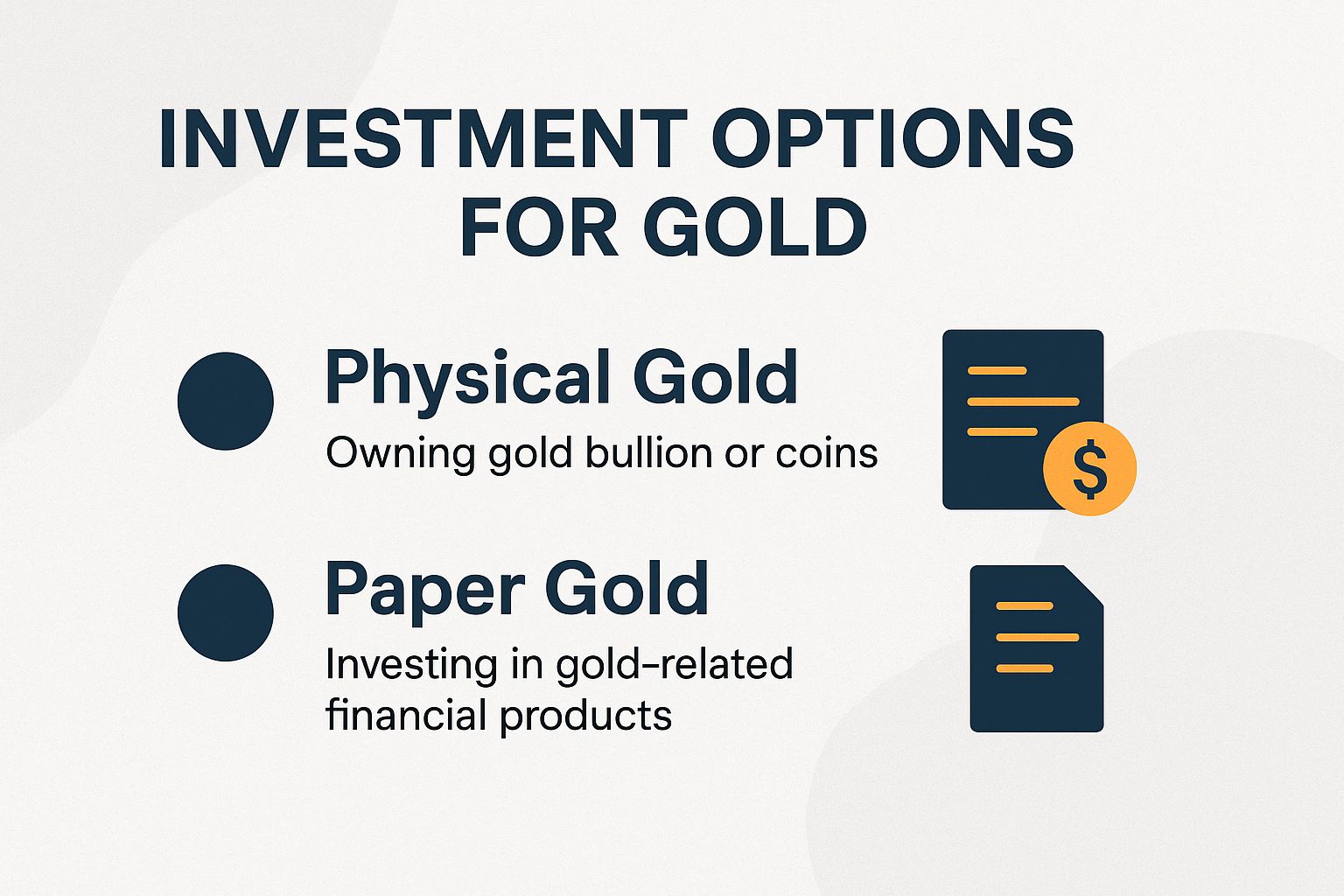
Retirees have the opportunity to invest in gold through Individual Retirement Accounts (IRAs) that hold physical bullion, typically stored in IRS-approved depositories such as the Delaware Depository. Alternatively, they may opt for exchange-traded funds (ETFs), including the SPDR Gold Shares (GLD), which oversees approximately $60 billion in assets under management (AUM).
Physical Gold vs. Paper Gold
Physical gold, exemplified by 1-ounce American Eagle coins priced at $2,500 per ounce (spot price plus a 3% premium, per Kitco 2023 data), provides direct ownership but entails annual storage fees of 0.5-1%. In contrast, paper gold through the GLD ETF can be traded without commissions and carries a 0.40% expense ratio.
To facilitate a thorough comparison, the key attributes of these investment vehicles are outlined in the table below:
| Attribute | Physical Gold | Paper Gold (ETFs/Futures) |
|---|---|---|
| Form | Tangible (coins/bars) | Digital (GLD shares) |
| Storage/Costs | $100-500 per year (vault storage) | 0.40% expense ratio |
| Liquidity | Relatively illiquid (requires dealer transactions) | Immediate access via NYSE |
| Risk | No counterparty exposure | Tracking error below 0.5%; additional ETF risks as disclosed in SEC filings |
Physical gold is particularly suitable for estate planning purposes, such as leveraging inheritance tax benefits in accordance with IRS regulations. Paper gold, however, is preferable for investors seeking rapid trading opportunities.
A hybrid approach, such as a Gold IRA, allows for the storage of physical gold in secure vaults while offering tax advantages. Historical performance data from the World Gold Council indicates that over a 15-year period, the GLD ETF delivered an annualized return of 6.2%, compared to 5.8% for physical gold after accounting for associated costs.