Picture the US dollar, the foundation of the world economy for over 100 years, starting to weaken! US debt is growing fast, while rivals like China’s yuan and the euro rise, along with cryptocurrencies such as Bitcoin-it’s thrilling yet urgent!
Dollar power now faces serious challenges. Expect higher inflation, trade problems, geopolitical changes, currency drops, and economic sanctions. This could lead to hyperinflation or recession in a multipolar world. What big changes are coming? Get ready!
Current Dominance of the US Dollar
The US dollar makes up 59% of global foreign exchange reserves in Q2 2023, per the IMF’s COFER data. This shows its top spot as the main reserve currency-a currency held by countries for international trade and stability.
It appears in 88% of foreign exchange deals, according to the 2022 BIS survey. SWIFT data from 2023 shows it handles 40% of world payments.
- Bretton Woods (1944): Tied currencies to dollar and gold until 1971.
- Petrodollar: 80% oil in dollars, US gains billions.
- 2008 Crisis: Dollar rose 20% as safe haven.
Factors Driving Potential Decline
Geopolitical changes and sanctions on countries like Russia, Iran, and Venezuela speed up dedollarization-moving away from using the dollar. BRICS nations (Brazil, Russia, India, China, South Africa, covering 42% of world people) push new payment systems and trade deals to dodge sanctions, as seen in 2023 meetings-act now before it’s too late!
De-Dollarization Trends: USD Share in Global Central Bank Reserves (1999-2024)
#570g0h5j.bar-container { position: relative; overflow: visible!important; } #570g0h5j.bar-value { position: absolute!important; left: 50%!important; top: 50%!important; transform: translate(-50%, -50%)!important; color: white!important; font-weight: 700!important; font-size: 14px!important; white-space: nowrap!important; background: rgba(0, 0, 0, 0.7)!important; padding: 4px 12px!important; border-radius: 20px!important; z-index: 30!important; text-shadow: 0 1px 2px rgba(0, 0, 0, 0.3)!important; pointer-events: none!important; display: inline-block!important; } #570g0h5j.animated-bar { z-index: 1!important; } @media (max-width: 768px) { #570g0h5j { padding: 16px!important; } #570g0h5j h2 { font-size: 24px!important; } #570g0h5j h3 { font-size: 16px!important; } #570g0h5j.bar-label { font-size: 12px!important; } #570g0h5j.metric-card { padding: 20px!important; } #570g0h5j.bar-value { font-size: 13px!important; padding: 3px 10px!important; } } @media (max-width: 480px) { #570g0h5j { padding: 12px!important; } #570g0h5j h2 { font-size: 20px!important; } #570g0h5j h3 { font-size: 14px!important; } #570g0h5j.bar-label { font-size: 11px!important; margin-bottom: 6px!important; } #570g0h5j.bar-value { font-size: 12px!important; padding: 2px 8px!important; min-width: 45px!important; text-align: center!important; } #570g0h5j.bar-container { height: 36px!important; overflow: visible!important; } }
De-Dollarization Trends: USD Share in Global Central Bank Reserves (1999-2024)
USD Reserve Share: Historical Share
(function() { setTimeout(function() { var bars = document.querySelectorAll(‘[class*=”animated-bar-570g0h5j”]’); bars.forEach(function(bar) { var width = bar.getAttribute(‘data-width’); if (width) { bar.style.width = width + ‘%’; } }); }, 100); })();
What De-Dollarization Means for the World
The World Bank warns that losing dollar power could mess up money policies around the world. This might cause wild swings in interest rates and currency values.
Central banks could fight back with digital currencies on blockchain tech. Blockchain is a secure digital ledger that records transactions. Act now to understand these shifts!
In growing economies, de-dollarization could shake things up. Here’s how:
- Worsen supply chain problems, delaying goods worldwide.
- Hit energy markets hard, raising costs fast.
- Threaten food supplies, putting security at risk.
- Boost reliance on imports and cut export cash, hurting budgets and trade balances.
These changes are happening now-don’t miss out!
Rich countries could see money flows change direction. Investors will need smart moves to stay safe.
- Use hedging to protect against risks-like insurance for investments.
- Spread money across stocks, bonds, and real estate.
- Shift to safe spots like government bonds during uncertainty.
Get ready-these shifts could hit your portfolio soon!
The whole world economy might slow down. Watch for these big impacts:
- Slower growth and shrinking GDP.
- More job losses and higher prices for everyday items.
- Banks facing cash shortages, hitting pensions and insurance.
- Increased chances of defaults, leading to debt fixes.
Global trade could get rocky. Key issues include:
- Tariffs and other barriers slowing down deals.
- Fights at the World Trade Organization over rules.
- G20 leaders talking fixes like printing more money (quantitative easing) or cutting spending.
- Risks of currency battles where countries weaken their money to gain edges.
Trade wars are brewing-stay informed!
Commodity prices will fluctuate wildly. This sparks:
- A super cycle of booms and busts in raw materials.
- Countries grabbing more control over resources (resource nationalism).
- Slower shift to green energy, affecting climate funding.
Inequality will grow, causing protests and shaky politics in our divided world. Time to act before it’s too late!
De-Dollarization Trends: USD Share in Global Central Bank Reserves (1999-2024) shows a big change in global finance. The U.S. dollar’s top spot as the main reserve currency is slowly fading.
Central banks hold foreign currencies for stability, trade, and handling crises. The USD has been key thanks to its steady value, easy trading, and the huge U.S. economy, but data shows its share dropping over 25 years.
In 1999, the USD made up 71.0% in 1999 of global central bank reserves. This was right after the Cold War, with the dollar ruling as the top reserve currency.
It supported the old Bretton Woods system (the post-WWII agreement setting USD as global anchor), global trade, oil sales (the petrodollar setup (where oil is priced in dollars)), and world debt.
By 2024, that share fell to 57.3%-a drop of almost 14 points. Countries want to mix up their reserves and cut USD reliance due to U.S. money moves, world conflicts, and new currency options.
- Key Drivers of Decline:
- The euro launched in 1999 and grabbed some share, hitting about 20% before settling.
- China’s yuan is rising fast, thanks to projects like the Belt and Road. It now holds 2-3% of reserves.
- U.S. sanctions on Russia after the 2022 Ukraine war sped things up. Nations like Russia, India, and Brazil now trade in their own currencies or the yuan.
- BRICS Influence: The bigger BRICS group-now with Egypt, Ethiopia, Iran, Saudi Arabia, and UAE-pushes hard for trade without dollars. They’re talking about a shared currency or digital options to shake up USD power!
- Implications for Global Economy: Less USD could mean wild currency swings, pricier U.S. loans, and more power for growing markets. The dollar still leads way ahead of the euro at 20%, but get ready for a world with multiple financial bosses-central banks are snapping up gold like never before! Buckle up for changes!
This steady drop warns leaders to watch these changes now.
Investors, eye non-USD assets for big wins! For the U.S., it’s a wake-up call to hold onto economic clout. De-dollarization is reshaping global money flows with more balanced power and countries standing on their own.
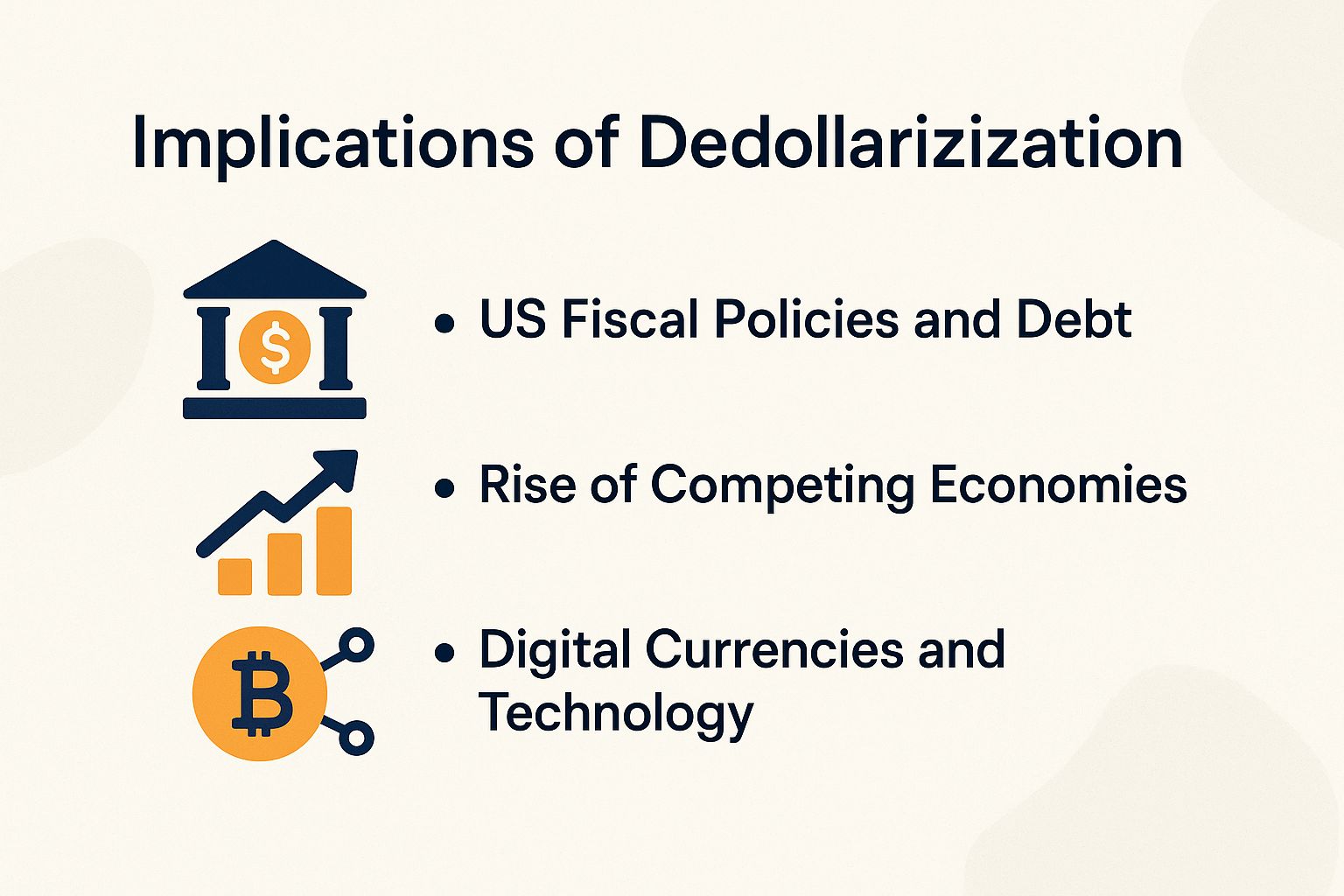
US Fiscal Policies and Debt
The U.S. national debt hit $34.5 trillion in early 2024-123% of GDP, per the Congressional Budget Office. This huge debt load shakes trust in the dollar with ongoing deficits out of control.
The Fed’s quantitative easing (printing money to buy bonds and boost economy) blew up its balance sheet to $9 trillion by 2022 after COVID (Fed data). It messed with interest rates and pumped up asset prices.
Deficit spending keeps pushing up bond yields. The 10-year Treasury rate jumped from 0.5% in 2020 to 4.5% in 2023 (Bloomberg). This hikes government borrowing costs and could mean steeper mortgage rates for you.
A 2023 IMF paper calls this “fiscal dominance”-it sparks big inflation waves.
Policymakers need fixes fast, like the 1985 Plaza Accord’s team devaluation or strict deficit cuts. Learn from the 1970s stagflation: debt-to-GDP at 35%, inflation roaring to 13%-don’t repeat that mess! This is happening now-act fast!
Rise of Competing Economies
China’s economy, second biggest at $18.5 trillion GDP (World Bank 2023), pushes its renminbi (yuan) worldwide. Its role in global payments climbed from 1% in 2015 to 4% in 2023 (SWIFT data).
This rise challenges the USD in a world with multiple economic powers emerging.
Key Competitors:
- China leads with yuan growth through trade deals.
- Other players like the euro and emerging currencies add pressure.
- Watch for more shifts-exciting times ahead!
- The BRICS nations, with a combined GDP of $26 trillion (International Monetary Fund, 2023), which are advancing initiatives for de-dollarization.
- India, projected to become the world’s third-largest economy by 2030 (PwC), where trade denominated in the rupee has been expanding at an annual rate of 20%.
- The European Union, where the euro accounts for 20% of global reserves (European Central Bank), and there is a preference for euro-based settlements.
A report from the Brookings Institution (2022) indicates that these multipolar shifts have resulted in a 10% reduction in dollar invoicing across Asia.
For practical strategies in currency diversification, organizations may consider emulating Russia’s 2022 transition to renminbi for 70% of its trade with China (State Administration of Foreign Exchange data) or Venezuela’s 2018 agreements for oil transactions in renminbi to circumvent sanctions. Such approaches help mitigate foreign exchange risks through bilateral swap arrangements.
Digital Currencies and Technology
More than 130 countries are actively exploring central bank digital currencies (CBDCs). Notably, China’s digital yuan processed $250 billion in transactions by 2023, according to data from the People’s Bank of China, thereby posing a significant challenge to the U.S. dollar’s dominance in cross-border payments.
This transformation is driven by three key innovations.
- First, Bitcoin, which holds a market capitalization of $1.2 trillion as of 2024 (per CoinMarketCap), serves as a hedge against currency devaluation.
- Second, CBDCs such as the Federal Reserve’s FedNow service, launched in 2023, enable instantaneous transfers in U.S. dollars.
- Third, blockchain technology, exemplified by Ripple’s XRP, has reduced remittance costs by 40-70%, as outlined in a 2022 World Bank study.
The Bank for International Settlements’ Annual Economic Report (2023) forecasts that digital currencies could diminish the U.S. dollar’s reserve currency status by up to 20% by 2030.
Businesses are encouraged to respond proactively by integrating solutions like Circle’s USDC API, which offers fees of just 0.1% and supports operations in 180 countries. A pertinent example is El Salvador’s adoption of Bitcoin as legal tender in 2021, which resulted in a 30% increase in remittances.
Short-Term Economic Shocks in the US
The United States inflation rate reached a peak of 9.1% in June 2022, according to data from the Bureau of Labor Statistics (BLS).
This escalation prompted the Federal Reserve to implement a series of interest rate hikes, elevating the federal funds rate to a range of 5.25% to 5.5% by 2023. These actions have consequently increased borrowing costs across the economy and heightened the risk of a recession, as reflected in the deceleration of gross domestic product (GDP) growth to 1.6% for the year 2023, per figures from the Bureau of Economic Analysis (BEA).
Inflation and Higher Borrowing Costs
The Federal Reserve’s aggressive interest rate hikes contributed an additional $1 trillion to U.S. interest payments on national debt in 2023 alone, according to Congressional Budget Office estimates. This development has intensified the pass-through of inflationary pressures to consumers, with the Consumer Price Index rising 3.2% year-over-year in 2024.
This fiscal strain has amplified broader economic disruptions. Mortgage rates, for instance, increased from 3% to 7% in 2023 (Freddie Mac data), resulting in an approximate $500 monthly increase for a $300,000 loan payment.
Corporate borrowing costs rose by 200 basis points (Moody’s analysis), thereby compressing profit margins by 10-15%. A 2023 National Bureau of Economic Research paper links the reversal of quantitative easing policies to heightened stock market volatility of 15%.
For practical recommendations, investors may consider reallocating to Treasury bills, which now yield 5% compared to 0.5% prior to 2022. Additionally, hedging portfolios with gold- which appreciated 20% in 2023 (Kitco data)-offers a prudent strategy.
The 2022 United Kingdom gilt crisis, characterized by a 1% spike in yields within days, underscores the potential risks of a liquidity crunch in the United States.
Disruptions to Global Trade
The US-China trade wars have led to the rerouting of 25% of global supply chains since 2018 (UNCTAD 2023), resulting in cost increases of 10-15% and an acceleration of non-dollar settlements in 30% of Asia-Pacific trade.
Organizations can mitigate these risks by diversifying their supplier base to countries such as Vietnam and Mexico, where electronics exports increased by 20% in 2023 (World Bank data). For example, Apple relocated 10% of its iPhone production to India, thereby reducing its tariff exposure by $1 billion annually.
To address emerging non-dollar trends, companies should consider adopting China’s Cross-Border Interbank Payment System (CIPS), which currently includes 1,300 members, for transactions denominated in yuan, thereby decreasing reliance on the SWIFT network. The Peterson Institute (2024) estimates that sanctions have resulted in $100 billion in lost exports for Russia, emphasizing the importance of risk hedging through commodity swaps.
Start with a full audit of your supply chain to spot disruptions. Then, focus on these steps:
- Identify the top 20% of suppliers by cost.
- Relocate 15% of operations to neutral hubs in six months.
Impacts on International Finance
Dollar shortages hit emerging markets hard in 2022. They caused $100 billion in capital outflows (Institute of International Finance data).
This led to a 300-basis-point jump in EMBI spreads-the Emerging Markets Bond Index tracks bond risks. It also forced IMF bailouts for six countries, where the IMF provides emergency loans.
The ensuing financial turmoil had broader implications for global markets, as evidenced by a 20% surge in foreign exchange (forex) volatility following Federal Reserve interest rate hikes (Bank for International Settlements [BIS] data). The safe-haven premium on U.S. Treasury bonds dropped by 5% due to worries about rising debt (J.P. Morgan 2024 report).
The World Bank’s 2024 report warns that a strong US dollar could slow global economic growth by 2%. Act fast to adjust your strategies!
To mitigate these risks, investors are advised to diversify their portfolios into Eurodollar markets, which facilitate $13 trillion in offshore U.S. dollar lending (BIS data). Try hedging strategies with Chicago Mercantile Exchange (CME) futures contracts to handle currency risks better. These tools can protect your investments now!
A pertinent historical analogy is the 1997 Asian financial crisis, during which the collapse of dollar pegs led to currency devaluations of up to 50%. This episode emphasizes the critical importance of implementing proactive risk management strategies.
Geopolitical Power Shifts
Russia’s 2022 invasion of Ukraine led 50 countries to impose economic sanctions. These actions have reduced the appeal of using the US dollar as a weapon and boosted the BRICS group to nine members with $1.5 trillion in trade potential (Kremlin, 2024).
This international backlash has intensified global dedollarization initiatives. For instance, Russia and China now conduct 40% of their bilateral trade in yuan or rubles, a significant increase from 20% prior to the invasion (Council on Foreign Relations, 2023).
To gauge impacts, track exclusions from the SWIFT payment system. Russia’s dollar transactions in banking dropped 30%-use the Bank for International Settlements’ dashboard for stats.
Look at these real examples:
- US sanctions froze $100 billion of Iran’s assets (US Department of State, 2023). Tehran turned to barter deals as a result.
- Venezuela launched the Petro cryptocurrency in 2018 for oil sales to bypass dollar control.
In response to waning Financial Hegemony-evidenced by America’s $877 billion military expenditure compared to China’s $292 billion (Stockholm International Peace Research Institute, 2023)-BRICS Nations are investigating the development of a common currency, reminiscent of the 1973 oil embargo’s challenge to the Gold Standard.
Emergence of Alternative Reserve Currencies
The euro makes up 20% of global reserve currency holdings (IMF 2023), whereas the Chinese yuan’s share has doubled to 2.3% since 2016, bolstered by the Belt and Road Initiative’s financing of $1 trillion in non-dollar loans (AidData 2023).
Dedollarization is gaining speed. An European Central Bank (ECB) study (2023) predicts the US dollar’s global reserve share will drop to 50% by 2030 in a more balanced world.
The euro stays stable despite Europe’s divided markets. The yuan offers less ups and downs with its fixed exchange rate to the dollar, but it ties closely to China’s economy-exciting times for alternatives!
Want to diversify your portfolio? Allocate 2-4% to the Chinese Yuan using exchange-traded funds (ETFs). These funds let you invest in currencies easily. Try the Invesco CurrencyShares Chinese Renminbi Trust (FXCH). It manages $50 million in assets.
- In 2023, Brazil and Argentina signed a $30 billion Chinese Yuan swap deal. This cuts foreign exchange risks in their trade.
- Russia is testing gold-backed digital rubles. These pilots help manage currency risks in new partnerships.
Long-Term Global Consequences
A falling US dollar could widen inequality gaps. Emerging markets might see borrowing costs rise by 10-15% (World Bank, 2024). This could push 100 million people into poverty (United Nations estimates). Act now to protect vulnerable economies!
Think back to the 1970s stagflation after the Bretton Woods collapse. Global inflation jumped 10-15% and hit developing economies hardest.
Recent reports predict a 0.5-1% drop in global GDP growth in a multipolar world (IMF World Economic Outlook, 2023). Commodity prices could swing wildly, with oil up 20% without the petrodollar system (EIA).
Trade fragmentation might cost the world $1-2 trillion in efficiency losses (UNCTAD Trade and Development Report, 2023). Key issues include tariffs and non-tariff barriers that slow down global business.
Policymakers, diversify your foreign exchange reserves now! Aim for a BIS basket with 60% in non-USD assets like euros and Chinese yuan. This fits central banks’ monetary policies and builds resilience.
By 2050, central bank digital currencies (CBDCs) built on blockchain could boost financial stability. The World Economic Forum sees this reducing dependence on one currency and fixing liquidity crises. Get ready for this game-changing shift!