As central banks worldwide roll out digital currencies like CBDCs and cryptocurrencies such as Bitcoin surge in popularity, with blockchain enabling decentralized finance (DeFi), smart contracts, and stablecoins as pegged currencies backed by collateral assets, driving adoption rates despite transaction fees and market capitalization considerations. The allure of a cashless future grows. Yet, hidden risks-from wild volatility, privacy concerns, hacking risks, cyber security risks, and government control-loom large, threatening financial stability, financial freedom, and exposing issues like financial regulation challenges. Discover gold’s timeless role as a store of value and safe haven asset: its historical performance and proven endurance through economic crises, recessions, stock market crashes, and periods of hyperinflation and currency devaluation in fiat currencies, its inflation-hedging power, and investment strategies for ownership that could provide financial protection and wealth preservation against digital pitfalls.
Central Bank Digital Currencies (CBDCs)
The Bank for International Settlements (BIS) indicates that, as of 2024, 93% of central banks are actively researching central bank digital currencies (CBDCs) as part of their monetary policy. Initiatives such as the European Central Bank’s digital euro pilot seek to improve transaction efficiency and interoperability while preserving monetary sovereignty amid shifting interest rates and quantitative easing.
A comprehensive understanding of CBDC operations requires consideration of the following key steps:
- Issuance by central banks, exemplified by the Federal Reserve’s Project Hamilton prototype, which demonstrated the capacity to process 1.7 million peer-to-peer transactions per second in a trustless system.
- Integration with established financial systems, including compatibility with SWIFT to facilitate efficient cross-border transfers and support global trade.
- Incorporation of privacy safeguards, such as limited anonymity measures that align with the European Union’s General Data Protection Regulation (GDPR) and financial regulations, thereby balancing user protections with anti-money laundering requirements.
| CBDC | Key Features | Status/Users | |——————-|—————————|——————————-| | China’s e-CNY | No interest accrual | 1.8 billion transactions; full rollout | | Sweden’s e-krona | Programmable money | Pilot phase; led by Riksbank | | Bahamas’ Sand Dollar | Full digital wallet support | 200,000 users; launched 2020 |
The BIS Annual Economic Report 2023 underscores scalability issues associated with CBDCs, particularly potential constraints in high-volume transaction environments for systems using consensus mechanisms such as proof of work or proof of stake, which also raise concerns about energy consumption, environmental impact, sustainability, energy costs, and supply chain disruptions.
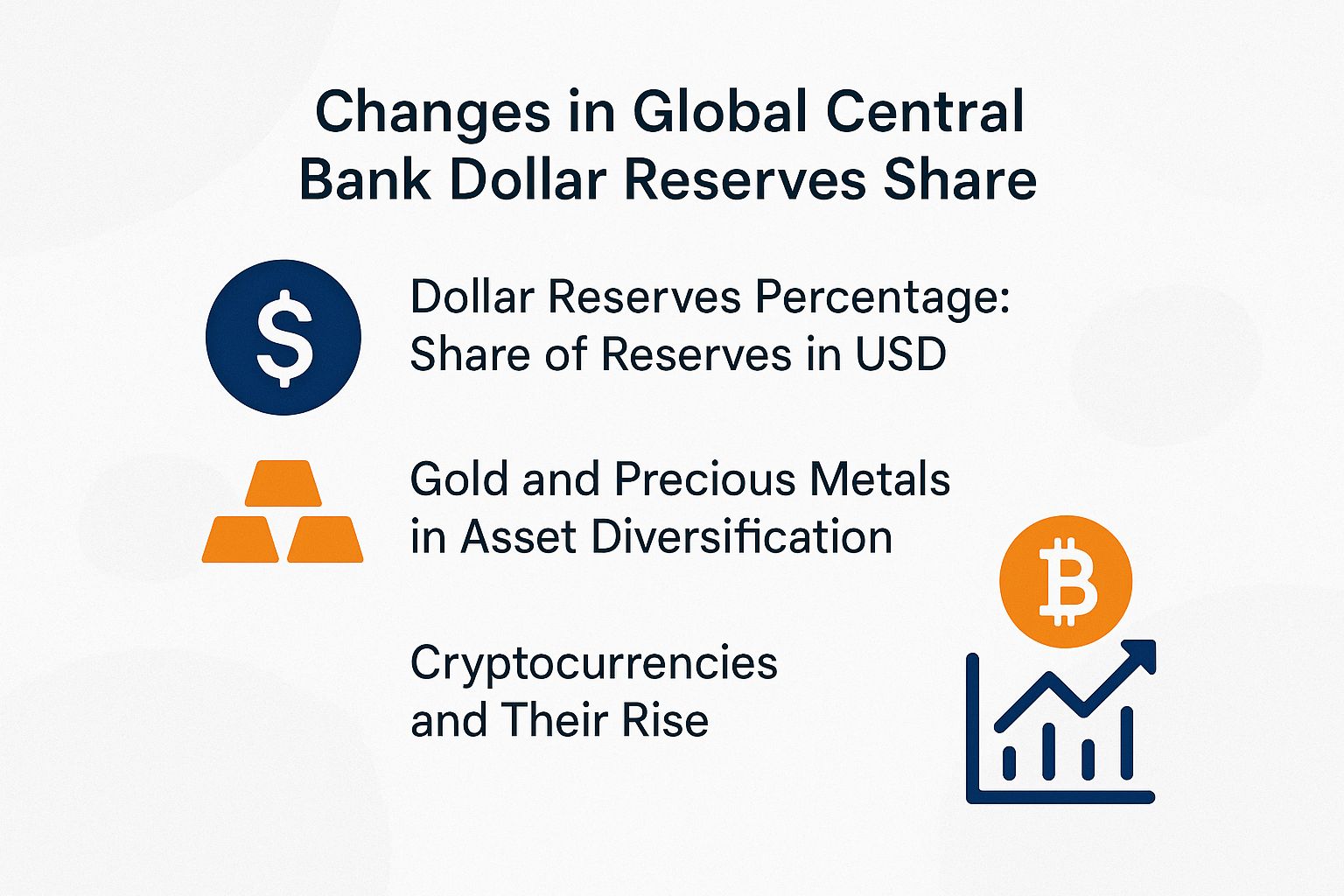
Changes in Global Central Bank Share of Reserves in the USD as the Primary Reserve Currency
:root { –bar-value-font-size: 14px; –bar-value-padding: 4px 12px; } /* Main Bar Styles */ #nwqbe1np.bar-container { position: relative; overflow: visible!important; } #nwqbe1np.bar-value { position: absolute!important; left: 50%!important; top: 50%!important; transform: translate(-50%, -50%)!important; color: white!important; font-weight: 700!important; font-size: var(–bar-value-font-size)!important; white-space: nowrap!important; background: rgba(0, 0, 0, 0.7)!important; padding: var(–bar-value-padding)!important; border-radius: 20px!important; z-index: 30!important; text-shadow: 0 1px 2px rgba(0, 0, 0, 0.3)!important; pointer-events: none!important; display: inline-block!important; } #nwqbe1np.animated-bar { z-index: 1!important; } /* Tablet Styles */ @media (max-width: 768px) {:root { –bar-value-font-size: 13px; –bar-value-padding: 3px 10px; } #nwqbe1np { padding: 16px!important; } #nwqbe1np h2 { font-size: 24px!important; } #nwqbe1np h3 { font-size: 16px!important; } #nwqbe1np.bar-label { font-size: 12px!important; } #nwqbe1np.metric-card { padding: 20px!important; } } /* Mobile Styles */ @media (max-width: 480px) {:root { –bar-value-font-size: 12px; –bar-value-padding: 2px 8px; } #nwqbe1np { padding: 12px!important; } #nwqbe1np h2 { font-size: 20px!important; } #nwqbe1np h3 { font-size: 14px!important; } #nwqbe1np.bar-label { font-size: 11px!important; margin-bottom: 6px!important; } #nwqbe1np.bar-value { min-width: 45px!important; text-align: center!important; } #nwqbe1np.bar-container { height: 36px!important; overflow: visible!important; } }
How the Dollar’s Grip on Global Reserves is Slipping – Act Now!
Dollar’s Share of Global Reserves
Why Gold is Your Secret Weapon for Smart Diversification
Times are shaky with rising national debts and global tensions. Gold stands out as your go-to for mixing up your investments safely.
It’s a real asset, not paper money, and one of the top precious metals. Gold holds value like a champ thanks to its rarity.
- Durability: It lasts forever.
- Divisibility: Easy to split into smaller pieces.
- Portability: Carry it anywhere.
- Fungibility: One piece swaps for another just like cash.
- Verifiability: Simple to check if it’s real.
Grab physical gold bars for hands-on security. Or dive into gold mining stocks for growth potential.
Gold ETFs (exchange-traded funds, like shares you can buy and sell easily on the stock market) give quick access without storage hassles. They come with lower costs and are booming in popularity.
Forget risky paper money that can be faked. Skip digital coins that governments might freeze during crises.
Gold shields your wealth from economic storms. The IMF and World Bank push it for developing countries facing wild interest rate swings – don’t wait, diversify today!
(function() { setTimeout(function() { var bars = document.querySelectorAll(‘[class*=”animated-bar-nwqbe1np”]’); bars.forEach(function(bar) { var width = bar.getAttribute(‘data-width’); if (width) { bar.style.width = width + ‘%’; } }); }, 100); })();
The Changes in Global Central Bank Dollar Reserves Share data illustrates a notable shift in the composition of international reserves held by central banks worldwide. This metric tracks the proportion of foreign exchange reserves denominated in U.S. dollars (USD), a key indicator of the dollar’s enduring role as the global reserve currency.
According to the dataset, the share of reserves in USD stood at 60.0% in 2022, declining to 57.0% in 2024. This drop shows central banks are diversifying their assets. It reflects geopolitical risks and economic changes, like supply chain issues.
Historically, the USD has dominated global reserves since the Bretton Woods system (a post-World War II agreement that made the USD the main global currency), facilitating global trade, investment, and financial stability.
However, the recent decline highlights growing efforts by countries to reduce reliance on the dollar amid rising national debt, sovereign debt, and concerns over currency devaluation.
- Escalating U.S.-China trade tensions.
- Economic sanctions on countries like Russia after the 2022 Ukraine invasion.
- Push for de-dollarization (reducing dollar use) in emerging markets, per IMF and World Bank.
Central banks in Asia and the Middle East, for instance, have increased holdings in alternative currencies such as the euro (which rose to about 20% of reserves), the Chinese yuan (now around 3%), and even gold or other precious metals as an investment strategy.
- Geopolitical Influences: Sanctions have prompted Russia and others to shift reserves away from USD to mitigate risks from asset freezes, accelerating diversification.
- Economic Diversification: Rising global trade in non-dollar currencies, like yuan-denominated oil deals, encourages central banks to align reserves with trade partners.
- Interest Rate Differentials: Higher yields on non-USD assets amid U.S. Federal Reserve policies have made alternatives more attractive.
This trend has profound implications for the global economy. Watch out-a smaller USD role might hike U.S. borrowing costs and hurt exports.
For emerging economies, diversification enhances resilience against dollar volatility but may introduce new risks, such as currency fragmentation. While the USD remains dominant-still over half of reserves-the 2022-2024 shift underscores the need for multilateral reforms to maintain financial stability. Keep an eye on this change. Central banks must juggle security, liquidity, and growth in our shifting world.
As central banks diversify from the USD, digital alternatives like cryptocurrencies are gaining traction. Let’s explore their rise.
Cryptocurrencies and Their Rise
Bitcoin hit over $1 trillion in market value in 2021, per CoinMarketCap. Blockchain-a secure, shared digital ledger-powers it in a trustless setup without middlemen.
It processed over a million daily peer-to-peer transfers by 2023. Methods like proof-of-work (solving puzzles to validate) and proof-of-stake (staking coins) keep it running. This has revolutionized direct payments and grown DeFi (finance without banks), though scaling and connecting systems remain tricky.
The remarkable growth of Bitcoin can be traced to the 2009 whitepaper authored by Satoshi Nakamoto, which introduced the world’s first cryptocurrency. Ethereum launched in 2015 and took things further with smart contracts-automatic agreements coded on the blockchain. This expanded DeFi uses beyond simple money transfers, but fees can still be high.
In 2021, El Salvador became the first nation to adopt Bitcoin as legal tender, a move that significantly accelerated global adoption. By 2023, the number of cryptocurrency users worldwide had reached 420 million, as reported by Triple-A.
Blockchain thrives on decentralization-no central control means fewer weak spots and safer deals in trustless environments.
But Bitcoin guzzles energy, using about 150 terawatt-hours a year according to Digiconomist. This sparks big worries about the environment and long-term sustainability. It’s a hot issue that could slow crypto’s boom!
A prominent example of Bitcoin’s volatility is Tesla’s $1.5 billion investment in the cryptocurrency in 2021, which was subsequently partially liquidated due to environmental concerns, underscoring the inherent risks associated with such assets.
Risks of Relying on Digital Money
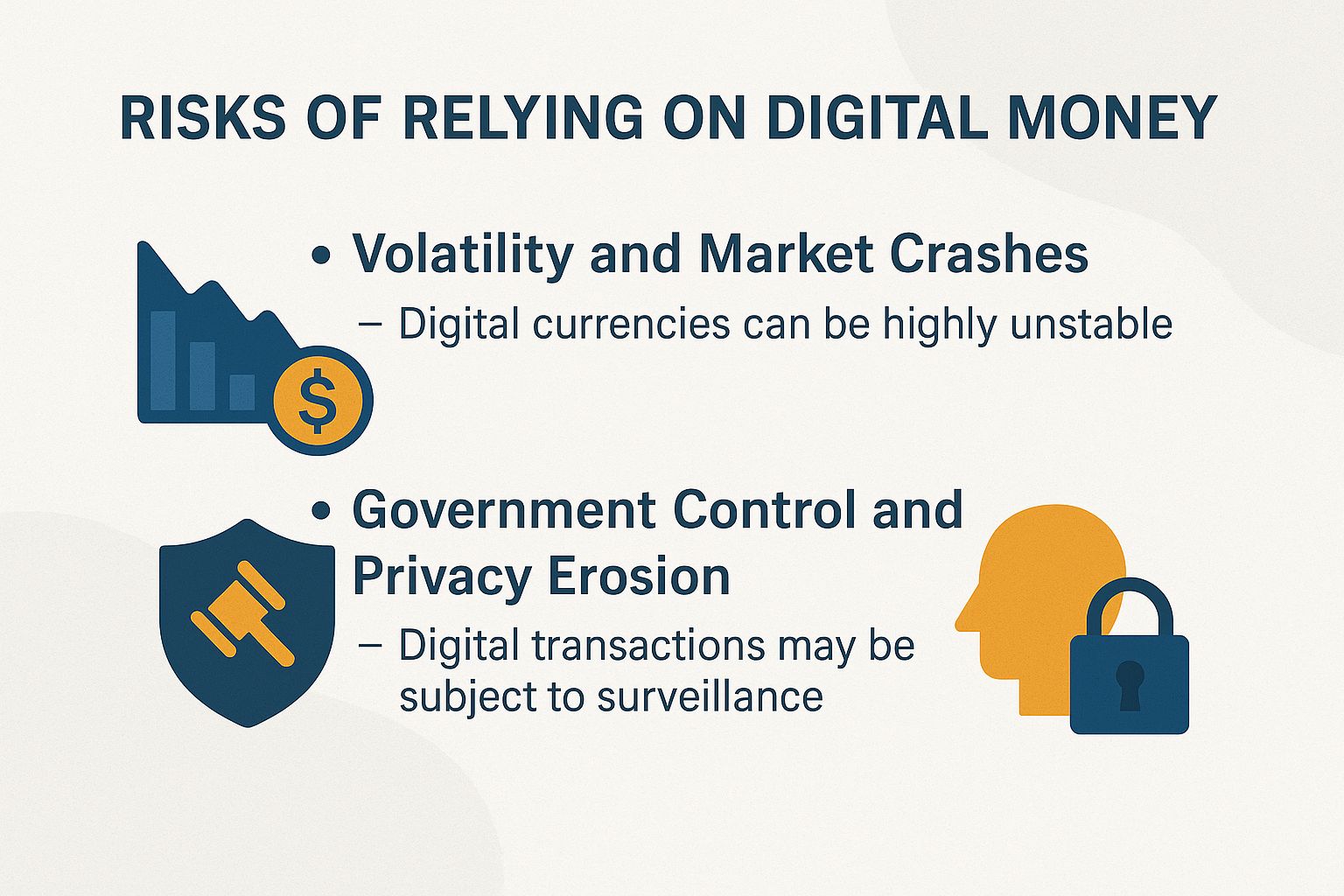
Digital currencies face big risks like cyber attacks and hacks on digital wallets. Crypto markets dropped 80% in 2022, based on CoinGecko data.
This wild volatility shows key weaknesses in digital assets. Gold gives stronger protection against economic ups and downs.
Volatility and Market Crashes
Bitcoin crashed 75% from its $69,000 high in 2022. The whole crypto market lost $2 trillion, per Chainalysis.
Digital assets make economic slumps worse than stable options like gold.
- Wild price swings: Ethereum plunged 80% in the 2018 bear market. Limit crypto to 5-10% of your portfolio to cut these risks.
- Liquidity constraints during market crashes: The collapse of FTX, which immobilized $8 billion in assets, exemplifies this issue and highlights liquidity challenges. Investors should employ stop-loss orders set at a 20% drawdown on reputable exchanges such as Binance for better market access.
- Increasing correlation with traditional equities: A 2023 JPMorgan analysis indicates a beta of 0.6 relative to the S&P 500, necessitating asset diversification across various asset classes including bonds with varying bond yields to manage exposure.
- Sudden flash crashes: The May 2021 incident, which erased $1 trillion in value, highlights the importance of utilizing real-time monitoring tools, such as TradingView alerts, amid quantitative easing effects.
The 2022 TerraUSD crash wiped out over $40 billion. This pegged stablecoin failed due to faulty algorithms.
Always check for strong audits and real backing in stablecoins to avoid disaster.
Government Control and Privacy Erosion
After the 2022 FTX mess, U.S. regulators like the SEC tightened Know Your Customer (KYC) rules. These changes hit 70% of crypto exchanges, per Chainalysis 2023, sparking fears of more spying, lost privacy, and frozen assets.
- Traceability: Blockchain analytics platforms, such as Elliptic, can monitor up to 90% of Bitcoin transactions, facilitating regulatory oversight of fund flows and raising privacy concerns.
- Capital Controls: The 2021 cryptocurrency ban in China led to the seizure of approximately $50 billion in assets, fostering black markets and illustrating the capacity of such prohibitions to immobilize holdings.
- Central Bank Digital Currency (CBDC) Surveillance: The Bahamas’ Sand Dollar system records all transactions to combat money laundering and counterfeit money, as detailed in a 2022 International Monetary Fund (IMF) study.
Switch to privacy coins like Monero. It uses zero-knowledge proofs to hide your transactions.
Use VPNs like NordVPN for $3.99 a month to stay secure. Keep assets in offshore wallets, such as Cayman Islands ones, for extra safety-act now before regulations tighten!
The EFF’s 2023 report warns of fading digital privacy. The EU’s MiCA rules start in 2024 and will demand strict compliance.
Get ahead-build smart risk plans today to protect your freedom!
Gold’s Historical Stability
Gold has stood the test of time through crises. Discover why it’s your safe haven now!
Gold has maintained its value for over 5,000 years as an inflation hedge and store of value, surpassing the historical performance of fiat currencies, which have lost 99% of their purchasing power since 1971-following the U.S. dollar’s departure from the gold standard-due to hyperinflation risks, as documented by Federal Reserve data.
Enduring Value Over Centuries
Gold, a key precious metal and tangible asset, has served as a timeless store of value for wealth preservation, from the gold bars of ancient Egypt to contemporary bullion, owing to its inherent scarcity and resistance to currency devaluation.
According to the World Gold Council (2023), annual gold mining production stands at approximately 3,000 tonnes, while global demand reaches 200,000 tonnes, reinforcing its enduring economic significance and role in asset diversification.
This lasting appeal arises from essential properties of money such as exceptional durability-gold does not corrode, in contrast to silver-divisibility, portability, fungibility, verifiability, and high portability.
A single 1-kilogram bar of bullion, valued at roughly $65,000, facilitates efficient wealth transfer through physical possession, though it involves storage costs and insurance needs.
Historically, the Roman Empire’s aureus coin upheld monetary stability for three centuries, and even the 19th-century gold rushes, which expanded supply by 50 percent, failed to diminish its intrinsic value.
Over the past century, gold’s purchasing power and historical performance have remained stable at 100 percent, as indicated by ShadowStats data, in stark contrast to the U.S. dollar, which has depreciated to a mere 5 percent of its original value, providing financial protection during economic instability.
During the Great Depression of 1929, a major economic crisis and recession, gold prices rose by 70 percent even as stock values declined by 89 percent in a stock market crash, thereby affirming its role as a safe haven asset and reliable hedge against economic instability (Federal Reserve studies).
Performance During Economic Crises
During the 2008 financial crisis, amid rising interest rates, bond yields, quantitative easing, and geopolitical risks, gold prices rose by 25 percent, while the S&P 500 index declined by 57 percent, according to Bloomberg data. This performance underscored gold’s role as a safe haven asset, with investors turning to gold ETFs for easy market access and liquidity amid widespread banking failures.
Similar patterns have emerged in other historical crises.
In the 1970s stagflation period, gold prices increased by 2,300 percent in contrast to 300 percent inflation, as detailed in the International Monetary Fund’s 2008 Global Financial Stability Report. This appreciation effectively hedged against the erosion of purchasing power.
During the 2020 COVID-19 market crash, gold gained 25 percent in the first quarter amid significant market volatility. Similarly, the 2022 Russia-Ukraine conflict, involving economic sanctions, supply chain disruptions, and rising energy costs, drove prices to $2,070 per ounce as geopolitical tensions intensified.
A 2023 Vanguard study indicates that allocating 5 to 10 percent of a portfolio to gold can reduce overall volatility by 15 percent without compromising returns.
For practical portfolio diversification and investment strategy, consider implementing a hybrid 60/40 stocks-to-bonds allocation-where bonds are sensitive to interest rates and bond yields-augmented by 5 percent in gold through low-cost gold ETFs such as GLD. This approach balances growth potential with stability amid economic instability and recession.
How Gold Counters Digital Vulnerabilities
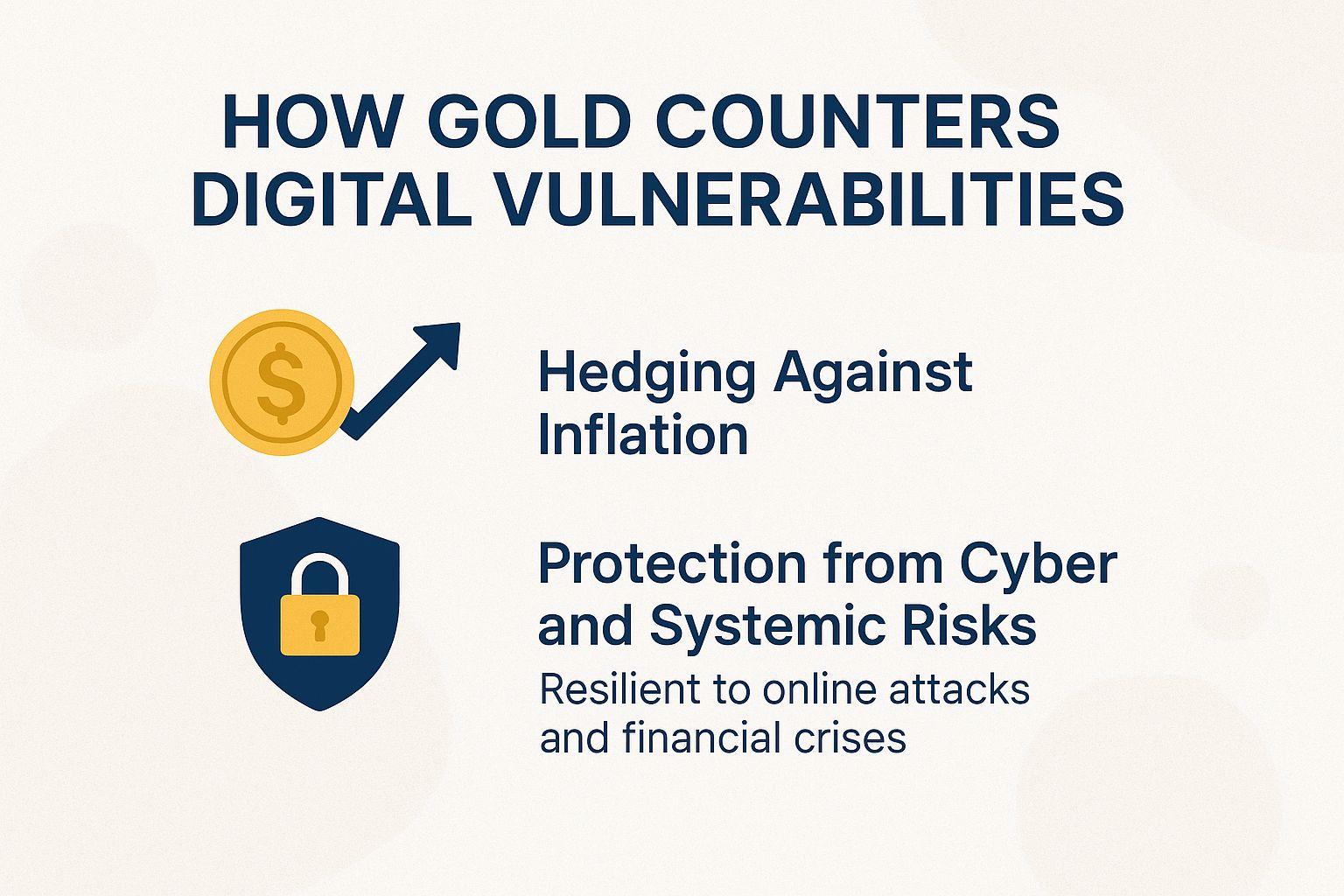
In an era where digital currencies, including cryptocurrencies like Bitcoin with high adoption rates and massive market capitalization, and even Central Bank Digital Currencies (CBDCs) like those powered by blockchain technology are increasingly susceptible to cyber security risks, privacy concerns, and hacking risks-resulting in $3.7 billion stolen through hacks in 2022, according to Chainalysis-gold’s tangible physical form delivers unparalleled financial protection and serves as a store of value. Unlike decentralized finance (DeFi) platforms that rely on smart contracts and stablecoins as pegged currencies backed by collateral assets, which face scalability issues, interoperability challenges, and high transaction fees despite their auditability, gold operates entirely offline, even amid economic instability, recession, or stock market crashes.
Hedging Against Inflation
As a premier inflation hedge and safe haven asset among precious metals, gold has historically delivered an annualized return of 10.1% during periods of high inflation, such as the 1970s, surpassing the Consumer Price Index (CPI) by 400 basis points, according to data from Morningstar. This historical performance underscores its role in asset diversification and sound investment strategy against monetary policy shifts like quantitative easing.
This performance positions gold as an effective hedge against the devaluation of fiat currencies.
Gold’s scarcity and limited global supply, estimated at 210,000 tonnes from gold mining operations that must consider environmental impact and sustainability, serves as a counterbalance to excessive monetary expansion and national debt accumulation, providing wealth preservation in times of economic crisis and sovereign debt concerns.
For instance, the U.S. M2 money supply increased by 40% between 2020 and 2021 in response to pandemic-related stimulus measures and expansive monetary policy.
Historical precedents underscore this dynamic: during the 1980s in an emerging market like Argentina, under strict government control, capital controls, and facing economic sanctions, gold prices appreciated by over 1,000% in U.S. dollar terms, even as the peso experienced hyperinflation, currency devaluation, and subsequent collapse, highlighting gold’s role as a store of value in black markets plagued by counterfeit money.
For practical investment strategies, it is advisable to allocate 10% of a portfolio to gold exchange-traded funds (ETFs), such as the SPDR Gold Shares (GLD), which currently trades at approximately $180 per share and maintains a competitive expense ratio of 0.40%.
Such allocations provide a robust defense against inflationary pressures, as supported by the Federal Reserve’s 2022 analysis of sustained price dynamics.
The long-term return on investment further demonstrates gold’s advantages: a $10,000 investment in gold from 2000 to 2023 would have appreciated to approximately $70,000, compared to just $25,000 in cash equivalents.
Protection from Cyber and Systemic Risks
Unlike digital wallets in cryptocurrency ecosystems, which are susceptible to hacking and varying financial regulation-as demonstrated by the 2017 Equifax data breach that compromised the information of 147 million individuals-physical gold eliminates counterparty risk, offers anonymity and financial freedom, and requires no internet connectivity, thereby ensuring access even during network outages or supply chain disruptions.
To protect your investment effectively, prioritize the following key safeguards:
- Opt for secure offline storage solutions, such as a home safe or allocated vaults offered by BullionVault, which includes comprehensive insurance coverage for a nominal fee of $4 per month.
- Physical gold inherently mitigates risks associated with cyberattacks and the high energy consumption of proof-of-work consensus mechanisms-unlike the $600 million theft from the Ronin Network in 2022, a key incident in decentralized finance-since it demands no form of digital access whatsoever, avoiding vulnerabilities in consensus mechanisms like proof of work or proof of stake.
- It provides resilience in the event of power outages or disruptions; for example, apprehensions surrounding the Y2K millennium bug in 1999 propelled gold prices upward by 20% as a reliable hedge.
Gold’s inherent qualities-durability, divisibility, portability, fungibility, and verifiability-make it an ideal tangible asset, providing financial protection through a trustless system alternative to blockchain’s peer-to-peer transactions, while ensuring wealth preservation.
Procure your gold from established, insured dealers such as JM Bullion, which provides complimentary shipping on orders valued at $199 or more.
In the context of Cyprus’s 2013 banking crisis and bailout-exacerbated by sovereign debt issues and capital controls-owners of physical gold preserved the full value of their holdings, serving as a reserve currency for market access in global trade and emerging markets, whereas bank deposits faced seizure (as reported by Reuters and the World Bank).
Practical Strategies for Gold Ownership
Investors may initiate their participation in gold exchange-traded funds (ETFs) with an initial investment as low as $100, utilizing options such as the SPDR Gold Shares (GLD). This ETF closely tracked gold’s 8% year-to-date return in 2023, according to Yahoo Finance data, while providing liquidity and eliminating the need for physical storage and handling.
To execute the investment and establish ownership, please follow these structured steps:
- Check your risk comfort level first. Allocate 5-10% of your portfolio to gold, following Ray Dalio’s All Weather strategy for balance.
- Sign up for a brokerage account at trusted spots like Vanguard or Fidelity. They let you buy ETFs with no minimum amount needed.
- Search for the GLD ticker (that’s the stock symbol for this gold ETF) and buy the shares you want. For example, $100 gets you about 0.5 shares at $200 each, according to Kitco.
- Try other gold ETFs too, like iShares Gold Trust (IAU). It charges just 0.25% in fees, beating GLD’s 0.40%.
- Track your investment using the Yahoo Finance app on your phone. Sell shares anytime without the hassle of storing physical gold!
Physical gold brings big downsides. It costs 2-5% a year in storage fees and over 5% in premiums, per APMEX.
ETFs keep things simple. They skip the IRS 28% capital gains tax on collectibles that hits physical gold hard.
Get started in just 15-30 minutes-it’s that quick! Watch out for expense ratios over 0.5%; they can quietly drain your profits, so check them now.