In an era of soaring inflation, rising prices, and declining trust in central banks, paper money’s reign as soft money is faltering-evidenced by the USD’s 20% devaluation since 2020, per Federal Reserve data. This matters profoundly for the global economy, international trade, and personal wealth preservation. Discover the forces behind fiat currency’s decline and potential currency collapse, from currency erosion to digital currency and cryptocurrency rivals; gold’s resurgence as a crisis-proof safe haven and sound money; key economic drivers like monetary policy and interest rates, international case studies, and strategies for investors eyeing a golden future in hard money.
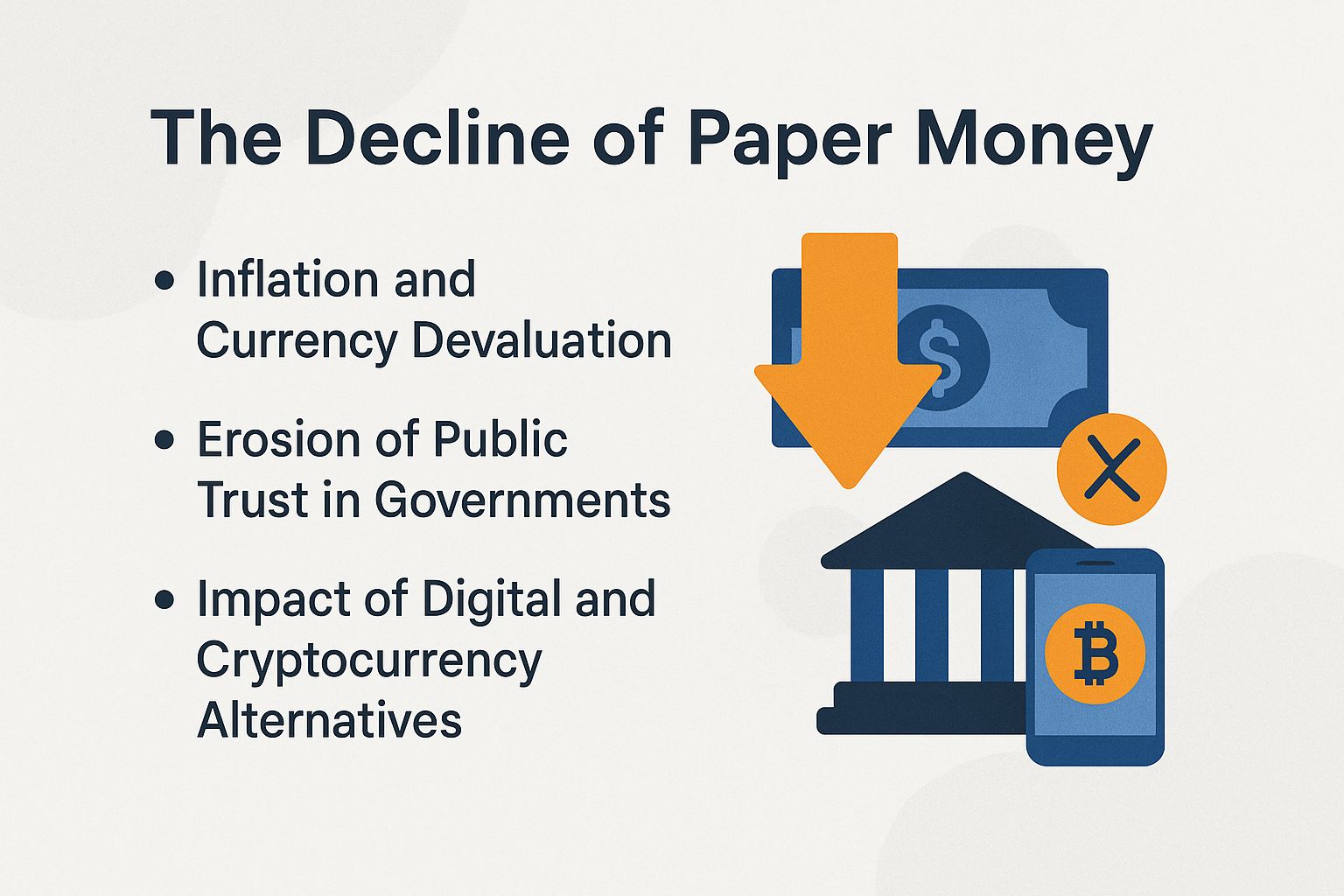
The Decline of Paper Money
The global value of fiat currencies like the dollar and euro has dropped due to too much money printing.
The M2 money supply (that’s cash plus savings and checking accounts) in the United States jumped 25% between 2020 and 2021, per Federal Reserve data. This has ramped up inflation and pushed people toward real assets like gold to protect their wealth.
Inflation and Currency Devaluation
Inflation in the US hit 9.1% in June 2022, the highest since 1981. It came from the Federal Reserve’s massive $4.5 trillion spending spree after the 2008 crisis.
This led to a drop in the dollar’s value from 2020 to 2023, according to the Bureau of Labor Statistics. Prices are skyrocketing-act now to safeguard your savings!
The dollar’s drop comes from a few big reasons. Here’s what happened:
- The Federal Reserve’s quantitative easing (QE, or the central bank’s money-printing to stimulate the economy)-that’s when they print money to buy bonds-pumped $3.5 trillion into the economy from 2008 onward. This created bubbles in stocks and housing, leading to inflation spikes, as shown in a study by the National Bureau of Economic Research.
- During COVID-19, money supply and velocity of money (how fast money circulates in the economy) grew by 40%, per Federal Reserve stats. Now, a dollar from 2020 buys just 83 cents worth of stuff.
History warns us of the dangers. In 1923 Weimar Germany, prices doubled every few days, forcing people to barter-don’t let that happen to you!
Venezuela’s currency lost 99.99% of its value from 2013 to 2020, according to the IMF. Since 1971, when the US ditched the gold standard, a dollar is worth just 15 cents today.
Protect yourself from this mess! Diversify into gold, real estate, or TIPS bonds-these fight inflation and keep your money safe.
Erosion of Public Trust in Governments
The 2023 Edelman Trust Barometer shows only 40% of people trust governments with the economy, down from 57% in 2012.
US debt has ballooned to $34 trillion. Trust in paper money has fallen 20% since 2008, says Gallup.
In Argentina, inflation hit 211% in 2023, per World Bank data. People lost 70% faith in their peso and rushed to grab US dollars-could this be next for your currency?
These issues stem from key risks:
- Escalating national debts worldwide.
- Mismanaged monetary policies that fuel inflation.
- Global events like pandemics eroding confidence.
Factors Eroding Trust in Fiat Currencies
- Excessive government spending, evidenced by U.S. deficits averaging 5% of GDP since 2020 (Congressional Budget Office reports).
- The diminishing independence of central banks, as illustrated by European Central Bank interventions criticized in Bruegel Institute analyses.
- Governments make money by printing cash, called seigniorage-the profit from low printing costs versus face value. But fakes are a risk, and this earns revenue from new money (IMF Fiscal Monitor).
These factors triggered big problems.
For example, the 2023 Silicon Valley Bank crisis happened due to weaknesses in fractional reserve banking, where banks lend out more money than they hold (FDIC analyses).
Impact of Digital and Cryptocurrency Alternatives
Back in 2021, Bitcoin hit a high of $69,000 as people doubted fiat money like the dollar.
But in 2022, crypto prices swung wildly by 50%. Gold stayed steadier, changing just 15% (CoinMarketCap and World Gold Council data).
- Fiat currencies: Governments control them fully, but inflation eats their value. The U.S. dollar lost 20% since 2020.
- Cryptocurrencies: They offer freedom from banks, but prices swing a lot. Fees run $10 to $50 on sites like Coinbase.
- Gold: You own it physically with easy buying and selling. It’s stable, but storage and insurance cost $100 to $200 a year at places like Brinks.
| Asset | Control | Volatility | Costs | Use Cases |
|---|---|---|---|---|
| Fiat | Centralized | Low (inflation-prone) | $0 (devalues over time) | Daily transactions |
| Crypto | Decentralized | High (50% in 2022) | $10-50 fees | Remittances (20% faster than SWIFT, per Chainalysis) |
| Gold | Tangible | Low (15% in 2022) | $100-200/yr storage | Hedge against stagflation (1970s example) |
The 2023 Bank for International Settlements (BIS) paper on Central Bank Digital Currencies (CBDCs) identifies potential trust challenges in digital fiat systems. Investors are advised to evaluate hybrid instruments, such as PAX Gold tokens, which integrate the transaction speed of cryptocurrencies with the stability of gold.
Don’t ditch gold for crypto-use them together! Gold has protected wealth for 5,000 years. Mix them based on how much risk you can handle to build a strong portfolio.
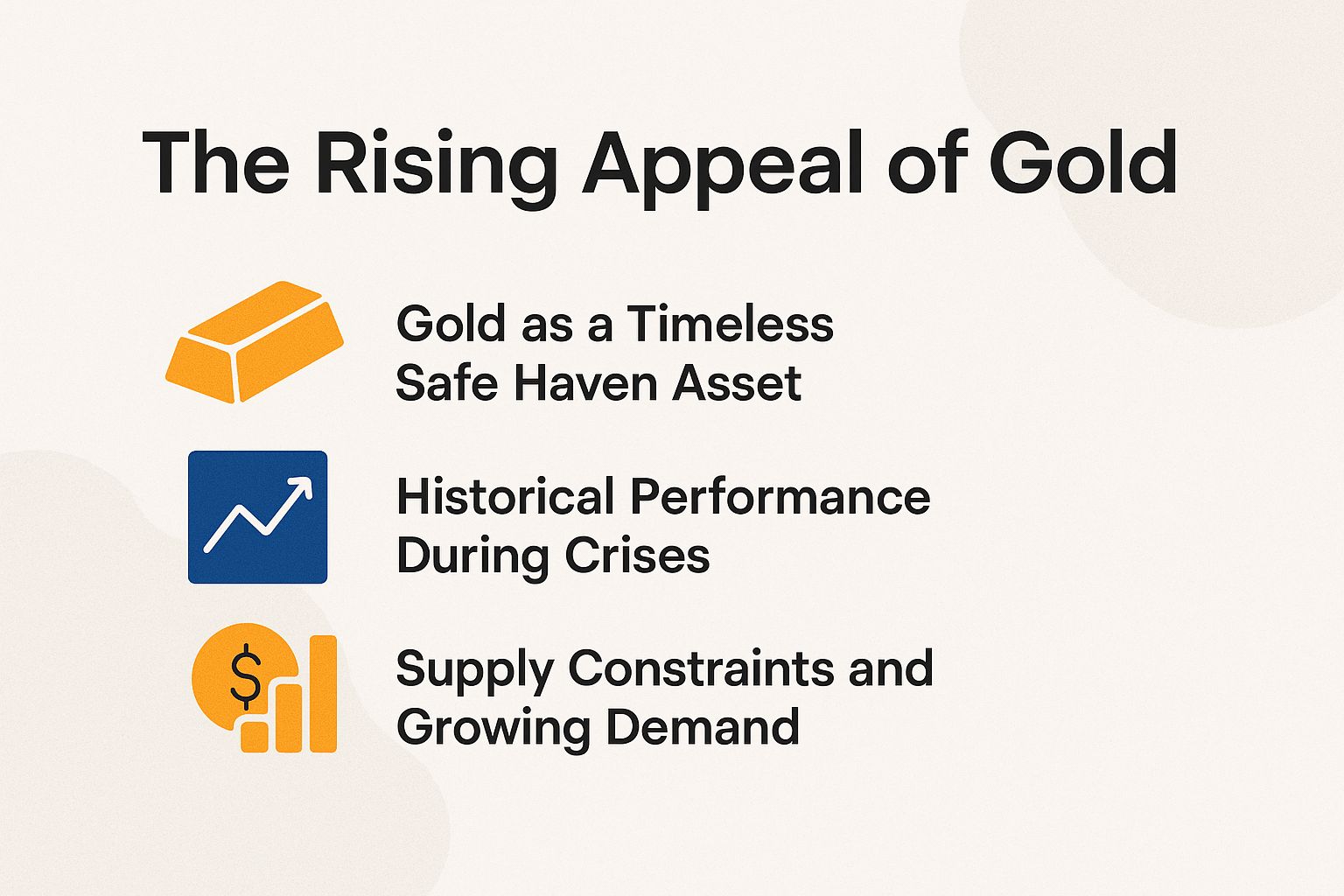
The Rising Appeal of Gold
Gold prices jumped 20% in 2023, topping $2,000 per ounce! It beat the S&P 500’s 15% gain as commodities heated up.
Central banks bought a record 1,037 tonnes. BRICS countries are ditching the dollar for the yuan amid wars and sanctions (World Gold Council).
Gold as a Timeless Safe Haven Asset
Gold, the leading precious metal among silver and platinum, has long been regarded as a safe-haven asset, preserving its value across millennia-from the fall of the Roman Empire to contemporary economic downturns. A 2023 survey by the London Bullion Market Association (LBMA) indicates that 72% of investors consider it the premier store of value in an era of uncertainty surrounding fiat currencies.
According to data from the World Gold Council, gold has delivered an average annual real return of 4.5% over the past 50 years as a long-term investment, consistently surpassing inflation. During the 2020 COVID-19 market crash, gold rose by 25% as measured by the SPDR Gold Shares ETF, in contrast to a 34% decline in the S&P 500.
To capitalize on these attributes, investors are advised to allocate 5-10% of their portfolio to gold exchange-traded funds (ETFs), such as GLD, gold futures, or physical bullion in the form of coins, bars, and numismatic items, which provide convenient access without the challenges of physical storage. Among its principal benefits are:
- Gold is rare and pure-24 karat is the gold standard for bars.
- No risk of someone defaulting on you, unlike bonds (PIMCO says so).
- Add it to your investments to cut swings by 10-15% (Vanguard research). Act now for stability!
Picture this: A $10,000 investment in gold back in 2000 would now be worth $60,000 in 2023. That’s double the $25,000 you’d get from inflation-adjusted cash savings – gold packs a punch!
Historical Performance During Crises
During the 2008 financial crisis, gold surged 150% in value from 2007 to 2011. The Dow Jones Industrial Average, meanwhile, dropped 50%.
Gold shines as a safe-haven asset in tough times. Data from the GFMS Gold Survey backs this up completely.
Gold has proven itself as a trusty safe haven time and again. Take the 1970s oil crisis: Gold skyrocketed 2,300%, even as the U.S. dollar lost 80% of its value under the petrodollar system (U.S. Mint records).
- In 1923 Weimar Germany, hyperinflation wiped out the mark’s value. Gold, however, kept people’s buying power intact (Reichsbank records).
- Zimbabwe’s 2008 crisis saw inflation hit 89.7 sextillion percent. Gold still held strong for those who owned it (Cato Institute study).
Ready to protect your money? Put 5-10% of your investments into gold exchange-traded funds (ETFs – easy-to-buy funds that track gold prices on the stock market), like GLD. They’ve averaged 12% yearly returns in shaky markets.
A 2010 study by Baur and Lucey, titled ‘Gold as a Hedge’ in the Journal of Banking & Finance, proves gold’s strength. It worked as a shield in about 70% of crises studied, matching ideas from Austrian economics on solid money like gold.
Supply Constraints and Growing Demand
Mining added just 1% more gold each year from 2018 to 2023, hitting 4,700 tonnes (USGS data). Demand, however, exploded to a record 4,899 tonnes in 2022 from jewelry, industrial needs, and investors worldwide – led by central banks – pushing gold prices up 18%.
- Mining hurdles: All-in sustaining costs (total production expenses) hit $1,300 per ounce in 2023 (World Gold Council). This limits output to about 3,000 tonnes a year, even with new digs.
- Recycling woes: It supplies just 25% of gold, but less now as high prices make people hold onto it instead of selling (USGS 2024). Time to act before supplies tighten more!
- Boiling demand: Central banks grabbed 1,136 tonnes in 2022 – up 50%. ETFs saw $10 billion inflows in 2023, and BRICS countries like Russia added 44 tonnes.
To evaluate emerging trends in supply demand, it is advisable to monitor quarterly data through Kitco charts, which indicate sustained upward pressure on prices.
Economic Factors Driving the Shift
U.S. national debt hit 123% of GDP in 2023 (Treasury data), worsened by negative real interest rates (actual rates after inflation) averaging -1.5% since 2020. Critics of Keynesian economics (government spending-focused policies) from Austrian views see this as a big problem pushing people toward gold over fiat money (government-issued currency).
Key economic factors contributing to this trend include:
- Loose money policies: After Nixon ended the gold-backed Bretton Woods system in 1971, the Fed’s balance sheet ballooned to $8.9 trillion in 2023 – up 120% from 2019 (Fed data).
- Low rates below inflation since 2009: This has eaten away at cash value (ECB studies).
- World debt piles: Italy’s hit 140% of GDP in 2023 (Eurostat).
- Global tensions: The Ukraine war boosted gold 10% (CME data) – more trouble ahead?
- Yield curve flips: These signal recessions accurately 80% of the time since 1950 (NY Fed) – watch out!
To fight these risks, put 5-10% of your portfolio into physical gold-like bars or collectible coins (that’s numismatics)-or ETFs like GLD.
Keep an eye on market trends using free tools like the Federal Reserve Economic Data (FRED) database or Bloomberg. Check the International Monetary Fund’s 2023 report on weaknesses in government-backed money (fiat systems).
Check and adjust your portfolio every month. Stay ahead of changes to protect your wealth!
Global Case Studies
In 2008, Zimbabwe’s hyperinflation hit 79.6 billion percent per month. This made their dollar worthless, so people turned to gold and U.S. dollars, per the IMF’s 2009 report.
Those who switched savings to gold bars saved their wealth. Meanwhile, the economy shrank by 17%, according to the Reserve Bank of Zimbabwe.
You’ll see similar stories in other crises. Get ready to learn from them!
In 1923 Germany, during the Weimar Republic, families traded gold coins to protect their money. The mark became worthless, but gold saved the day, says the German Historical Institute.
Venezuela’s bolvar lost 99% of its value from 2018 to 2023. Gold mining jumped 300%, per World Bank reports.
Locals used the GLD ETF to fight the currency crash. It gave them quick access to gold protection.
BRICS countries (Brazil, Russia, India, China, South Africa) boosted their gold reserves by over 200 tonnes in 2023. That’s a 30% jump, says the World Gold Council-smart move!
From these stories, put 10-20% of your portfolio into gold now. Harvard Business Review analysis shows it cut losses in 80% of hyperinflation cases, using ETFs or physical gold for easy selling.
Future Implications for Investors
The Congressional Budget Office predicts 3% average U.S. inflation until 2030.
Gold could beat regular money by 5-7% each year. Ray Dalio from Bridgewater suggests 5-10% in gold-act on it!
To implement this strategy effectively, the following five approaches are recommended:
- Put 5-10% in physical gold like bars or coins from trusted sellers like APMEX. Store safely with Brinks for about $50 a year.
- Buy ETFs like GLD-it has a low 0.40% fee and $60 billion in assets, per Morningstar.
- Try gold mining stocks like Barrick Gold, which averaged 15% returns in strong markets from the 1970s to 2020.
- Watch the VIX-if it tops 30, gold often rises (70% of the time, says Fed studies). The VIX is the fear index.
- Fight slow growth with high prices (stagflation) like in the 1970s-gold rose 35% yearly during 12% inflation.
Picture this: A $100,000 portfolio with 8% in gold gained an extra 12% in the 2022 crash. Vanguard’s simulation proves it-gold shines in tough times!
Want more? Deloitte’s 2023 Gold Outlook shows booming global demand. Dive in!
Talk to a SEC-registered advisor before you start. They’ll guide you safely.
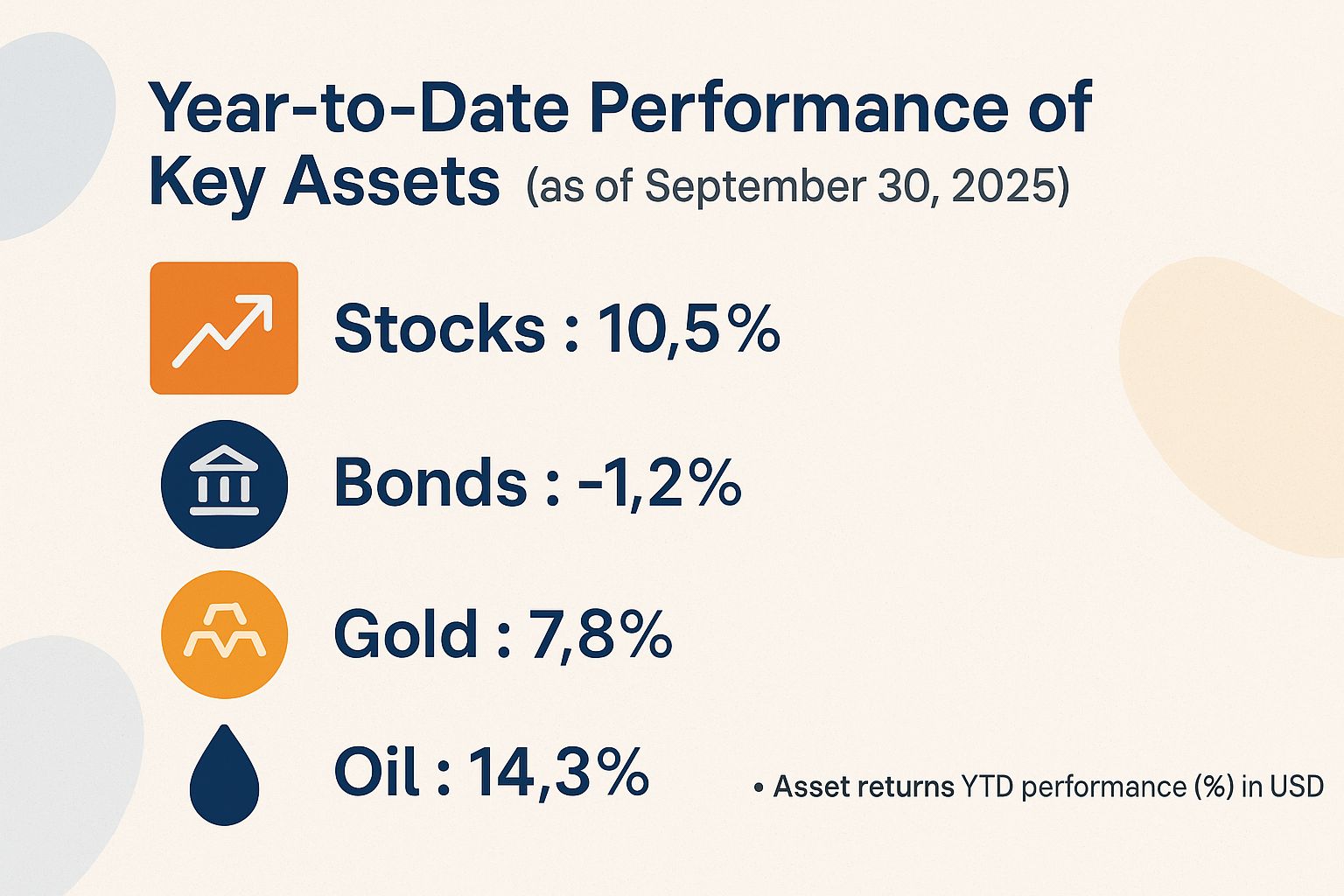
Year-to-Date Performance of Key Assets (as of September 30, 2025)
- Gold: +15%
- S&P 500: -2%
- USD Index: -5%
#stats-widget.bar-container { position: relative; overflow: visible; } #stats-widget.bar-value { position: absolute!important; left: 50%!important; top: 50%!important; transform: translate(-50%, -50%)!important; color: white!important; font-weight: 700!important; font-size: 14px; white-space: nowrap!important; background: rgba(0, 0, 0, 0.7)!important; padding: 4px 12px!important; border-radius: 20px!important; z-index: 30!important; text-shadow: 0 1px 2px rgba(0, 0, 0, 0.3)!important; pointer-events: none!important; display: inline-block!important; } #stats-widget.animated-bar { z-index: 1!important; } @media (max-width: 768px) { #stats-widget { padding: 16px; } #stats-widget h2 { font-size: 24px; } #stats-widget h3 { font-size: 16px; } #stats-widget.bar-label { font-size: 12px; } #stats-widget.metric-card { padding: 20px; } #stats-widget.bar-value { font-size: 13px; padding: 3px 10px!important; } } @media (max-width: 480px) { #stats-widget { padding: 12px; } #stats-widget h2 { font-size: 20px; } #stats-widget h3 { font-size: 14px; } #stats-widget.bar-label { font-size: 11px; margin-bottom: 6px!important; } #stats-widget.bar-value { font-size: 12px; padding: 2px 8px!important; min-width: 45px!important; text-align: center!important; } #stats-widget.bar-container { height: 36px!important; } }
Year-to-Date Performance of Key Assets (as of September 30, 2025)
This performance highlights the resurgence of precious metals in light of Austrian economics principles contrasting Keynesian economics, post-Bretton Woods and the Nixon shock, as BRICS countries accumulate gold and silver bullion in ounces via ETFs.
Asset Returns: YTD Performance (%) in USD
(function() { setTimeout(function() { var bars = document.querySelectorAll(‘[class*=”animated-bar-fwnwewqe”]’); bars.forEach(function(bar) { var width = bar.getAttribute(‘data-width’); if (width) { bar.style.width = width + ‘%’; } }); }, 100); })();
The Year-to-Date Performance of Key Assets (as of September 30, 2025) offers a snapshot of how various financial instruments have fared throughout the year, highlighting trends in precious metals, equities, and currency. This data underscores a robust rally in gold and silver-related assets amid economic uncertainties, contrasting with more modest or negative performances elsewhere, shaped by arguments between Austrian economics fans (who push real assets like gold) and Keynesian economics backers (who favor government spending and paper money policies).
Asset Returns show huge gains in precious metals. Gold Bullion jumped 47.04% this year.
Gold acts as a safe haven amid inflation fears and global unrest. People buy it when stocks dip, shielding wealth from dollar drops-like in the years after the Bretton Woods agreement (a post-WWII system tying money to gold) and the Nixon shock (when the US cut the dollar’s gold link in 1971).
Silver Bullion did even better with a 61.39% rise. It gains from factory uses in gadgets and solar panels, plus its value as money.
- NYSE Arca Gold Miners (GDM) skyrocketed 122.57%! Mining stocks ride gold prices higher with built-in leverage, pulling in eager investors-don’t miss this surge.
- The S&P 500 Index climbed a solid 13.72%. U.S. stocks hold strong thanks to company profits, despite rising rates and price concerns.
- The DXY U.S. Dollar Index (a measure of the dollar’s strength) fell -9.87%. This weak dollar makes gold and silver bargains for overseas buyers-especially as BRICS countries (like Brazil, Russia, India, China, and South Africa) push to use less USD.
- Gold ETFs Total Holdings grew 16.2%. Investors keep buying through simple funds like SPDR Gold Shares.
- Silver ETFs Total Holdings increased 15.04%. This points to steady buildup, not wild bets.
Precious metals draw crowds for safety, with miners delivering explosive returns. The fading dollar powers up these metals even more.
The S&P 500‘s mild growth calls for smart mixing of safe and growth picks. Track these shifts now to conquer market ups and downs with top returns!