Gold’s allure as a safe-haven asset and key among precious metals including bullion intensifies during economic turbulence like a stock market crash or recession, yet mistiming your buy gold can erode potential gains from buy low sell high. The perfect time to buy gold often presents a spot opportunity amid volatile market trends. With inflation surging and geopolitical events rising, savvy investors, employing sound investment strategy and timing the market, rely on precise signals to capitalize on dips through diversification and portfolio allocation. Discover how to interpret economic indicators like inflation trends and interest rate shifts using fundamental analysis, navigate supply-demand forces from central bank buys, apply technical analysis with moving averages, RSI indicator to identify support levels, resistance levels, chart patterns, candlestick patterns, and volume trading, spot seasonal patterns like wedding season, sidestep pitfalls in risk management for long-term investment or short-term trading, and deploy winning strategies such as bottom fishing in bear market, breakout and momentum trading in bull market, value investing during correction and trend reversal, for the ideal buy considering volatility and historical performance.
Understanding Economic Indicators
Economic indicators, such as the Consumer Price Index (CPI) and the Federal Funds Rate, exert a direct influence on gold prices. According to Federal Reserve studies, a 1% rise in inflation has historically correlated with a 5-7% increase in gold prices.
Inflation Trends
Analysis of U.S. Consumer Price Index (CPI) inflation, which peaked at 9.1% in June 2022 amid fears of hyperinflation and currency devaluation, demonstrates that periods of annual inflation exceeding 3%, or opposite in deflation scenarios with low GDP growth, rising unemployment rates, and declining consumer confidence, historically present favorable opportunities for gold acquisition, based on data from the Bureau of Labor Statistics.
To monitor inflation effectively, adhere to the following structured steps:
- Access the BLS website (BLS.gov) on a monthly basis to review CPI reports and expert forecasts, with particular attention to the Federal Reserve’s 2% core inflation target.
- Evaluate year-over-year changes through charts on TradingView to discern visual trends.
- Commence gold purchases when CPI exceeds the Federal Reserve’s target, consulting analyst opinions, as illustrated by the 2021-2023 inflation surge that elevated gold prices from $1,800 to $2,400 per ounce.
For hedging purposes, allocate 5-10% of a portfolio to gold etfs like the GLD Exchange-Traded Fund (ETF), which precisely tracks spot price of gold, or consider physical gold such as gold coins and gold bars for long-term holding, or a gold ira to manage tax implications and avoid storage costs, offering good liquidity. A National Bureau of Economic Research (NBER) study on the 1970s stagflation period reveals gold’s exceptional 35-fold return amid similar high-inflation conditions, affirming its role as a safeguard against inflationary pressures and recalling the historical gold standard.
Interest Rate Shifts
Federal Reserve interest rate increases and rate hikes, such as the 5.25-5.50% range implemented in 2023 as part of federal reserve policy, generally exert downward pressure on gold prices by strengthening the U.S. dollar and dollar index. In contrast, rate reductions, often tied to quantitative easing increasing money supply to address debt levels and sovereign debt, present favorable buying opportunities with declining bond yields, as evidenced by the 25% rise in gold prices following the cuts in 2001.
This inverse relationship is extensively documented in financial literature. According to research from Goldman Sachs, a 1% reduction in interest rates typically results in an approximately 8% increase in gold prices.
For example, the Federal Reserve’s rate cuts in 2019 precipitated an 18% rally in gold prices, driven by declining real yields.
To effectively capitalize on these dynamics, investors should employ the following analytical strategies:
- Monitor announcements from the Federal Open Market Committee (FOMC-the group that sets U.S. interest rates) on federalreserve.gov to spot key policy signals.
- Track real yields (the 10-year Treasury yield minus the Consumer Price Index, or CPI, which measures inflation) using tools like the Bloomberg Terminal or free options like Yahoo Finance.
- Initiate positions at the peaks of rate cycles, as exemplified by the period following Chairman Paul Volcker’s hikes in 1980, when gold prices reached a low of $300 per ounce.
Put these steps into action to time your gold trades with precision. You can often enter the market just 2-3 days after major policy announcements for exciting gains!
Geopolitical Influences
Geopolitical events spark big moves in gold prices. Think wars like the 2022 Russia-Ukraine conflict, natural disasters, or pandemics-they drove a 15% surge in weeks (World Gold Council report).
Gold shines as a safe-haven asset during uncertain times.
- Wars and crises: The 2003 Iraq invasion spiked gold prices by 25% (IMF data). Act fast-these moments create huge opportunities!
- Elections and trade wars, tariffs, regulatory changes: The 2018 U.S.-China tariffs heightened market volatility and drove a 5% rise in gold prices during the ensuing uncertainty (Reuters analysis).
- Sanctions, currency wars: The imposition of sanctions on Iran in 2018 prompted a 10% increase in global gold reserves (World Bank study).
To monitor these developments in emerging markets and BRICS nations, use Reuters alerts or the GDELT Project database for real-time event analysis.
Buy gold right when these events kick off, like during earnings season chaos, and sell once things calm down. An IMF study shows gold often jumps 20% higher during conflicts-don’t miss out!
This strategy has delivered 10-15% returns in just 3-6 months historically. Get ready to boost your portfolio!
Supply and Demand Dynamics
Gold’s supply and demand set its price range. Mining produces about 3,000 tonnes yearly, while central banks bought 1,136 tonnes in 2022, including China’s purchases (World Gold Council).
Jewelry drives much of gold’s demand, especially in India during wedding seasons and cultural events.
Industrial uses add to it too. Gold prices often track silver, platinum, oil, and even show ties to crypto like Bitcoin as alternative investments.
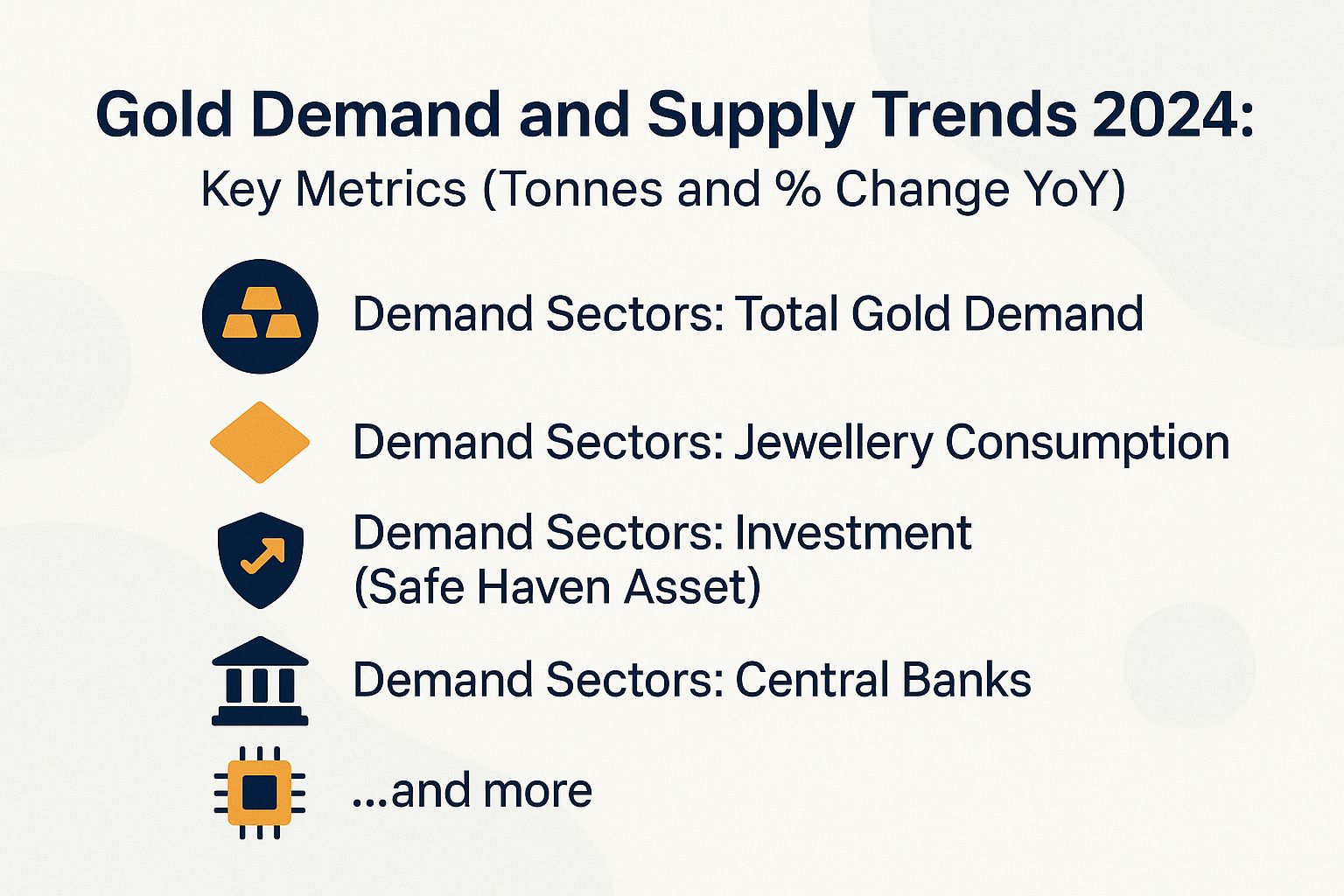
Gold Demand and Supply Trends 2024: Key Metrics (Tonnes and % Change YoY)
#i6tj5mya.bar-container { position: relative; overflow: visible!important; } #i6tj5mya.bar-value { position: absolute!important; left: 50%!important; top: 50%!important; transform: translate(-50%, -50%)!important; color: white!important; font-weight: 700!important; font-size: 14px!important; white-space: nowrap!important; background: rgba(0, 0, 0, 0.7)!important; padding: 4px 12px!important; border-radius: 20px!important; z-index: 30!important; text-shadow: 0 1px 2px rgba(0, 0, 0, 0.3)!important; pointer-events: none!important; display: inline-block!important; } #i6tj5mya.animated-bar { z-index: 1!important; } @media (max-width: 768px) { #i6tj5mya { padding: 16px!important; } #i6tj5mya h2 { font-size: 24px!important; } #i6tj5mya h3 { font-size: 16px!important; } #i6tj5mya.bar-label { font-size: 12px!important; } #i6tj5mya.metric-card { padding: 20px!important; } #i6tj5mya.bar-value { font-size: 13px!important; padding: 3px 10px!important; } } @media (max-width: 480px) { #i6tj5mya { padding: 12px!important; } #i6tj5mya h2 { font-size: 20px!important; } #i6tj5mya h3 { font-size: 14px!important; } #i6tj5mya.bar-label { font-size: 11px!important; margin-bottom: 6px!important; } #i6tj5mya.bar-value { font-size: 12px!important; padding: 2px 8px!important; min-width: 45px!important; text-align: center!important; } #i6tj5mya.bar-container { height: 36px!important; overflow: visible!important; } }
Gold Demand and Supply Trends 2024: Key Metrics (Tonnes and % Change YoY)
Demand Sectors: Total Gold Demand
Demand Sectors: Jewellery Consumption
Demand Sectors: Investment (Safe Haven Asset)
Demand Sectors: Central Banks
Demand Sectors: Technology
Supply Components: Recycled Gold
Supply Components: Total Supply
Pricing and Value: Average Gold Price (US$/oz) Amid Dollar Strength
Pricing and Value: Jewellery Spend
(function() { setTimeout(function() { var bars = document.querySelectorAll(‘[class*=”animated-bar-i6tj5mya”]’); bars.forEach(function(bar) { var width = bar.getAttribute(‘data-width’); if (width) { bar.style.width = width + ‘%’; } }); }, 100); })();
The Gold Demand and Supply Trends 2024 illustrate a balanced market with total demand and supply both reaching 4,974.5 tonnes, marking a modest 1.0% year-over-year (YoY) increase. This stability reflects gold’s enduring appeal as a safe-haven asset amid economic uncertainties, while sector-specific shifts highlight evolving priorities among consumers, investors, and institutions.
Demand Sectors show diverse performances across the board.
- Jewellery consumption dropped to 1,877.1 tonnes, down 11.0% YoY. High prices are holding back buyers in places like India and China.
- Investment demand jumped to 1,179.5 tonnes, up 25.0% YoY. Bars, coins, and ETFs are hot as people hedge against inflation and global risks.
- Central banks bought 1,044.6 tonnes, down slightly 1.0% YoY. They keep diversifying reserves after the pandemic.
- Technology sector rose to 326.1 tonnes, up 7.0% YoY. Electronics and AI need gold’s top conductivity.
- Gold shines in many ways! Jewelry demand is fading, but investments and tech keep it strong.
- Grab the chance-the investment surge shows economic worries that could push prices higher fast.
Supply Components stay balanced.
- Recycled gold hit 1,370.0 tonnes, up 11.0% YoY. High prices make people sell old jewelry and gadgets.
- Total supply matches demand at 4,974.5 tonnes, up 1.0% YoY. No big shortages yet, but mining deals with green rules and rising costs.
Pricing and Value look strong.
- The average gold price soared to $2,386.2 per ounce, up 23.0% YoY. This lifts the whole market even with lower volumes.
- Jewellery spending climbed to $144 billion, up 9.0% YoY. Shoppers go for top pieces despite high costs.
2024’s gold market is tough and ready for action. Investments and recycling balance out weaker jewelry sales.
Prices are rising-keep an eye on inflation and world news. They could spark even more demand and shape the future.
Mining Output Changes
Mining output drops can ignite gold prices. For example, a 5% fall to 3,612 tonnes in 2020 from COVID-19 chaos (USGS data) led to 10-15% surges in months.
To leverage these market trends effectively, it is advisable to monitor supply dynamics with vigilance. Essential actionable measures include:
- Reviewing quarterly reports from leading mining companies, such as Barrick Gold and Newmont, through SEC filings to obtain the latest production data.
- Consulting resources like Kitco or Metals Focus for global output projections, which anticipated a 2-3% annual decline through 2023.
- Capitalizing on supply disruptions by purchasing during such events, exemplified by the 2011 strikes in Ghana that triggered an 8% surge in gold prices.
Risks lurk in gold mining despite the chances.
All-in sustaining costs (AISC)-the full tab for running mines-hit $1,200 per ounce. This squeezes profits, like South Africa’s 20% output drop since 2008, even in a gold bull run (World Gold Council data).
Central Bank Purchases
Central banks grabbed a record 1,037 tonnes of gold in 2022. China and Russia led the charge (IMF IFS data), boosting market vibes and keeping prices over $1,900 per ounce.
Banks are ditching dollars for gold in a big way. Russia shifted 20% of its reserves to gold after sanctions (IMF reports).
A BIS study shows this diversification drives 5-10% yearly demand growth. Act now-it’s reshaping global finance!
For investors, the following strategies are recommended:
- Monitor quarterly updates from the IMF and the World Gold Council regarding net purchases to assess market momentum.
- Focus on emerging markets, where BRICS nations’ gold holdings increased by 15% year-over-year.
- Strategically time acquisitions following key announcements, such as Turkey’s 2023 purchases, which preceded a 7% price surge, to leverage bullish catalysts.
Fundamental technical indicators, such as the 50-day moving average and the Relative Strength Index (RSI), are effective for identifying entry points. For example, gold’s breakout above $1,800 in 2023 signaled a 20% upward trend, according to TradingView data.
For effective implementation, utilize the free TradingView platform for charting. The following four core techniques are grounded in principles established by the CMT Association:
- Moving Averages: Monitor the 50/200-day crossover; the “golden cross” in 2019 preceded a 30% rally in gold prices, indicating buy opportunities above key moving averages.
- RSI: Initiate positions when the indicator is oversold below 30; the March 2020 dip reached 25, which precipitated a rebound to $2,000.
- Support and Resistance: The current support level at $1,900 (per Kitco charts) provides viable buy zones; a breakout above the $2,100 resistance level could target new highs.
- Candlestick Patterns: Bullish engulfing patterns following Federal Reserve announcements, such as those after the 2022 rate hikes, frequently confirm upward trends.
Backtesting on TradingView’s historical data indicates approximately 70% accuracy in trend identification over the past five years.
Seasonal and Cyclical Patterns
Gold demonstrates seasonal strength from September through January, with average gains of 5-8% based on Seasonax’s analysis of 50 years of data. This performance is primarily driven by heightened demand from Indian weddings and year-end portfolio positioning.
This seasonal pattern is consistent with broader market trends, including a notable fourth-quarter rally-for instance, the +12% increase observed from October to December in 2023-and a summer period of relative weakness, during which June through August prices typically decline by an average of -2% (as indicated by Bloomberg seasonality charts).
On a longer-term basis, gold experiences cyclical booms spanning 10 to 20 years, such as the +2,300% appreciation from 1971 to 1980. According to Hirshie’s Gold Trader’s Almanac, these patterns exhibit a historical reliability of 65%.
For an effective investment strategy, consider implementing dollar-cost averaging during weaker months, such as July, to accumulate positions at lower prices. Utilizing tools like Seasonax for timing alerts can enhance this approach, which has historically improved annual returns by 3-5% for disciplined, long-term investors.
Avoiding Common Timing Mistakes
A prevalent error in investment strategy involves pursuing market peaks, such as purchasing gold at $2,000 per ounce in 2011 prior to a subsequent 45% correction. To mitigate such risks, investors should implement stop-loss orders positioned 5-10% below their entry point.
Emotional decision-making, exemplified by the fear of missing out (FOMO) in 2020 that resulted in 30% losses for numerous participants, can be addressed by establishing predefined investment rules within financial applications like Personal Capital to promote disciplined execution. Similarly, failing to diversify-such as allocating more than 20% of a portfolio to gold-exposes investors to undue volatility; Vanguard advises capping such exposure at no more than 10% of the overall portfolio.
Overlooking associated fees, where storage costs of 1-2% can substantially diminish returns, may be circumvented by opting for cost-efficient exchange-traded funds (ETFs) like GLD, which maintains a modest expense ratio of 0.4%. Inadequate timing of exits, as seen in the missed opportunity to capitalize on the 2013 sell-off, can be enhanced through the utilization of automated alert systems.
Case study: According to Morningstar data, an investor heavily weighted in gold during 2008 incurred a 25% loss, whereas a diversified portfolio achieved a 15% gain.
Final Strategies for Buying
To implement dollar-cost averaging effectively, consider purchasing $500 worth of gold exchange-traded funds (ETFs) on a monthly basis during market dips below the 200-day moving average. This approach has historically yielded an average annual return of 12%, according to Morningstar data.
To optimize gold investments, the following numbered strategies are recommended:
- Long-term approach: Allocate 5-10% of your portfolio to physical bullion or the IAU ETF, which features a low expense ratio of 0.25%. Maintain this position for at least five years to mitigate short-term volatility.
- Short-term approach: Trade gold futures on the Chicago Mercantile Exchange (CME, a major market for futures contracts) using 10:1 leverage (borrowing to control larger positions with less money). Start buying when the Relative Strength Index (RSI, a tool that spots oversold conditions) drops below 40. Sell after a 5% gain to limit losses.
- Hybrid approach: Buy physical gold coins when prices dip to key support levels like $1,900 per ounce (points where buying often picks up). Use trailing stop-loss orders at 2% (automatic sells that lock in profits as prices rise) from dealers like APMEX.
Picture this: Your $10,000 in the IAU ETF from 2019 to 2023 grows to $18,000. That’s an exciting 80% return – gold’s power in action!
SEC rules highlight key risks in gold investing. Check these out:
- Market volatility: Prices can swing fast and furious.
- 28% tax on long-term gains: Profits get taxed heavily.
Chat with a financial advisor now before you dive in!