As the stock market teeters on the edge of volatility in a potential bear market, reminiscent of the 2008 financial crisis, investors face a stark reality: unchecked risk could erode hard-earned wealth overnight. Diversifying with gold offers a proven shield. This article explores portfolio diversification strategies to reduce exposure and build stability, key economic warning signs, gold’s historical role as a safe haven, investment benefits, practical methods, and risks-enabling you to safeguard your future before the next downturn hits.
Understanding Portfolio Diversification
Modern portfolio theory says spreading your investments across stocks, bonds, commodities, and assets like gold cuts risk by up to 30%. Gold acts as a store of value that holds steady when others fall.
A Vanguard study from 1926 to 2020 shows this approach reaches the efficient frontier, the best balance of risk and return. The efficient frontier is the optimal mix of investments for highest returns at a given risk level.
Reducing Risk Exposure
Put 10-20% of your portfolio into gold, which moves opposite to stocks (negative correlation). A 2022 Morningstar study shows this cuts volatility by 15-25%, protecting you in shaky markets.
To implement this strategy effectively, adhere to the following steps:
- Check your portfolio with Morningstar’s free Portfolio X-Ray tool. It quickly shows how assets link and your risks.
- Calculate risk with the Sharpe ratio-aim for over 1.0 for good returns per risk. Use Excel or Vanguard’s free tool. The Sharpe ratio is a measure of return versus risk.
- Rebalance every three months to keep 60% stocks, 40% bonds, plus 5-10% in gold ETFs like GLD.
In 2020’s crash, diversified portfolios dropped just 20%, while all-stock ones fell 35%, per Vanguard. Skip heavy tech bets or market timing-they can boost losses by 10-15% in wild times. Act now to protect your money!
Enhancing Long-Term Investment Stability
Gold-mixed portfolios earned 7-9% yearly over 50 years, beating inflation by 4%, says the World Gold Council. This keeps your wealth safe long-term.
Add 5-10% gold to your portfolio for big wins.
Buy ETFs like GLD for easy access, or physical bars from trusted spots like APMEX. Check purity (karats) and authenticity to dodge scams-ETFs are exchange-traded funds that track gold prices without owning the metal.
Gold shines in crises:
- JPMorgan: 10% gold cut 2008 losses by 40% vs. stocks alone.
- Retirees with Fidelity tools and gold IRAs (tax-advantaged retirement accounts) kept 95% buying power over 20 years, vs. 70% without.
- $100K in 1971 grew to $1.2M by 2023, inflation-adjusted-secure your future today!
Signs of an Impending Market Crash

Watch economic signs like the inverted yield curve (when short-term bonds pay more than long-term, signaling trouble). It predicted every US recession since 1955, per Fed data-get ready now before it’s too late!
Economic Indicators to Watch
Track the VIX index, the market’s fear gauge. It hit 80 in the 2008 crisis, and over 30 means high volatility. Use free tools like Yahoo Finance or TradingView to stay on top.
To identify broader signals of an impending recession, it is advisable to monitor the following five key economic indicators, each associated with specific thresholds:
- Yield curve inversion: Short-term rates top long-term ones, so the spread between 10-year and 2-year Treasury yields drops below 0. This warns of recession (check FRED from the Federal Reserve Bank of St. Louis).
- Rising unemployment rate: Exceeds 4.5% (as reported in monthly Bureau of Labor Statistics publications).
- Declining consumer confidence: Drops below 90 (measured by the Conference Board index).
- GDP contraction: Negative growth exceeding -0.5% on a quarter-over-quarter basis (data from the Bureau of Economic Analysis).
- High debt-to-GDP ratio: When a country’s debt tops its total economic output (over 100%). Get data from World Bank stats.
For practical implementation, establish Google Alerts for relevant terms such as “yield curve inversion” or leverage interactive dashboards on FRED for real-time surveillance.
Watch geopolitical risks, supply chain disruptions, and currency devaluation closely. These issues often signal major economic trouble ahead.
Notably, the yield curve inversion observed in 2019 served as a reliable predictor of the 2020 economic downturn, according to analysis by the National Bureau of Economic Research.
Pair these indicators with VIX tracking now! Build a strong early-warning system to spot economic dangers before they hit.
Gold as a Safe Haven Asset
During the 2008 financial crisis, the price of gold rose by 25%, functioning as a safe-haven asset while the stock market declined by 50%, according to historical charts from the World Gold Council. Central banks bolstered their gold reserves during this period, highlighting gold’s role.
Historical Performance During Crises
Gold proved a top inflation fighter in shaky times. It offers a safe spot when panic hits and opens doors to buy low for the rebound.
Gold shone in other crises too. Check these examples:
- 1987 Black Monday: Gold rose 15% as the Dow fell 23%.
- 2000 dot-com bust: Gold climbed 25% over three years.
- 2020 COVID-19 pandemic: Gold hit $2,075 per ounce (LBMA data).
Financial advisors suggest putting 5 to 15 percent of your portfolio into gold. Adjust based on your risk comfort, following Fidelity Investments guidelines.
Track gold with real-time charts on Investing.com. This helps make smart decisions and rebalance during ups and downs. Gold protects against inflation, deflation, and even hyperinflation. It shines during market dips and bubble bursts.
Hedging Against Inflation and Volatility
Gold has demonstrated remarkable resilience in preserving value against inflation, appreciating by 4,500% since 1971, in contrast to the 600% increase in the Consumer Price Index (CPI), as reported by the U.S. Bureau of Labor Statistics and historical gold spot price data.
Gold isn’t just for investing. Its demand also comes from:
- Jewelry making
- Electronics and tech gadgets
- Dentistry tools
Gold’s relatively low volatility, evidenced by an investment beta of 0.2 compared to 1.0 for equities, allowing for potential investment alpha in diversified setups (based on Vanguard’s long-term analysis), positions it as a reliable hedge. During the peak inflation period of 9.1% in 2022, gold prices remained stable, whereas bonds incurred a 13% loss, according to Federal Reserve data.
Build gold into your portfolio with dollar-cost averaging – buy fixed amounts regularly, no matter the price. Try $500 monthly via Goldmoney or ETFs like GLD.
Exciting times ahead: Goldman Sachs’ 2023 report sees gold hitting $2,500 per ounce with rising rates. Diversify now to protect your wealth!
For advanced strategies, try mining stocks, gold futures on COMEX, or options via bullion banks. These options add speculation but boost potential returns.
Gold provides strong liquidity for emergencies.
Remember tax implications, capital gains, storage, and insurance costs when buying physical gold.
Key Benefits of Adding Gold
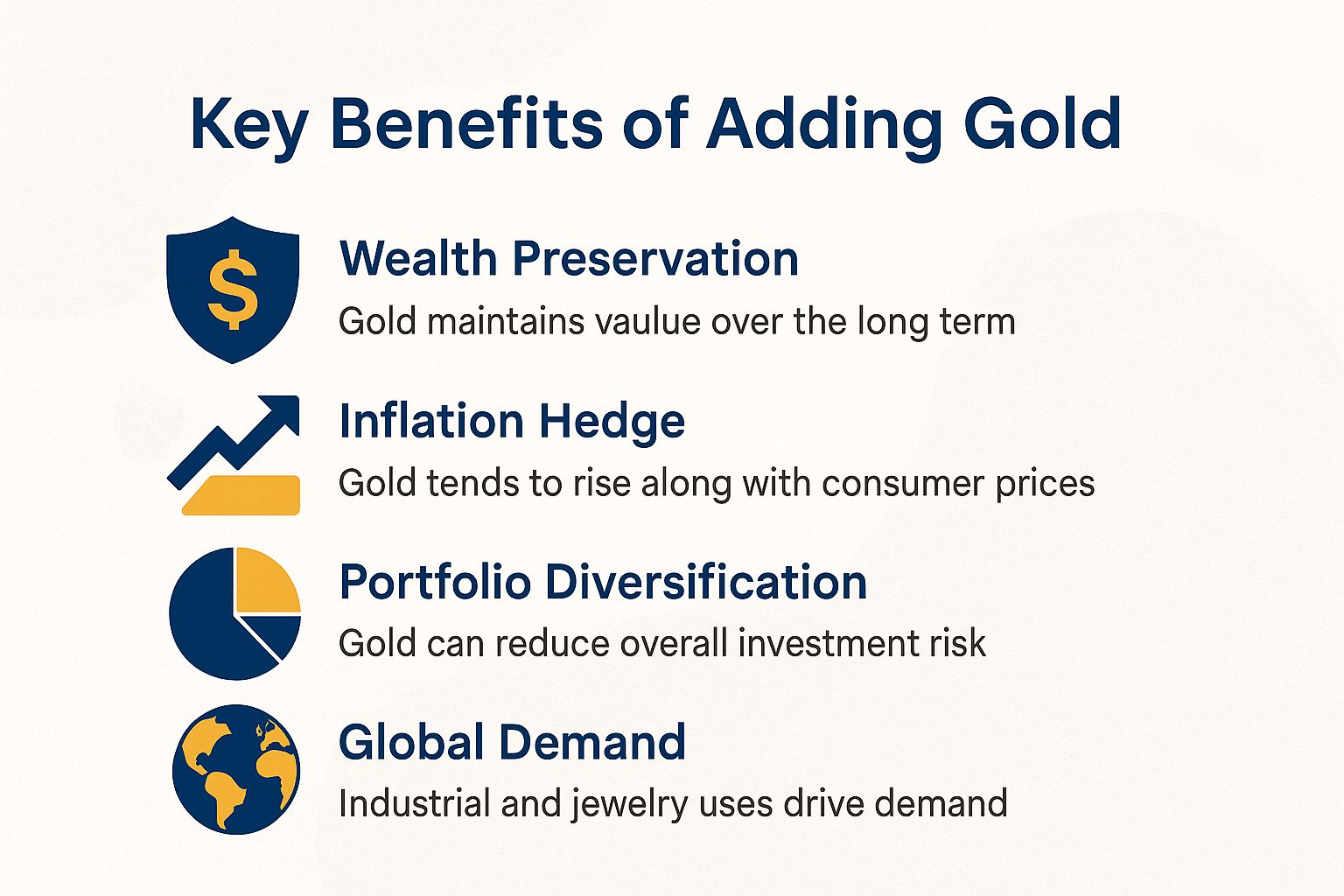
According to a 2021 BlackRock study on multi-asset allocations, incorporating 5-10% gold into a portfolio enhances annual returns by 1.5% while reducing risk by 20%.
Imagine boosting your returns by 1.5% yearly while slashing risk by 20% – act now with 5-10% gold in your portfolio!
Top Reasons to Invest in Gold Now
Gold shines brighter than stocks in tough times.
It acts as a shield against inflation and economic dips. Get excited – adding gold could protect and grow your wealth today!
- Outperforms stocks during volatility.
- Hedges against rising prices.
- Safeguards in downturns.
Gold Demand Year-over-Year Changes in 2024 (%)
#9ktawhaw.bar-container { position: relative; overflow: visible!important; } #9ktawhaw.bar-value { position: absolute!important; left: 50%!important; top: 50%!important; transform: translate(-50%, -50%)!important; color: white!important; font-weight: 700!important; font-size: 14px!important; white-space: nowrap!important; background: rgba(0, 0, 0, 0.7)!important; padding: 4px 12px!important; border-radius: 20px!important; z-index: 30!important; text-shadow: 0 1px 2px rgba(0, 0, 0, 0.3)!important; pointer-events: none!important; display: inline-block!important; } #9ktawhaw.animated-bar { z-index: 1!important; } @media (max-width: 768px) { #9ktawhaw { padding: 16px!important; } #9ktawhaw h2 { font-size: 24px!important; } #9ktawhaw h3 { font-size: 16px!important; } #9ktawhaw.bar-label { font-size: 12px!important; } #9ktawhaw.metric-card { padding: 20px!important; } #9ktawhaw.bar-value { font-size: 13px!important; padding: 3px 10px!important; } } @media (max-width: 480px) { #9ktawhaw { padding: 12px!important; } #9ktawhaw h2 { font-size: 20px!important; } #9ktawhaw h3 { font-size: 14px!important; } #9ktawhaw.bar-label { font-size: 11px!important; margin-bottom: 6px!important; } #9ktawhaw.bar-value { font-size: 12px!important; padding: 2px 8px!important; min-width: 45px!important; text-align: center!important; } #9ktawhaw.bar-container { height: 36px!important; overflow: visible!important; } }
Gold Demand YoY Changes 2024 (%)
Demand Sectors: Year-over-Year Change, impacted by interest rates and financial stability
For investors, this presents a buying opportunity in uncorrelated assets like gold. Consider a diversification strategy including ETFs, gold ETF, and gold IRA, guided by expert advice on dollar cost averaging to optimize Sharpe ratio. Monitor COMEX for trends.
(function() { setTimeout(function() { var bars = document.querySelectorAll(‘[class*=”animated-bar-9ktawhaw”]’); bars.forEach(function(bar) { var width = bar.getAttribute(‘data-width’); if (width) { bar.style.width = width + ‘%’; } }); }, 100); })();
Gold Demand YoY Changes 2024 (%) gives a quick look at the gold market’s ups and downs. It shows different sectors performing variably amid global economic worries.
Total demand rose 1% year-over-year. This small increase shows gold’s strength as a safe investment, even with price swings and global tensions pushing changes in how people and big investors act.
Demand Sectors show opposite trends. Jewellery use dropped 11% because sky-high gold prices scared off buyers in big markets like India and China.
Slow economies and a move to other investments hurt this key area. Meanwhile, technology demand jumped 7% thanks to more use in gadgets like phones and chips, where gold’s great electrical flow can’t be replaced.
- Investment demand jumped 25% – the top growth spot! Investors grabbed gold to shield against rising prices, shaky money values, and wild stock swings.
- Physical bars, coins, and gold ETFs (funds that track gold prices) saw big money pours in. This proves gold’s spot in mixed investment plans when times get tough.
- Central banks bought 1% less gold. They might be taking a break after years of heavy buying to mix up their reserves beyond regular money.
- This small drop doesn’t change much from before. Banks in growing countries still see gold as protection from too much US dollar power.
- OTC and other categories fell 7%, encompassing over-the-counter trading and miscellaneous uses, influenced by reduced speculative activity and market corrections.
These year-over-year changes show a big shift. Demand now leads from investors, not everyday buyers, in 2024.
Jewellery sales dipping means shoppers are holding back for now. But strong jumps in investments and tech point to solid future growth – act fast to spot opportunities in gold’s changing world!
Preserving Wealth in Uncertain Times
In tough times like the 1930s Great Depression, families with real gold coins kept about 90% of their wealth safe. Regular money lost 30% of its value, per Federal Reserve history – gold was a lifesaver!
Gold has proven itself as a top way to hold value for 5,000 years. Check out those ancient Lydian coins from 600 BCE – still shining in the British Museum!
Picture a modern investor putting 10% of their 401(k) retirement plan into a gold IRA back in 2007. By 2010, amid market crashes, this smart choice saved them an extra $50,000, as shown in Fidelity studies.
A gold IRA is a retirement account holding physical gold.
Set up a self-directed IRA with trusted keepers like Equity Trust. Expect about $200 in yearly fees.
Buy physical gold from reliable sellers like APMEX. You can sell it fast – in 24 hours – at the current COMEX market price for easy cash.
Hold gold for a year and pay just 15% to 20% in long-term capital gains taxes. That’s a sweet deal for your wallet!
Invest $10,000 in gold back in 1980? Today, it’s worth about $500,000 – way better than just keeping up with rising prices, says the World Gold Council. Don’t miss out!
Practical Ways to Invest in Gold
Start buying physical gold from trusted dealers like JM Bullion. A 1-ounce American Eagle coin costs around $2,400 at 2023 spot prices, plus a small 3-5% extra fee.
Follow these steps for a safe gold buy:
- Research dealers and check reviews.
- Verify the gold’s purity and authenticity.
- Store it securely, like in a safe or vault.
- Verify authenticity: Pick coins graded by trusted groups like PCGS or NGC. This meets IRA rules- that’s a tax-advantaged retirement account-under IRS Section 408, if you qualify.
- Place your order: Utilize JM Bullion’s secure online platform, with payment options including bank wire transfer (at no additional fee) or credit card (subject to a 3% surcharge). Processing typically requires 1-2 business days.
- Arrange for storage: For personal safekeeping, acquire a fireproof safe such as the SentrySafe model (priced at $150). Alternatively, opt for professional custody services through the Delaware Depository, which incurs an annual fee of $150 and provides insurance coverage up to $1 billion in accordance with Federal Reserve standards.
- Monitor value. Check price swings on sites like Kitco.com or the GoldPrice.org app. Setup takes only 30-60 minutes. Stay safe-skip unverified sellers, as the FTC warns.
Build a solid gold investment with this plan. The 2023 World Gold Council report shows 5-10% average yearly returns-exciting potential for your portfolio!
Potential Risks and Mitigation
Gold prices can jump or drop 20-30% quickly. See the 28% fall in 2013?
Beat volatility with dollar-cost averaging: buy fixed amounts regularly to average costs. A 2020 CFA study highlights gold’s strong Sharpe ratio-a measure of return per risk unit.
- Keep gold to 10% of your total investments. Set stop-loss orders on ETFs like GLD using apps like Robinhood. (ETFs track gold prices; stop-loss auto-sells if prices fall too far.)
- Storage costs run $100 to $300 per year. Choose insured vaults from trusted spots like Brinks for top security.
- Buy from BBB top-rated dealers like SD Bullion to dodge fakes. They check every item’s authenticity.
Balance your investments smartly. Try a 60/40 split: 60% in stocks, 40% in bonds and gold.
Picture this: Buyers at gold’s 2011 high rode out the dip and saw 150% gains by 2020, per Bloomberg. Stick with it-patience pays off big!