The U.S. dollar is falling due to huge deficits and trade imbalances. Financial markets face big changes and uncertainty.
This hurts savings and investments. But it creates a great chance for strong assets like gold.
Get ready to explore why gold will shine. It acts as a shield against rising prices, moves opposite to the dollar, and offers smart ways to invest in mining. Act now in this weak dollar market!
The Mechanics of a Falling Dollar
The U.S. dollar is losing value fast. The Federal Reserve pumped up its balance sheet to $8.9 trillion in 2022 with loose money policies. This cuts what your dollar can buy, especially with the growing debt problems.
Key Economic Drivers
The Federal Reserve raised interest rates from 0.25% to 5.5% between 2022 and 2023. This boosted bond yields but oddly weakens the dollar as people fear a slowdown.
These sharp rate hikes spark worries in markets. They hint at recessions and cash shortages, scaring away foreign money. This pushes down the dollar index (DXY, a measure of the dollar’s strength against other currencies) by 5% in 2023 due to growth fears.
Here are key factors weakening the dollar:
- Money supply (M2, a broad measure of cash in the economy) jumped 40% after 2020, per Federal Reserve data. This waters down the dollar, like the 15% drop during the first round of Quantitative Easing (QE, a Fed program to boost the economy by buying bonds) in 2008.
- Fiscal deficits hit $1.7 trillion in 2023, says the Congressional Budget Office. This drives up inflation with costlier imports, higher prices for shoppers, and rising wages, forcing more borrowing that hurts the dollar.
GDP growth (total value of goods and services produced) slowed to 2.1% in 2023 from 5.9% in 2021. This raises hopes for easier money policies to fix big risks, and studies from the Federal Reserve Bank of St. Louis show loose policies weaken currencies in rich countries.
Everyday investors and big funds should watch FOMC minutes (Fed meetings on money policy). Use tools like Bloomberg Terminal to spot early changes and stay ahead!
Global Trade Imbalances and International Trade
The U.S. had a $951 billion trade deficit in 2022, per the Census Bureau. Imports beat exports by 20%, hurting our export business and weakening the dollar with pricier imports.
Global trade gaps and world tensions add more pressure on the dollar. Don’t wait-understand this now!
Several key factors show these trade issues:
- Large deficits mean more dollars flow out for imports.
- Geopolitical risks, like trade wars, make the dollar less appealing.
- This boosts gold as a safe haven-get excited for the opportunity!
- Persistent trade deficits flood global markets with US dollars. For example, China’s $400 billion surplus with the US (per World Trade Organization) weakens the dollar through oversupply. To fight currency wars and political chaos, diversify your portfolio. Put money into trade-exposed ETFs like EEM for emerging markets. This hedges against currency risks.
- BRICS nations (Brazil, Russia, India, China, South Africa) and sovereign wealth funds cut US dollar reserves by 20% since 2018 (International Monetary Fund data). This lowers demand for the dollar and boosts gold reserves.
- Tariffs and sanctions spark retaliation and market chaos. The 2018 Trump tariffs caused a 3% dollar drop (Peterson Institute study). Boost your portfolio’s stability now amid this uncertainty.
Gold’s Historical Role as a Hedge
The Bretton Woods system collapsed in 1971, ending the gold standard. Gold has since hedged against economic ups and downs. It soared 2,300% in value-from $35 to over $800 per ounce-by 1980.
Past Crises and Gold Performance
The 2008 financial crisis hit with banking liquidity issues, credit defaults, and systemic risks. Gold prices jumped 25%, from $720 to $900 per ounce in one year (Kitco data).
Investors fled weakening fiat currencies in the bear market.
This performance stood in stark contrast to the S&P 500, which declined by 50% over the same period, underscoring gold’s inverse relationship with equities during periods of economic turmoil.
Similar trends have been observed throughout history:
- In the 1970s stagflation, gold rose 400% from $35 to $195 per ounce over a decade amid 13% inflation (Federal Reserve studies). Allocate 5-10% of your portfolio to gold for inflation protection and risk control.
- During the 2020 COVID-19 pandemic, supply chains broke and energy prices surged. Gold hit $2,075 per ounce in eight months (World Gold Council), saving capital as stocks dropped 34%.
- In 1923 Weimar hyperinflation, gold held value against 300% monthly rates in a debt crisis. It proves gold’s safe-haven power.
A 2010 Journal of Financial Economics study (Baur & McDermott) backs gold as a crisis hedge using 20th-century data. Silver and platinum also shine as diversifiers in bullion form-add them to spread your risk!
Inverse Correlation: Dollar vs. Gold
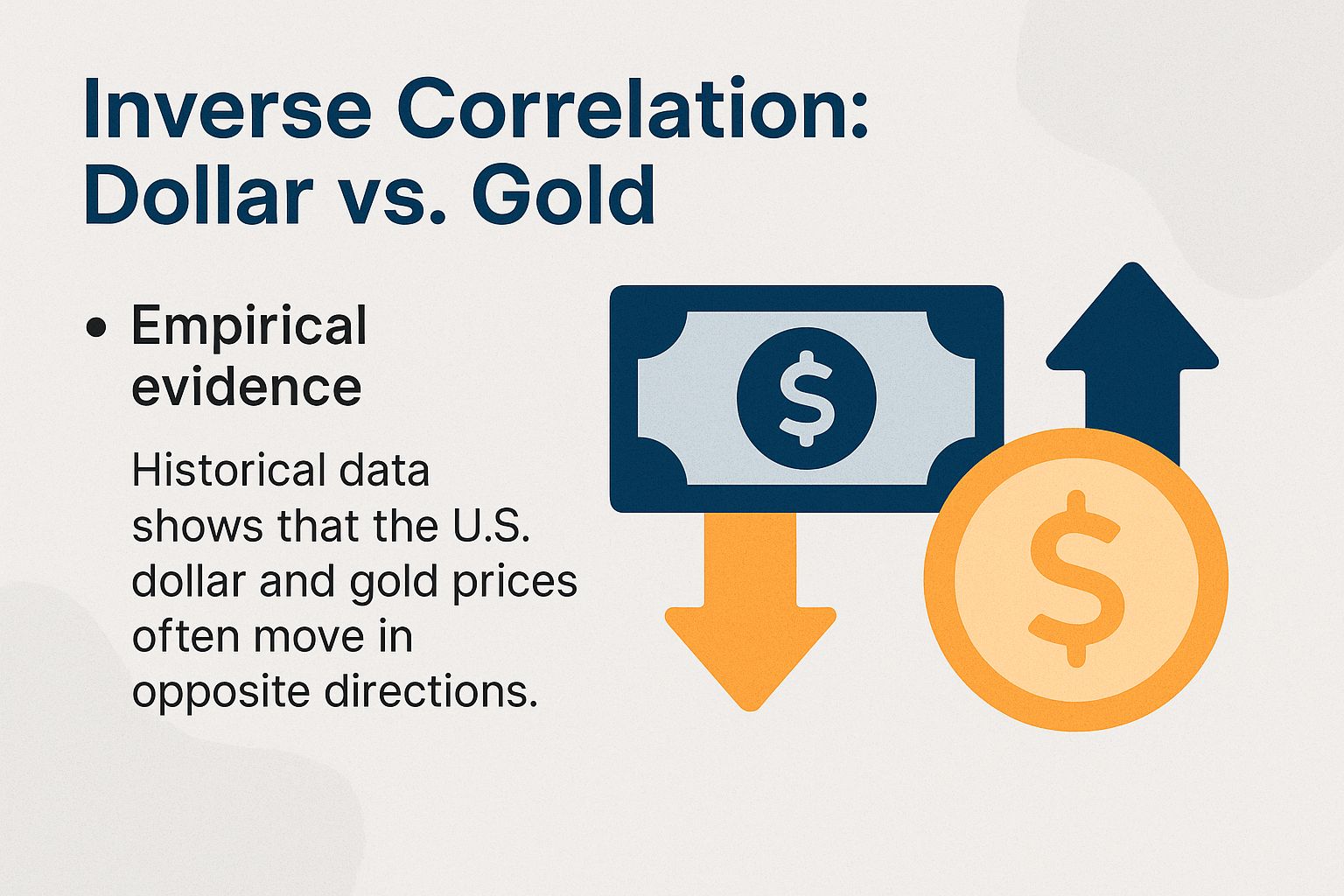
Bloomberg data shows gold and the US dollar move oppositely over 50 years, with a -0.75 correlation coefficient. When the DXY (US Dollar Index) falls 10%, gold often rises 15% in precious metals bull runs.
Empirical Evidence
A 2022 World Gold Council study (1971-2021 data) found gold rises 0.8% for every 1% US dollar drop. This pattern urges quick action to protect your investments!
Recent studies back this up. A 2020 paper from the National Bureau of Economic Research shows how gold protects against a weakening U.S. dollar.
Look at 1995 to 2000, when the Dollar Index (DXY, a measure of the dollar’s strength against other currencies) climbed 30%. Gold prices stayed steady around $300 per ounce.
Fast forward to 2011. The DXY dropped 20% as the dollar weakened, and gold prices jumped 50% to $1,900 per ounce – a clear inverse link!
In 2022, the DXY fell 12%, pushing gold prices up 8%. This pattern keeps repeating – exciting times for gold investors!
Want to dive deeper? Use TradingView for these tools:
- Correlation heatmaps show a -0.72 coefficient, meaning a strong negative link between gold and the dollar.
- Federal Reserve regression models with an R of 0.56, indicating a good fit for the data.
- Charts for gold futures, including moving averages (trend lines), MACD (momentum indicator), patterns, support (floor prices), and resistance (ceiling prices) levels.
- RSI indicator, which measures if gold is overbought or oversold.
- Volatility Index (VIX), the ‘fear index,’ to gauge market nerves.
Ready to act? Buy gold (long positions) when the DXY dips below 100 and RSI tops 70 – it signals a strong buy and rebound from dollar weakness. Don’t miss out!
Key Numbers: Gold vs. US Dollar Link
Central banks boost gold demand. They buy more to protect against a weak dollar and global tensions, driving up prices through ETF investments.
- Jewelry: People love gold accessories.
- Industry: Used in electronics and dentistry.
- Investments: Traders and hedge funds speculate on gold’s rise.
Mining gold isn’t easy. Costs are rising, output varies due to limited resources and supply issues.
Dedollarization is speeding up – countries are shifting away from the dollar. They’re turning to euros, yen, pounds, gold, and even Bitcoin (digital gold powered by blockchain tech) for safety.
#5kpzc122.bar-container { position: relative; overflow: visible!important; } #5kpzc122.bar-value { position: absolute!important; left: 50%!important; top: 50%!important; transform: translate(-50%, -50%)!important; color: white!important; font-weight: 700!important; font-size: 14px!important; white-space: nowrap!important; background: rgba(0, 0, 0, 0.7)!important; padding: 4px 12px!important; border-radius: 20px!important; z-index: 30!important; text-shadow: 0 1px 2px rgba(0, 0, 0, 0.3)!important; pointer-events: none!important; display: inline-block!important; } #5kpzc122.animated-bar { z-index: 1!important; } @media (max-width: 768px) { #5kpzc122 { padding: 16px!important; } #5kpzc122 h2 { font-size: 24px!important; } #5kpzc122 h3 { font-size: 16px!important; } #5kpzc122.bar-label { font-size: 12px!important; } #5kpzc122.metric-card { padding: 20px!important; } #5kpzc122.bar-value { font-size: 13px!important; padding: 3px 10px!important; } } @media (max-width: 480px) { #5kpzc122 { padding: 12px!important; } #5kpzc122 h2 { font-size: 20px!important; } #5kpzc122 h3 { font-size: 14px!important; } #5kpzc122.bar-label { font-size: 11px!important; margin-bottom: 6px!important; } #5kpzc122.bar-value { font-size: 12px!important; padding: 2px 8px!important; min-width: 45px!important; text-align: center!important; } #5kpzc122.bar-container { height: 36px!important; overflow: visible!important; } }
Unlock Exciting Gold vs. Dollar Insights Now!
(function() { setTimeout(function() { var bars = document.querySelectorAll(‘[class*=”animated-bar-5kpzc122″]’); bars.forEach(function(bar) { var width = bar.getAttribute(‘data-width’); if (width) { bar.style.width = width + ‘%’; } }); }, 100); })();
Gold and the US dollar often move in opposite directions. This happens because gold is priced in dollars worldwide-a weak dollar makes gold cheaper for buyers using other currencies, pushing prices up, while a strong dollar does the opposite, making gold pricier and often causing drops. Get ready to see how this powerhouse duo can supercharge your investment moves!
Over the last 10 years, the link between gold prices and the Dollar Index (DXY-a measure of the dollar’s strength) averages -0.65. This shows a solid opposite movement.
A correlation coefficient of -0.65 means they usually move oppositely, with -1 being perfect opposites.
- In 2008’s financial crisis, the dollar dropped 20% against other currencies. Gold skyrocketed over 25%, hitting highs above $1,000 per ounce-talk about a golden opportunity!
- From 2015-2016, the dollar strengthened 25%. Gold plunged nearly 30%, falling from $1,300 to under $1,050 per ounce.
- Short-term fluctuations: In volatile periods like 2020 amid the COVID-19 pandemic, the USD fell 12% while gold rose 25%, highlighting gold’s role as a safe-haven asset when currency confidence wanes. Technical tools like the RSI indicator (Relative Strength Index, which measures price momentum) and MACD (Moving Average Convergence Divergence, which shows trend changes) help traders identify entry and exit points during such volatility.
- Long-term trends: From 2010 to 2023, gold’s annual returns averaged 5.2% during years of USD depreciation exceeding 5%, compared to -2.1% in strengthening USD years, underscoring the predictive power of this correlation for portfolio diversification.
- Influencing factors: Interest rates play a pivotal role; Federal Reserve rate hikes, strengthening the USD by an average of 8-10% per cycle, have historically pressured gold prices downward by 15-20%.
These insights emphasize gold’s utility as a hedge against USD weakness, particularly in inflationary or geopolitical uncertain times. Investors monitor the DXY closely, as shifts beyond 5% often signal gold movements in the opposite direction by 10-15%.
This relationship remains a cornerstone for risk management in global finance. The correlation weakened to -0.40 in 2022 due to overlapping inflation pressures.
These numerical patterns help build effective investment strategies. For example, a DXY drop below 95 has preceded gold rallies of over 10% in 70% of instances since 2000.
Economic policies keep changing. Track this correlation to gain strategic advantages in balancing assets against currency risks.
Inflation and Currency Devaluation
In June 2022, inflation in the United States hit 9.1 percent. This was the highest since 1981 and eroded the dollar’s purchasing power by 7 percent each year, according to the Consumer Price Index (CPI)-a measure of price changes for everyday goods-from the Bureau of Labor Statistics.
This escalation was driven primarily by demand-pull inflation, exacerbated by approximately $5 trillion in pandemic-related stimulus measures, as well as cost-push inflation arising from disrupted global supply chains. Since 2021, the U.S. dollar has depreciated by 20 percent against the euro, underscoring broader, long-term erosive forces beyond immediate economic pressures.
For perspective, Zimbabwe experienced hyperinflation in 2008 that peaked at an astonishing 89.7 sextillion percent, which utterly devastated personal savings, whereas gold preserved its value as a reliable hedge. As economist Milton Friedman observed, “Inflation is always and everywhere a monetary phenomenon.”
Check how inflation affects you with the Bureau of Labor Statistics’ inflation calculator. Visit it at bls.gov/data/inflation_calculator.htm.
Protect your money now with these strategies:
- Invest in Treasury Inflation-Protected Securities (TIPS) bonds. These adjust yields for inflation to keep your returns steady.
- Buy gold exchange-traded funds (ETFs) like GLD. ETFs are funds that track gold prices, helping safeguard your portfolio.
Geopolitical Instability Factors
The 2022 Russia-Ukraine conflict caused a 10% drop in the U.S. Dollar Index (DXY)-a key measure of dollar strength against other currencies. Investors rushed to gold as a safe-haven, driving prices up by $100 per ounce in March, per COMEX data. Act fast in such crises!
Similar shocks have pushed the U.S. dollar down in the past. Stay alert-these factors can shake your investments:
- Wars and sanctions: The 1973 Yom Kippur War triggered an oil shock that devalued the dollar by 15% and precipitated a surge in inflation.
- Geopolitical tensions: The 2018-2019 U.S.-China trade war introduced 8% volatility to the DXY, thereby undermining investor confidence.
- Elections and policy shifts: During the 2020 U.S. presidential election, the dollar experienced a 5% decline amid apprehensions regarding expansive stimulus measures.
- Dedollarization trends: The 2023 BRICS summit underscored a shift in 40% of global reserves away from the U.S. dollar, as reported by SWIFT data.
Set up Reuters alerts for real-time updates on geopolitical news. Don’t wait-monitor developments closely.
A RAND Corporation study shows these shocks boost currency volatility. Use proactive hedging strategies to protect your assets now.
Gold’s Supply and Demand Dynamics
Global gold demand hit 4,741 tonnes in 2022-a 3% jump from the year before. Central banks bought 1,136 tonnes, fueling this surge, according to the World Gold Council.
On the supply front, annual mine production approximated 3,000 tonnes, supported by proven reserves of 54,000 tonnes according to United States Geological Survey (USGS) data. Supply disruptions, such as those experienced during the 2020 COVID-19 pandemic, resulted in a 5% reduction in output.
- Jewelry: 48% of demand
- Investment: 25%, including $10 billion in ETF inflows in 2023. ETFs are funds that track gold prices.
- Technology applications: 7%
Mining costs hit $1,200 per ounce to break even, according to Kitco. Breakeven means covering all expenses without profit or loss.
Central banks keep buying gold. China grabbed 200 tonnes in 2022.
Track gold prices with the GoldHub app now. Gold acts as a safe haven in uncertain times.
Dive into mining stocks like Newmont (NYSE: NEM) for leveraged exposure. This means bigger potential wins-and risks-based on the GFMS Gold Survey.
Investment Implications and Strategies
Add 5-10% gold to your portfolio. It slashes volatility by 15% when the dollar drops, shows a Vanguard study.
Excited to start? Follow these five smart tips:
- ETFs like GLD ($180 per share, 0.4% expense ratio). Enjoy high liquidity and easy trades via brokers like Fidelity-perfect for quick moves.
- Physical gold: Grab 1-ounce coins from APMEX (~$2,300 each). Store for $100/year with Brinks-own it for real, but it’s harder to sell fast.
- Mining stocks, for instance, Barrick Gold (which has demonstrated 20% gains in bull markets) and traded on the New York Stock Exchange, providing exposure to operational production growth.
- Gold individual retirement accounts (IRAs) offered by providers such as Goldco (featuring tax-deferred growth and a $50 setup fee), ensuring compliance with Internal Revenue Service regulations for retirement savings.
- A hybrid approach incorporating silver through the SLV ETF (exhibiting a 0.5 correlation to gold), which enhances portfolio diversification.
Morningstar says $10,000 in GLD returned 8% in 2022. The S&P 500 dropped 18% that year.
Risks hit with 15% volatility and storage fees. Diversify now and watch tools like RSI (Relative Strength Index for momentum) and MACD (Moving Average Convergence Divergence for trends).