
Central banks worldwide buy gold reserves faster than since the 1970s. World Gold Council data shows this quiet shift back to gold in the global economy.
Inflation eats away at paper money. Geopolitical tensions grow deeper, making gold a trusted protector once more.
Explore gold’s rich history. Look at economic issues like debt problems and de-dollarization, plus bank moves, investor excitement, and what it means for future markets.
Historical Context of Gold’s Role
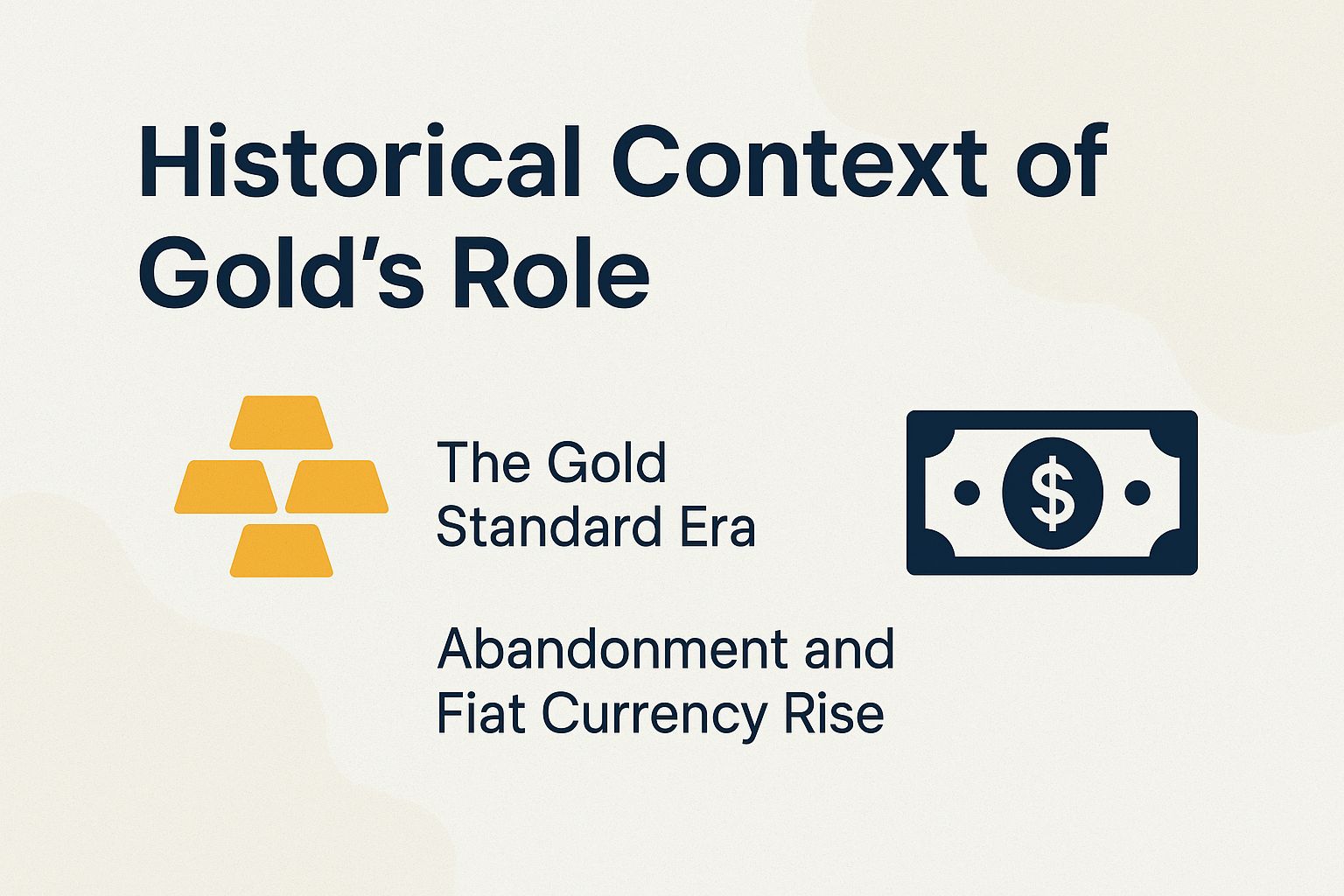
Gold has been key to world economies for centuries. It protected against inflation and acted as trusted money until paper currencies took over in the 1900s. Fiat currency is government-issued money not backed by gold or silver.
The Gold Standard Era
Between 1870 and 1914, the classical gold standard established a fixed exchange rate system by linking currencies to gold, which contributed to an annual international trade growth rate of 3.4%, as documented in the research of economist Barry Eichengreen.
Under this framework, participating nations upheld convertibility at predetermined par values. For instance, the United States dollar was fixed at $20.67 per ounce of gold through the Gold Standard Act of 1900, thereby promoting stability through the backing of paper currency with gold reserves.
Central banks tweaked interest rates to handle gold flows in and out. The UK stuck to its rate of GBP3.89 per ounce.
The gold standard shone in keeping prices steady and finances secure. Global inflation stayed at just 0.1% a year, says Federal Reserve history.
Challenges hit during recessions and uncertainty. The rigid money supply limited credit and slowed recovery.
Barry Eichengreen explains this in his 1992 book *Golden Fetters*. The lack of flexibility in money policy made downturns worse and longer. Sound money is a stable currency backed by real value like gold.
- 1870: Gold standard starts, trade grows.
- 1914: World War I disrupts it.
Abandonment and Fiat Currency Rise
On August 15, 1971, President Richard Nixon terminated the convertibility of the United States dollar into gold, an event known as the “Nixon Shock.” This decision introduced fiat currencies, which facilitated more adaptable monetary policies but also introduced significant economic volatility.
In his televised address to the nation, President Nixon stated, “I have directed the Secretary of the Treasury to suspend temporarily the convertibility of the dollar into gold.”
The goal was to protect the US economy from speculators. Vietnam War costs and trade gaps made it worse.
This ended the Bretton Woods system from 1944. It had kept global money stable.
The effects hit hard and fast. By 1974, US inflation soared to 11%, sparking the tough stagflation of the 1970s-Bureau of Labor Statistics data confirms it. Stagflation is high inflation mixed with stagnant growth.
Fiat systems allow flexible tools like quantitative easing. After 2008, the Fed pumped $4 trillion into the economy to help recover. Quantitative easing is central banks buying assets to boost money supply.
But they risk devaluing money. IMF studies show instability after the 1944 Bretton Woods ended.
For contemporary investors, several critical lessons emerge from this historical episode:
- Watch M2 money supply growth on FRED to spot inflation risks-act now!
- Diversify into gold bullion; it’s up over 500% since 2000.
- Use TIPS to fight rising rates.
Economic Instabilities Fueling the Shift
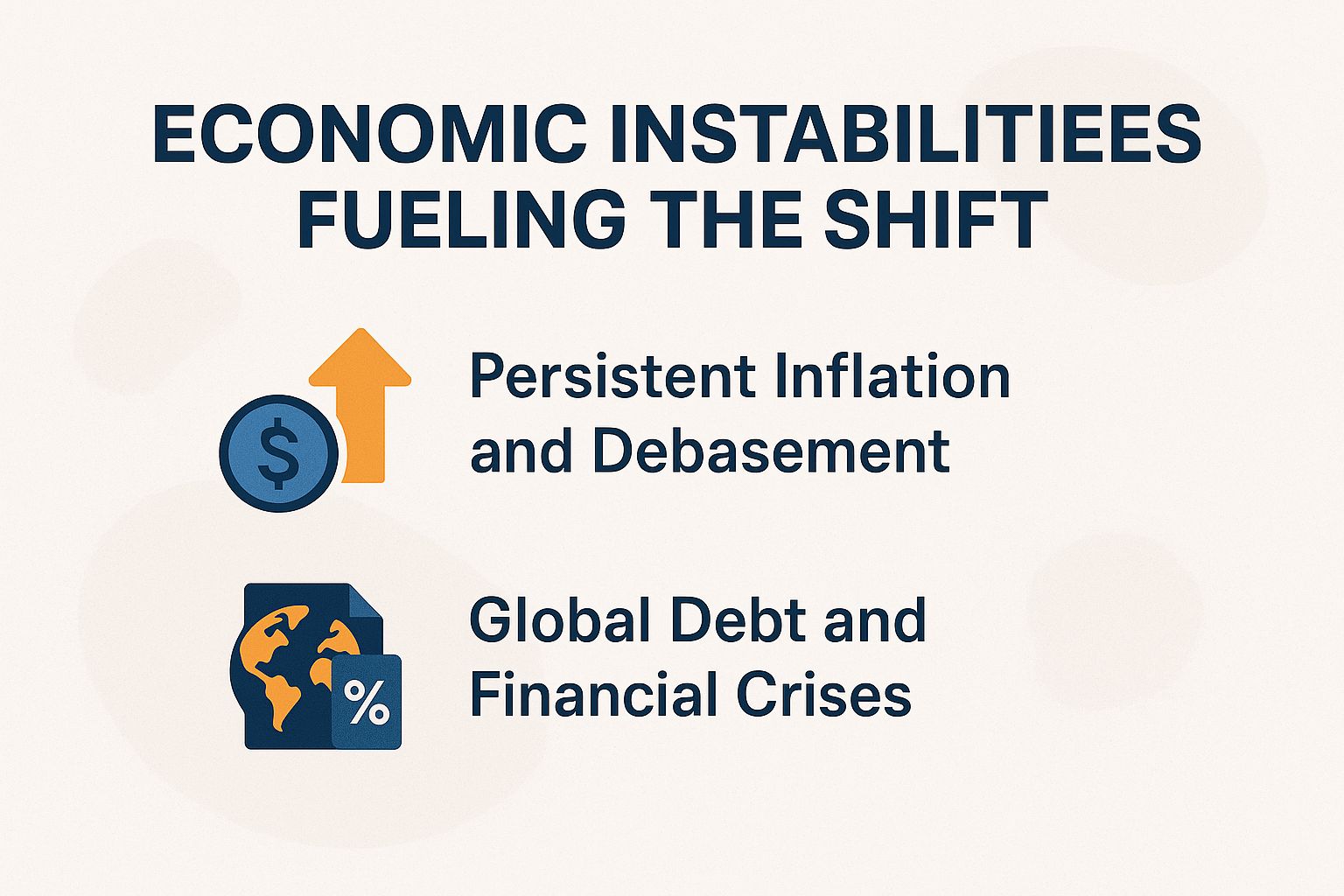
Escalating economic pressures, including high inflation rates, supply shocks, and the energy crisis surpassing 8% in major economies during 2022 (per International Monetary Fund data), are fueling renewed interest in gold as a reliable hedge against economic instability and contributing to a commodity boom in metal prices.
Persistent Inflation and Debasement
Global inflation reached 8.7% in 2022, marking the highest level in four decades according to the International Monetary Fund’s (IMF) World Economic Outlook. This surge has contributed to the debasement of fiat currencies, currency devaluation, and driven an 18% increase in gold prices during that year.
The underlying cause of this currency debasement lies in excessive monetary expansion. For instance, the Federal Reserve’s balance sheet expanded from $4 trillion in 2019 to $9 trillion by 2022 to finance stimulus measures, thereby diluting the intrinsic value of the currency.
A particularly stark illustration is Venezuela’s experience with hyperinflation in 2018, which peaked at 1.7 million percent and eroded the value of savings held in bolivars, while gold retained its worth as a store of value for those who held it.
According to the IMF’s April 2023 report, there exists a robust positive correlation between inflation and gold prices. Over the period from 1970 to 2022, gold prices increased by an average of 10% annually during years when inflation exceeded 5%, as evidenced by the report’s accompanying chart data.
To mitigate such risks, investors are advised to allocate 5-10% of their portfolios to gold, in line with the diversification strategy employed by Ray Dalio at Bridgewater Associates.
Global Debt and Financial Crises
Global debt reached $305 trillion in 2022, according to data from the Institute of International Finance (IIF), representing 336% of global GDP. This escalation has intensified economic crises, such as the $10 trillion in losses incurred during the 2008 financial downturn, while enhancing the appeal of gold as a safe-haven asset, which experienced a 25% price rally.
The collapse of Lehman Brothers in 2008 precipitated $10 trillion in global losses, as reported by the IIF, severely challenging debt sustainability and sovereign debt amid widespread bank failures, liquidity issues, credit risk, and a freeze in credit markets under banking regulations.
In a comparable manner, the 2020 COVID-19 downturn in the post-pandemic economy resulted in a 3.4% contraction in global GDP, according to the World Bank, thereby heightening vulnerabilities in economies burdened by high debt levels.
Central banks responded to these pressures by increasing their gold reserves by 20% in 2008, per the World Gold Council, which highlights gold’s critical function in mitigating financial risks.
For practical risk mitigation and portfolio diversification, investors are advised to diversify into gold ETFs, physical gold, digital gold, or tokenized assets during periods of recession; for instance, the SPDR Gold Shares (GLD) ETF appreciated by 30% in 2020 amid market volatility.
It is recommended to review the IIF’s Global Debt Monitor on a quarterly basis to evaluate potential threats to debt sustainability and adjust investment portfolios as necessary.
Central Banks’ Strategic Moves
According to the World Gold Council, central bank purchases of 1,136 tonnes of gold in 2022, marking a 52% increase from the previous year. This strategic accumulation serves as a protective measure against potential risks associated with the US dollar.
Accumulating Gold Reserves
According to data from the People’s Bank of China, China gold buying has increased the country’s gold reserves to 2,235 tonnes by 2023, reflecting a 17% increase since 2019, while Russia augmented its holdings by 44 tonnes in 2022 in response to international sanctions.
Central banks worldwide are actively accumulating gold reserves to mitigate risks associated with inflation and geopolitical instability. In Russia’s case, these purchases helped offset the 11.9% consumer price index (CPI) inflation experienced in 2022, as documented in reports from the Central Bank of Russia.
Among other leading purchasers, Poland acquired 130 tonnes in 2022, and Turkey added 45 tonnes, as part of broader strategies to diversify reserves away from U.S. dollar dominance. Investors may monitor central bank holdings through the World Gold Council’s comprehensive database to identify potential signals for gold purchases, particularly in anticipation of upward price movements.
For instance, driven by India gold demand, the Reserve Bank of India (RBI) procured 100 tonnes of gold between 2022 and 2023, which supported the stabilization of the Indian rupee amid economic volatility, according to the RBI’s annual report.
The following table presents a comparison of gold reserve-to-GDP ratios for selected countries:
| Country | Gold Reserves (tonnes, 2023) | GDP (USD trillion) | Ratio (%) |
|---|---|---|---|
| China | 2,235 | 17.7 | 0.2 |
| Russia | 2,333 | 2.2 | 1.9 |
| India | 803 | 3.4 | 0.4 |
| Poland | 377 | 0.8 | 0.8 |
| Turkey | 584 | 1.1 | 0.9 |
- China: Low ratio at 0.2% shows room for more gold buys.
- Russia: Higher 1.9% ratio highlights diversification push.
- India: 0.4% ratio indicates moderate gold backing relative to its growing economy.
- Poland: 0.8% reflects a strategic increase in reserves for stability.
- Turkey: 0.9% underscores efforts to bolster reserves amid inflation challenges.
Geopolitical Tensions and Dedollarization
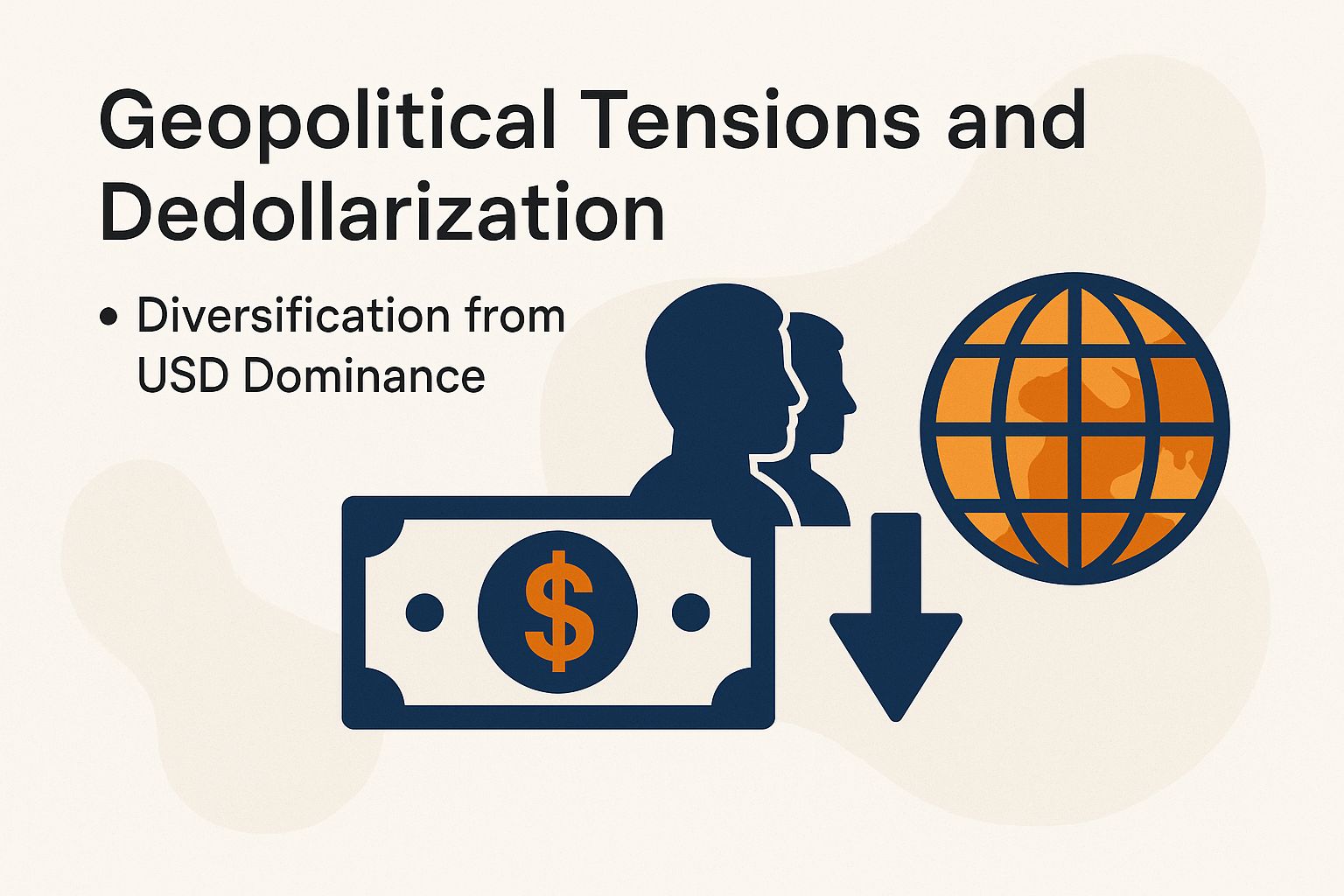
The 2022 Russia-Ukraine war sped up dedollarization big time-that’s reducing reliance on the USD in global finance. Geopolitical risks are pushing countries away from the dollar.
BRICS and emerging markets now do 28% of trade in local currencies, up from 10% in 2019, says the IMF. Cryptocurrencies are even entering the mix as alternatives to old systems.
Diversification from USD Dominance
Countries want less reliance on the dollar. They’re trading in other currencies and challenging the petrodollar system-where oil sales use dollars-and the USD’s role as the top global reserve currency.
Trade wars and sanctions speed this up. Get ready for big changes in how the world pays!
In 2023, the BRICS nations introduced a gold-backed payment system, which has reduced the use of the U.S. dollar (USD) in international trade by 20 percent. This shift is exemplified by Russia’s transition to ruble-yuan settlements following the imposition of sanctions, while increasing its Russia gold reserves.
Gold’s Broader Market and Supply Factors
Gold plays a big role in jewelry and industry. In places like India, it’s a key part of weddings.
Supply challenges include higher mining costs and efforts to find new deposits. Countries are also claiming more control over their resources, a trend called resource nationalism.
Sustainable practices help reduce environmental harm. Recycling gold offers a green way to get more bullion.
Check out royalty companies if you’re into this area. Watch gold futures, market contango (when future prices are higher than spot), and trader moods for clues on metals like silver, platinum, and palladium.
Dedollarization is picking up speed fast. China bought $3.2 billion in gold in 2023 to bolster reserves amid U.S. tensions, per customs data.
Saudi Arabia is warming up to BRICS. This could shake up oil trade, ditching old petrodollar deals where oil is priced in dollars. Don’t miss this shift-it’s changing global trade right now!
The USD index (DXY) dropped 10% since 2022. Fed policy changes are raising risks for dollar assets and possible debt troubles.
Protect yourself by grabbing gold bullion now-it’s a top safe haven! Try one-ounce American Eagle coins at spot price plus 3% premium from trusted spots like APMEX.
Investor Demand and Market Trends
Retail gold demand hit 1,181 tonnes in 2022, per the World Gold Council. Strong buying from India helped, fueled by $10.5 billion into exchange-traded funds (ETFs)-baskets of gold you can buy like stocks.
Spot prices soared to $2,070 per ounce. Stocks tumbled, with the S&P 500 down 19%, but gold shone through the chaos!
Want returns like gold’s? Diversify with physical gold, ETFs, or gold mining shares. This fits Austrian economics, which favors hard assets like gold over fiat money.
Buy physical gold from trusted dealers like JM Bullion. It gives you real assets, but expect about 5% yearly storage fees.
Long-term investors love this. Put 5 to 15% of your portfolio in gold, just like Vanguard suggests.
Try gold ETFs like SPDR Gold Shares (GLD). They follow gold prices closely with just 0.4% fees, offer easy trading, and skip storage hassles.
Craving bigger wins? Gold mining stocks offer high-risk thrills. Barrick Gold jumped 15% in 2023-exciting potential ahead!
Gold crushed crypto in tough times. Bitcoin dropped 65% in 2022, but gold held strong!
The World Gold Council (WGC) sees gold demand staying hot into 2024. Bloomberg predicts prices hitting $2,500 per ounce by 2025-get in now!
Quick Steps to Start Investing in Gold
- Check your risk comfort level.
- Sign up with a trusted broker like Fidelity.
- Dive into gold options today!
Top Ways to Invest in Gold
- Physical Gold: Buy from dealers like JM Bullion for tangible assets (5% storage fee). Ideal for long-term holds (5-15% portfolio allocation per Vanguard).
- Gold ETFs: Like GLD, track prices with 0.4% fees. Super liquid, no storage needed.
- Mining Stocks: High risk, high reward-Barrick Gold up 15% in 2023!
Global Gold Investment: 2023 vs. 2024 Breakdown
Insert chart content here (e.g., bar chart HTML for 2023 vs 2024 data).
#yymwgbg9.bar-container { position: relative; overflow: visible!important; } #yymwgbg9.bar-value { position: absolute!important; left: 50%!important; top: 50%!important; transform: translate(-50%, -50%)!important; color: white!important; font-weight: 700!important; font-size: 14px!important; white-space: nowrap!important; background: rgba(0, 0, 0, 0.7)!important; padding: 4px 12px!important; border-radius: 20px!important; z-index: 30!important; text-shadow: 0 1px 2px rgba(0, 0, 0, 0.3)!important; pointer-events: none!important; display: inline-block!important; } #yymwgbg9.animated-bar { z-index: 1!important; } @media (max-width: 768px) { #yymwgbg9 { padding: 16px!important; } #yymwgbg9 h2 { font-size: 24px!important; } #yymwgbg9 h3 { font-size: 16px!important; } #yymwgbg9.bar-label { font-size: 12px!important; } #yymwgbg9.metric-card { padding: 20px!important; } #yymwgbg9.bar-value { font-size: 13px!important; padding: 3px 10px!important; } } @media (max-width: 480px) { #yymwgbg9 { padding: 12px!important; } #yymwgbg9 h2 { font-size: 20px!important; } #yymwgbg9 h3 { font-size: 14px!important; } #yymwgbg9.bar-label { font-size: 11px!important; margin-bottom: 6px!important; } #yymwgbg9.bar-value { font-size: 12px!important; padding: 2px 8px!important; min-width: 45px!important; text-align: center!important; } #yymwgbg9.bar-container { height: 36px!important; overflow: visible!important; } }
Global Gold Investment by Category 2023 vs 2024
In the context of Austrian economics, investors are increasingly favoring gold amid policy shifts from the Federal Reserve, IMF, and World Bank. This trend is amplified by BRICS nations, with notable China gold buying, surging India gold demand, and expansions in Russia gold reserves, influencing sectors like gold ETFs.
Investment Volumes (tonnes): Total Investment
Investment Volumes (tonnes): Bar and Coin Investment
Investment Volumes (tonnes): Gold-backed ETFs
(function() { setTimeout(function() { var bars = document.querySelectorAll(‘[class*=”animated-bar-yymwgbg9″]’); bars.forEach(function(bar) { var width = bar.getAttribute(‘data-width’); if (width) { bar.style.width = width + ‘%’; } }); }, 100); })();
The Global Gold Investment by Category 2023 vs 2024 data illustrates a notable uptick in overall gold investment volumes, measured in tonnes, reflecting shifting investor preferences amid economic uncertainties. Total investment rose from 945.5 tonnes in 2023 to 1179.5 tonnes in 2024, a significant increase of approximately 24.7%, signaling renewed confidence in gold as a safe-haven asset.
Geopolitical tensions, inflation, and central banks in BRICS nations (like Brazil, Russia, India, China, and South Africa) are driving this. These include Russia’s buildup of gold reserves and China’s gold purchases, pulling more money into physical and financial gold products.
Bar and coin investments represent physical gold holdings. They showed strong stability, hitting 1189.8 tonnes in 2023 – just above the total investment that year.
In 2024, this category fell slightly to 1186.3 tonnes, down only 0.3%. Retail investors and wealthy individuals in Asia and the Middle East, especially with India’s strong demand for gold, keep this interest alive. Physical gold offers portability and real value, acting as a shield against falling currencies despite price swings.
- Gold-backed ETFs showed big outflows in both years, but 2024 improved a lot.
- In 2023, outflows hit -244.2 tonnes due to high interest rates pushing money to bonds.
- By 2024, outflows dropped to -6.8 tonnes – a 97% cut! Investors love ETFs for quick trades and no storage worries compared to physical gold.
Gold markets are changing fast. Physical investments stay strong, while ETF flows bounce back – thanks to easy access for big institutions.
Watch out: If total investments keep climbing, gold prices could surge, boosting mining economies and pushing for greener gold sourcing!
Future Implications for Global Finance
Rising risks of stagflation – that’s when the economy stalls while prices keep rising – give gold a big comeback chance. JPMorgan sees a 40% chance by 2025, fitting ideas from Austrian economics. Experts predict gold prices could jump 20% with $100 trillion in global debt, per the World Bank.
This gold comeback might mean partial backing, like Switzerland’s 20% gold reserves rule. It could also bring cool digital gold on blockchains like Pax Gold, cutting the pain from money printing (quantitative easing) and maybe hiking U.S. interest rates to 5.5%, as the IMF warned in October 2023.
Goldman Sachs highlights gold as your shield against wild market swings. Act now – experts like those at BlackRock suggest putting 10% of your portfolio into gold to grab this hot opportunity!
In periods of economic uncertainty, the following strategies warrant consideration:
- Acquire physical gold exchange-traded funds (ETFs), such as GLD, to ensure liquidity;
- Invest in gold mining equities (e.g., Newmont Corporation) for leveraged exposure to price movements;
- Engage in gold futures contracts on the Commodity Exchange (COMEX) to capitalize on anticipated price fluctuations.