Why Silver’s Industrial Boom Is Just Beginning
Silver powers modern industry. It drives a boom in demand that could shake up global markets for metals and commodities.
It’s key for semiconductors, solar panels, and antibacterial tech. The green energy shift boosts its use in EVs, batteries, and power grids.
Get ready-the supply is tightening fast due to low mining output, disruptions, and trade issues. Discover what’s fueling this rise, price trends, and smart ways to invest, like diversifying your portfolio.
Silver’s Core Industrial Applications
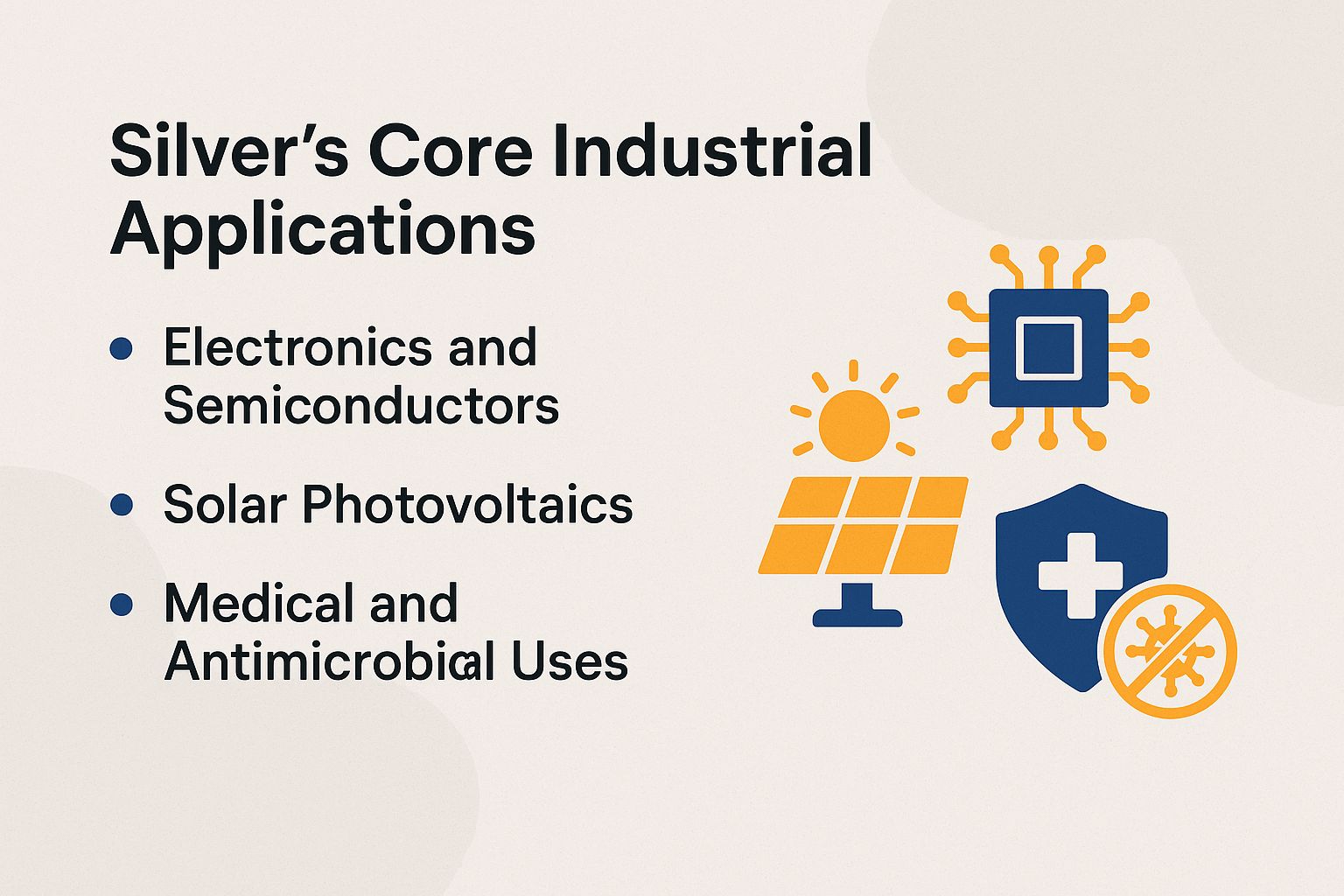
Silver’s many uses make up over half of global demand. Its top traits-like great electrical and thermal conductivity (ability to carry electricity or heat efficiently), shine, flexibility, stretchiness, and rust resistance-make it vital for electronics and solar tech.
The Silver Institute’s 2023 survey backs this up.
Electronics and Semiconductors
Silver conducts electricity six times better than copper. That’s why it’s used in 5G antennas and RFID tags.
Last year, electronics used 132 million ounces of silver, per the Silver Institute.
- Conductive inks power printed circuits in iPhones, using 0.1 grams per phone. They cut materials by 30% and costs by 15%-huge wins!
- Silver alloys solder AI hardware like NVIDIA GPUs. They boost heat handling by 20% and speed data ten times over.
- RFID tags with silver track items in Amazon warehouses-one billion yearly! This speeds inventory by 25%, saving $500 million a year.
Samsung ramped up silver use by 18% in 2023 factories. Tech advances drove this smart move.
IEEE studies show it improved conductivity by 12% and cut energy use by 10%. Efficiency like this is game-changing!
Solar Photovoltaics
Solar panels need about 20 grams of silver paste each. Demand could hit 200 million ounces by 2025, says BloombergNEF’s 2023 report.
The solar boom is here-silver demand is exploding!
Silver plays several critical roles in solar panels, including:
- Silver forms busbars that carry 90% of the current for smooth energy flow.
- Gridlines from silver cut shading by 5%, grabbing more sunlight.
- Back contacts boost PERC cell efficiency to 22%. (PERC means Passivated Emitter and Rear Cell-a solar tech upgrade.)
Adding these silver parts to production takes 6 to 12 months. But using too much paste hikes costs by 10%-watch out!
Silver can’t be replaced in solar due to its top conductivity, per NREL’s 2022 study. JinkoSolar hit 25% efficiency by tweaking silver layers-impressive!
Tip: Balance paste thickness and test yields to save money.
Medical and Antimicrobial Uses
Silver kills 99.9% of bacteria like E. coli in just six hours, EPA tests show. That’s why it’s in 15% of wound care and medical gear worldwide.
A 2022 Journal of Antimicrobial Chemotherapy study confirms this powerhouse role.
- Wound dressings that heal faster.
- Coatings on hospital tools to stop germs.
- Water filters for clean drinking.
- Textiles like bandages with silver threads.
- Implants that fight infections.
Silver’s germ-killing power is revolutionizing health-don’t miss out on this trend!
- Silver nanoparticles fight germs in wound dressings like Acticoat bandages. These contain 0.5% silver and keep infections away for up to seven days.
- Special coatings on catheters cut urinary tract infections by 40%. The Centers for Disease Control and Prevention (CDC) backs this with their data.
- Antimicrobial fabrics power personal protective equipment (PPE). Think COVID-19 masks with silver ions that block germ spread.
- Dental fillings use 10% silver amalgam. This protects your teeth from cavities.
- Silver in water filters kills 99% of harmful germs. The World Health Organization (WHO) approves this method.
Johnson & Johnson leads with silver-infused medical devices and tools. They cut infection rates by 25%.
The Food and Drug Administration (FDA) approved them in 2018. This boosts safety in bioelectronics, diagnostics, and imaging tech around the world.
Rising Demand from Green Energy Transition
The International Energy Agency (IEA) 2023 report predicts big changes. Green energy shifts, tied to the Paris Agreement, will boost silver demand by 25% to 300 million ounces by 2030.
Expect even more from growing markets. Get ready for this exciting surge!
#cn8jayv8.bar-container { position: relative; overflow: visible!important; } #cn8jayv8.bar-value { position: absolute!important; left: 50%!important; top: 50%!important; transform: translate(-50%, -50%)!important; color: white!important; font-weight: 700!important; font-size: 14px!important; white-space: nowrap!important; background: rgba(0, 0, 0, 0.7)!important; padding: 4px 12px!important; border-radius: 20px!important; z-index: 30!important; text-shadow: 0 1px 2px rgba(0, 0, 0, 0.3)!important; pointer-events: none!important; display: inline-block!important; } #cn8jayv8.animated-bar { z-index: 1!important; } @media (max-width: 768px) { #cn8jayv8 { padding: 16px!important; } #cn8jayv8 h2 { font-size: 24px!important; } #cn8jayv8 h3 { font-size: 16px!important; } #cn8jayv8.bar-label { font-size: 12px!important; } #cn8jayv8.metric-card { padding: 20px!important; } #cn8jayv8.bar-value { font-size: 13px!important; padding: 3px 10px!important; } } @media (max-width: 480px) { #cn8jayv8 { padding: 12px!important; } #cn8jayv8 h2 { font-size: 20px!important; } #cn8jayv8 h3 { font-size: 14px!important; } #cn8jayv8.bar-label { font-size: 11px!important; margin-bottom: 6px!important; } #cn8jayv8.bar-value { font-size: 12px!important; padding: 2px 8px!important; min-width: 45px!important; text-align: center!important; } #cn8jayv8.bar-container { height: 36px!important; overflow: visible!important; } }
Silver Demand Explodes: Key Metrics for 2024
(function() { setTimeout(function() { var bars = document.querySelectorAll(‘[class*=”animated-bar-cn8jayv8″]’); bars.forEach(function(bar) { var width = bar.getAttribute(‘data-width’); if (width) { bar.style.width = width + ‘%’; } }); }, 100); })();
The Silver Industrial Demand Growth and Key Metrics 2024 underscores the metal’s pivotal role in modern industries, driven by its unique conductivity, reflectivity, and antibacterial properties. Silver demand has surged due to advancements in electronics, renewable energy, and healthcare, with industrial applications accounting for over 50% of global silver consumption. This growth reflects broader economic shifts toward sustainability and technological innovation, positioning silver as a critical commodity in the green transition.
Key growth drivers include the expanding solar photovoltaic (PV) sector, where silver paste is essential for efficient energy conversion. In 2024, solar demand alone is projected to consume nearly 200 million ounces of silver, a 15-20% increase from prior years, fueled by global clean energy initiatives. Electronics, particularly in semiconductors and 5G technology infrastructure, contribute another major share, with silver’s superior electrical conductivity enabling smaller, faster devices like consumer electronics and IoT devices. Automotive sector electrification adds momentum, as electric vehicles (EVs) require up to 50 grams of silver per unit for EV batteries and wiring, potentially boosting demand by 25 million ounces annually as EV adoption accelerates in emerging markets.
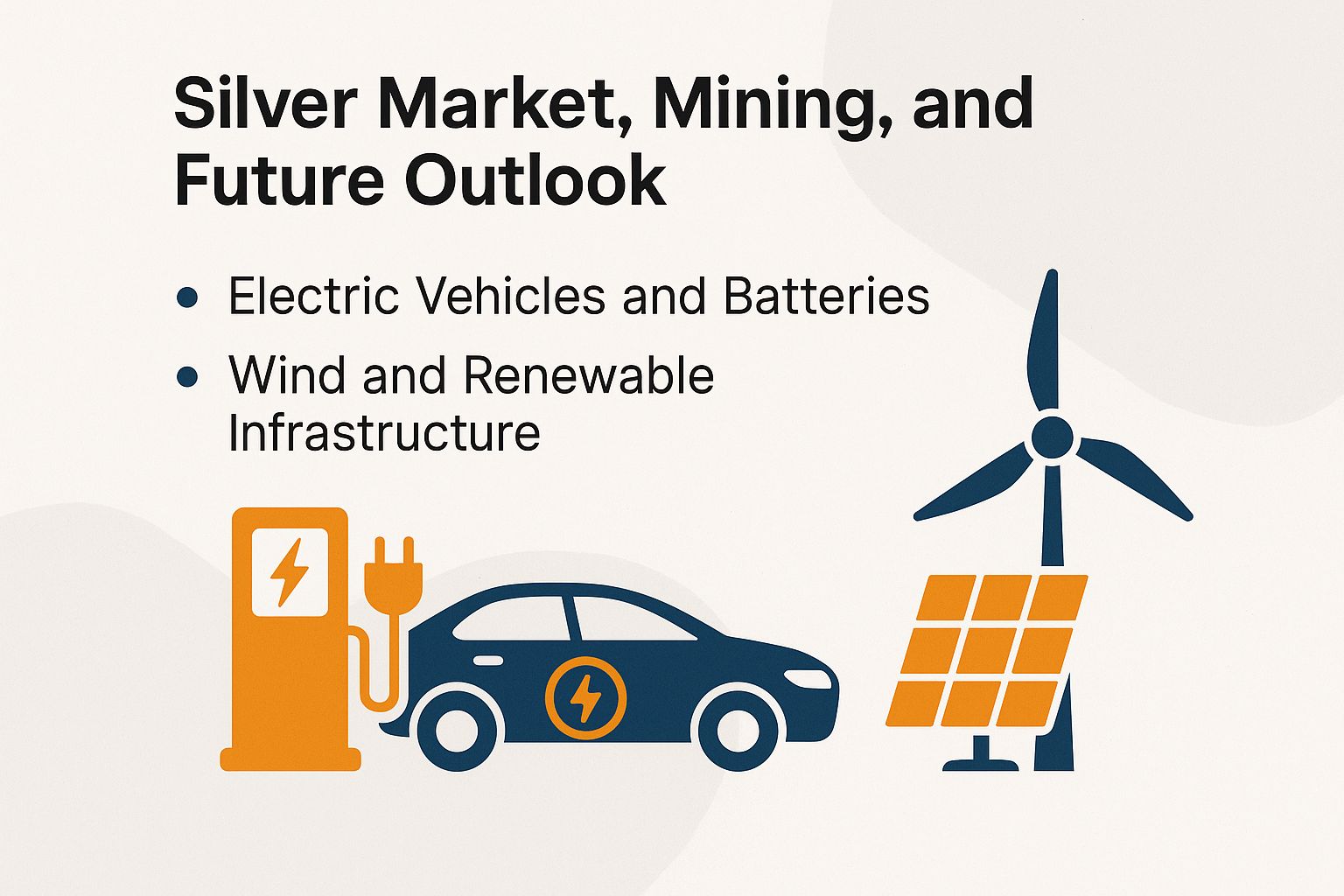
Silver Market, Mining, and Future Outlook
The silver outlook is bright amid a bull market in commodities, with commodity trading influenced by supply-demand dynamics, price volatility, and hedging strategies. Silver prices have reached historical prices and all-time highs, as shown in chart analysis using technical indicators and fundamental analysis, including the silver-gold ratio. Demand forecast indicates peak silver risks due to resource depletion, prompting mineral exploration for new deposits and silver recycling efforts.
Global production from silver producers is challenged by mining output, extraction methods, refining processes, and byproduct silver from lead-zinc mining and copper mining. Silver reserves, ore grades, production costs, capital investment, and operational efficiency are key, alongside regulatory compliance and ESG standards like ethical mining, environmental impact, carbon footprint, water usage, and community relations. Labor issues, strikes, mergers acquisitions, corporate earnings, and shareholder value are critical for silver producers, especially with China silver demand and India silver demand driving economic growth.
Innovation drivers include nanotechnology, flexible electronics, printed electronics, and applications in aerospace applications, telecommunications, data centers, cloud computing, AI hardware, quantum computing, hydrogen fuel cells, desalination plants, air purification, textiles, adhesives, lubricants, sensors, actuators, displays, touchscreens, LEDs, OLEDs, supercapacitors. Medical advancements leverage antimicrobial coatings, hygiene products, pharmaceuticals, orthopedics, cardiology, neurology, optics, lasers, mirrors, telescopes, satellites, and space exploration. Economic indicators such as GDP growth, manufacturing index, and PMI data underscore the industrial boom and silver’s role as an inflation hedge, with investment options like silver ETFs and futures market for portfolio diversification.
- Healthcare applications: Silver’s antimicrobial qualities drive its use in medical devices, wound care, dentistry, and water purification systems. Post-pandemic hygiene awareness has spiked demand by 10%, with innovations like silver-infused textiles and coatings enhancing infection control.
- Other sectors: In photography (though declining), brazing alloys, chemical catalysts, LEDs, OLEDs, and RFID tags, silver maintains steady use. Emerging fields like flexible electronics, 5G technology, IoT devices, and AI hardware are expected to add incremental growth, diversifying demand sources.
Metrics for 2024 indicate total industrial demand reaching approximately 650 million ounces, up 8% year-over-year amid strong China silver demand and India silver demand. Supply constraints, including mine production shortfalls and recycling limitations, could tighten markets, pushing prices toward $30 per ounce. Investment demand, while volatile, supports industrial growth through silver ETFs and physical holdings. Regionally, Asia-Pacific leads consumption at 40%, driven by China’s manufacturing prowess and India’s solar push, while North America focuses on tech and renewables.
Challenges include price volatility from macroeconomic factors like currency fluctuations, GDP growth, and PMI (Purchasing Managers’ Index, a key measure of business activity) data. Substitution efforts also play a role in some applications.
Silver’s unique properties in high-tech sectors keep growth steady. No one can easily replace it.
Policymakers and investors must watch these metrics closely. Silver’s path ties directly to industrial innovation and green goals.
In 2024, silver stands out as a vital global asset. Demand is surging, pointing to strong industrial growth ahead-don’t miss this boom!
Electric Vehicles and Batteries
Silver goes into EV batteries, conductive adhesives, and switches-about 5-10 grams per vehicle. Demand jumped 30% in 2023, thanks to Tesla making 1.8 million units, per the International Council on Clean Transportation.
EVs use way more silver than traditional cars-over 5-10 grams versus less than 1 gram. In old cars, silver sticks to basic wiring, which leads to higher emissions from poor electrical setups.
In EVs, silver conductive pastes boost battery efficiency by 20%. Costs run $2 to $5 per unit, helping manage heat better.
| Aspect | EVs | Traditional Autos |
|---|---|---|
| Efficiency Gain | 20% improvement in battery performance | Negligible; increased emissions |
| Cost | $2-5 per unit | <$1 per vehicle |
| Use Case | Ford F-150 Lightning’s battery management system for thermal regulation | Basic switches only |
Hybrids are getting a boost too! BYD’s Blade batteries mix silver with copper alloys to stretch driving range by 15%, based on a 2022 U.S. Department of Energy study on conductive materials.
Wind and Renewable Infrastructure
Silver is key in wind turbine slip rings and cabling. It backed 10 GW of new installs yearly and used 15 million ounces in 2022, says the Global Wind Energy Council.
Silver shines in three main wind turbine uses. This boosts reliability and matches the IEA’s goal of 2,000 GW global capacity by 2030.
- Conductive Coatings on Turbine Blades: Vestas turbines use silver coatings to redirect lightning. This hits 99% uptime and cuts expensive downtime. Setup takes 3-6 months in upgrades, like rsted’s 1.3 GW Hornsea 2 offshore project.
- Brazing Alloys in Nacelle Electronics: Siemens Gamesa uses 2 kg of silver per 5 MW turbine for heat-resistant joints. This keeps electronic components stable in tough conditions. Implementation takes 3-6 months for assembly line changes.
- Infrastructure Cabling for Offshore Farms: Silver-infused cables resist corrosion better. This allows reliable power transmission over long times. Costs for these applications range from $500 to $1,000 per turbine.
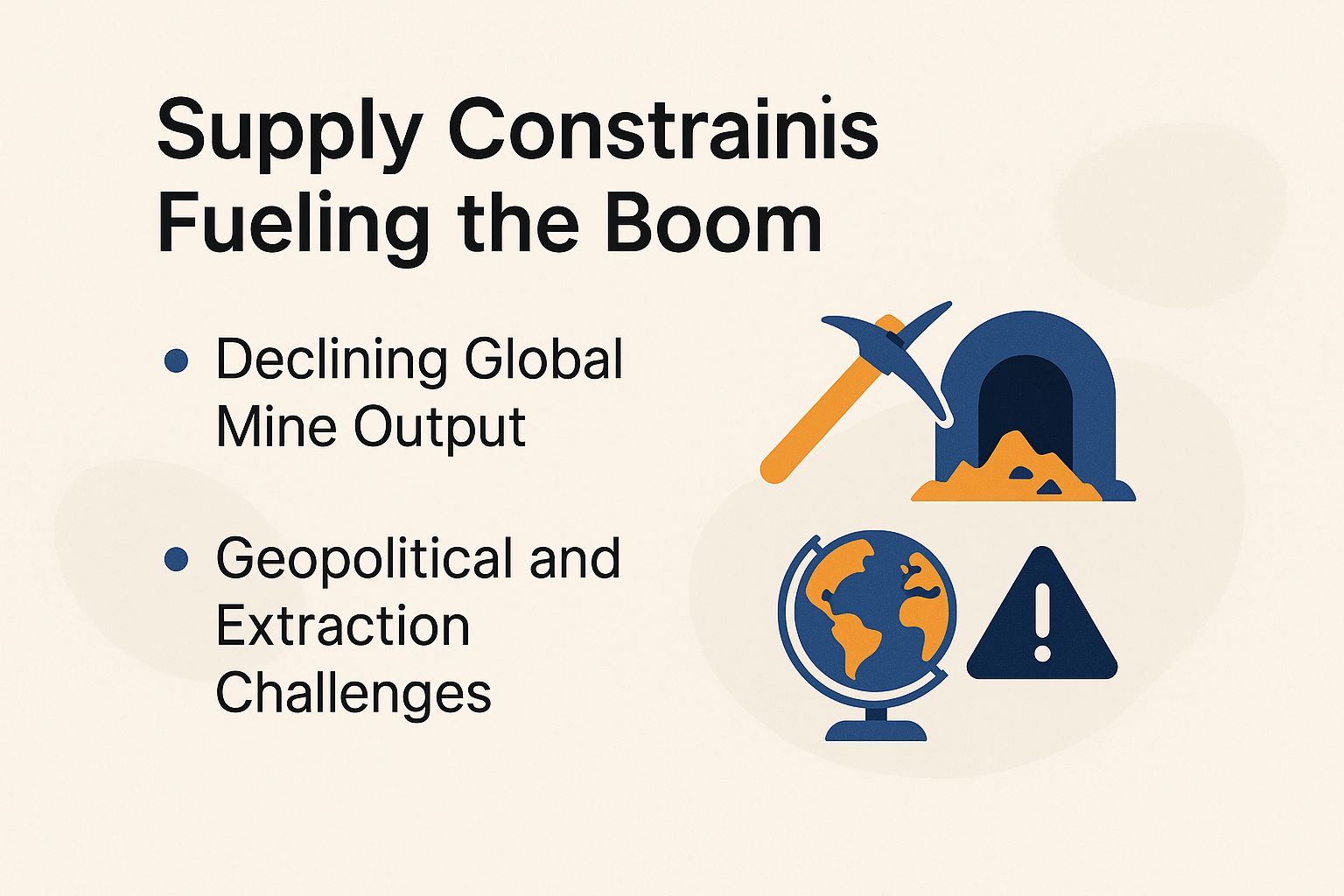
Supply Constraints Fueling the Boom
According to the Silver Institute, global silver mine production declined by 1% to 830 million ounces in 2023, further widening the 200 million ounce market deficit amid escalating industrial demand.
Declining Global Mine Output
Silver output from top mines in Peru (180 million ounces) and Mexico (170 million ounces) dropped 5% due to lower ore quality (now averaging 80 grams per ton), per the 2023 USGS report. This highlights big hurdles in mining-time to watch supply tighten!
Key issues hit hard-check these out:
- Ore grade depletion, exemplified by Polymetal’s Varvara mine where grades decreased from 120 grams per ton to 70 grams per ton, potentially leading to 20% reductions in output. To mitigate this, operators should employ AI-assisted drilling technologies, such as those utilized by Rio Tinto, to identify and target higher-grade zones more effectively.
- Substantial reliance on byproducts, with approximately 70% of silver derived from lead-zinc or copper ores, which leaves producers vulnerable to fluctuations in base metal prices. Diversification through targeted exploration for primary silver deposits is recommended to reduce this exposure.
- Escalating exploration costs, which have risen by 15% to $100 million per project, placing considerable pressure on budgets. Implementing cost-efficient geophysical survey methods can help alleviate these financial strains.
A pertinent case study is Fresnillo PLC’s production decline in 2022, which resulted in a 10% drop in its stock value.
This incident emphasizes the importance of proactive recycling initiatives, which could recover up to 50 million ounces of silver annually.
Geopolitical and Extraction Challenges
In 2023, geopolitical tensions, such as U.S.-China trade tariffs, disrupted approximately 10% of global silver supply chains, while mining protests in Peru resulted in the suspension of 20 million ounces of production, as outlined in the World Bank’s commodity market forecasts.
Silver mining faces these tough hurdles:
- China’s export quotas restrict annual exports to 50 million ounces.
- The EU’s CBAM (a carbon tax on imports) hikes costs 12% for high-emission mines.
- Disputes over indigenous rights in Mexico delayed operations at the Peasquito mine by six months.
- Water scarcity in Andean mining activities has reduced output by 15%.
- Labor strikes have driven up wages by 20%.
Companies can tackle these problems by following ESG standards- that’s environmental, social, and governance rules. For example, Newmont’s zero-water tech recycles water in mining. Glencore’s Antamina shutdown cost $200 million, per the IEA. Time to diversify your sources now!
Market Dynamics and Price Projections
By mid-2023, silver hit $25 per ounce-a whopping 20% jump! A 215 million ounce global shortage fueled it, says the CPM Group’s 2024 Yearbook. Prices could reach $30 by 2025-exciting times ahead!
Industrial demand makes up 55% of the silver market. Green tech like solar panels and electric vehicles drives it hard.
But supply chain changes can shake things up. Investment demand takes 25% and acts as a solid shield against inflation-prices jumped 600% in the 1980s during tough economic times!
Want to protect your investments? Use hedging with COMEX futures-these are contracts on the Commodity Exchange, each covering 5,000 ounces. Keep an eye on the CFTC’s Commitment of Traders reports. They show 50,000 net long contracts lately, signaling a hot bullish market!
The World Bank sees silver prices hitting $35 per ounce by 2030. Get ready-seasonal boosts from festivals in India and China could spike prices 10% in the fourth quarter!
Investment Opportunities in Silver’s Future
Silver could surge 15-20%-jump in via ETFs like iShares Silver Trust (SLV)! It holds 500 million ounces with $12 billion in assets. Morningstar’s 2023 report says silver beat gold by 10% as green energy booms. Don’t wait!
Here are the main ways to invest in silver:
- Silver ETFs track silver prices easily. The iShares Silver Trust (SLV) earned 18% returns in 2023 with just a 0.5% fee.
- Mining stocks like Pan American Silver jumped 25%. This came from ramped-up production to meet rising demand from China and India, per the London Bullion Market Association (LBMA).
- Buy physical silver like American Silver Eagles. They cost just $3 more than the current market price.
Put 5-10% of your portfolio into silver. Stick to ESG standards, which focus on environmental, social, and governance factors.
Use hedging to protect your investments. Try options contracts, like $25 strike call options, for this.
From 2020 to 2023, betting against the trend on silver paid off big. It brought 80% returns, beating the S&P 500’s 50%-get in on this now!
Silver demand surged due to key industries. Here’s what’s driving it:
- EV batteries
- 5G technology
- RFID tags
- IoT devices
- AI hardware
- LEDs and OLEDs
This matches LBMA data, boosted by strong GDP and positive PMI reports.