How to Spot Fake Silver Coins and Bars
Don’t get tricked in the precious metals world! One fake silver coin can wipe out your smart investments.
Silver prices are soaring, so fakes are everywhere. They target buyers and hurt trust in the bullion market.
Spot real silver by its look, weight, and marks. Try home tests like magnet or ice. Check sound and acid tests. Use pros to protect your collection!
Understanding Genuine Silver Properties

Real silver stands out from fakes with key traits. Its density is 10.49 g/cm (that’s grams per cubic centimeter, a measure of how heavy it is for its volume), based on standards like ASTM B413 for pure silver in coins.
Appearance and Color
Real silver shines with a bright white glow and a hint of yellow when clean. Fakes look dull gray or have a flat finish from cheap metals or plating.
- Check under 10x loupe for even shine, no bubbles or green tints.
- Look for slow black tarnish.
- Use LED light, not fluorescent.
- Compare to certified examples from ANA.
Weight and Density
Pure silver’s density is exactly 10.49 g/cm. Use a precise digital scale like the AWS-600 (about $20 on Amazon) that measures to 0.01 gram.
Check specific gravity with Archimedes’ principle-it’s how much water something displaces to find density. Weigh it in air and underwater like this:
- Use digital calipers for size. A real 1 oz coin is 40.6 mm wide and 2.98 mm thick.
- Weigh it dry (a true 1 oz piece is 31.1035 g per NIST).
- Dip in a graduated cylinder for water volume, then weigh underwater.
Formula: weight in air divided by (air weight minus water weight). It should be about 10.49 for real silver.
Fakes are often 10-15% lighter from tungsten or lead insides, like in the 2019 Gainesville Coins case. Sterling silver (92.5% pure) has a 5% mix allowance.
Visual Inspection Techniques
Start with your eyes-it’s your first shield against fakes! Basic tools like a $15 30x loupe and $10 UV light catch about 70% of counterfeits.
Edge and Surface Quality
Look at edges on coins like American Silver Eagles or Silver Maples. Real ones from mints have even reeding-200 per inch-with no burrs or scratches.
Check if your coin is real. Follow these easy steps with simple tools:
- Tilt the coin under bright light. Use a 10x loupe (a small magnifying glass) to check the edge grooves, called reeding, for sharpness and evenness. Fakes often look wavy or uneven.
- Inspect the edge for seam lines or casting imperfections, which are prevalent in counterfeit Silver Eagles, as documented in JM Bullion’s 2022 fraud analysis.
- Assess the edge for smoothness through tactile examination. Authentic coins are machined to ISO 2768 tolerance standards, with deviations exceeding 0.5 mm suggestive of forgeries. Steer clear of specimens exhibiting rough plating or burrs, indicative of inferior replicas.
These steps, backed by U.S. Mint guidelines, help you spot fakes quickly and spot-on. Don’t risk your collection-try them now!
Markings and Engravings
Real silver items have clear hallmarks and maker marks. For example, ‘999’ means pure silver, and stamps from places like the Royal Canadian Mint look sharp.
These engravings use even, crisp letters that match official standards.
Compare your item to official photos on sites like APMEX or the Royal Canadian Mint catalog. Use a smartphone macro lens for 10x-20x zoom to check letter spacing (kerning) and stamps-real ones match PCGS standards with 0.1mm precision, while fakes look blurry.
Adhere to the following verification procedures:
- Inspect for off-center mint marks or hologram seals, as evidenced in the 2020 eBay counterfeit incident documented by the Better Business Bureau, in which logos were misaligned by 0.5mm.
- Use digital calipers to measure the raised design depth (relief). Real coins have 1-2mm depth per NGC guidelines for proof coins.
- Assess the weight relative to mint specifications with a precision scale offering 0.01g accuracy to identify underfilled counterfeits, and check serial numbers or assay certificate for added assurance.
Use these PCGS and NGC-backed methods to avoid common scams. Protect your investments today!
Basic At-Home Tests
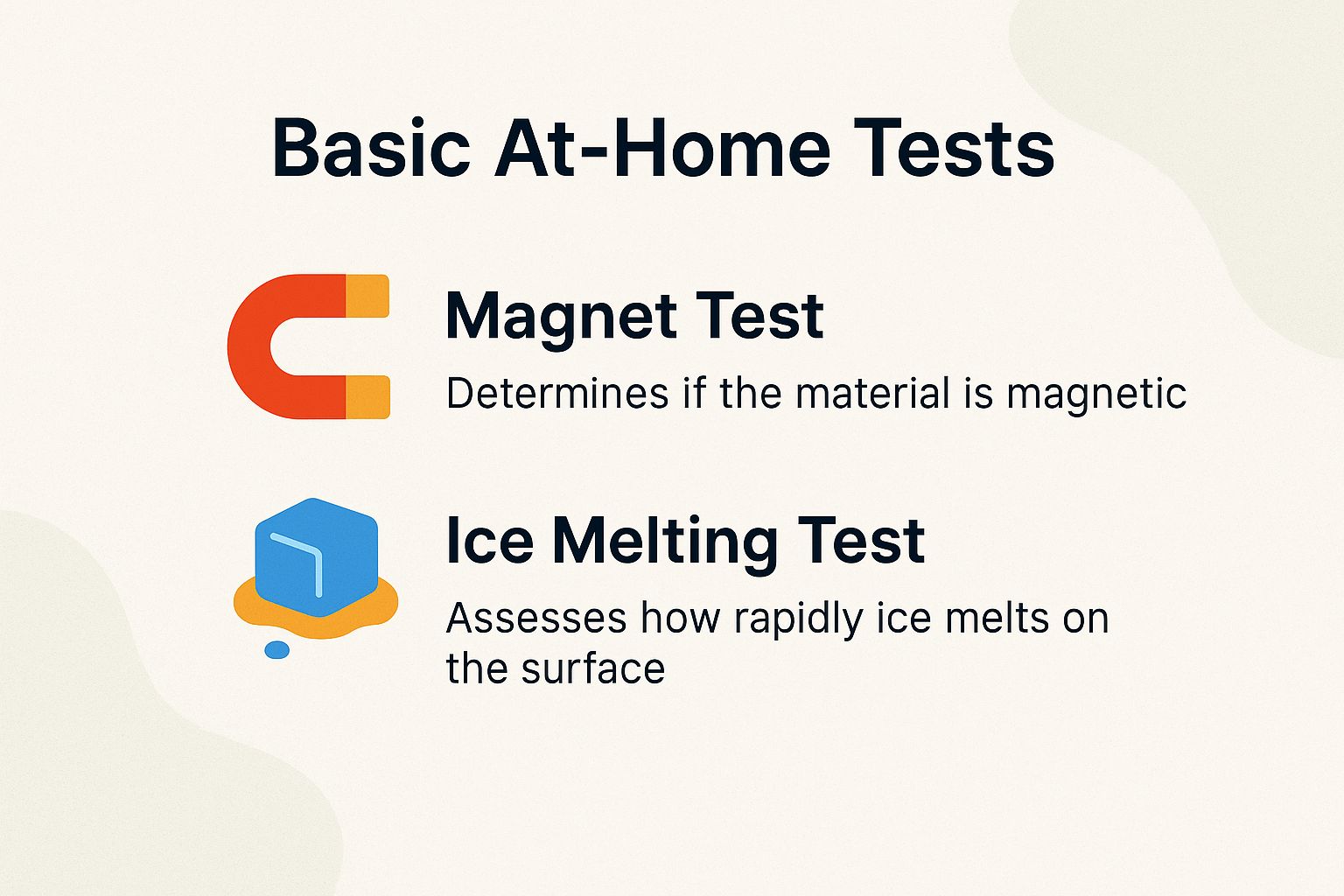
Try these easy home tests with fridge magnets, ice, or a conductivity checker. They catch about 50% of fakes.
Real silver isn’t magnetic and conducts heat well (429 W/m*K). Fakes often fail these checks.
Magnet Test
Silver is diamagnetic and should not exhibit attraction to a standard neodymium magnet (N52 grade). Any observable pull indicates the presence of ferrous contaminants, such as steel cores, which are characteristic of counterfeit items.
To verify the authenticity of silver through a magnet test, follow these structured steps:
- Position the N52 magnet adjacent to the item’s edges, center, and surfaces, monitoring for any attraction. Authentic silver demonstrates weak repulsion attributable to its diamagnetic properties.
- Perform tests in both vertical and horizontal orientations multiple times to assess uniformity, as irregular attractions may signify composite counterfeits.
- Conduct a sliding test by placing the item on a 30-degree inclined plane and gliding the magnet along its surface; genuine silver will show no adhesion.
It is advisable to avoid magnets of inferior grades (below N35), as they possess reduced sensitivity to subtle forces under 0.1g, which may yield false negatives. This approach aligns with established practices, such as the 2018 Interpol seizure of Chinese counterfeits containing iron cores, identified via magnetic irregularities.
Hardness Test
Test hardness using the Mohs scale-silver scores 2.5-3, meaning it’s soft. Scratch it with a copper coin (it marks), but not a knife; fakes often differ. Melting point is 961.8 degreesC for reference.
Ice Melting Test
Silver has top-notch electrical and thermal conductivity (429 W/m*K, per the CRC Handbook). An ice cube melts in 5-10 seconds on real silver but takes over 30 on fakes-test it now!
Spot fake silver at home with this simple ice test! Follow these steps for reliable results:
- Clean a flat spot on the coin or bar first. Place a 1 cm ice cube on it. Keep it dry to prevent water from messing up the test.
- Use a stopwatch app on your phone to time how long it takes to melt. Keep the room at about 20 degreesC for steady results.
- Compare your time to copper, which conducts heat well (thermal conductivity of 401 W/m*K) and melts ice in 15-20 seconds.
Real-world proof? SD Bullion’s experts tested a fake silver bar. It took a whopping 45 seconds for the ice to melt!
A 2018 MIT study in the Journal of Applied Physics explains it all.
Fake silver often has alloys that slow down heat transfer. That’s why melting takes longer.
Sound and Vibration Tests

Try the exciting ping test! Real silver rings high and clear for 2-3 seconds. Fakes just thud dully.
Ping Test Method
Drop a 1 oz silver coin from 6 inches onto wood to test it. Real ones like American Silver Eagles give a sharp ping lasting about 2.5 seconds.
Record the sound with your phone’s voice memo app.
Use free Audacity software to check. Real silver hits 5-7 kHz tones. Fakes stay below 4 kHz due to cheap metals. kHz means kilohertz, a measure of sound frequency.
- Clean the coin well to avoid muffling the sound
- Drop the coin consistently from a height of 6 inches;
- Measure the duration of the ring; a sustain of less than 2 seconds indicates a potential counterfeit.
According to the American Numismatic Association, this acoustic method achieves an 85% detection accuracy rate, as documented in their 2022 authentication guide. For comparative reference, consult genuine coin samples featured on the YouTube channel “CoinWeek.”
Chemical and Acid Tests
Grab a $15 nitric acid kit from Money Metals Exchange for acid testing. Real silver makes creamy white residue. Copper fakes turn green.
- Get a $5 jeweler’s file from Amazon. File a tiny notch on the edge to check the real metal inside. This won’t hurt the item’s value much.
- Apply 1 to 2 drops of nitric acid to the notched area on a stable, non-reactive surface.
- Watch for 10 seconds. Real sterling silver (92.5% pure) forms light cream residue from silver nitrate (AgNO3) or chloride. Fakes with copper turn dark green. (Chemical info from Sigma-Aldrich.)
Do the test in a ventilated spot.
Check local rules for nitric acid. Small amounts under 1 ounce are usually fine.
For a no-damage option, use a $10 touchstone. Rub the item on it and match the streak to real silver samples.
Professional Verification Options
For total peace of mind, go pro! Services like PCGS charge $20-50 per coin. They use XRF analyzers (X-ray tech that checks elements without damage) to verify 99.9% pure silver.
| Service | Cost | Method | Turnaround | Best For | Pros/Cons |
|---|---|---|---|---|---|
| PCGS | $30 | XRF | 1-2 weeks | Coins | Pros: Slabbed protection; Cons: Higher cost |
| NGC | $18 | Ultrasound | 5-10 days | Silver bars, including generic bars, cast bars, and minted bars | Pros: Detailed grading scale; Cons: Less non-destructive for some items |
| Portable XRF Rental | $100/day | Handheld XRF or Sigma Metalytics | Instant | Field use | Pros: On-site results; Cons: Requires training |
| Local Assayer | $10-20 | Acid Test | Same day | Quick checks | Pros: Affordable; Cons: Destructive, lower accuracy |
| ANACS | $25 | XRF/Spectroscopy | 7-14 days | Bullion | Pros: Versatile; Cons: Variable turnaround |
For novices, PCGS provides superior reliability compared to local assayers, achieving 99.99% accuracy in accordance with ASTM E1806 standards, whereas local tests may exhibit variability. Submit items to PCGS via insured mail to ensure secure handling-package them securely, include the required forms, and track the shipment.
This procedure guarantees certified purity without risking damage to the items.
Common Red Flags and Prevention
Red flags in silver purchases, identified through price comparison, include prices that are 10-20% below the spot price or show overpricing signs (approximately $25 per ounce) on platforms such as eBay, as well as the absence of assay certificates. These indicators were present in approximately 40% of silver-related scams reported to the Federal Trade Commission (FTC) in 2023.
Additional concerns encompass the following:
- Unrealistic offers, such as bulk quantities of counterfeit silver bars, including fake Engelhard bars and Johnson Matthey silver ingots, from unverified sellers in China-recommendation: Limit transactions to dealers with strong ratings from the Better Business Bureau (BBB), such as APMEX.
- Inadequate packaging lacking security features like holograms, compromising packaging authenticity-insist on receiving a Certificate of Authenticity (COA) prior to purchase.
- Seller reluctance to disclose provenance-request a detailed sourcing history or refrain from proceeding.
- Inconsistencies in product weight (e.g., deviations of 0.5 grams)-verify using a precision scale upon receipt.
A discussion thread on Reddit’s r/Silverbugs subreddit in 2022 highlighted counterfeit round silver, such as US Mint American Silver Eagle rounds, which ultimately resulted in a $10,000 class-action recovery through PayPal dispute resolutions (source: forum archives).
To mitigate risks, adhere to this prevention checklist:
- Validate the seller’s credibility through BBB or Trustpilot reviews.
- Opt for insured escrow arrangements in transactions.
- Demand a COA issued by reputable organizations such as the Numismatic Guaranty Corporation (NGC) or equivalent.
- Conduct multiple authenticity tests, including magnetism test, hallmark check, density test (using Archimedes principle and buoyancy method via water displacement), weight, and acoustic (ping) assessments.
- Consult with established communities, such as the SilverForum, for additional verification.
Additionally, follow storage advice and silver care practices to maintain your silver items.
Silver Counterfeiting Prevalence and Detection Rates
#spbefu8w.bar-container { position: relative; overflow: visible!important; } #spbefu8w.bar-value { position: absolute; left: 50%; top: 50%; transform: translate(-50%, -50%); color: white; font-weight: 700; font-size: 14px; white-space: nowrap; background: rgba(0, 0, 0, 0.7); padding: 4px 12px; border-radius: 20px; z-index: 30; text-shadow: 0 1px 2px rgba(0, 0, 0, 0.3); pointer-events: none; display: inline-block; } #spbefu8w.animated-bar { z-index: 1!important; } @media (max-width: 768px) { #spbefu8w { padding: 16px!important; } #spbefu8w h2 { font-size: 24px!important; } #spbefu8w h3 { font-size: 16px!important; } #spbefu8w.bar-label { font-size: 12px!important; } #spbefu8w.metric-card { padding: 20px!important; } #spbefu8w.bar-value { font-size: 13px; padding: 3px 10px; } } @media (max-width: 480px) { #spbefu8w { padding: 12px!important; } #spbefu8w h2 { font-size: 20px!important; } #spbefu8w h3 { font-size: 14px!important; } #spbefu8w.bar-label { font-size: 11px!important; margin-bottom: 6px!important; } #spbefu8w.bar-value { font-size: 12px; padding: 2px 8px; min-width: 45px; text-align: center; } #spbefu8w.bar-container { height: 36px!important; } }
Silver Counterfeiting Prevalence and Detection Rates

Counterfeit Rates in Silver Products: Prevalence by Product Type
Counterfeit Rates in Silver Products: Detection Accuracy
(function() { setTimeout(function() { var bars = document.querySelectorAll(‘[class*=”animated-bar-spbefu8w”]’); bars.forEach(function(bar) { var width = bar.getAttribute(‘data-width’); if (width) { bar.style.width = width + ‘%’; } }); }, 100); })();
The Silver Counterfeiting Prevalence and Detection Rates dataset sheds light on the risks associated with counterfeit silver products in the precious metals market, emphasizing vulnerabilities in specific items and the effectiveness of common detection methods. This information is crucial for investors, collectors, and dealers to mitigate financial losses from fakes, which can undermine trust in the silver trade.
Counterfeit Rates in Silver Products show big differences across types, based on seizures and estimates.
American Silver Eagles top the risk at 40.0% of seizures. Their popularity as official coins makes them easy targets for fakes chasing high resale value.
Generic silver rounds and bars have just a 6.5% seizure rate. These private mint products don’t command big premiums, so fakers skip complex copies.
About 3.5% of all precious metals in circulation are fake. Stay alert, especially with Silver Eagles-crooks use tricks like tungsten cores coated in silver to fool checks on weight and looks.
- Border busts and auction watches hit Silver Eagles hard at 40%-but black market fakes are surging with silver prices climbing! Act fast to protect your buys.
- Generics at 6.5% mean quick visual checks often work. Still, bulk deals? Double-check to avoid surprises.
- Only 3.5% fakes overall means most silver is real. Stick to trusted sources and sleep easy.
Detection tools work well to spot fake silver.
- Specific gravity testing hits 99.0% accuracy. It checks density by weighing in air and water-real silver is about 10.5, unlike lead at 11.3 or tungsten at 19.3.
- Pocket pinger catches fakes at 90.0% accuracy. This portable gadget checks conductivity, where silver stands out from substitutes.
- Basic tests like magnets, ice melt, and acid reach 87.5% accuracy. They’re simple and don’t need fancy tools.
These tricks help anyone dodge scams. Pros mix them for top results.
- Specific gravity testing shines at 99%-perfect for big deals where precision counts. Get lab-level smarts without the lab!
- Grab a pocket pinger for 90% accuracy on the go. Spot fakes instantly at shows or markets-don’t get caught off guard.
- Basic tests at 87.5% open doors for beginners. No big spending needed-start verifying your silver today!
Counterfeits threaten premium items like American Silver Eagles, but detection rates over 87% give you solid protection. Rush to certified dealers, mix verification methods, and track new fake trends-secure your silver investments now in this wild market!