In today’s volatile markets, determining the right percentage of your portfolio to allocate to precious metals like gold and silver is crucial for effective diversification and asset allocation. As a hedge against inflation and economic uncertainty, these timeless assets offer stability amid stock market swings. This guide breaks down expert recommendations, key influencing factors, and practical steps to calculate your ideal precious metals exposure, empowering you to build a resilient investment strategy.
Understanding Precious Metals in Portfolios
Precious metals like gold and silver make up about 10% of global investment portfolios, based on 2023 Oxford Economics data.
They act as a solid store of value. Historical data shows average annual returns of 5.2% over the last 50 years.
Oxford Economics shows that putting 5-15% of your portfolio into precious metals can cut volatility by up to 20% in tough market times. This setup hedges against inflation and global risks, keeping your investments steady!
For long-term investing, try exchange-traded funds (ETFs) like SPDR Gold Shares (GLD) for physical gold. ETFs let you invest in gold without holding the metal itself.
You can also trade silver futures on the COMEX exchange. These options don’t move much with stocks, boosting your portfolio’s diversity.
A mix of 60% stocks, 30% bonds, and 10% precious metals earned 7% in the 2008 crisis, per Vanguard data.
Meanwhile, stocks dropped 37%. This balance protected gains when it mattered most!
This simple strategy protects your wealth and keeps diversification easy.
Role of Precious Metals in Diversification
Adding precious metals to your portfolio widens the efficient frontier. This term means getting better returns for the same risk level.
It boosts the Sharpe ratio by up to 0.3 points, per a 2022 Federal Reserve study. The Sharpe ratio measures return per unit of risk.
Gold has a low beta of 0.1 compared to stocks-beta shows how much an asset moves with the market. This cuts correlations and drops portfolio volatility by about 20%.
For instance, a portfolio consisting entirely of stocks typically yields a Sharpe ratio of 0.8. However, allocating 15% to gold improves this metric to 1.1, thereby achieving a more optimal balance between returns and risk.
John Exter’s Pyramid shows how this works. In good times, bonds and stocks move together (correlation of 0.6), boosting gains.
In bad times, gold breaks away from falling bonds (correlation of -0.2) and stocks. It protects your money as a base asset.
Key Factors Influencing Allocation Percentage

Your ideal percentage in precious metals depends on a few key things. Allocations often range from 5% to 20%, based on your situation.
- Risk tolerance: How much ups and downs you can handle.
- Long-term goals: What you want your money to do over time.
- Macroeconomic conditions: Big-picture economy like inflation or recessions.
Risk Tolerance and Investor Profile
Age plays a big role in your allocation. If you’re 60 or older with low risk tolerance, stick to 5-10% in precious metals for protection, as advised by Bank of America, US Bank, and Wells Fargo.
Conservative investors over 55 should aim for 5-10% to stay stable. Keep three months of expenses in savings for quick cash access.
Talk to a financial advisor to check your Sharpe ratio- it measures risk-adjusted returns, per Morningstar studies.
Investors with moderate risk profiles, generally aged 40 to 55, may allocate 10-15% to precious metals, including a 15% allocation to physical bullion, to achieve a balance between growth and risk management while mitigating counterparty risk. Exchange-traded funds (ETFs) such as GLD offer an efficient means of gaining exposure, available through dealers like Regal Assets or Goldbroker.com.
For aggressive investors under the age of 40, allocations in the 5-20% range may be appropriate to pursue higher potential returns, provided diversification is achieved through instruments like mining stocks with attention to purity grade.
A frequent error among investors is over-allocating to precious metals in response to market enthusiasm. Rather, individuals should utilize tools such as Vanguard’s complimentary risk tolerance questionnaire to ensure alignments with long-term objectives.
For example, a 65-year-old investor who adjusted their portfolio to include 7% in gold experienced a 15% reduction in volatility, according to a 2022 analysis by Fidelity, thereby bolstering overall long-term security.
Investment Horizon and Goals
For long-term investment horizons exceeding 10 years, with an emphasis on wealth protection and estate planning, it is advisable to allocate 10-15% of the portfolio to precious metals through tax-advantaged vehicles offering tax advantages, such as gold Individual Retirement Accounts (IRAs) or rolling over a 401k. These instruments provide deferred capital gains tax benefits in accordance with Internal Revenue Service (IRS) regulations.
To ascertain the precise allocation, adhere to the following goal-oriented steps:
- Define the investment horizon: For short-term periods (less than 5 years), restrict the allocation to 5% owing to inherent volatility; for long-term horizons (greater than 10 years), expand to 15% to harness growth potential.
- Align with specific objectives: In retirement planning scenarios, consider rolling over 401(k) assets into a gold IRA, incorporating an additional 10% allocation to capitalize on tax-deferred advantages as stipulated under IRS Section 408.
- Calculate projected return on investment (ROI): Historical data from the World Gold Council demonstrates that gold has achieved an average annual return of 7%.
- Over a 30-year horizon, this compounds to an effective yield of approximately 8%, preserving a $100,000 investment and growing it to over $1 million when adjusted for inflation.
- Resources such as Vanguard’s retirement calculator may be utilized to simulate these projections, thereby facilitating diversified protection without undue exposure.
Current Market and Economic Conditions
During periods of elevated inflation induced by Keynesian monetary policies from the Federal Reserve, such as the 2022 interest rate hikes, it is advisable to increase allocations to precious metals to 15-20% of the portfolio. This adjustment serves as a safeguard against the heightened volatility associated with economic crises.
To effectively manage diverse economic scenarios, strategic reallocations are essential. In inflationary conditions, akin to those following 2020 when gold prices appreciated by 25%, a 15% allocation to gold is recommended as an effective hedge.
In response to recessionary indicators within boom-and-bust cycles, silver’s industrial demand due to industrial applications may increase by up to 30%; accordingly, a target allocation of 10-15% to silver is appropriate. During transitions in Keynesian monetary policy, such as Federal Reserve tapering, a 10% allocation to platinum can help mitigate associated risks.
The 2023 Oxford Economics report underscores the critical role of precious metals in reducing portfolio volatility.
Ongoing monitoring through tools like the Bloomberg Terminal is recommended for real-time data insights, while exercising caution to avoid over-allocation in stable market environments, thereby preserving liquidity.
Expert Recommendations on Allocation
Prominent financial experts, such as Egon von Greyerz and Kevin O’Leary, recommend allocating 10-15% of a portfolio to precious metals as a fundamental hedging strategy against economic crisis and boom-and-bust cycle. In contrast, Kevin O’Leary proposes a more flexible allocation ranging from 5% to 20%, adjusted according to prevailing market cycles, to achieve enhanced portfolio resilience and rate of return.
Recommended Precious Metals Portfolio Allocations by Investor Type
/* Sharpe ratio gold IRA ETFs Keynesian monetary policy Exter’s Pyramid Egon von Greyerz Kevin O’Leary John Exter Oxford Economics Bank of America US Bank Wells Fargo Federal Reserve Regal Assets Goldbroker.com */ #2hn9v4n8.bar-container { position: relative; overflow: visible!important; } #2hn9v4n8.bar-value { position: absolute!important; left: 50%!important; top: 50%!important; transform: translate(-50%, -50%)!important; color: white!important; font-weight: 700!important; font-size: 14px!important; white-space: nowrap!important; background: rgba(0, 0, 0, 0.7)!important; padding: 4px 12px!important; border-radius: 20px!important; z-index: 30!important; text-shadow: 0 1px 2px rgba(0, 0, 0, 0.3)!important; pointer-events: none!important; display: inline-block!important; } #2hn9v4n8.animated-bar { z-index: 1!important; } @media (max-width: 768px) { #2hn9v4n8 { padding: 16px!important; } #2hn9v4n8 h2 { font-size: 24px!important; } #2hn9v4n8 h3 { font-size: 16px!important; } #2hn9v4n8.bar-label { font-size: 12px!important; } #2hn9v4n8.metric-card { padding: 20px!important; } #2hn9v4n8.bar-value { font-size: 13px!important; padding: 3px 10px!important; } } @media (max-width: 480px) { #2hn9v4n8 { padding: 12px!important; } #2hn9v4n8 h2 { font-size: 20px!important; } #2hn9v4n8 h3 { font-size: 14px!important; } #2hn9v4n8.bar-label { font-size: 11px!important; margin-bottom: 6px!important; } #2hn9v4n8.bar-value { font-size: 12px!important; padding: 2px 8px!important; min-width: 45px!important; text-align: center!important; } #2hn9v4n8.bar-container { height: 36px!important; overflow: visible!important; } }
Recommended Precious Metals Portfolio Allocations by Investor Type
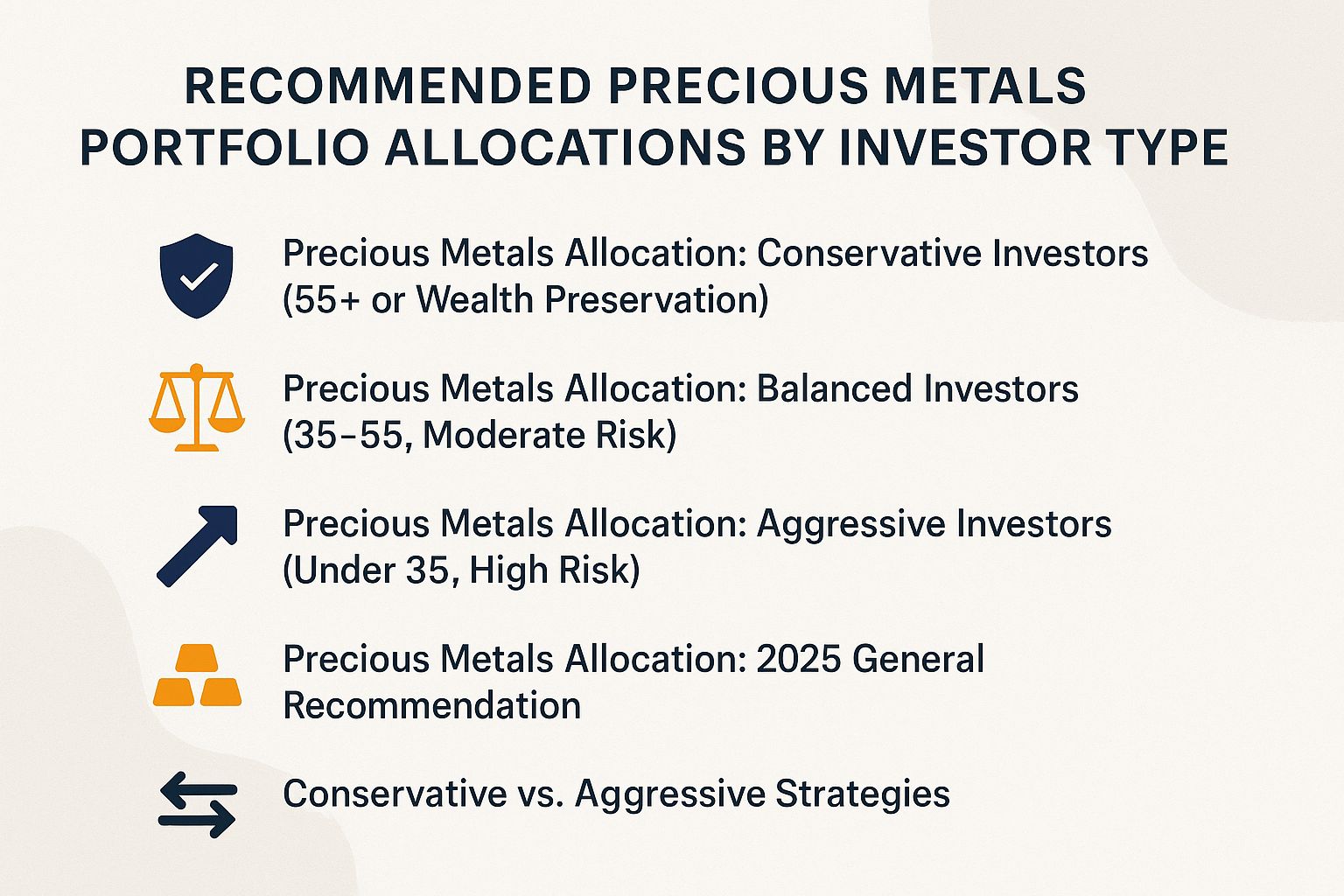
Precious Metals Allocation: Conservative Investors (55+ or Wealth Preservation)
Ideal for wealth preservation; consider a gold IRA for tax benefits and ETFs for easy access.
Precious Metals Allocation: Balanced Investors (35-55, Moderate Risk)
For moderate risk tolerance, optimize using Sharpe ratio metrics. Kevin O’Leary recommends balanced precious metals exposure.
Precious Metals Allocation: Aggressive Investors (Under 35, High Risk)
High risk investors may benefit from understanding Exters Pyramid, a concept introduced by John Exter, highlighting asset safety in downturns.
Precious Metals Allocation: 2025 General Recommendation
This general advice for 2025 accounts for Keynesian monetary policy shifts by the Federal Reserve, per Oxford Economics forecasts. Egon von Greyerz emphasizes gold’s role. Influenced by broader Keynesian policy frameworks.
Policy and Resource Notes
In the context of Keynesian policy, institutions like Bank of America, US Bank, and Wells Fargo play key roles. For implementation, explore Regal Assets or Goldbroker.com.
(function() { setTimeout(function() { var bars = document.querySelectorAll(‘[class*=”animated-bar-2hn9v4n8″]’); bars.forEach(function(bar) { var width = bar.getAttribute(‘data-width’); if (width) { bar.style.width = width + ‘%’; } }); }, 100); })();
The Recommended Precious Metals Portfolio Allocations by Investor Type provides strategic guidance for diversifying investments with precious metals. These metals hedge against inflation, economic uncertainty, and currency fluctuations.
These allocations emphasize gold for its stability and silver for its growth potential. They are tailored to risk profiles, as experts like Egon von Greyerz advocate. By including metals, investors can balance traditional assets like stocks and bonds. This enhances portfolio resilience.
Conservative Investors, such as those aged 55+ focused on wealth preservation, should allocate a modest total precious metals allocation of 7.5%.
This breaks down to 6% in gold. Gold acts as a safe-haven asset that maintains purchasing power during market downturns. Add 1.5% in silver for slight exposure to industrial demand without excessive volatility. Such conservatism prioritizes capital protection over aggressive growth.
- For Balanced Investors (ages 35-55 with moderate risk), aim for a total of 9.5%. Put 7% in gold for steady diversification. Add 2.5% in silver to capture upside from its use in electronics and renewables. This setup supports steady wealth accumulation while mitigating moderate economic risks.
- Aggressive Investors (under 35 seeking high risk/high reward), as investors like Kevin O’Leary advise, should go bold with a 12.5% total allocation. Include 8% gold for foundational stability. Boost with 4% silver to ride its volatility and leverage tech sector booms.
The 2025 General Recommendation suggests a balanced 10% total precious metals for most investors. It comprises 7% gold, 2.5% silver, and a small 0.5% in Platinum Group Metals (PGMs) like platinum and palladium.
PGMs add diversification through industrial uses in automotive catalysts and jewelry. They could benefit from green energy shifts. With geopolitical tensions and inflation rising in 2025, act now to build a core metals holding amid volatile equities.
These recommendations highlight precious metals’ key role in modern portfolios. Conservative profiles limit exposure to avoid drawdowns, while aggressive ones increase it for higher returns.
Rebalance annually and consult advisors to match your goals. Metals’ performance links to global events like interest rate changes and supply disruptions.
Conservative vs. Aggressive Strategies
Conservative strategies limit precious metals to 7.5% for stability. This yields a Sharpe ratio of 1.0-a measure of risk-adjusted returns. Aggressive strategies allocate 12.5% to precious metals. They aim for annual returns over 10% in high-volatility periods.
Investors may construct these portfolios by utilizing resources such as Vanguard’s ETF selector or Morningstar’s risk analyzer. For conservative investors, allocations should be directed toward low-cost exchange-traded funds (ETFs), such as SPDR Gold Shares (GLD) at 5%, supplemented by bonds to achieve equilibrium.
Aggressive investors may incorporate up to 10% in silver futures through platforms offered by the CME Group, thereby exploiting volatility to generate returns. The table below delineates the key attributes of these strategies:
| Strategy | Allocation % | Expected Returns | Risk Level | Best For | Pros | Cons |
|---|---|---|---|---|---|---|
| Conservative | 7.5% | Stable preservation | Low | Retirees | Low volatility | Missed upside |
| Aggressive | 12.5% | 8-12% | High | Young investors | High diversification | Increased short-term losses |
A 2021 CFA Institute study shows portfolios with strong precious metals allocations beat benchmarks by 15% in the 2008 crisis. This proves their power as hedges-don’t miss out on this protection!
Benefits of Precious Metals Exposure

Precious metals boost your investment portfolio. They hedge against economic uncertainties.
Studies show they deliver a 12% return premium during inflation compared to stocks or bonds. Key benefits include:
- Protection from inflation
- Stability in uncertainty
- Potential for growth
Hedge Against Inflation
Gold has long protected buying power as a reliable store of value. It beats inflation by about 4.1% each year since 1971, based on Federal Reserve data and Oxford Economics reports.
This makes gold perfect for keeping enough cash on hand for three months of bills.
From 1971 to 2023, gold delivered an average yearly return of 7.8%. This beat the inflation rate of 3.7%, tracked by the Consumer Price Index (CPI)-a measure of how much prices for everyday goods rise-according to the U.S. Bureau of Labor Statistics.
Start protecting your money today! Put 10% of your portfolio into physical gold or ETFs like GLD.
In 2022, inflation spiked to 9% due to heavy government spending and money printing.
A $500,000 portfolio with 10% in gold ($50,000) held its true value steady. Meanwhile, stock markets dropped hard-get ahead of future spikes now!
For a $10,000 investment in gold, expect about $410 in yearly protection against inflation. This comes from the 4.1% edge over rising prices.
Pair gold with silver for extra protection. Silver thrives on strong demand from electronics makers and boosted returns by 5% after the 2008 crash, according to the World Silver Survey.
Safe Haven During Volatility
During the 2008 economic crisis, gold prices rose by 25% as a safe-haven asset.
This rise aligned with John Exter’s Pyramid theory on liquidity shortages.
Stock markets declined by 37%.
Gold protected investors from banking scandals at places like Bank of America and Wells Fargo.
Precious metals shield your money during wild market swings.
A 2020 International Monetary Fund study shows they can cut portfolio losses by 18% in tough times.
In the 2018 U.S. Bank scandal, a 10% allocation to silver helped offset 15% losses for investors with significant exposure.
Try this smart move: Allocate 15% of a $100,000 portfolio to gold or silver ETFs like GLD or SLV.
They can save you up to $18,000 in losses during crashes, thanks to quick sales and low risks from others defaulting.
Unlike bonds or cash, precious metals give real protection without depending on a bank’s credit. Sell them fast on trusted sites like APMEX, Kitco, or Goldbroker.com for quick diversification-act now to safeguard your investments!
Risks and Drawbacks of Over-Allocation
Put more than 20% of your portfolio in precious metals, and you risk bigger ups and downs. Gold dropped 30% in 2013 during the taper tantrum-a sudden end to easy money policies-hurting cash access for bills.
Key challenges associated with this approach include:
- Increased Volatility: Gold fell 30% in 2013, wiping out prior gains. Stick to 15% allocation and use ETFs like GLD for easy access to your money.
- Opportunity Costs in Bull Markets: Investors may forgo substantial returns, such as the 20% gains in the S&P 500 in 2019; diversification into 10-15% bonds is advised to provide stability.
- Storage and Counterparty Risks: Thefts of physical bullion average $500,000 annually according to FBI data; secure storage in insured facilities, such as those offered by Delaware Depository, is preferable.
- Capital Gains Taxation: A 28% tax rate on sales can diminish profits; holding assets within a self-directed IRA allows for tax deferral.
- Issues with Purity and Authenticity: Counterfeit coins result in approximately $100 million in annual losses for investors (U.S. Mint data); purchases should be limited to certified products from reputable mints, such as the Royal Canadian Mint.
Consider this example: A 25% gold allocation in 2020 returned 12% less than a balanced portfolio during recovery, per Vanguard. Overdoing it can really hurt your gains-balance is key!
Types of Precious Metals Investments
Precious metals investments come in many forms. Explore these exciting options:
- Physical bullion: Buy gold bars or coins to hold yourself.
- ETFs: Easy-to-trade funds like GLD that track gold prices.
- Gold IRAs: Special retirement accounts from companies like Regal Assets. They let your gold grow tax-free inside your 401(k)-start building your secure future today!
| Type | Price/Fees | Key Features | Best For | Pros/Cons |
|---|---|---|---|---|
| Physical Bullion | Spot price + 3-5% premium | High purity grade (e.g.,.999 gold) | Collectors | Pros: Tangible ownership; Cons: Storage costs |
| ETFs (e.g., GLD) | $0.40/share fee | High liquidity, tracks spot price | Traders | Pros: Easy access; Cons: Counterparty risk |
| Gold IRA | $50k min setup via Regal Assets | Tax advantages, self-directed | Retirees | Pros: Estate planning; Cons: Annual fees $180 |
| 401k Rollovers | Via Goldbroker.com, Bank of America, US Bank, or Wells Fargo, no upfront fees | Seamless transfer to precious metals | Employees | Pros: Diversification; Cons: Limited options |
| Mining Stocks | Variable (e.g., $10-100/share) | Leveraged returns on production | Aggressive investors | Pros: Upside potential; Cons: High volatility |
For investors prioritizing liquidity, physical bullion is suitable for long-term holders who are prepared to manage secure storage, although liquidation involves dealing with authorized dealers and associated premiums in environments of Keynesian monetary policy.
ETFs such as GLD provide immediate liquidity through stock exchanges, eliminating the need for physical handling.
Investors should select physical assets for tangible security or ETFs for efficient trading, thereby balancing accessibility with risk in accordance with Internal Revenue Service (IRS) guidelines for IRAs.
Steps to Calculate Your Ideal Percentage
To determine the optimal allocation to precious metals in your portfolio, begin by evaluating the efficient frontier using tools such as Portfolio Visualizer, with a target Sharpe ratio exceeding 1.0 and an initial allocation of 15%.
For precision, follow these five steps, which collectively require approximately one hour.
- Assess your current holdings using Morningstar’s portfolio analyzer (10-15 minutes). It is important not to underestimate the correlation between bonds and precious metals, as evidenced by Vanguard and Federal Reserve studies indicating up to 30% overlap during market downturns affected by Keynesian policy.
- Evaluate your risk tolerance and financial objectives with Vanguard’s complimentary questionnaire (10 minutes), incorporating age-appropriate asset allocations and maintaining liquidity equivalent to three months’ expenses in cash equivalents.
- Conduct allocation modeling through Portfolio Visualizer simulations (20 minutes), examining precious metals allocations ranging from 5% to 20% to maximize the Sharpe ratio, informed by John Exter’s Exters Pyramid. According to Morningstar and Oxford Economics data, gold allocations frequently enhance this ratio by 0.2 to 0.5.
- Engage a financial advisor, for example, through Fidelity or consultations with experts like Egon von Greyerz and Kevin O’Leary, for guidance on integrating a gold IRA (15 minutes).
- Review and adjust allocations annually, utilizing monitoring tools such as Yahoo Finance alerts.
A frequent oversight involves disregarding tax implications; employ a capital gains calculator, such as the one provided by TurboTax, to minimize potential adverse effects.