
As global debt eclipses $305 trillion (Institute of International Finance), the global economy faces economic uncertainty, with potential recessions, trade wars, and geopolitical tensions affecting emerging markets and developed economies like the eurozone. Economies teeter on the brink of crisis, squeezing households and governments alike, impacting credit ratings and risking bankruptcy. What if gold, this precious metal and secret weapon for investment and wealth preservation, with its millennia-old allure, holds the key to resilience? This article unpacks the mounting debt challenge, gold’s safe-haven properties and inflation-hedging prowess, practical integration strategies, inherent risks, compelling case studies, and forward-looking prospects-revealing its potential as a stealthy debt defender in times of currency risk and currency devaluation.
Global debt has topped $305 trillion, according to the Institute of International Finance. Economic uncertainty looms with recessions, trade wars, and geopolitical tensions hitting markets everywhere.
Households and governments feel the squeeze, with credit ratings at risk and bankruptcy threats rising. Imagine gold as your secret weapon for protecting wealth-it’s been a go-to for centuries.
This article dives into the debt crisis, gold’s safe-haven perks, and how to use it smartly. Discover real stories and future outlooks that could shield you from currency crashes-don’t miss out!
Understanding the Debt Challenge
Global debt hit over $305 trillion in 2023, per the Institute of International Finance. This includes US, sovereign, and personal debts with high debt-to-GDP ratios-meaning countries owe more relative to what they produce.
US household debt stands at $17.5 trillion, says the Federal Reserve. National debt keeps climbing due to budget shortfalls.
Personal debt comes in many forms that trap people in cycles of owing money.
- Credit card debt: $1.1 trillion
- Real estate mortgages: $12.4 trillion
- Other leverage and margin debt adds to the burden
Meanwhile, national debt towers at $34 trillion, per the U.S. Treasury. Act now to break free from this debt trap!
The 2008 crisis shows debt’s dangers-bad subprime loans led to a $700 billion bailout via TARP, per Federal Reserve data. It sparked massive foreclosures, defaults, and restructurings, shaking the whole country.
Interest rates have jumped lately due to central bank moves and bond markets. This hikes monthly payments by 20-30% for many folks.
Fight back for financial freedom and a secure retirement. Try these steps:
- Track spending with apps like Mint or YNAB.
- Refinance high-rate loans via SoFi for 1-2% savings-start today!
The Unique Role of Gold
Gold shines as a top pick for saving wealth over time-it’s a real asset you can hold. Central banks stockpile over 35,000 tons, says the World Gold Council. Isn’t it time you joined them?
Historical Significance
It all began in ancient Lydia around 600 BCE with the first gold coins, boosting trade despite myths and alchemy tales. The gold standard tied money to real gold reserves. It started with the UK in 1821, then the US in 1900, and ended in 1971 under Nixon. The UK’s 1821 switch fueled 2.5% GDP growth in the 1800s, per Bank of England and IMF data. Key points:
- Stabilized economies, especially in the Great Depression.
- Kept inflation low at about 0.5% yearly.
In 1933, US Executive Order 6102 forced people to hand over gold to fight deflation and tough economic times. Bretton Woods fell apart in 1971, ending dollar-to-gold swaps due to Vietnam War costs-marking the shift to paper money.
Today, banks like Russia’s have grabbed over 1,000 tons of gold since 2014. It protects against fiat money’s ups and downs-like paper cash not backed by anything. Here’s why:
- Currency drops and dollar dominance risks.
- Money printing, sanctions, and BRICS shifts away from the dollar.
- Even cryptos like Bitcoin as rivals.
Get in on this hedge now!
Properties as a Safe Haven
Gold acts as a safe haven during tough times. It holds value when stocks crash or inflation spikes-think of it as your financial bunker!
During the 2008 financial crisis, gold prices rose 25%. The stock market, tracked by the S&P 500, dropped 37%.
This shows gold acts as a safe haven. A study from the Federal Reserve Bank of St. Louis backs this up.
Gold stays strong thanks to four key traits.
Gold doesn’t move much with stocks. Its beta of 0.1 – a measure of how it reacts to market changes – keeps your investments steady, per Vanguard.
You can buy or sell gold easily. It trades $30 billion daily on COMEX (a major gold exchange) and forex markets.
Gold is rare, which keeps its value high.
Mines produce about 3,000 metric tons yearly, but demand hits 4,700 tons. United States Geological Survey data shows this gap.
In the 2020 COVID crash, stocks tanked. Gold prices rocketed to $2,075 per ounce!
Gold as a Hedge Against Inflation
Since 1971, gold has beaten inflation big time. It averaged 7.8% returns yearly, topping the 3.9% CPI rate (a measure of price rises), says the World Gold Council.
Mechanisms of Protection
Gold protects against rising prices as a top commodity hedge.
It moves opposite to fiat money growth (government-issued currency not backed by gold). In the 1970s stagflation, gold jumped 2,300% while CPI hit 13.5%, per Bureau of Labor Statistics.
This protective quality arises from three primary mechanisms.
- Gold’s supply is fixed. Mines add less than 2% yearly, unlike fiat money that grows over 10%, says USGS.
- When real interest rates go negative (rates below inflation), gold rises. JPMorgan research shows 5-7% gains then.
- Third, heightened psychological demand emerges during inflationary episodes and periods of economic uncertainty, leading to a 20% rise in retail gold purchases.
See the real return formula: Real return = Gold’s stated return minus CPI. In Zimbabwe’s 2008 hyperinflation, CPI hit a staggering 89 sextillion percent, but gold held its value as the currency crashed.
Historical Evidence
- In the 1970s US inflation crisis, gold soared from $35 to $850 per ounce. This beat the 13.5% average CPI and 108% total inflation, per Federal Reserve reports.
- In 1923 Weimar Germany, gold kept value during 300% monthly hyperinflation, from Reichsbank archives.
- In 2010s Turkey, gold rose 400% against 70% inflation, says the Central Bank.
- In 2022, gold gained 8%, matching 8% US CPI, per Bureau of Labor Statistics.
NBER research shows gold and inflation link at -0.6 (meaning they move oppositely). This proves gold fights inflation well.
Grab long-term protection now! Put 5-10% of your portfolio in physical gold or ETFs like GLD. They’ve averaged 4.5% real returns over 100 years.
Incorporating Gold into Debt Strategies
Add gold to cut portfolio ups and downs by 15% when bonds dominate. Vanguard’s study on mixed assets during rate hikes confirms this.
Gold as Hedge Against Debt: Key Statistics 2024-2025
Major economies like the US, China, and Japan face massive debts. The World Bank and IMF stress gold’s role in sovereign wealth funds and pension funds.
Sovereign wealth funds are government-owned investment pools. Pension funds manage retirement savings.
Fiscal debates rage over austerity, bailouts, and debt ceilings. Budget deficits raise risks of default, restructuring, or even bankruptcy.
Gold and metals like silver and platinum act as safe havens. They protect in bonds, stocks, and real estate markets.
- Gold preserves wealth against deflation and hyperinflation.
- It counters currency risks, geopolitical tensions, and sanctions.
- Trade wars and uncertainty in emerging markets make gold essential.
Even in forex trading and cryptocurrencies like Bitcoin, gold bullion stands out. Grab this timeless asset now to shield your future!
/* Styles for economic indicators including: commodities, ETFs, BRICS, IMF, GDP, debt-to-GDP ratio, US debt, China debt, Japan debt */ #3zlvrurt.bar-container { position: relative; overflow: visible!important; } #3zlvrurt.bar-value { position: absolute!important; left: 50%!important; top: 50%!important; transform: translate(-50%, -50%)!important; color: white!important; font-weight: 700!important; font-size: 14px!important; white-space: nowrap!important; background: rgba(0, 0, 0, 0.7)!important; padding: 4px 12px!important; border-radius: 20px!important; z-index: 30!important; text-shadow: 0 1px 2px rgba(0, 0, 0, 0.3)!important; pointer-events: none!important; display: inline-block!important; } #3zlvrurt.animated-bar { z-index: 1!important; } @media (max-width: 768px) { #3zlvrurt { padding: 16px!important; } #3zlvrurt h2 { font-size: 24px!important; } #3zlvrurt h3 { font-size: 16px!important; } #3zlvrurt.bar-label { font-size: 12px!important; } #3zlvrurt.metric-card { padding: 20px!important; } #3zlvrurt.bar-value { font-size: 13px!important; padding: 3px 10px!important; } } @media (max-width: 480px) { #3zlvrurt { padding: 12px!important; } #3zlvrurt h2 { font-size: 20px!important; } #3zlvrurt h3 { font-size: 14px!important; } #3zlvrurt.bar-label { font-size: 11px!important; margin-bottom: 6px!important; } #3zlvrurt.bar-value { font-size: 12px!important; padding: 2px 8px!important; min-width: 45px!important; text-align: center!important; } #3zlvrurt.bar-container { height: 36px!important; overflow: visible!important; } }
Gold as Hedge Against US Debt, China Debt, and Japan Debt: Key Statistics 2024-2025
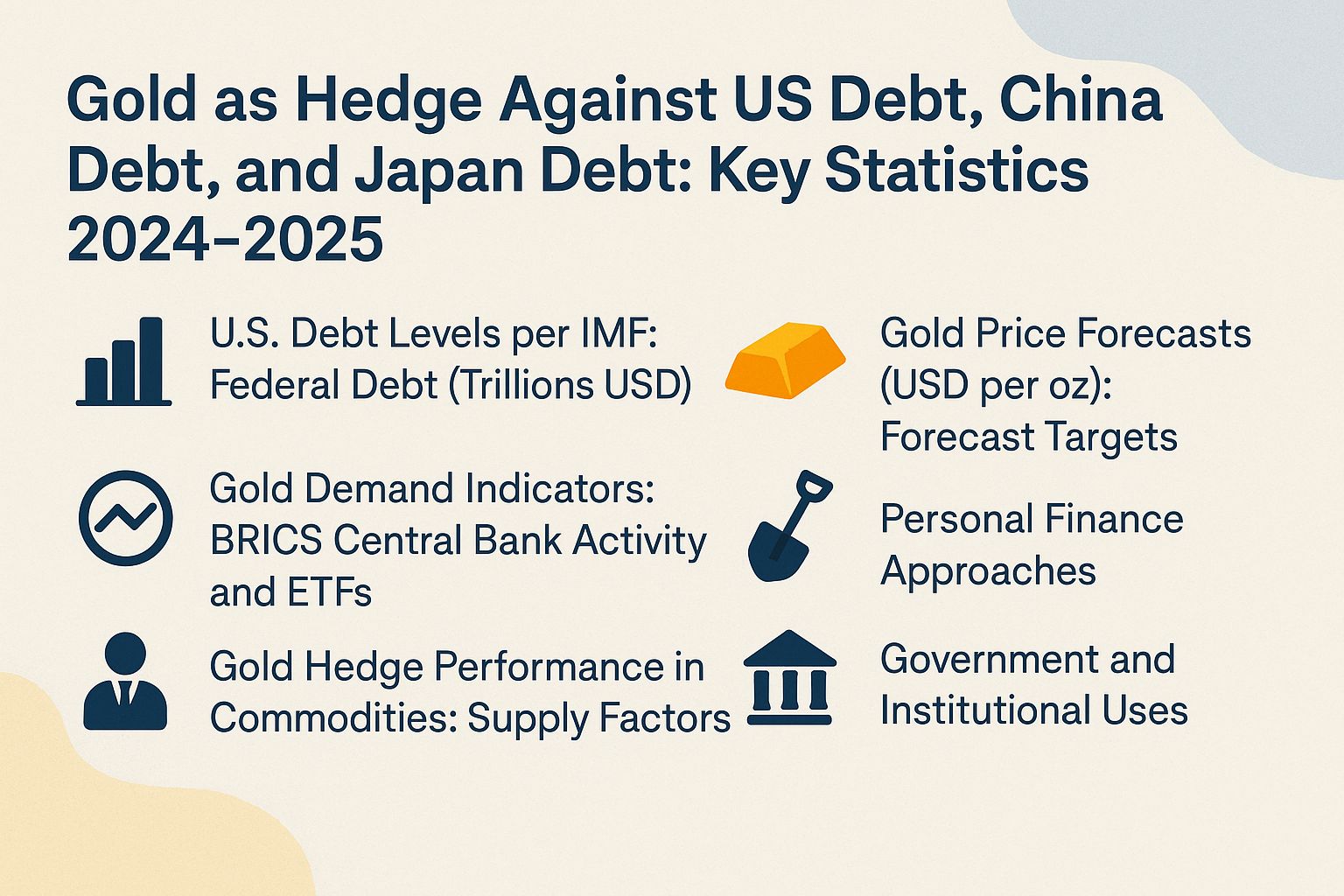
U.S. Debt Levels per IMF: Federal Debt (Trillions USD)
Gold Price Forecasts (USD per oz): Forecast Targets
Gold Demand Indicators: BRICS Central Bank Activity and ETFs
Gold Hedge Performance in Commodities: Supply Factors
(function() { setTimeout(function() { var bars = document.querySelectorAll(‘[class*=”animated-bar-3zlvrurt”]’); bars.forEach(function(bar) { var width = bar.getAttribute(‘data-width’); if (width) { bar.style.width = width + ‘%’; } }); }, 100); })();
Gold as Hedge Against Debt: Key Statistics 2024-2025 illustrates the growing appeal of gold amid escalating U.S. debt, China debt, and Japan debt, positioning it as a reliable safe-haven asset. With national debt levels surging, investors and central banks are turning to gold to mitigate risks from inflation, currency devaluation, and economic uncertainty.
U.S. Debt Levels underscore the urgency: federal debt reached $34.4 trillion in 2024 and is projected to hit $36.5 trillion by March 2025. Looking further, debt is forecasted to climb to 130% of GDP by 2034, straining fiscal stability and potentially eroding investor confidence in the dollar. Such rapid accumulation, driven by deficits and spending, heightens fears of inflationary pressures, making non-fiat assets like gold increasingly attractive for portfolio diversification.
- Gold Price Forecasts: Analysts predict significant appreciation, with Citi forecasting $3,500 per ounce in three months of 2025, a median target of $3,220 for 2025, and a potential high of $4,000. These projections reflect gold’s inverse correlation to debt vulnerabilities, as higher debt often bolsters demand for tangible stores of value.
Gold Demand Indicators highlight robust institutional interest, particularly from central banks. In Q1, banks purchased 243 metric tons of gold, dipping to 166 metric tons in Q2, yet signaling sustained appetite amid geopolitical tensions. Notably, 95% of surveyed banks plan further purchases in the next 12 months, viewing gold as a hedge against sovereign debt risks and a diversifier from traditional reserves.
Gold Hedge Performance is supported by supply dynamics: annual global production stands at 3,300 tonnes, with China holding a 12.5% mining share. Limited supply growth, combined with rising demand, reinforces gold’s scarcity value, enhancing its role as a buffer against debt-induced volatility. In essence, these statistics affirm gold’s enduring status as a strategic asset, offering protection in an era of ballooning public liabilities and uncertain monetary policies.
Personal Finance Approaches
For individuals, allocating 5-10% of a portfolio to gold exchange-traded funds (ETFs), such as GLD (SPDR Gold Shares, with an expense ratio of $0.40), serves as an effective hedge against the erosion of personal debt due to average credit card interest rates of 7%.
To implement this strategy, adhere to the following numbered steps:
- Evaluate your debt obligations, ensuring that the debt-to-income ratio remains below 36%, as advised by the Consumer Financial Protection Bureau (CFPB), to mitigate the risks of over-leveraging.
- Select an appropriate investment vehicle: consider physical gold, such as JM Bullion’s coins priced at $50 per ounce, for tangible ownership, or ETFs like GLD, which oversees $60 billion in assets under management (AUM) to provide enhanced liquidity.
- Initiate allocation at 5%-for a $100,000 portfolio, this equates to $5,000 invested in GLD shares.
- Conduct annual rebalancing utilizing tools such as the Vanguard portfolio calculator to preserve the intended allocation.
For instance, a retiree with $500,000 in savings could thereby diminish a 20% inflation risk associated with debt-laden fixed-income investments.
Please note that long-term capital gains on gold investments are subject to taxation at rates of 15-20%, in accordance with Internal Revenue Service (IRS) guidelines.
Government and Institutional Uses
In 2022, central banks acquired a record 1,136 tons of gold, valued at approximately $70 billion, primarily as a safeguard against potential devaluation of the U.S. dollar. This figure is based on surveys conducted by the World Gold Council, including responses from major institutions such as the People’s Bank of China.
This trend continued into 2023, with emerging markets accounting for 80% of the 1,037 tons purchased, driven by heightened geopolitical uncertainties, according to the World Gold Council. Central banks employ three primary strategies to build their gold reserves:
- Reserves accumulation: Following the imposition of sanctions, Russia has maintained 2,300 tons of gold, representing 20% of its total reserves, to enhance financial stability.
- Sovereign wealth funds: Norway’s $1.4 trillion sovereign wealth fund allocates 2% to gold holdings as a means of diversifying investment risks.
- Policy innovations: India’s gold monetization scheme aims to mobilize approximately $20 billion from gold stored in temple vaults.
The International Monetary Fund (IMF) advises that central banks maintain 10-15% of their reserves in gold to achieve a balanced approach to liquidity management.
Risks and Limitations of Gold Investments
Gold protects against inflation well. But its price swings can cause big drops of 20-30%. Sharp declines like the 28% fall in 2013, triggered by rising U.S. interest rates, show this risk (Bloomberg data). A ‘drawdown’ means a temporary value loss in investments.
Other principal risks associated with gold investments include the following:
- Big price swings hit hard. Gold peaked at $1,900 per ounce in 2011, then dropped to $1,050 by 2015. Use dollar-cost averaging to fight this: buy fixed amounts regularly over time. Apps like Acorns make it easy.
- Storing physical gold costs money. Expect 1-2% of its value each year. Choose safe vaults like those from Brinks for protection.
- Lack of yield generation, in contrast to fixed-income instruments like bonds. To address this, gold holdings may be complemented with dividend-paying equities to generate income.
- Taxes can hurt gold profits. Special items like gold face a 28% capital gains tax. An Individual Retirement Account (IRA) is a tax-advantaged savings plan; use it to delay or cut these taxes.
History highlights these dangers. The 1980 gold bubble burst caused a 65% drop from its high (archival market data). The U.S. Securities and Exchange Commission (SEC) warns against risky trading in gold futures. These contracts use leverage, which means borrowed money that can magnify losses.
Real-World Case Studies
Venezuela’s 2018 hyperinflation crisis skyrocketed prices by 1.7 million percent yearly (IMF data). Smart citizens swapped their collapsing bolivars for gold and saved about 90% of their wealth.
During World War II, Switzerland stayed neutral thanks to its massive gold reserves. Swiss banks held 1,040 tons, ensuring economic stability (Bank for International Settlements reports). Imagine the power of gold in tough times!
In the 2008 United States financial crisis, investors who allocated 10 percent of their portfolios to gold achieved a recovery rate 15 percent faster than those with portfolios heavily weighted toward stocks, according to a study by Morningstar.
Buy gold when prices dip for the best deals. Grab it at lows like $800 per ounce in 2008. Use trusted dealers or ETFs like GLD. These funds trade like stocks and skip storage hassles.
Future Prospects for Gold in Debt Management
Global debt will hit 100% of GDP by 2028 (IMF projections). This could boost gold demand by 15% yearly, especially as central banks in places like India and Turkey stock up. Get ready for gold’s big rise!
Key forward-looking trends contributing to this anticipated surge include:
- BRICS countries are ditching the dollar fast. They plan to boost gold reserves to 20% (Reuters, 2023). This shift could supercharge gold prices-act now!
- The emergence of digital gold tokens, such as PAX Gold on blockchain platforms, which currently hold a market capitalization of $500 million and facilitate seamless trading;
- Geopolitical hedging strategies, wherein historical war risks have typically elevated gold prices by 10-20%;
- Expansion in exchange-traded funds (ETFs), forecasted to achieve $1 trillion in assets under management (AUM) by 2030 (BlackRock estimate).
In case of a recession, financial advisors recommend allocating 10% of a portfolio to gold as a core stabilizing asset, as emphasized in the World Bank’s report on commodities within fiscal policy frameworks.
Investors are advised to track central bank acquisitions through professional tools like Bloomberg terminals to identify optimal entry points.