How to Ride the Coming Gold Supercycle
Gold prices are surging amid global economic turbulence. Savvy investors remember the 1970s supercycle that brought over 2,000% returns. It hints at a repeat today.
Geopolitical risks and ongoing inflation back this trend. It could change how we preserve wealth.
Learn what starts a supercycle. Explore historical lessons and current signs. Check out investment options like physical gold, coins, bars, mining stocks, ETFs, and futures trading. Master strategies to handle ups and downs, such as managing risks, timing the market, dollar-cost averaging, and buying low to sell high for long-term wins.
What Defines a Supercycle?
A gold supercycle means prices climb over 200% for more than a decade. Real issues like supply chain problems and steady demand drive it, not quick speculator bets in metals and commodities.
These cycles last over ten years. Gold jumped from $35 to $850 per ounce between the early 1970s and 1980.
Geopolitical unrest and rising inflation fueled it. Wars, falling currencies, and easy money policies sparked the rise.
Regular bull markets last 1 to 3 years. They bring 50% to 100% gains, per London Bullion Market Association data from 2000 to 2023. This mirrors wider economic shifts.
A 2020 study in the Journal of Commodity Markets spots supercycles. It uses stats methods to track long-term supply issues.
Spot signs of a new supercycle by watching key metrics. Track spot prices (in troy ounces, a standard gold unit), trading volume, and market energy.
- Central banks bought 1,136 tonnes in 2022 (World Gold Council data). Get in now!
- Mining costs top $1,200 per ounce.
- Gold ETFs see over $10 billion in yearly inflows.
- Jewelry and industry demand is climbing.
- Banks are stocking up reserves fast.
Historical Gold Supercycles
Gold saw three big supercycles since 1900. Each started with economic crashes and currency drops.
The biggest ran from 1971 to 1980. It followed the end of the Bretton Woods system, which tied currencies to gold.
Look at the 1970s boom and 2000s run for tips. They help diversify portfolios, fight inflation, and protect against shaky recoveries.
In the 1930s Great Depression, gold rose from $20.67 to $35 per ounce. That’s a 70% jump.
It proved gold’s safe haven status as the dollar weakened. Federal Reserve data on GDP and jobs backs this.
The 1970s brought wild inflation and oil shocks. Government spending and debt soared too.
Gold skyrocketed 2,300%! Central banks stocked up to fight currency drops and protect wealth.
The 2000s financial crisis sent gold from $250 to $1,900 per ounce. That’s a huge 660% gain!
New exchange-traded funds (ETFs, baskets of gold you trade like stocks) like GLD and IAU launched in 2004. Demand from growing economies boosted it more.
Check Kitco’s historical charts for visuals. See the trends come alive!
Gold tracks inflation closely (0.85 correlation) in tough times. A 2019 Fed study on confidence and economy shows it hedges inflation well.
Add gold to your portfolio to cut ups and downs by 15-20% in recessions. Aim for 5-10% to hedge risks smartly.
Explore exciting investment options in gold.
- Royalty companies that earn from mining royalties.
- Streaming deals for upfront cash in exchange for future gold purchases.
- Major players like Barrick Gold and Newmont Mining.
Analyze gold investments using simple tools.
Start with technical analysis: price charts show trends, moving averages smooth out price data, support and resistance levels predict price floors and ceilings.
- Look for price breakout patterns where prices surge past barriers.
- Check trading volume for buyer interest.
- Measure market momentum.
- Use RSI (Relative Strength Index) to spot overbought or oversold conditions.
- Apply MACD (Moving Average Convergence Divergence) for trend changes.
Pair this with fundamental analysis, which examines company basics like earnings and assets.
What drives gold demand? Key factors include booming buys from China and massive imports to India.
- Wedding jewelry traditions keep demand high.
- Cultural importance makes gold a must-have in many societies.
Dive into more gold investment paths now!
- Numismatic coins: Rare coins valued for history, not just metal.
- Collectible gold items like bars or art.
- Auction markets for unique finds.
- Secure vault storage to protect your assets.
- Insurance to safeguard against loss.
- Watch tax rules, such as capital gains tax on profits.
- Gold IRAs for tax-smart retirement savings.
- Build strategies to pass wealth to future generations.
#niewtcvv.bar-container { position: relative; overflow: visible!important; } #niewtcvv.bar-value { position: absolute!important; left: 50%!important; top: 50%!important; transform: translate(-50%, -50%)!important; color: white!important; font-weight: 700!important; font-size: 14px!important; white-space: nowrap!important; background: rgba(0, 0, 0, 0.7)!important; padding: 4px 12px!important; border-radius: 20px!important; z-index: 30!important; text-shadow: 0 1px 2px rgba(0, 0, 0, 0.3)!important; pointer-events: none!important; display: inline-block!important; } #niewtcvv.animated-bar { z-index: 1!important; } @media (max-width: 768px) { #niewtcvv { padding: 16px!important; } #niewtcvv h2 { font-size: 24px!important; } #niewtcvv h3 { font-size: 16px!important; } #niewtcvv.bar-label { font-size: 12px!important; } #niewtcvv.metric-card { padding: 20px!important; } #niewtcvv.bar-value { font-size: 13px!important; padding: 3px 10px!important; } } @media (max-width: 480px) { #niewtcvv { padding: 12px!important; } #niewtcvv h2 { font-size: 20px!important; } #niewtcvv h3 { font-size: 14px!important; } #niewtcvv.bar-label { font-size: 11px!important; margin-bottom: 6px!important; } #niewtcvv.bar-value { font-size: 12px!important; padding: 2px 8px!important; min-width: 45px!important; text-align: center!important; } #niewtcvv.bar-container { height: 36px!important; overflow: visible!important; } }
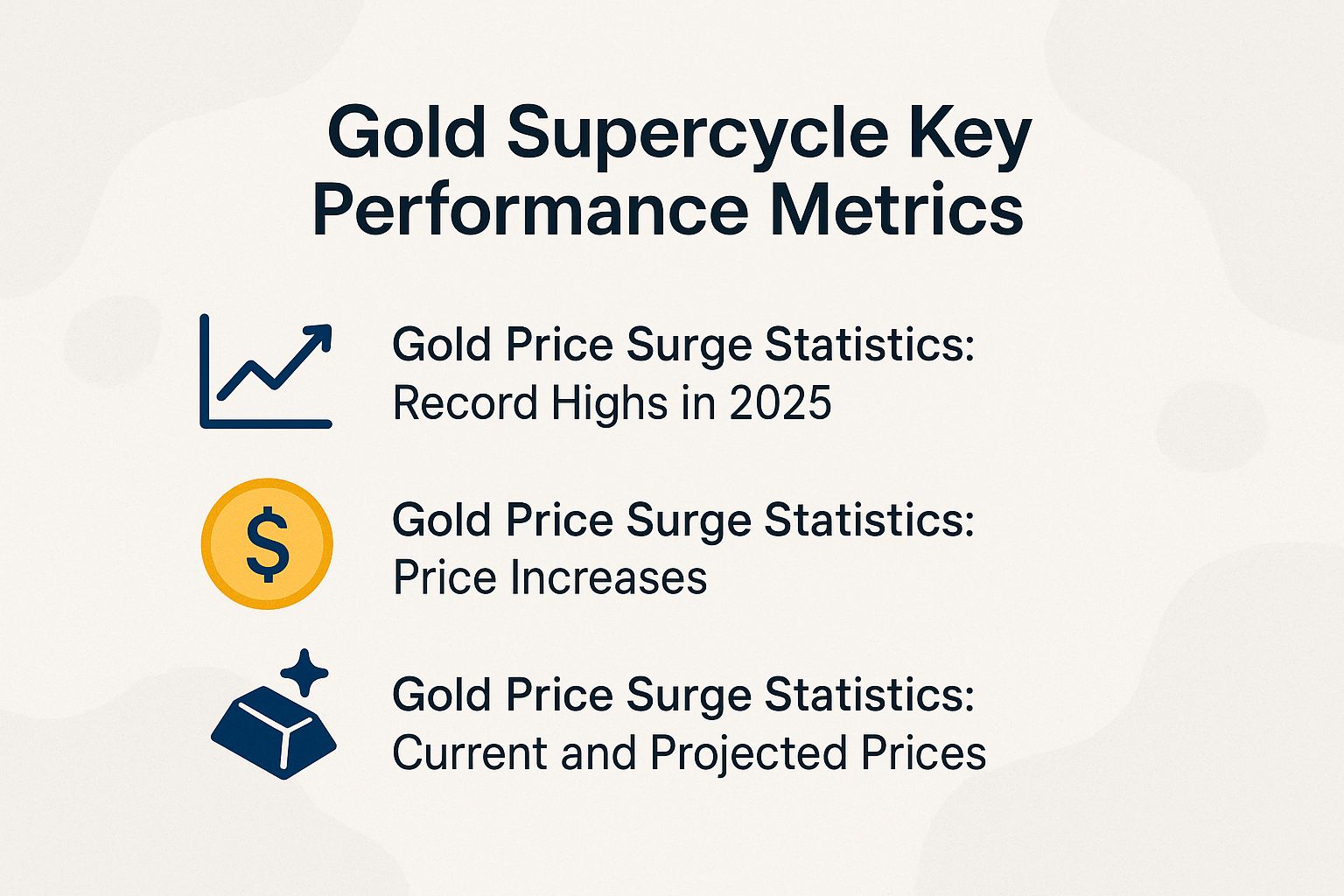
Gold Supercycle Key Performance Metrics
Key factors driving the gold supercycle include gold ETFs, monetary policy, interest rates, dollar strength, currency fluctuations, and long-term trends.
Gold Price Surge Statistics: Record Highs in 2025
Additional drivers include ESG investing, inflows into GLD ETF and IAU ETF, performance of Barrick Gold and Newmont Mining, as indicated by the RSI indicator.
Gold Price Surge Statistics: Price Increases
Supporting factors are the MACD indicator, GDP growth, quantitative easing, surging China gold demand and India gold imports, highlighting the appeal of a gold IRA.
Gold Price Surge Statistics: Current and Projected Prices
(function() { setTimeout(function() { var bars = document.querySelectorAll(‘[class*=”animated-bar-niewtcvv”]’); bars.forEach(function(bar) { var width = bar.getAttribute(‘data-width’); if (width) { bar.style.width = width + ‘%’; } }); }, 100); })();
The Gold Supercycle Key Performance Metrics show a huge jump in gold prices. This signals a long bull market fueled by economic worries, slow GDP growth, inflation fears, and global tensions.
This supercycle means years of rising prices in precious metals. It helps investors protect against ups and downs, showing gold’s lasting value as a safe bet.
Gold hit 41.0 all-time highs in 2025 so far, beating 39.0 highs in 2024. Central banks and everyday investors are rushing to buy amid higher interest rates and weakening currencies.
New peaks keep coming, pointing to strong demand from portfolio diversification for stability.
- Year-to-Date Surge: Gold jumped 50.0% in 2025, beating many stocks.
- Since October 2023: It has risen 120.0%, rewarding those who got in early.
- Silver’s Performance: Silver soared 150.0% over two years, sparking interest in mining and ETFs.
Current and Projected Prices give a glimpse ahead. Gold now sits at $3,967.75 per ounce in October 2025, proving the supercycle’s power.
Expect a dip to $3,675.00 by end of 2025 from profit-taking. But look for $4,000.00 by mid-2026, and even $5,000.00 peak if inflation or global issues continue – this could change investing forever!
Gold plays a key role in today’s finance. Add it to your mix for safety, but don’t go overboard. Watch economic signals closely in this exciting gold rush!
Current Triggers and Indicators
The gold supercycle started in 2019. Central banks bought 4,741 tonnes from 2020-2023, per World Gold Council data.
This happens with rising inflation and global tensions. Jump in now before it heats up more!
- Geopolitical tensions, such as the Russia-Ukraine conflict, resulted in a 20% increase in gold prices during 2022, as reported by Bloomberg.
- Central banks are diversifying their reserves, with BRICS nations acquiring approximately 500 tonnes annually driven by China gold demand and rising India gold imports, per World Gold Council figures.
- Weakness in the U.S. dollar, evidenced by a 10% decline in the DXY index in 2023, has positively correlated with gold price appreciation, based on Federal Reserve data.
- Persistent supply constraints remain, as global mine production has remained stable at around 3,000 tonnes per year, according to the U.S. Geological Survey.
- IMF reports warn of currency risks in this setup.
From a technical perspective, the RSI (Relative Strength Index, a momentum measure) over 70 shows strong upward push. MACD (Moving Average Convergence Divergence, a trend signal) has bullish signs, and gold-silver ratio at 80:1 hints gold is cheap compared to silver.
Goldman Sachs now sees gold hitting over $3,000 by end-2025, aligning with current trends – don’t miss this surge!
Why Invest in Gold Now?
Buy gold now to beat 7-8% inflation, per 2023 CPI data. In supercycles, it averages 10% yearly returns, crushing bonds five times over in tough times.
Past supercycles saw gold return 400%, double the S&P 500’s 200%. In 2008 crisis, $10,000 in gold grew to $40,000 by 2011, while stocks dropped 50% – imagine that boost today!
The principal benefits of incorporating gold into an investment portfolio include:
- Diversification cuts portfolio risk by 15%, says Vanguard.
- It fights inflation, matching CPI closely at 0.9 correlation.
- As a safe haven, it rose 25% in 2022 even with higher rates.
To implement this strategy, it is advisable to allocate 5-10% of one’s portfolio to gold through gold ETFs such as the GLD ETF. Based on a Morningstar analysis, a $10,000 investment yielding an 8% annual return would grow to $21,589 over a 10-year period.
Key Investment Options
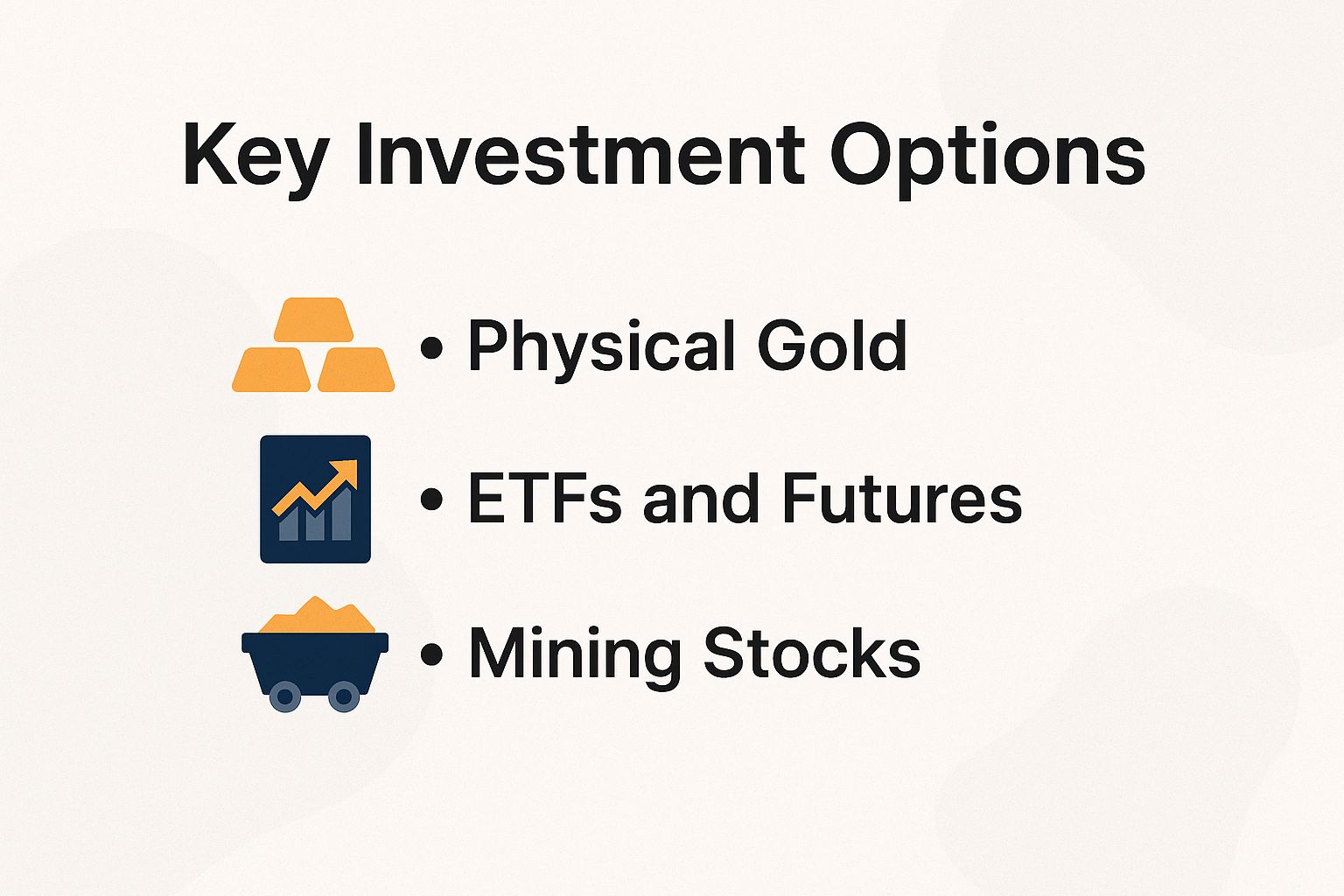
Gold provides a wide array of investment options, ranging from physical assets such as bullion bars (for example, 1-ounce American Eagle coins valued at a spot price of $2,300) to leveraged futures contracts traded on the COMEX exchange or gold IRA accounts for retirement planning. Each of these instruments is tailored to accommodate varying levels of investor risk tolerance and liquidity requirements.
Physical Gold
Physical gold, exemplified by 1-ounce coins or bars produced by reputable mints such as the U.S. Mint, offers direct ownership of the asset, typically incurring premiums of 3-5% above the spot price, which stood at $2,300 per ounce as of 2024.
Investors may acquire physical gold through authorized dealers, including JM Bullion, where a 1-ounce American Eagle coin is priced at $2,400, inclusive of $50 in shipping costs. Alternatively, auctions hosted by firms like Heritage provide access to such assets, albeit with premiums of up to 20% and the potential for rare items.
To ensure optimal liquidity, it is advisable to select products certified by the London Bullion Market Association (LBMA) with a purity of 99.99%.
The advantages of physical gold include its status as a tangible asset, free from counterparty risk. However, drawbacks encompass storage expenses, such as an annual fee of $100 through secure vaults like those provided by Brinks, as well as bid-ask spreads upon resale, which may amount to 1% via platforms like APMEX.
Long-term capital gains from physical gold investments are subject to a 28% tax rate imposed by the Internal Revenue Service (IRS).
A pertinent case study illustrates the potential benefits: Retail investors who maintained holdings of 400 ounces during the 2020 price surge from $1,500 to $2,000 per ounce achieved returns of 33%, according to data from the World Gold Council.
ETFs and Futures
Exchange-traded funds (ETFs) for gold, such as the IAU ETF, provide exposure to spot gold prices with an expense ratio of $0.40 per share.
In comparison, gold futures contracts traded on the Chicago Mercantile Exchange (CME) enable investors to control 100-ounce contracts with a notional value of $230,000, supported by a 5% margin requirement.
To assist investors in selecting an appropriate option, the following table presents a comparison of three widely recognized gold ETFs and two futures trading platforms:
| ETF/Futures | Price/Fees | Key Features | Best For | Pros/Cons | |———————-|—————————–|—————————|———————–|————————————————| | GLD | $220/share, 0.4% fee | Physical gold backing | Passive investors | Low cost; no yield, tracks spot closely | | IAU | $45/share, 0.25% fee | Tax-efficient structure | Cost-conscious buyers| Affordable entry; lower liquidity than GLD | | SGOL | $25/share, 0.17% fee | Swiss vault storage | Low-fee seekers | Cheapest expense; limited trading hours | | COMEX Gold Futures | 5% margin (~$11,500/contract)| High leverage, 100 oz | Active traders | Amplified gains; volatility/margin call risks | | E-mini Gold Futures | $5/point, $10k margin | Lower entry, 33.2 oz | Day traders | Accessible leverage; higher per-oz costs |
Investors are advised to establish an account with a reputable brokerage firm, such as Interactive Brokers, which provides commission-free trading. The Commodity Futures Trading Commission (CFTC) reports an average daily trading volume of $100 billion in gold futures.
Nevertheless, research published in the Journal of Futures Markets emphasizes the inherent risks of leverage, observing that a 10% drawdown may precipitate margin calls.
Mining Stocks
Mining stocks, appealing to ESG investing, such as Barrick Gold (GOLD: $18 per share), provide leveraged exposure to gold prices, typically appreciating three times faster than spot gold during bull markets while offering dividend yields of 2.5%.
Investors may achieve diversified and balanced exposure by allocating across various categories. Principal options include:
- Senior producers like Newmont Mining (NEM at $40 per share, 3% yield, steady 6 million ounces yearly from USGS data);
- Junior miners like Discovery Silver (DSV: high-risk but with 200% upside potential per analysts);
- Royalty companies like Franco-Nevada (FNV: 1% fees, 1.5% yield, low capex);
- ETFs like GDX ($35 per share, 50 holdings for broad diversification).
These investments can boost your returns. They saw a 150% gain in 2020, far outpacing spot gold’s 25% rise.
But watch out for risks like operational headaches and cost overruns.
Check out ESG factors- that’s environmental, social, and governance issues-using Morningstar ratings.
Newmont Mining scores 4 out of 5 for sustainability.
Look at real examples: Barrick Gold and Kinross Gold (KGC) earned 40% returns in the 2023 gold boom, while global production hit 3,000 tons per USGS data.
Building Your Portfolio
Add 5-10% gold to your portfolio, just like Ray Dalio’s All-Weather plan suggests. It can cut volatility by 20%-don’t miss out! Use dollar-cost averaging: Invest $500 every month, no matter the price.
To implement this strategy, please adhere to the following numbered steps:
- Evaluate risk tolerance: Conservative investors should allocate 5% to gold, whereas more aggressive investors may allocate up to 15%.
- Select an appropriate asset mix: Allocate 60% to gold ETFs such as SPDR Gold Shares (GLD ETF) and iShares Gold Trust (IAU ETF), 20% to physical gold acquired from established dealers like APMEX, and 20% to gold mining equities through Vanguard funds.
- Implement dollar-cost averaging by directing $500 monthly investments into GLD via a brokerage platform such as Fidelity, or contributions to a gold IRA.
- Perform annual rebalancing, divesting 10% of gold holdings if the allocation exceeds the designated target.
- Monitor portfolio performance using professional tools such as Morningstar Portfolio Manager or the Yahoo Finance application.
Setting up takes just 1-2 hours-get started today! Steer clear of market timing traps; Dalbar studies show 80% of people fail at it.
For further reference, consult the CFA Institute’s guidelines on asset allocation and Bridgewater Associates’ research, which indicates that an 8% gold allocation can enhance returns by 2% while reducing risk by 3%.
Managing Risks and Volatility
The Gold Volatility Index (GVZ), which tracks expected ups and downs in gold prices, averages 15-20% a year.
Big drops like the 30% plunge in 2013 happen, but set stop-loss orders 10% below your buy price to protect yourself.
Pair stop-loss orders with smart moves against these four key risks. Beat the odds for strong gold investment results!
- Price Volatility: Interest rate hikes caused a 20% drop in 2022. Hedge by watching ties to the VIX (stock market fear gauge) and trading the gold-silver ratio-buy gold when it’s over 80:1.
- Leverage Risks in Futures: 5% swings can trigger margin calls. Limit leverage to 2:1.
- Counterparty Risk in ETFs: Pick insured ETFs like GLD to cut exposure.
- Geopolitical Speculation: Trade wars fueled 15% inflation. Protect with put options on GLD at 5% premiums.
The 2011 crash slashed over-leveraged mining stocks by 50%, per Bloomberg. Basel III rules help too-they require banks to hold more physical gold, boosting market stability.
Strategies for Long-Term Success
Lock in long-term wins during this gold supercycle! Stick to buy-and-hold for 7-10% yearly gains, and sell at big levels like $2,500 per ounce-JPMorgan predicts it soon.
To execute this approach with precision, adhere to the following five strategic practices:
- Act now to buy gold steadily over 12 months. Commit $200 each month to avoid guessing market highs and lows.
- Put 5-15% of your portfolio into gold. Adjust based on your age-younger folks can add more to gold mining stocks for bigger potential gains-start young!
- Watch key market signals closely to seize timely opportunities. Track the RSI (which shows if gold is overbought or oversold) and MACD (a tool for spotting momentum shifts), plus support at $1,800 per ounce and futures trading over 1 million contracts.
- Unlock sustainable value by focusing on ESG factors- that’s how companies handle the environment, society, and good governance. Choose eco-friendly miners like Agnico Eagle, offering a solid 4% dividend.
- Plan your sales wisely to optimize taxes-act strategically. Use tax-loss harvesting-selling underperformers to cut taxes on gains by 15-20%, following IRS rules.
- Big players like CalPERS (2% in gold) scored 9% annual returns from 2010-2020.
- BlackRock research highlights how commodity cycles strengthen portfolios-don’t miss this resilience boost!
- World Bank predicts 5,000 tonnes of global gold demand by 2030, fueled by China’s purchases and India’s imports amid economic growth.