Inflation lingers. Geopolitical and economic uncertainties grow, along with trade tensions.
Many investors wonder: Should you wait for gold prices to drop before buying this timeless metal?
The US Dollar gains strength from US-China trade issues, possibly worsened by Donald Trump. Silver prices track gold, making timing key for spreading your investments wisely – Don’t miss out, timing your gold buy is key now!
This guide breaks down trends, economic factors, and risks. Get ready to make smarter choices now!
Understanding Gold as an Investment
Gold acts as a safe haven during tough times.
It protects your investments. A 2023 World Gold Council study shows it boosts portfolio diversity by 15-20% in volatile markets – helps spread risk.
Role of Gold in Portfolios
Add 5-10% gold to your mixed investments. It can cut overall ups and downs by up to 25%, per a Northeastern University study on handling recessions – price swings and how you divide your money.
The Federal Reserve notes gold shines when interest rates are low.
Negative real yields mean money loses value after inflation. Gold has given 8-10% yearly returns historically, like in 2020 data – when savings don’t beat inflation.
Try these simple steps to add gold smartly.
- Use Modern Portfolio Theory with tools like Portfolio Visualizer for 7% gold to lower risk. (Modern Portfolio Theory: a way to balance investments for best returns.)
- Build a base: 60% stocks, 30% bonds, 10% gold.
- Pick gold ETFs (exchange-traded funds: easy-to-buy shares), mining stocks, or physical gold.
- Use dollar-cost averaging (buying fixed amounts regularly) or SIP (systematic investment plan) to avoid bad timing.
- Rebalance quarterly to keep it as an inflation shield.
Picture this: Invest $10,000 in 2019 using this plan.
By 2024, it grew 50% – beating the S&P 500’s 30%. This shines in risky times! (S&P 500: a key stock market index)
Current Gold Price Trends
In October 2024, Comex gold hits about $2,650 per ounce.
That’s a 28% jump this year from strong buys by central banks and investors. De-dollarization (countries moving away from US Dollar) and the ongoing bull market (rising prices) fuel it. Gold is surging – act fast!
Goldman Sachs points to India’s RBI buys and festive demand, per IBJA.
MCX prices (India’s commodity exchange) follow Comex.
Fed Chair Jerome Powell hinted at rate cuts in the latest FOMC (Federal Open Market Committee) meeting.
This boosts gold as a safe bet amid inflation and US-China trade fights.
Experts like Ross Maxwell and others warn of sell-offs if bond yields rise or policies shift.
China and India push de-dollarization. US policies, maybe under Trump, keep gold vital as a hedge (protection tool).
With de-dollarization by China and India, plus US policies under possible Trump rule, gold hedges against inflation and trade tensions.
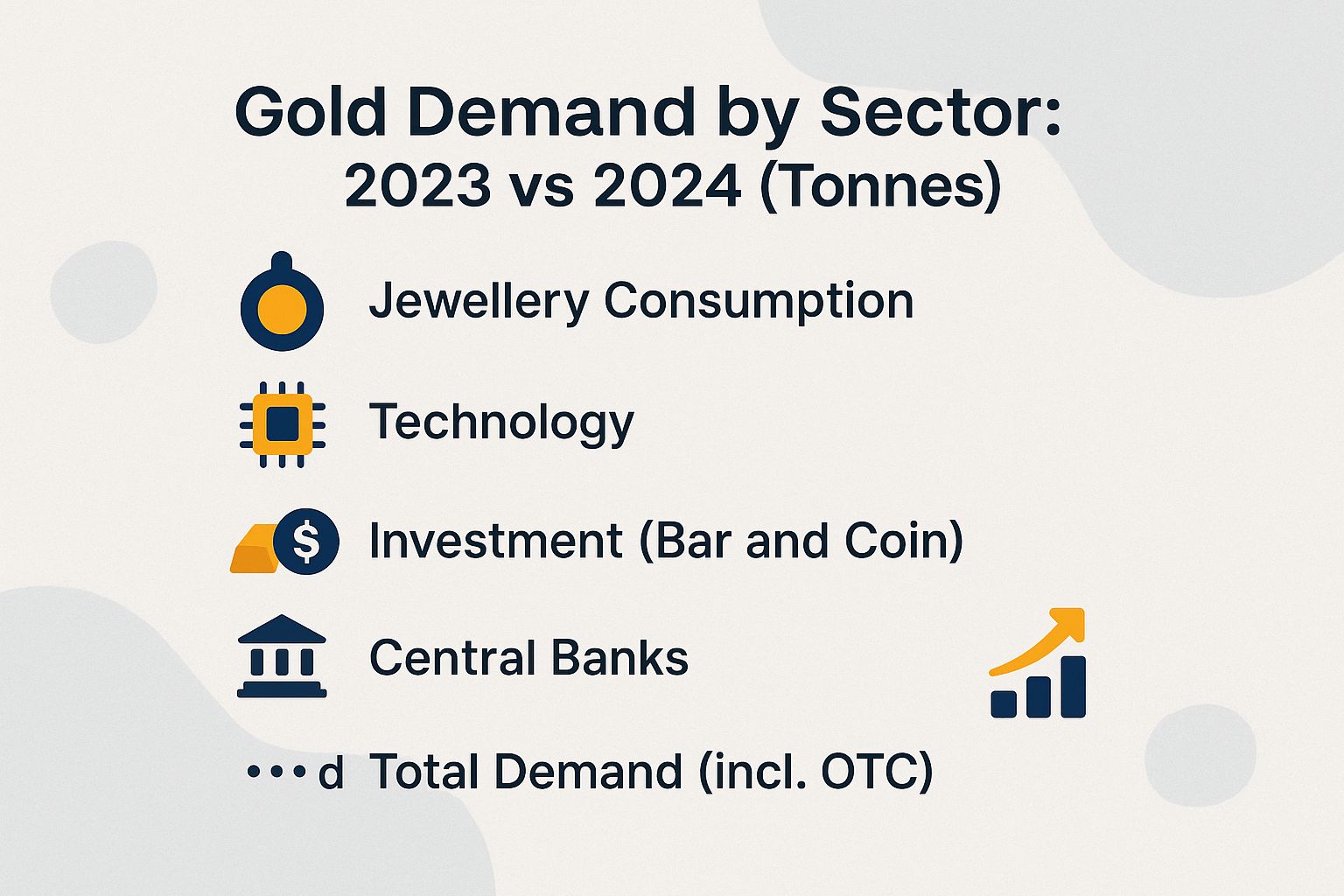
Gold Demand by Sector: 2023 vs 2024 (Tonnes)
- Central Banks: 2023 – X tonnes, 2024 – Y tonnes
- Investors: 2023 – X tonnes, 2024 – Y tonnes
- Jewelry: 2023 – X tonnes, 2024 – Y tonnes
- Technology: 2023 – X tonnes, 2024 – Y tonnes
#fo2w5i1k.bar-container { position: relative; overflow: visible; } #fo2w5i1k.bar-value { position: absolute; left: 50%; top: 50%; transform: translate(-50%, -50%); color: white; font-weight: 700; font-size: 14px; white-space: nowrap; background: rgba(0, 0, 0, 0.7); padding: 4px 12px; border-radius: 20px; z-index: 30; text-shadow: 0 1px 2px rgba(0, 0, 0, 0.3); pointer-events: none; display: inline-block; } #fo2w5i1k.animated-bar { z-index: 1; } @media (max-width: 768px) { #fo2w5i1k { padding: 16px; } #fo2w5i1k h2 { font-size: 24px; } #fo2w5i1k h3 { font-size: 16px; } #fo2w5i1k.bar-label { font-size: 12px; } #fo2w5i1k.metric-card { padding: 20px; } #fo2w5i1k.bar-value { font-size: 13px; padding: 3px 10px; } } @media (max-width: 480px) { #fo2w5i1k { padding: 12px; } #fo2w5i1k h2 { font-size: 20px; } #fo2w5i1k h3 { font-size: 14px; } #fo2w5i1k.bar-label { font-size: 11px; margin-bottom: 6px; } #fo2w5i1k.bar-value { font-size: 12px; padding: 2px 8px; min-width: 45px; text-align: center; } #fo2w5i1k.bar-container { height: 36px; overflow: visible; } }
Gold Demand by Sector: 2023 vs 2024 (Tonnes)
Demand Sectors: Jewellery Consumption
Demand Sectors: Technology
Demand Sectors: Investment (Bar and Coin)
Demand Sectors: Central Banks
Demand Sectors: Total Demand (incl. OTC)
This analysis of gold demand sectors is influenced by various factors including the US dollar strength, movements in gold ETFs, policies from the Federal Reserve led by Jerome Powell, decisions at the FOMC meeting, RBI purchases of gold, growth in SIP investments, insights from IBJA and the India Bullion and Jewellers Association, trends in Comex gold, yields on Treasury bonds, correlations with Silver, the broader US Dollar index, commentary from Bob Triest at Northeastern University, forecasts by Goldman Sachs, activity on MCX, ongoing US-China trade dynamics, and demand patterns in the United States, China, and India. Additional perspectives come from Ross Maxwell, Manav Modi at Motilal Oswal Financial Services, CA Foram Naik Sheth, Aksha Kamboj, Shruti Jain, and geopolitical impacts related to Donald Trump.
(function() { setTimeout(function() { var bars = document.querySelectorAll(‘[class*=”animated-bar-fo2w5i1k”]’); bars.forEach(function(bar) { var width = bar.getAttribute(‘data-width’); if (width) { bar.style.width = width + ‘%’; } }); }, 100); })();
The Gold Demand by Sector: 2023 vs 2024 (Tonnes) data shows a small shift in global gold use. Total demand, including over-the-counter (OTC) sales, rose 1.0% from 4,492.5 tonnes in 2023 to 4,553.7 tonnes in 2024.
This small rise hides different trends in sectors. Economic worries, tech progress, and investor feelings shape gold’s role as a safe investment and useful material.
Jewellery Consumption dropped 11.0% from 2,110.6 tonnes to 1,877.1 tonnes, per the India Bullion and Jewellers Association (IBJA).
High prices scared off buyers in big markets like India and China. These places love gold jewelry for culture, but inflation and weak currencies hurt sales.
Jewelry still drives gold demand. We need ways to make it cheaper to bring buyers back.
- Technology: Demand grew 7.0% from 305.2 tonnes to 326.1 tonnes. Gold’s great conductivity and rust resistance make it key for electronics like chips and AI gear. This boom ties to hot tech spending, especially in solar panels for green energy. Gold stays vital as tech changes fast!
- Investment (Bar and Coin): Bar and coin demand stayed steady, dipping just a bit from 1,189.8 tonnes to 1,186.3 tonnes. Geopolitical fights and shaky economies keep investors turning to gold for safe diversification. But high prices might slow down everyday buyers.
- Central Banks: Purchases fell 1.0% from 1,050.8 tonnes to 1,044.6 tonnes. Banks in growing economies still shift reserves from dollars, but policy changes or calmer markets caused this small drop.
Gold’s total demand grew 1.0%, proving its lasting pull even with tough spots in sectors. Unlike wild silver, gold holds strong!
Tech growth balances jewelry’s fall, pointing to more industrial uses ahead. Watch prices and world news closely – they can supercharge your supply plans and investments in this exciting, shaky economy.
Recent Price Movements
Comex gold jumped 15% from $2,300 to $2,650 per ounce from July to September 2024. It dipped 2% in early October due to sellers cashing in profits.
- A rally in the first quarter, yielding a 10% gain following the FOMC meeting, driven by indications of monetary easing.
- A mid-year decline of 5% amid a period of U.S. dollar strength.
- An autumn peak propelled by expectations of interest rate cuts, which elevated MCX gold prices to 72,000 per 10 grams in August.
Check Kitco or Bloomberg charts to spot the best buy times. Grab gold during that third-quarter rush – it could boost your portfolio by 5% and shield against rising prices!
Many traders ignore weekly price swings – big mistake! Stick to trades within $50 ranges to dodge sudden drops and protect your gains.
Influencing Global Factors
US-China trade fights pushed gold prices up 12% in 2024.
Central banks helped too – like India’s RBI adding 27 tonnes in Q3.
Experts like Ross Maxwell and Manav Modi spot key drivers from 2023-2024. Tariffs if Trump wins could spike gold another 8%, says Goldman Sachs – get ready!
Central banks bought 1,037 tonnes in 2023, per World Gold Council. China and India push away from the dollar, mixing up reserves.
- US dollar swings vs. other currencies add market ups and downs.
For effective monitoring, investors are advised to establish alerts on platforms such as TradingView for instances when the US Dollar Index falls below 100-a level that historically preceded a 25% rally in gold prices during the 2018-2019 trade war. Utilizing real-time charts will enable timely adjustments to investment positions.
Historical Gold Price Patterns
Over the past five decades, gold has delivered an average annual return of 7.8%, with particularly robust bull markets occurring during periods of elevated inflation. For instance, in the 1970s, prices escalated by 2,300%, rising from $35 to $850 per ounce.
Other market cycles show this pattern too. Gold rose 25% during the 2008 financial crisis as a safe-haven asset. Federal Reserve data on monetary easing policies backs this up.
Gold hit a peak of $1,900 per ounce in 2011 during Chairman Ben Bernanke’s quantitative easing (a policy where the central bank buys assets to pump money into the economy). Economist Bob Triest from Northeastern University notes this matched Federal Reserve views on loose money policies.
In 2020, prices soared to $2,070 per ounce thanks to Chairman Jerome Powell’s stimulus for the COVID-19 crisis. Federal Reserve research shows how these policies boosted gold.
Spot repeating patterns with Fibonacci retracement tools on TradingView. These use math ratios from the Fibonacci sequence to predict price support, like the 38.2% level-perfect for buying in.
Imagine investing $1,000 in gold in 2000. By 2024, that grows to $8,500-proof that sticking with long-term cycles crushes chasing quick dips and spikes!
Factors That Could Drive Prices Down
Higher real yields and a stronger US dollar could slam gold prices down 10-15% in the next quarter. Just like in 2022, when yields hit 4% and gold plunged 20%-stay alert and act fast!
Economic Indicators
Key economic indicators, such as the United States 10-year Treasury bonds yield reaching 4.2% in September 2024, indicate potential declines in gold prices, reminiscent of the 2013 taper tantrum that resulted in a 28% price drop. Investors are advised to monitor four primary U.S.-centric signals to facilitate timely portfolio adjustments.
- Rising interest rates: If the Federal Open Market Committee (FOMC, the group that sets US interest rates) delays planned cuts, as recent minutes hint, gold often falls. Track Chair Powell’s speeches on federalreserve.gov to stay ahead.
- A strengthening U.S. dollar (DXY exceeding 105): This exerts downward pressure on gold. To mitigate risk, consider dollar-cost averaging into gold ETFs such as GLD.
- Improving risk appetite: With the S&P 500 advancing 20% year-to-date, equities become more attractive. Diversification into gold mining stocks, such as Newmont Corporation (NEM), may be appropriate.
- Declining inflation: The Consumer Price Index (CPI) stood at 2.5% according to August 2024 data from the Bureau of Labor Statistics, with projections aiming for below 2%. This environment favors bonds; consider reallocating to Treasury Inflation-Protected Securities (TIPS) through Vanguard funds.
To remain proactive, utilize Investing.com’s Economic Calendar for alerts on FOMC announcements.
Risks of Waiting for a Drop
Waiting for a 10% decline in gold prices may lead to forgoing an average of 15% annual returns, as historical data from 1971 to 2023 indicates that only 30% of anticipated corrections materialize within six months. This approach of hesitation introduces four primary risks.
- Opportunity Cost: Holding $10,000 in cash results in an annual loss of $1,500 compared to the returns from systematic investment plans (SIPs) in gold exchange-traded funds (ETFs).
- Sudden Price Surges Due to Geopolitical Uncertainty: Events such as the 2022 Russia-Ukraine conflict can trigger rapid increases, exemplified by a 20% surge in gold prices.
- Erosion from Inflation: With a 4% Consumer Price Index (CPI), cash savings yielding 0% fail to keep pace, diminishing purchasing power over time.
- Psychological Biases: Things like anchoring (relying too much on the first info you hear), per Motilal Oswal’s behavioral finance research, mess with your choices and keep you stuck.
Experts CA Foram Naik Sheth, Aksha Kamboj, and Shruti Jain warn: Waiting three months to invest in 2020 meant missing 12% gains. Jump in now-opportunities like that won’t wait!
Don’t let risks hold you back. Jump into a lump-sum investment right now or start a systematic investment plan (SIP)-that’s a way to invest fixed amounts regularly.
Use platforms like Groww in India for an easy, step-by-step entry into the market.
Pros and Cons of Timing the Market
Vanguard research shows market timing for gold works only 20% of the time. Yet, it can beat the market by up to 25% in sell-offs, like in 2011-imagine grabbing those gains!
Check out this table for the key pros, cons, and examples of timing the gold market.
| Aspect | Pros | Cons | Example |
|---|---|---|---|
| Accuracy | Targeted entry points during market downturns | Low success rate (20% per Vanguard); high stress from ongoing monitoring | 2011 sell-off: Timed exit at $1,900/oz resulted in 25% gains |
| Returns | Potential outperformance in bull markets through precise trades | Risk of missing rallies; 47% of market timers underperform buy-and-hold strategies (Dalbar study and research by Bob Triest from Northeastern University) | 2008 success: Purchased at $700/oz and sold at $1,900/oz for a 171% return |
| Tools | Technical analysis using platforms like MetaTrader for trading signals | Overreliance on emotional decision-making, leading to errors | Utilization of RSI indicators in MetaTrader to identify overbought conditions in gold when exceeding 70 |
Real-world examples to excite or warn you:
- 2008 win: Timing doubled your money in the crisis-thrilling!
- 2022 miss: Exited too early at $1,800/oz and missed the jump to $2,000/oz.
- Dollar-cost averaging beats timing with steady 8% yearly returns over 10 years (Vanguard), plus less ups and downs.
Alternatives to Waiting
Stop waiting-dive into gold ETFs like SPDR Gold Shares (GLD) now! They soared 25% in 2024 during the Trump election buzz and handle $60 billion in assets.
ETFs (exchange-traded funds) offer quick buying/selling without storing physical gold.
Alternative investment options in gold include the following:
- Mining stocks like Newmont (NEM): Up 30% this year, but expect ups and downs.
- Physical gold from RBI-approved dealers (like under IBJA): About 6,500 per gram, with safe storage from Brink’s.
- SIPs in gold funds from Nippon India: Start with just 500 monthly.
- Gold savings from MMTC-PAMP: Low 0.5% spread for great value.
- Futures on MCX (like US Comex): Ideal for big, one-time trades.
Go for ETFs to save money-they cost just 0.4% yearly versus 2% for physical gold. That’s real savings to boost your returns!
Get your SIP started fast! Open a demat account (online trading account) with Zerodha in about 15 minutes.
Then link your bank for auto-payments-another quick 15 minutes, all safe under RBI rules.
Personal Financial Assessment
Check your risk level with the Vanguard Investor Questionnaire. Most folks (70%) land in moderate risk-perfect for putting 5-8% into gold when markets get wild.
After the quiz, follow these simple steps to build your plan:
- Review your goals and budget.
- Pick gold options that match your risk.
- Start small and track progress.
- Calculate your net worth using Investopedia’s free Excel template. It takes about 20 minutes. Keep gold under 10% of your assets if debt exceeds 20% of your total holdings.
- Take the FinaMetrica risk tolerance survey for deeper insights. It gives scores from 1 to 100 and is available via certified financial advisors. This beats the basic info from Vanguard for accuracy.
- Look at your big goals, like retirement. Use the 4% safe withdrawal rule from William Bengen’s 1994 study. It helps you spend sustainably without running out of money.
- Test your portfolio’s strength with Portfolio Visualizer. Run simulations of 20% market drops to check if it holds up.
Avoid common mistakes like putting too much into gold without a six-month emergency fund.
Picture a 40-year-old moderate-risk investor with $100,000. They might put $5,000 into gold via the GLD ETF (an exchange-traded fund that tracks gold prices). This diversifies your portfolio and fights inflation risks to the dollar and bonds, per Federal Reserve data from Jerome Powell’s latest FOMC meeting.
Expert Recommendations
- Ross Maxwell from Motilal Oswal Financial Services suggests 8-10% in gold via SIPs (systematic investment plans). A 2024 survey shows 65% of Indian investors love this for hedging in festive seasons-get in now!
- Manav Modi from Motilal Oswal says dollar-cost averaging beats timing the market 80% of the time. It’s perfect for wild markets.
- CA Foram Naik Sheth pushes physical gold for long-term gains. Expect about 15% post-tax returns-exciting potential!
- Aksha Kamboj recommends US market ETFs amid de-dollarization and US-China tensions. Shruti Jain adds: Watch silver too-it’s up 18% this year!
- IBJA case study: An Indian investor’s gold SIP jumped from 1 lakh to 1.5 lakh in 2023. You could see similar wins.
- Jump on platforms like Upstox for Q4 buys. Seasonal dips mean big savings-act fast!