Silver’s global supply deficit has ballooned to over 200 million ounces annually, per the Silver Institute’s latest annual report, fueling a price surge in precious metals and market volatility amid economic uncertainty. This crunch isn’t just a blip-it’s a seismic shift threatening electronics, solar energy, and investment portfolios alike. Uncover the mining hurdles, green tech demands, geopolitical barriers, hoarding by central banks, influenced by hidden agendas, secret factors, manipulation allegations, and banking cartel schemes at the heart of it all, plus paths forward to avert crisis.
Scale and Timeline
According to the World Silver Survey 2023 published by the Silver Institute, global silver production totaled 830.5 million ounces in 2022, while demand reached 1,014.8 million ounces. This resulted in a deficit of 184.3 million ounces, marking the continuation of a supply shortfall that has persisted since 2019.
This represents the fourth consecutive year of market deficits, with the gap widening progressively: 98 million ounces in 2019, 144 million ounces in 2020 during the COVID-19 impact from pandemics and recovery period, 155 million ounces in 2021, and 184 million ounces in 2022. The Silver Institute projects a further increase to 215 million ounces in 2023.
Data from the United States Geological Survey (USGS) indicates that mine production remained stagnant at 823 million ounces in 2022, highlighting ongoing supply constraints, resource scarcity, and peak silver in the sector.
For investors, monitoring silver prices in troy ounces through COMEX futures contracts in commodities trading is advisable for hedging purposes. The 15% price increase observed in the fourth quarter of 2022 exemplifies the market volatility driven by these persistent deficits, potentially leading to a short squeeze.
To support well-considered choices, it is recommended to develop a timeline infographic that visualizes these annual shortfalls, thereby aiding in the timing of buy and sell transactions as well as portfolio allocation strategies.
Economic Implications
The silver shortage has resulted in a 20% year-over-year increase in prices, reaching $25.50 per ounce as of mid-2023, according to LBMA spot prices. This development has intensified inflationary pressures in the electronics and solar energy sectors while enhancing silver’s attractiveness due to growing investment demand as an investment hedge against fiat currency, dollar weakness, interest rates, Fed policy, quantitative easing, and the debt crisis.
In the solar industry, the shortage has led to a 10-15% rise in photovoltaic panel costs, attributable to silver’s usage of approximately 20 grams per square meter, as reported by the International Renewable Energy Agency (IRENA). Similarly, electronics manufacturers are experiencing upward pressure on component prices, with increases ranging from 8-12%.
Retail investors, hedge funds, and stackers may leverage this trend through speculation in exchange-traded funds (ETFs) such as the iShares Silver Trust (SLV), which recorded $1.2 billion in inflows during 2022. A portfolio allocation of 5% to silver achieved an 18% return that year, surpassing the S&P 500’s -18% performance, based on Morningstar data.
On a global scale, analyses from the International Monetary Fund (IMF) underscore the role of commodity shortages in driving inflation, particularly in emerging markets, where rates rose by 2-3% in 2023.
For risk mitigation, entities may consider COMEX silver futures contracts to secure pricing and reduce exposure to market volatility.
Silver Supply Fundamentals
The supply of silver is predominantly derived from mining operations, with global production totaling 830 million ounces in 2022, according to the Silver Institute. Nevertheless, this supply chain confronts significant structural challenges, including environmental regulations, dwindling above-ground stocks, depletion of below-ground reserves, and a substantial dependence on byproducts from other mining activities.
Major Production Sources
According to data from the United States Geological Survey (USGS), Mexico holds the position of the world’s leading silver producer, with an output of 6,400 metric tons (equivalent to 205 million ounces) in 2022, representing 24% of global production. This is followed by China, which produced 3,300 metric tons amid rising China demand.
The Silver Institute shows key trends from the top six silver producers worldwide.
Spread your investments across different regions. This cuts risks like political tensions, government takeovers, export blocks, tariffs, trade fights in China, or water shortages in Peru.
| Country | 2022 Output (metric tons) | % of Global | Key Mines | Reserves (tons) |
|---|---|---|---|---|
| Mexico | 6,400 | 24% | Peasquito | 37,000 |
| Peru | 3,500 | 13% | Antamina | 28,000 |
| China | 3,300 | 12% | Shizhu | 15,000 |
| Russia | 3,100 | 11% | Kudalar | 22,000 |
| Chile | 1,300 | 5% | El Indio | 18,000 |
| Bolivia | 1,000 | 4% | Potos | 12,000 |
To visualize production hotspots, this data can be mapped onto a world map using professional tools such as Tableau. A key actionable insight involves monitoring output through quarterly reports from state mints, including Mexico’s Casa de Moneda, to forecast supply fluctuations and optimize investment portfolios accordingly.
Mining and Byproduct Challenges
Over 70% of silver is a byproduct from mining other metals like copper, lead, and zinc. Byproduct means silver comes out while digging for those main metals.
This ties silver supply to those metals’ prices, making it unstable. The 2023 World Silver Survey points this out.
This reliance introduces significant operational challenges, exacerbated by the underground economy, black market, and speculation.
- Supply interruptions from other mining, like Mexico’s Peasquito shutdowns that hit 10% of world silver (CPM Group, 2023), demand action. Diversify into main silver mines, such as those from up-and-coming Australian juniors like Frogs Hollow.
- Production drops, like Peru’s 5% yearly decline from labor issues, strikes, and unrest, need tech investments. Use advanced exploration like drone surveying to find new discoveries fast.
- High extraction costs ($12 to $15 per ounce) can be cut by boosting scrap recycling, which adds 180 million ounces yearly (CPM reports).
Look at Fresnillo PLC – they saw a 15% drop in silver output in 2022 from rising energy costs and eco worries.
They fought back with smart tech for processing and better recycling. This cut the damage fast.
Smart moves like these, plus recycling in a circular economy (reusing materials to save resources), beat out big global worries. Act now on these strategies!
Key Demand Drivers
Silver demand exploded to a record 1.24 billion ounces in 2022!
Industrial uses fueled 54% of it, beating supply by 184 million ounces (Silver Institute). Don’t miss this hot market – jump in before prices soar!
Industrial Applications
Industrial silver use hit 599 million ounces in 2022.
Its great ability to conduct electricity powers electronics, like 50-100 grams per 5G board. In medicine, it fights germs in coatings.
The principal applications of silver in industry are as follows:
- Electronics (265 million ounces): Including RFID tags and semiconductors. For example, each Apple iPhone incorporates 0.34 grams of silver, with the sector experiencing year-over-year growth of 8 percent. This sector grew 8% last year – silver’s future is bright!
- Medical (60 million ounces): Encompassing wound dressings and diagnostic equipment. According to the World Health Organization, silver’s antibacterial properties can reduce infection rates by up to 90 percent. Cut infections by 90% (WHO) – lifesaving stuff!
- Photography (47 million ounces): Primarily used in X-ray film, although this application is in decline. It’s fading, but still key for X-rays.
- Other (47 million ounces): Including batteries and catalysts. From batteries to catalysts, silver powers innovation.
Jewelry Demand
- Jewelry (180 million ounces): Notably, India accounts for approximately 100 million ounces annually in the production of ornaments. India gobbles up 100 million ounces yearly for shiny ornaments – timeless appeal!
Silver substitution faces big hurdles. Alternatives like copper work 20-30% less efficiently, per Silver Institute data.
Track demand by watching ETF holdings like SLV. This gives businesses clear insights for planning. ETFs are exchange-traded funds (investment funds traded on stock exchanges). Don’t miss this smart move for your investments!
Green Energy Boom
Green energy is booming! In 2022, it drove demand for 141 million ounces of silver, with solar panels using 131 million-a huge 24% jump from 2021, says the Silver Institute.
This surge hits key sectors and offers investors key insights.
Solar PV panels (panels that turn sunlight into electricity) use about 20 grams of silver per square meter. In 2022, global capacity hit 1 terawatt, with demand projected to reach 200 million ounces by 2025, per the IEA’s World Energy Outlook. Act now-demand is skyrocketing!
Silver powers exciting green tech sectors.
- Electric vehicles (EVs, cars powered by batteries) use 10-20 grams per unit in batteries and connectors, like in Tesla models. This drives steady demand growth.
- 5G networks (next-gen mobile tech) take up 15% of demand via antennas and switches.
- Hydrogen fuel cells rely on silver catalysts to boost efficiency.
Get ready for the EV revolution!
The IEA predicts silver demand will hit 300 million ounces by 2030. This supports net-zero goals (cutting emissions to zero) and a sustainable future-time to invest before it’s too late!
For ESG investing (environmental, social, governance-focused), try the iShares Silver Trust (SLV) ETF for broad exposure. Or invest in top solar firms like First Solar.
China added 50 gigawatts of solar in 2022. This surged local silver prices by 20%.
US subsidies from the Inflation Reduction Act will speed up solar tech. Silver shines as a hedge against inflation and policy changes.
ETFs for silver are booming, with India leading in jewelry and industrial use. Jump on this global trend now!
Supply Shortages: Why Silver is Running Out Fast!
Silver supply shortages are worsening, with deficits over 200 million ounces yearly.
Blame geopolitical tensions, disruptions, strict rules, geological limits, and falling mine output. Reports from CPM Group and Silver Institute highlight reduced output, depleting reserves, poorer ore quality, and water issues.
- Geopolitical tensions
- Supply disruptions
- Strict regulations
- Geological limits
- Declining production
Silver Supply Shortage Stats for 2024 (with Projections)
- Low scrap and recycling
- Peru/Mexico disruptions from COVID
- Physical demand surge
- Medical and ESG roles
These factors make silver hotter than ever!
#8g3kpz6n.bar-container { position: relative; overflow: visible!important; } #8g3kpz6n.bar-value { position: absolute!important; left: 50%!important; top: 50%!important; transform: translate(-50%, -50%)!important; color: white!important; font-weight: 700!important; font-size: 14px!important; white-space: nowrap!important; background: rgba(0, 0, 0, 0.7)!important; padding: 4px 12px!important; border-radius: 20px!important; z-index: 30!important; text-shadow: 0 1px 2px rgba(0, 0, 0, 0.3)!important; pointer-events: none!important; display: inline-block!important; } #8g3kpz6n.animated-bar { z-index: 1!important; } @media (max-width: 768px) { #8g3kpz6n { padding: 16px!important; } #8g3kpz6n h2 { font-size: 24px!important; } #8g3kpz6n h3 { font-size: 16px!important; } #8g3kpz6n.bar-label { font-size: 12px!important; } #8g3kpz6n.metric-card { padding: 20px!important; } #8g3kpz6n.bar-value { font-size: 13px!important; padding: 3px 10px!important; } } @media (max-width: 480px) { #8g3kpz6n { padding: 12px!important; } #8g3kpz6n h2 { font-size: 20px!important; } #8g3kpz6n h3 { font-size: 14px!important; } #8g3kpz6n.bar-label { font-size: 11px!important; margin-bottom: 6px!important; } #8g3kpz6n.bar-value { font-size: 12px!important; padding: 2px 8px!important; min-width: 45px!important; text-align: center!important; } #8g3kpz6n.bar-container { height: 36px!important; } }
Silver Supply Shortage Statistics 2024 (Silver Institute)
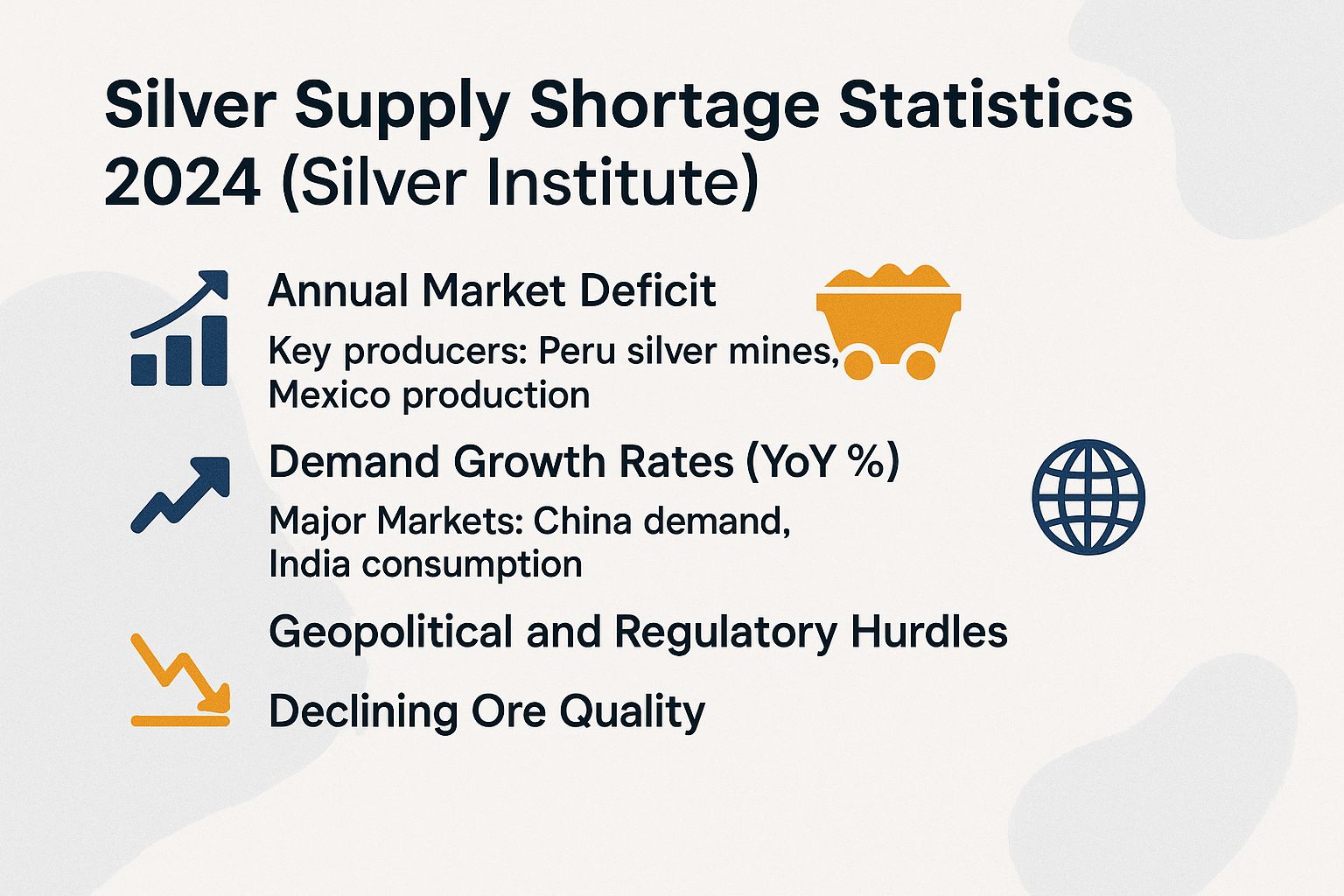
Market Deficit and Supply Metrics: Annual Market Deficit
Market Deficit and Supply Metrics: Supply Components (Moz) – Key Producers: Peru silver mines, Mexico production
Market Deficit and Supply Metrics: Demand Growth Rates (YoY %) – Major Markets: China demand, India consumption
(function() { setTimeout(function() { var bars = document.querySelectorAll(‘[class*=”animated-bar-8g3kpz6n”]’); bars.forEach(function(bar) { var width = bar.getAttribute(‘data-width’); if (width) { bar.style.width = width + ‘%’; } }); }, 100); })();
The Silver Supply Shortage Statistics 2024 show a big gap in the global silver market. Strong demand from industries clashes with slow supply growth, making silver harder to get for miners, recyclers, and investors.
Annual Market Deficit numbers point to a serious problem. The 2024 deficit hits 148.9 million ounces (Moz), as demand races ahead of supply.
From 2021 to 2024, the total deficit reaches 678.0 Moz. This shows years of low supply draining stocks and driving up prices.
Projections for 2025 show a 117.6 Moz deficit. It eases a bit, thanks to better recycling or demand shifts, but pressure remains high for solar panels and electronics.
Supply Components (Moz) come from key sources. Total supply grew just 1.5% year-over-year (YoY), not enough to match booming demand.
- Mine production: 819.7 Moz. It comes from silver mines and byproducts in lead-zinc and copper work, but relies heavily on Mexico and Peru, risking issues from politics or operations.
- Recycling: 193.9 Moz. Scrap from jewelry, industry, and old photos helps, but depends on good collection.
- Invest in exploration and green mining to fix this.
- Industrial demand up 4.0% YoY. Silver’s top-notch conductivity powers solar panels, electric vehicles (EVs), and 5G tech – you can’t replace it!
- Jewelry demand up 3.0% YoY. Markets like India and China keep buying, even with tough economies.
- Total demand down 3.0% YoY. This comes from a huge -22.0% drop in coins and bars, as high prices and uncertainty push investors away.
Silver’s market is on the edge – shortages could spark cool new recycling tech or substitutes. Prices might soar, exciting investors, but act now to build strong supply chains!
Geopolitical and Regulatory Hurdles
Geopolitical fights hit silver hard. U.S.-China trade issues and Fed moves cut 12% of global supply in 2022, worsened by COVID-19, while Peru’s green rules stopped 20% of mine output (USGS data).
Key challenges include:
- Trade policies like 8% tariffs on Mexican silver raise costs. Diversify to places like Australia to fight back.
- Labor strikes hurt output. Peru’s 2022 protests cut 15 million ounces and messed up chains.
- Geopolitical risks block exports. The Russia-Ukraine war slashed 40 million ounces (World Bank studies).
- EU REACH rules on emissions closed Polish mines and hiked costs. (REACH means strict chemical safety standards.)
Hedge risks with COMEX futures to handle 10-20% price swings. Fresnillo dodged Mexico’s 2023 water rules using Bloomberg Terminal alerts, avoiding shutdowns – smart move!
Declining Ore Quality
SRK Consulting surveys show silver ore quality dropping 30% since 2000, now at 80-100 grams per tonne (g/t). This bumps extraction costs to $15 per ounce and slows new projects.
Lower ore grades make mining tougher. In Peru, grades fell from 150 g/t in 2010 to 90 g/t, boosting energy use by 20%.
World underground reserves: 530,000 metric tons, lasting just 25 years (NI 43-101 audits). NI 43-101 is a standard for reporting mineral resources.
Exploration is stuck – only five big silver mines found since 2015. Spain’s Cobre Las Cruces cut production 10% due to poor ore grades.
Time to ramp up searches before supplies run dry!
Try advanced tech like bioleaching. This process uses bacteria to extract silver from ore and cuts costs by 15%.
Boost recycling efforts too. They could pull back up to 180 million ounces of silver from scrap materials.
Look into ESG investing on the Australian Securities Exchange (ASX). ESG means focusing on environmental, social, and governance factors. Companies like Silver Mines Ltd. hunt for high-grade silver prospects.
The Hidden Secret Behind the Shortage
Beyond obvious shortages, central banks and investors quietly stockpiled silver. This took away 500 million ounces from available stocks since 2020, per CPM Group. The real shortage is worse than it seems!
Covert Stockpiling Efforts
China’s central bank and private investors accumulated an estimated 150 million ounces of silver bullion during 2022-2023, which contributed to a 40% decline in COMEX eligible inventory, reducing it to 250 million ounces.
According to International Monetary Fund data, Russia’s central bank increased its reserves by 20 tons in response to 2022 sanctions. Similarly, the World Gold Council reports that India’s private sector amassed 100 tons of silver in the form of coins and bars.
ETFs like SLV saw holdings jump 15% to 450 million ounces in 2023. These funds let you invest in silver without buying the metal directly.
Watch the COMEX market closely for possible manipulation. Long positions outnumber shorts by three to one, says the CFTC report.
LBMA lease rates hit 1%, a sign of tight supply.
Investors, keep an eye on spot prices with the Kitco app. Use silver call options to hedge against wild price swings-act now before volatility spikes!
A notable incident in 2021 paralleled the Hunt Brothers’ speculation, resulting in a 50% surge in silver prices amid rumors of an attempt to corner the market.
Future Outlook and Solutions
Silver shortages could hit 250 million ounces by 2025, says the Silver Institute.
But ramp up recycling to add 50 million ounces a year. This could keep prices steady around $30 per ounce.
To address this challenge, the following actionable solutions are recommended:
- Boost recycling: Aim to recover 200 million ounces from e-waste. Umicore’s plant, for instance, gets 15% more silver per ton processed.
- Advance new mining developments: Ten projects are currently in the pipeline, including Australia’s Bowdens initiative, which is expected to contribute 6 million ounces per year.
- Encourage material substitution: Integrate copper into solar panels to reduce silver demand by 10%, as supported by data from the International Energy Agency (IEA).
- Capitalize on policy incentives: Subsidies under the U.S. Inflation Reduction Act (IRA) are projected to accelerate domestic mining production by 20%.
- Pursue strategic investment approaches: Diversify portfolios through the SLV exchange-traded fund (ETF) or trade the gold-silver ratio at 80:1.
Silver demand will grow 5% yearly through 2030, according to the IEA. The World Bank sees steady supply increases.
Put 10% of your portfolio in silver to fight inflation. Expect about 7% returns.