
Empires rose and fell, but gold endured. This trusted metal adorned ancient tombs and backed currencies in the Gold Standard era.
In shaky markets, gold still shines. It offers rock-solid stability during economic ups and downs and global risks.
We’ll dive into gold’s rich history and cultural role. Discover its key traits like scarcity, toughness, ease of carrying, and worldwide appeal. See how it fights inflation, acts as a safe spot in crises, preserves wealth, works as a global currency, and beats out stocks, bonds, real estate, and even Bitcoin-the so-called digital gold. Gold’s track record proves it’s a timeless winner!
Historical Significance of Gold
Gold has been a reliable, touchable treasure for over 5,000 years. Ancient Egyptians used it for burial masks, like the famous one on Tutankhamun, to show lasting wealth and power as a top status symbol.
Ancient Civilizations
- Egypt (3000 BCE): Mined gold in Nubia for Tutankhamun’s 11kg mask, worth $2M+ today. Used for divine jewelry like 24-karat rings.
- Mesopotamia/Lydia (600 BCE): First electrum coins kickstarted empire-wide trade.
- Inca Empire: Called it “sweat of the sun” for religious art. Spanish stole 20 tons in 1530s!
British Museum studies show gold’s 99.9% purity and how it fights rust (corrosion means it doesn’t tarnish). These traits keep its value steady, lasting forever with top reliability.
All this built gold’s core value as a lasting wealth store. It beats the ups and downs of paper money (fiat currencies).
Gold Standard Era
Britain adopted the gold standard in 1821. The US followed in 1900, tying money to gold at $20.67 per ounce for steady exchange rates.
This boosted global trade stability. It lasted until the Great Depression forced a pause in 1933.
The gold standard rolled out step by step. Britain’s 1821 fixed rate kept yearly inflation at just 0.5%, per IMF data, inspiring other countries to join.
It brought steady prices and exploded global trade by 300% from 1870 to 1914. World Bank data backs this up.
But its rigid rules caused problems. The 1944 Bretton Woods deal tied the US dollar to gold at $35 an ounce, yet it collapsed in 1971 amid post-WWII pressures.
In 1896, US election drama: William McKinley won pushing gold standard over Bryan’s silver idea. This locked in the policy.
Today, we see paper money (fiat currencies) fixes gold’s shortage issue. It allows flexible money policies to handle economic hits like inflation spikes.
Intrinsic Properties
- Scarcity: Limited supply drives value.
- Durability: Doesn’t corrode, lasts forever.
- Portability: Easy to carry wealth.
- Universality: Accepted everywhere.
Scarcity and Durability
Gold is a precious metal with special qualities. It acts as a great store of value because it’s rare and doesn’t corrode like other assets.
Only 208,874 tonnes have ever been mined, per the World Gold Council. This scarcity sets it apart from things that wear out over time.
Gold is super rare in the Earth’s crust-just 0.004 parts per million. That’s why its price jumped from $35 an ounce in 1971 to $2,300 in 2023, making it a smart long-term pick.
- All the gold ever mined fits in a 21m x 21m x 9.1m cube, says the World Gold Council.
- We mine about 3,500 tonnes yearly, but demand hits 4,700 tonnes-creating ongoing shortages that drive up value.
Unlike copper, which is plentiful at 50 parts per million in the crust, gold never tarnishes. Hold onto it for years-it’s built to last!
Gold shines in tough spots too!
- NASA used it on Voyager probes since 1977 to block space radiation.
- It powers electronics and dental work.
Smart investors put 5-10% of their portfolio into gold ETFs like GLD. This hedges against inflation, adds variety, and acts as an emergency backup.
ETFs are easy-to-buy funds that track gold prices.
Recycling helps the planet. The EPA says reusing 50% of jewelry gold cuts mining’s harm by 20%, pushing greener ways to get gold.
Divisibility and Portability
Gold divides easily into small pieces, from 1-gram coins worth about $75 to 400-ounce bars.
Its high value per weight makes it super portable. A 1kg bar ($75,000) fits in your pocket!
Splitting gold doesn’t lose value, unlike dividing land that costs a fortune in surveys and lawyers. Romans used aurei coins (1/40th of a pound) for easy trade across their empire-imagine that power!
In crises, gold’s portability saves the day. WWII refugees sewed it into clothes hems to escape Nazis undetected-your secret weapon for tough times!
One ounce of gold ($2,300) slips into your pocket easily. But $2,300 in hundred $20 bills? That’s bulky and bulky!
Gold’s interchangeable nature shines in global trade, per the London Bullion Market Association-think easy swaps of 400-ounce bars via futures or spot deals. For quick sales, grab one-ounce American Eagle coins from APMEX (add $50 premium).
- These coins sell, trade, or barter fast-no assays or fake checks needed.
- Store safely in insured, secure vaults to shield from theft.
Assays test purity.
Hedge Against Inflation
Gold keeps your money’s buying power strong during inflation, beating paper currencies. $100 in gold from 1971? Worth $4,500 now. The S&P 500? Just $1,200 after 7.5% yearly inflation.
- Morningstar shows gold returned 10.1% yearly since 1971, beating inflation by 7.6%.
- In the 1970s stagflation (high inflation at 13.5%), gold soared 2,300% as the dollar lost 50% value-don’t miss out on this powerhouse!
Stagflation is high inflation with slow growth.
Gold works well as an inflation hedge. It has a negative link to the Consumer Price Index (CPI, a measure of price changes for goods and services), with studies from the Federal Reserve showing a correlation of r = -0.65.
Central banks stock up on gold too. For example, Russia added 2,300 tonnes from 2010 to 2023.
Imagine investing $10,000 in gold. Over 20 years, it could deliver an 8% real return, beating cash savings hands down.
Don’t forget taxes like capital gains and its inheritance benefits. Experts from IMF reports suggest putting 5-10% of your portfolio into gold for retirement to fight inflation.
Safe Haven in Crises
In tough economic times, gold acts as a safe spot to park your money. It also signals how the economy is doing.
Take the 2008 crisis: gold jumped 25% while stocks dropped 50%. Bloomberg data shows investors rushed to gold for confidence.
Economic Downturns
In the 2008 recession, gold soared from $800 to $1,900 per ounce by 2011-a whopping 137% gain! While the Dow fell 54%, investors grabbed gold for stability after Lehman Brothers collapsed. This pattern repeats in other downturns.
Gold shines in crashes. Check these examples:
- In 2020 COVID crash, gold rose 40% to over $2,000/oz as Fed cut rates to zero (IMF Paper WP/20/232).
- In 2000 dot-com bust, gold gained 15% while Nasdaq plunged 78%.
Manage risks smartly with gold. Morningstar says 5-15% of your portfolio; Vanguard suggests 10% for protection. In 2008, $20 billion flowed into GLD ETFs!
See Venezuela’s 2018 hyperinflation at 1.7 million percent. People smuggled gold bars and coins to save their wealth-act now to protect yours!
Pair gold with bonds in your portfolio. This mix cuts volatility by 20-30%, drawing from centuries of history.
Universal Global Acceptance and Universality
Gold is accepted everywhere, like a global currency. 98% of central banks hold it-36,000 tonnes total (World Gold Council).
Its lasting value aids trade, from ancient Silk Road to modern IMF SDR baskets (a mix of currencies for global finance).
The US Fed holds 8,133 tonnes-70% of reserves-for stability in crises. Russia boosted holdings post-2022 sanctions to counter risks.
In India, people hold 25,000 tonnes privately, often for weddings with rings and jewelry (Reserve Bank of India). It shows gold as a reliable value store and status symbol.
IMF’s 2023 report notes gold’s 0.5% in SDR baskets, boosting global liquidity and signaling confidence.
Gold’s steady presence in over 150 countries helps international investors build portfolios. It’s a great alternative and legacy asset. Buy via COMEX futures for liquidity and low storage costs in secure vaults. This diversifies risks in all markets: bull runs, bear drops, rallies, and corrections.
Comparison to Modern Assets like Stocks and Cryptocurrency
- Stocks: Grow with economy but crash hard.
- Crypto: Exciting but unpredictable-gold offers stability!
Gold stands out as a steady choice over risky options like stocks or crypto. The S&P 500 tracks the market closely (beta of 1.0 means average risk), and Bitcoin has plunged over 80% at times.
Gold barely moves with stocks (correlation of 0.2 from JPMorgan data). It offers easy trading with $150 billion in daily volume worldwide.
| Asset | Annualized Return/Volatility | Key Features | Use Cases |
|---|---|---|---|
| Gold as a commodity and tangible asset | Around 15% returns with low price swings; current spot: $2,300 per ounce | Tangible asset, inflation hedge with scarcity and durability, no yield, intrinsic value | Add 5-10% for balance (like Ray Dalio’s all-weather strategy); great for emergencies and retirement; cuts risk by 20% (BlackRock study). Value at Risk (VaR) measures potential losses. |
| Stocks | 10% growth, high volatility | Dividends, equity exposure | Core growth holding for long-term wealth |
| Bonds | 4% stable yield | Interest rate sensitive, low risk | Income generation in conservative portfolios |
| Crypto | High risk/reward, 100%+ volatility | No intrinsic value, speculative | Pair a small 1-5% with gold; crypto acts as ‘digital gold’ but lacks gold’s long-proven stability. |
| Real Estate | 7% return, illiquid | Maintenance costs, rental income | Inflation protection via property appreciation and gold’s price stability |
Grab a 7.5% slice of gold in your mix now! It fights inflation and softens big drops, just like Ray Dalio’s balanced all-weather plan.
Check JPMorgan’s stats on how gold stays strong and independent.
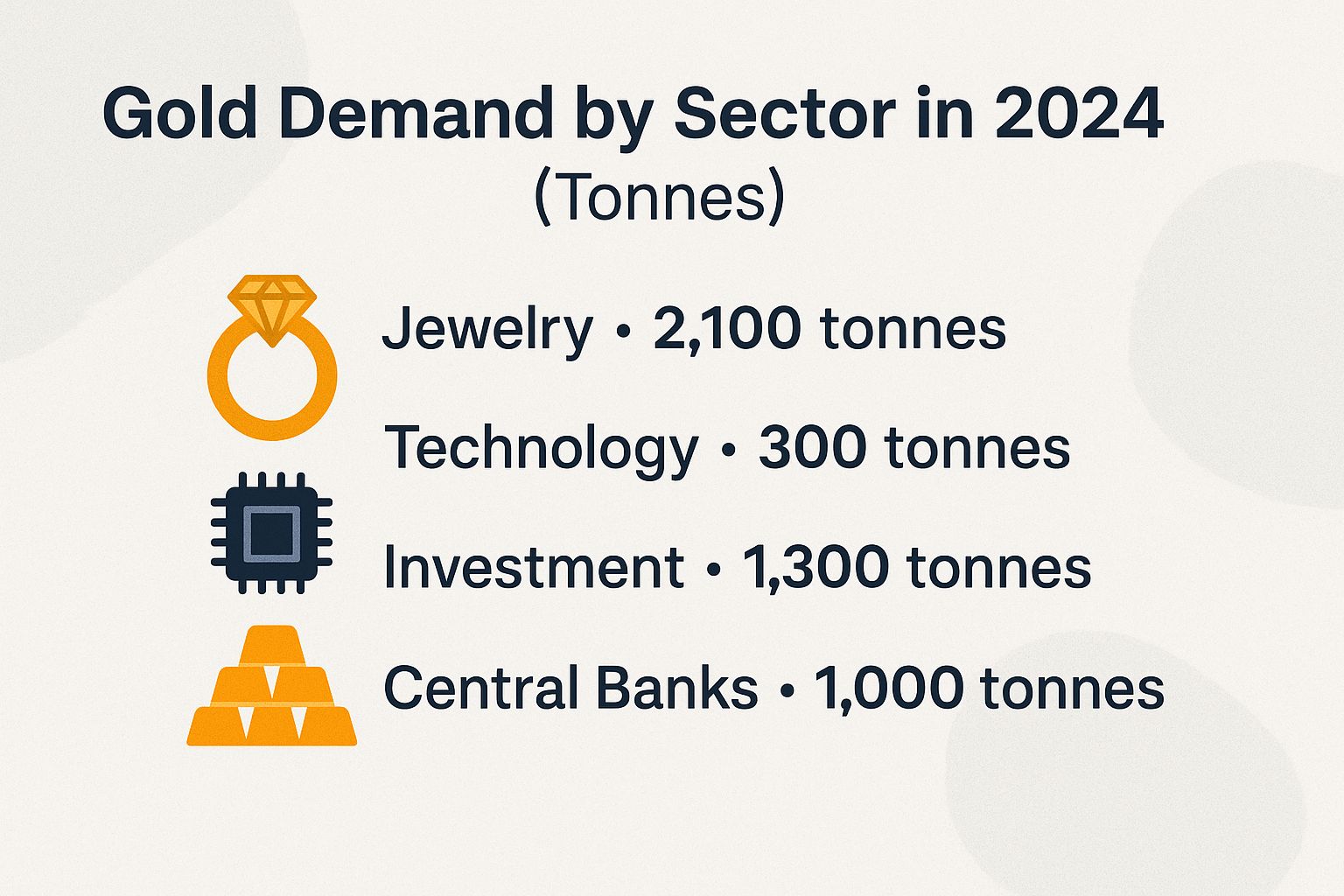
Gold Demand by Sector in 2024 (Tonnes)
- Mining Supply
- Industrial Use in Electronics and Dentistry
- Jewelry
- Central Bank Reserves
#gt49h2tb.bar-container { position: relative; overflow: visible!important; } #gt49h2tb.bar-value { position: absolute!important; left: 50%!important; top: 50%!important; transform: translate(-50%, -50%)!important; color: white!important; font-weight: 700!important; font-size: 14px!important; white-space: nowrap!important; background: rgba(0, 0, 0, 0.7)!important; padding: 4px 12px!important; border-radius: 20px!important; z-index: 30!important; text-shadow: 0 1px 2px rgba(0, 0, 0, 0.3)!important; pointer-events: none!important; display: inline-block!important; } #gt49h2tb.animated-bar { z-index: 1!important; } @media (max-width: 768px) { #gt49h2tb { padding: 16px!important; } #gt49h2tb h2 { font-size: 24px!important; } #gt49h2tb h3 { font-size: 16px!important; } #gt49h2tb.bar-label { font-size: 12px!important; } #gt49h2tb.metric-card { padding: 20px!important; } #gt49h2tb.bar-value { font-size: 13px!important; padding: 3px 10px!important; } } @media (max-width: 480px) { #gt49h2tb { padding: 12px!important; } #gt49h2tb h2 { font-size: 20px!important; } #gt49h2tb h3 { font-size: 14px!important; } #gt49h2tb.bar-label { font-size: 11px!important; margin-bottom: 6px!important; } #gt49h2tb.bar-value { font-size: 12px!important; padding: 2px 8px!important; min-width: 45px!important; text-align: center!important; } #gt49h2tb.bar-container { height: 36px!important; overflow: visible!important; } }
Gold Demand by Sector in 2024 (Tonnes)
As a trusted asset mined from the Earth, gold serves as a safe haven and store of value, acting as an inflation hedge and precious metal. Bullion, including gold bars and gold coins, is key for Jewelry making. Central banks maintain reserves in their portfolios for diversification as a tangible asset characterized by scarcity, durability, and universality. Throughout history, from ancient civilizations, it underpinned the gold standard, influencing monetary policy as an alternative to fiat currency during economic uncertainty, geopolitical risk, financial crisis, and recession. As a commodity, gold’s mining affects supply, driving demand and ensuring price stability for wealth preservation and as a hedge against inflation. It holds cultural significance and industrial use in electronics and dentistry, providing value retention and high liquidity in the gold market via trading, ETFs, futures, and spot price measured in ounces or troy ounces. Refining achieves high purity, often in karat form without alloy, protecting against counterfeit through authentication. Secure storage in vaults provides security with insurance is essential, while considering taxation and capital gains for inheritance. As a legacy asset, gold offers timeless value, intrinsic value, and symbolic value as a status symbol in wedding rings and gold medals, embodying reliability, consistency, a proven track record, longevity, and enduring appeal with global acceptance as a borderless currency. It functions as an emergency fund and aids retirement planning as an alternative investment compared to stocks, bonds, real estate, cryptocurrency like Bitcoin-sometimes called digital gold-offering stability against volatility, risk management, and asset allocation. Gold serves as an economic indicator, enhancing investor confidence and market sentiment during bull markets, bear markets, rallies, corrections, and ultimately leading to appreciation.
Demand Breakdown: Demand Volume
(function() { setTimeout(function() { var bars = document.querySelectorAll(‘[class*=”animated-bar-gt49h2tb”]’); bars.forEach(function(bar) { var width = bar.getAttribute(‘data-width’); if (width) { bar.style.width = width + ‘%’; } }); }, 100); })();
The Gold Demand by Sector in 2024 shows key drivers of global consumption. Measured in tonnes, it highlights economic, cultural, and strategic influences on this precious metal.
Gold is a trusted tangible asset mined from Earth. Its history dates back to ancient civilizations, valued for scarcity, durability, and universal appeal. Total demand mixes physical uses and investments. Sectors vary with spot prices-current market prices-and geopolitical risks like economic uncertainty.
Demand Breakdown shows top sectors. Jewellery consumption tops the list at 1877.1 tonnes.
It plays a big role in cultures, especially in India and China. Festivals, wedding rings, and events like gold medal awards cause seasonal boosts.
Gold shines as an asset and status symbol. Its symbolic, timeless, and intrinsic value draws people in, but high prices can slow sales. Gold’s cultural magic keeps it shining bright!
- Technology uses 326.1 tonnes of gold.
- Electronics: smartphones, computers
- Dentistry: fillings and crowns
Gold’s conductivity-its ability to carry electricity-and resistance to corrosion make it perfect. With AI and renewable energy booming, expect this demand to skyrocket!
- Bar and Coin Investment hit 1186.3 tonnes. These include gold bars and coins as bullion-pure gold forms. Retail investors love them as safe havens during inflation and economic uncertainty. They protect against rising prices and offer secure storage in vaults with insurance. In shaky stock markets, gold surges to preserve wealth and pass on as inheritance!
- ETFs (exchange-traded funds) and futures contracts dropped by -6.8 tonnes net. Investors are pulling out to try bonds, real estate, or cryptocurrencies like Bitcoin-some call it digital gold. High spot prices mean profits and taxes tempt sales. This small dip hints at shifting market moods in bull (rising) or bear (falling) conditions. Don’t panic-it’s just a minor tweak in gold’s strong story!
- Central Banks bought 1044.6 tonnes. Countries like China and Russia are adding gold to reserves, moving from fiat currency (government money) in their monetary policies. This nods to the old gold standard days. It stabilizes prices and hedges against crises, recessions, and global tensions-making gold a top economic signal. Big banks are betting big on gold for stability!
- OTC and Other total 420.7 tonnes. This covers over-the-counter trades and niche uses in medicine and dentistry. They use karat alloys-gold mixed for strength-with high purity. These boost the gold market’s liquidity, or ease of buying and selling. Even small sectors keep gold’s market flowing smoothly!
2024 gold demand and supply hit about 4849.0 tonnes, after adjusting for ETF outflows. Investments and jewelry lead despite economic challenges and crisis fears.
Diverse sectors protect gold from slumps. Its track record of consistency and longevity shines in finance and industry.
Gold’s global acceptance makes it like borderless money. Jewelers and policymakers-grab this data now for smart planning and risk handling in a wild world!
Enduring Trust in the Future
Gold’s future looks bright with growing trust. Stay tuned for trends that could boost your investments!
Gold has a solid reputation for reliability and consistency. Demand from emerging markets will likely boost this further.
BRICS nations hold 20% of global reserves. They are pushing gold-backed trade, per a 2023 Reuters report, which could drive up prices 5-7% yearly until 2030. This highlights gold’s lasting value-don’t miss out!
Grab these gold investment wins with these five smart strategies:
- Long-term investment: Aim for 6.5% real returns over 10 years, based on LBMA data. Buy physical gold as a tangible asset or ETFs (funds that track gold prices) as an easy option. Hold steady through ups and downs for smart risk management and balanced assets.
- Add ESG factors: Pick gold from eco-friendly mining and refining. For example, Rand Refinery cuts carbon emissions by 30% while keeping gold pure and real-perfect for ethical investors who care about the planet.
- Diversify your retirement portfolio: Put 3-5% of your 401(k) assets into gold, as Fidelity suggests. This fights inflation and builds an emergency fund, acting as a safe bet alongside stocks, bonds, real estate, crypto, and Bitcoin (aka digital gold).
- Track supply and demand in emerging markets: Watch China’s 1,000-tonne yearly gold imports. Use BRICS trade shifts as signs of investor confidence to time your buys perfectly.
- Explore tech uses for gold: Gold powers 300 tonnes yearly in electronics and industries. This steady demand keeps prices strong-jump on it now!
The World Gold Council sees gold hitting $3,000 per troy ounce (a standard gold weight) by 2025. Geopolitical tensions and crisis risks will fuel this surge.
Start easy with SPDR Gold Shares ETF, managing $60 billion in assets. Build a portfolio with 5% gold, rebalance yearly for risk control, and watch global reserves to buy low in bull rallies or bear dips-act fast!