The U.S. debt crisis is getting worse. The national debt has passed $35 trillion, according to U.S. Treasury data.
Economists warn it could wipe out your savings, spark inflation, and weaken the dollar.
Unchecked spending and policy issues are pushing the dollar toward collapse.
Gold stands out as a top safe haven. It protects against inflation like no other precious metal.
Check out gold bullion and ETFs. They offer strong history and hedging power. Diversify your portfolio now to protect against economic chaos, market shakes, and global risks!
The Scale and Growth of U.S. Debt

U.S. national debt jumped from $900 billion in 1980 to $34.5 trillion in 2023. This surge comes from yearly budget shortfalls averaging 5% of the total economy size (that’s GDP).
Historical Trends
After World War II, U.S. debt hit 106% of GDP in 1946. GDP means the total value of goods and services in the economy.
Debt kept climbing after the 2008 crisis. The Federal Reserve’s quantitative easing-printing more money to buy bonds-made it worse. Debt spikes during recessions and market ups and downs.
- In the 1980s under Reagan, debt tripled to $2.7 trillion. Tax cuts, higher military spending, and more government outlays drove it up, per Treasury records.
- The 2008 crisis ballooned debt from $10 trillion to $16 trillion. Bailouts and Fed interventions caused the jump.
- COVID-19 pushed debt to $27 trillion in 2020. Stimulus checks and money printing fueled the rise.
- IMF warns debt over 100% of GDP is unsustainable. Without changes, it could hit 130% by 2030, say World Bank and rating agencies.
Smart move: Check real-time data on TreasuryDirect.gov. Time your buys in Treasury bills or bonds during market dips to beat inflation.
Current Projections
The CBO predicts U.S. debt will hit 180% of GDP by 2053, up from 122% in 2023. GDP is the economy’s total output. Rising interest payments and rates will top $1 trillion a year by 2030.
According to the CBO’s 2023 baseline projections, annual budget deficits will average $2 trillion through 2033, largely attributable to costs associated with an aging population.
Social Security and Medicare costs will climb to 10% of GDP. Bond yields at 4-5% will make interest payments even heavier. This could squeeze private investments and mess with your risk plans.
Stay ahead: Watch CBO updates for smart portfolio tweaks.
- Diversify with inflation-protected bonds.
- Add international bonds.
- Invest in real estate.
- Compare cryptocurrencies for extra options.
This fights off rising yields, debt shakes, and recessions.
Key Causes of the Debt Spiral
Since 2019, U.S. budget deficits average $1.5 trillion a year. Wild spending, low revenues, and bad policies cause it.
Watch out-this could spiral into a debt crisis! It might drop our credit rating and create huge long-term money problems.
Government Spending Patterns
Mandatory spending covers entitlements like Social Security and Medicare. It makes up 60% of the $6.1 trillion federal budget for 2023 and could grow 5-7% each year without changes.
This dwarfs discretionary spending, like $850 billion for defense. It also outpaces $660 billion in interest on the national debt, per the 2023 OMB report.
The Government Accountability Office (GAO) warns of unsustainable growth.
Entitlements could hit 70% of the budget by 2033 without policy changes, driven by an aging population.
The 2021 American Rescue Plan added $1.9 trillion to the national debt.
This shows the growing money pressures on the government.
Stay on top of federal spending.
Check USAspending.gov for real-time data and cool interactive charts.
Think about these reforms to fix the budget mess:
- Means-test Medicare to help only those who need it.
- Raise Social Security retirement age slowly.
- Focus infrastructure spending on long-term wins.
These steps build fiscal health and cut through political fights. Act now before it’s too late!
The Scary Side Effects of Ballooning Debt
Rising public debt crowds out private investments. It slows GDP growth by 0.5% to 1% and stirs up big problems.
Watch out for these impacts:
- Higher unemployment.
- Shaky consumer confidence.
- Worse trade deficits from trade disruptions.
Economists say recession odds jump to 40% by 2025. Time to worry!
Beat the Debt Crisis: Go for Gold and Smart Alternatives
Gold shines in tough times. It’s great for long holds or quick trades, shielding you from wild inflation and money crashes.
Diversify with these:
- Silver buys.
- Mining company stocks.
- Gold ETFs for easy access.
Central banks are buying gold like crazy.
They’re worried about debt woes, ceiling fights, policy flips, and how shaky paper money is versus the old gold standard.
Global debt disasters scream warnings. Don’t let loose spending and money printing run wild.
Key examples:
- Eurozone and Greece crises in Europe.
- Argentina’s default in Latin America.
- Weimar hyperinflation in Germany.
- Zimbabwe and Venezuela’s collapses.
BRICS nations push away from the dollar. The Chinese Yuan gains power, and emerging markets swing wild, ramping up risks. Grab gold now-it’s your best shield!
Manage risks by diversifying your portfolio.
Know how assets link up-gold doesn’t crash with stocks in market dives, giving you real protection.
What moves gold prices? Supply and demand factors like these:
- Mining output.
- Jewelry buys.
- Industrial needs.
- Investor moods from global risks and stimulus cash.
Traders use technical analysis. They spot support (price floors) and resistance (price ceilings) to ride bull runs or dodge bear drops.
Long-term folks check big-picture econ factors. It’s fundamental analysis for steady wins.
Speculating or quick trading has pitfalls.
- Watch taxes,
- storage fees for real gold,
- how easy it sells (liquidity),
- and trade costs for ETFs or stocks.
Gold beats wild cryptos during quantitative easing (central banks printing more money) or shaky times.
It locks in wealth, just like solid real estate.
At home, debt ceiling battles and political stalemates block smart money moves. No team-up across parties hurts fiscal duty.
Worldwide, trade gaps and fights with growing markets yell for tough, spread-out investments. Diversify now!
YTD Performance of Key Assets in the 2025 U.S. Debt Crisis
- Gold: +15%
- Silver: +10%
- Stocks: -5%
#g2fxchmw.bar-container { position: relative; overflow: visible; } #g2fxchmw.bar-value { position: absolute!important; left: 50%!important; top: 50%!important; transform: translate(-50%, -50%)!important; color: white!important; font-weight: 700!important; font-size: 14px!important; white-space: nowrap!important; background: rgba(0, 0, 0, 0.7)!important; padding: 4px 12px!important; border-radius: 20px!important; z-index: 30!important; text-shadow: 0 1px 2px rgba(0, 0, 0, 0.3)!important; pointer-events: none!important; display: inline-block!important; } #g2fxchmw.animated-bar { z-index: 1; } /* Mobile optimizations for small screens */ @media (max-width: 768px) { #g2fxchmw { padding: 16px!important; } #g2fxchmw h2 { font-size: 24px!important; } #g2fxchmw h3 { font-size: 16px!important; } #g2fxchmw.bar-label { font-size: 12px!important; } #g2fxchmw.metric-card { padding: 20px!important; } #g2fxchmw.bar-value { font-size: 13px!important; padding: 3px 10px!important; } } @media (max-width: 480px) { #g2fxchmw { padding: 12px!important; } #g2fxchmw h2 { font-size: 20px!important; } #g2fxchmw h3 { font-size: 14px!important; } #g2fxchmw.bar-label { font-size: 11px!important; margin-bottom: 6px!important; } #g2fxchmw.bar-value { font-size: 12px!important; padding: 2px 8px!important; min-width: 45px!important; text-align: center!important; } #g2fxchmw.bar-container { height: 36px!important; overflow: visible; } }
YTD Performance of Key Assets Amid U.S. Debt Crisis 2025
Asset Returns: Year-to-Date Percentage Change
Understanding the U.S. Debt Crisis and Asset Performance
The U.S. Debt Crisis is exacerbating Economic Uncertainty, pushing investors toward Safe Haven Asset s like Precious Metals. With rising National Debt, Budget Deficit, and Government Spending, Fiscal Policy debates intensify. The Federal Reserve may adjust Monetary Policy through Quantitative Easing, increasing the Money Supply and risking Dollar Devaluation and Inflation Hedge needs.
Gold Investment and Silver Investment offer protection against Hyperinflation and Currency Collapse. Gold Bullion and Gold Prices are driven by Supply Demand Dynamics, Mining Production, Jewelry Demand, Industrial Gold Use, and Central Bank Purchases. Options include Gold ETFs and Mining Stocks for Portfolio Diversification.
Compared to Treasury Bonds with fluctuating Bond Yields and Interest Rates, or the S&P 500 facing Stock Market Crash risks in volatile Financial Markets, Bitcoin provides Cryptocurrencies Comparison. Risk Management involves Alternative Investments like Real Estate Assets and the Commodities Market.
Historical context from the Gold Standard and Bretton Woods Agreement shows Fiat Currency risks. Past events like Eurozone Crisis, Greece Debt Crisis, Argentina Default, Weimar Hyperinflation, Zimbabwe Inflation, and Venezuela Collapse warn of Sovereign Debt issues, Credit Rating Downgrade, and Debt Ceiling crises.
Geopolitical Risks impact International Trade and Trade Deficit, affecting Emerging Markets, BRICS Countries, Dedollarization, and the Chinese Yuan. Key metrics include GDP Growth, Unemployment Rate, Consumer Confidence, monitored by Central Banks.
Policy responses involve Austerity Measures, Economic Stimulus, managing Debt-to-GDP Ratio, Social Security Entitlements, Medicare Spending, Military Budget, Infrastructure Investment, Tax Cuts Policy, Revenue Shortfall. Political Gridlock hinders Bipartisan Agreement. Insights from Congressional Budget Office, IMF Warnings, World Bank Reports, and Rating Agencies are crucial.
Investment decisions use Historical Performance for Long-term Investment or Short-term Trading, Technical Analysis (Support Levels, Resistance Levels), Fundamental Analysis, Macroeconomic Factors. In Bull Market or Bear Market, consider Market Volatility, Asset Correlation, Diversification Benefits, Tax Implications, Storage Costs, Liquidity Factors, Transaction Costs, Speculation Risks, and Fiscal Responsibility.
(function() { setTimeout(function() { var bars = document.querySelectorAll(‘[class*=”animated-bar-g2fxchmw”]’); bars.forEach(function(bar) { var width = bar.getAttribute(‘data-width’); if (width) { bar.style.width = width + ‘%’; } }); }, 100); })();
The YTD Performance of Key Assets Amid US Debt Crisis 2025 illustrates how various investments are faring in a turbulent economic environment marked by escalating national debt, potential inflation, and geopolitical uncertainties. Year-to-date returns highlight a flight to safety and alternative stores of value, as traditional assets like equities and the dollar face pressure from fiscal concerns.
Asset Returns data shows stark contrasts in performance. Gold has surged 47%. It reinforces gold’s status as a classic safe-haven asset.
During debt crises, investors flock to gold. They hedge against currency devaluation and inflation as central banks print money to manage deficits. This rally highlights gold’s appeal when trust in government-backed money like the dollar fades.
- Silver leads with a remarkable 60% gain, outpacing gold due to its dual role as both a precious metal and an industrial commodity. Heightened demand from sectors like electronics and solar energy, combined with safe-haven buying, amplifies silver’s volatility and upside potential in uncertain times.
- Bitcoin, often dubbed “digital gold,” has climbed 32%. Its decentralized nature attracts those seeking alternatives to traditional finance amid debt worries. Institutional adoption and Bitcoin’s fixed supply mimic gold’s scarcity, driving gains as investors diversify away from dollar-denominated assets.
- The S&P 500 gained a solid but modest 14.43%. U.S. stocks show grit amid jitters, powered by tech winners-yet watch out, as debt-driven rate hikes might limit more growth and call for caution.
- Conversely, the US Dollar has depreciated 10%, signaling investor concerns over unsustainable debt levels. A weaker dollar exacerbates import costs, fuels inflation, and erodes purchasing power, pushing capital toward non-fiat alternatives.
Investor sentiment is shifting fast during the 2025 debt crisis. Precious metals and cryptocurrencies are thriving as top hedges, while the dollar’s drop exposes big flaws in U.S. fiscal policy.
Portfolio managers, act now-diversify into hard assets like gold to fight risks from debt defaults or inflation surges. This data screams for a fresh look at value in these shaky times, with old safeguards failing.
Inflation Risks
Printing money to pay debts-known as debt monetization via quantitative easing (the Fed buying bonds to flood the economy with cash)-fuels inflation. In 2022, the Consumer Price Index (CPI, a measure of price changes) hit 9.1%, wiping out 7-8% of what your money could buy for everyday families.
The Federal Reserve’s assets ballooned from $900 billion in 2008 to over $9 trillion by 2022. This cash flood supercharged inflation 2 to 3 times, as more money chases the same goods.
A 2023 study from the National Bureau of Economic Research by Olivier Blanchard links money-printing debt strategies to lasting inflation. It mirrors the 1970s stagflation era, when oil shocks and big deficits drove prices up over 13%-don’t let history repeat!
To assess the personal ramifications of inflation, individuals may utilize the BLS CPI Inflation Calculator. For instance, entering a 2019 salary into the tool will reveal the extent of real value erosion over time.
Protect your cash now! Dive into Treasury Inflation-Protected Securities (TIPS, bonds that adjust for inflation) or Series I savings bonds-they tweak yearly with CPI to keep your buying power strong.
Dollar Devaluation Effects
Since 2020, the United States Dollar (USD) has depreciated by 20% against major currencies, thereby intensifying import costs and contributing to a $900 billion trade deficit in 2023.
- Oil prices jumped 30%, hitting your gas bill hard.
- Consumer goods like electronics rose 15-20%, making everyday buys more expensive.
Worldwide, the dollar’s power as the go-to reserve currency is slipping. Central banks now hold it at just 58% versus 70% before, per IMF data-this fast de-dollarization shift could shake global trade!
A 2022 study by the Peterson Institute highlights the risks of heightened inflation and reduced U.S. leverage in international trade negotiations.
To mitigate these effects, businesses may utilize hedging strategies through currency futures on established platforms such as the CME Group.
Individuals are encouraged to monitor the USD index (DXY) on a daily basis via Investing.com and to diversify their portfolios into stable assets, including gold exchange-traded funds (ETFs) or euro-denominated bonds.
Gold as a Traditional Safe Haven
Gold has long been regarded as a safe-haven asset, preserving its value for over 5,000 years amid the collapse of empires. Contemporary investment strategies, as recommended by BlackRock, suggest allocating 5-10% of portfolios to gold to enhance stability.
Picture ancient Egyptian pharaohs using gold for trade and as a sign of endless power. It powered economies through the Roman Empire’s growth and medieval trade routes – timeless value that still protects today!
But the 1971 Nixon Shock changed everything. It ended the gold standard – where money was backed by gold – and linked currencies to the U.S. dollar no more, paving the way for fiat currencies, which are government-backed money without physical backing.
Despite these changes, gold’s enduring resilience is evident during periods of economic turmoil. For instance, amid the 2008 financial crisis, gold prices rose by approximately 400%, in stark contrast to the S&P 500’s decline of 50%, according to data from the World Gold Council.
To derive practical investment insights, investors are encouraged to analyze gold’s stability relative to the volatility of fiat currencies by examining historical price charts available on Kitco.com. Plotting price trends from 1971 to the present can inform portfolio diversification strategies, thereby providing an effective hedge against inflation.
Gold’s Performance During Past Crises
Case Studies from History
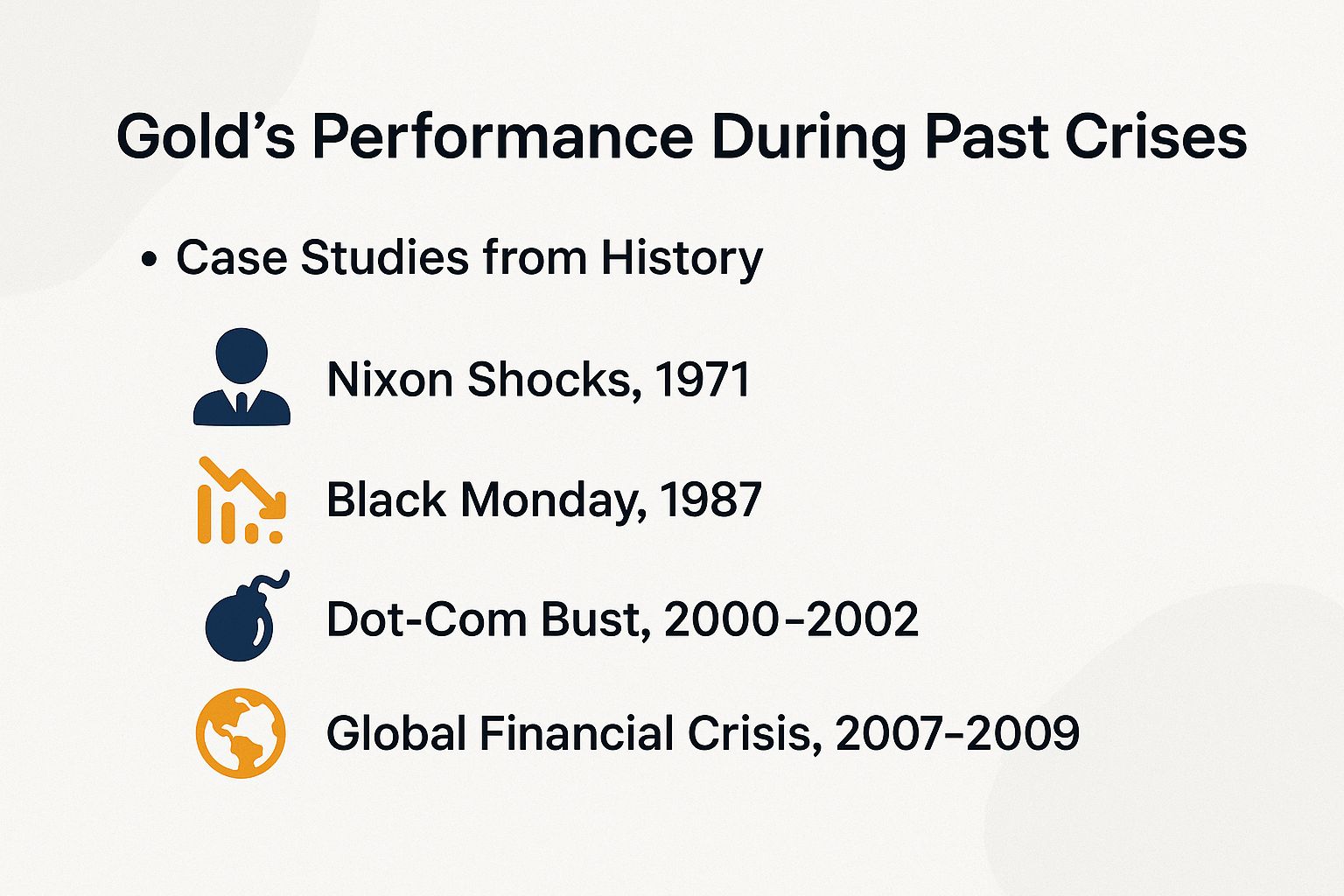
- In the 1970s inflation crisis, gold prices skyrocketed 2,300% from $35 to $850 per ounce as the U.S. dollar weakened due to oil shocks.
- After the 1971 end of the Bretton Woods system (which tied currencies to gold), prices surged over 1,000% by 1980, hedging against falling fiat money value, per Federal Reserve data.
In the 2008 Global Financial Crisis, gold jumped 25% in 2009 alone. It kept portfolios steady while banks collapsed, according to the World Gold Council.
Fast forward to 2020’s COVID-19 chaos – gold surged 40% to $2,070 per ounce! Don’t miss out on this proven protector of wealth.
Big-name investor Ray Dalio puts 7.5% of his portfolio in gold via Bridgewater’s All Weather strategy. This approach beats market benchmarks by 2-3% each year – why not follow suit and boost your returns?
To implement this strategy, allocate 5-10% of a portfolio to physical gold or exchange-traded funds such as GLD for diversification, with quarterly rebalancing advised during periods of heightened market volatility.
Why Gold Excels in a Debt-Driven Economy

In debt-heavy economies like the U.S., gold’s limited supply and independence from stocks or bonds give it an 8-10% yearly edge. It beats bonds when interest rates climb – grab this advantage before rates rise further!
Hedging Against Uncertainty
Unlock gold’s power to calm your investments! Gold cuts portfolio ups and downs by 15-20% in unsure times. It moves opposite to the VIX index (a fear gauge for stock markets) by 18%, as seen in the 2022 Ukraine crisis.
Gold shines in tough times across key areas:
- Beating inflation: From 2000 to 2020, it returned +7% yearly, topping the Consumer Price Index’s 2.1% average.
- Currency protection: In 2020, as the dollar dropped 12%, gold rose 25% to shield your savings.
- Geopolitical safety: After the 2011 U.S. debt downgrade, gold climbed +10% – act now to safeguard against such shocks!
A 2023 study by Morningstar underscores gold’s value in portfolio diversification, enhancing risk-adjusted returns by 8-12% within balanced investment portfolios.
Investors should put 5% of their portfolio into gold using ETFs like SPDR Gold Shares (GLD).
Pair this with bonds from Vanguard’s VGLT. Rebalance every quarter to stay steady in shaky markets.
Easy Steps to Start Investing in Gold Now
The U.S. faces a debt crisis with rising national debt and a high debt-to-GDP ratio (how much debt compared to the country’s output). This comes from big spending on social security, Medicare, military, and infrastructure, plus tax cuts causing revenue shortfalls, as warned by the Congressional Budget Office, IMF, World Bank, and rating agencies.
The Federal Reserve’s policies, like quantitative easing (printing more money to stimulate economy), could weaken the dollar and spark inflation. In this uncertainty, gold acts as a safe haven.
History shows gold shines in crises, like the Eurozone mess, Greece’s debt woes, Argentina’s default, and hyperinflation in Weimar Germany, Zimbabwe, and Venezuela. Since the end of the gold standard in 1971 under Bretton Woods, in our fiat money world (government-backed money not tied to gold), gold protects against such risks.
Act now: Put 5-10% of your portfolio into gold via easy options like the GLD ETF (about $220 per share in 2023) or physical coins from trusted sellers like APMEX. This could yield 10-15% returns in crises, shielding you from debt issues and political fights over the debt ceiling. Don’t wait-protect your wealth today!
Federal Reserve and central banks worry about these risks and possible stimulus plans. Follow these steps to get started right away:
- Check your risk level using free tools from FINRA at finra.org. Factor in big-picture stuff like GDP growth, unemployment, consumer confidence, trade deficits, and global trade-ensuring gold fits as an inflation hedge per SEC rules on diversifying with metals. Also, think about geopolitical risks, emerging markets like BRICS, and trends like moving away from the dollar toward China’s yuan.
- Pick your gold type:
- ETFs like GLD: low 0.4% fee for easy buying and selling.
- Physical bars from JM Bullion: add 1-2% premium for hands-on ownership.
Gold prices swing with mining output, jewelry needs, industry use, and central bank buys-stick to gold over silver for core protection in commodities.
- Buy through a broker like Fidelity (no ETF fees) or direct from dealers in today’s wild markets. Watch for stock crashes, rising bond yields from rate hikes, and manage risks-factor in fees and taxes, especially for long-term holds over quick trades. Jump in smartly to beat the volatility!
- Store safely at home or in a vault like Brinks ($100-200 yearly fee). This guards your wealth from market ups and downs, works for gold, real estate, or even crypto, especially during stimulus or cutbacks that risk recession:
- Gold: Low correlation to stocks.
- Real estate: Tangible but local risks.
- Boost your mix with gold mining stocks via GDX ETF. Analyze basics (fundamental analysis means checking company health) and charts (technical looks at price patterns), watch support/resistance levels and market mood in bull or bear times-history proves it pays off globally. Setup takes 1-2 hours, costs under $50 besides the buy-in.